
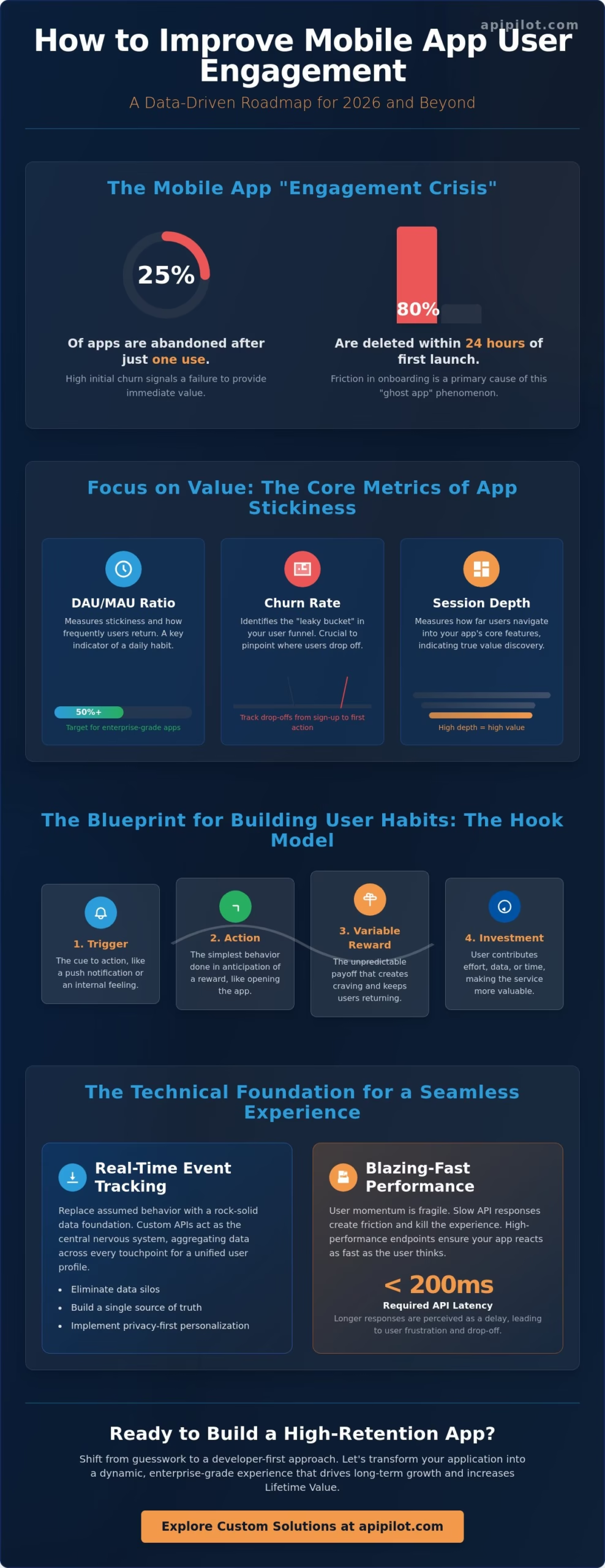
According to Statista, nearly 25% of mobile applications are abandoned after just one use. If you’re witnessing high Day-30 churn rates or users who stall during onboarding, you must learn how to improve mobile app user engagement using technical precision rather than guesswork. It’s frustrating to invest in development only to see your product become a “ghost app” on a user’s home screen. You need a strategy that moves beyond the download and focuses on building a seamless, high-performance digital environment.
Planning a project like this? See how our mobile app development services work, from a free scope to a fixed quote in 48 hours.
The Hook Model remains the most effective framework for building user habits. It consists of a Trigger, Action, Variable Reward, and Investment. Variable rewards are particularly powerful; the unpredictability of new content, social interactions, or data updates keeps users checking the app frequently. To master how to improve mobile app user engagement, you must ensure your app provides a robust loop that rewards every interaction. For example, College Copilot uses personalized milestones to encourage student investment in their college planning journey. The investment phase is the key to long-term retention because it represents the time and data a user commits to the platform, making it harder for them to switch to a competitor.
This guide provides the data-driven roadmap to build a sticky mobile app that drives long-term retention and increases Lifetime Value (LTV) through 2026. We’ll explore how to implement robust APIs and blazing-fast optimizations that turn passive users into loyal brand advocates. You’ll learn to eliminate friction, boost session frequency, and deliver the rock-solid reliability that modern mobile users demand. By the end of this article, you’ll have the tools to transform your static application into a dynamic, enterprise-grade experience that scales with your business.
Key Takeaways
- Shift your focus from vanity metrics like downloads to high-value retention data to drive sustainable, long-term mobile growth.
- Build a rock-solid data foundation by replacing assumed user behavior with real-time event tracking via robust custom APIs.
- Discover how to improve mobile app user engagement through deep personalization and meaningful gamification progression systems.
- Minimize user frustration and “Rage Clicks” by prioritizing blazing-fast performance and seamless offline-first functionality.
- Scale your application efficiently using a developer-first approach tailored to your specific engagement and retention KPIs.
Understanding Mobile App User Engagement in the 2026 Landscape
Engagement isn’t a single data point. It represents the depth, frequency, and duration of how users interact with your software. To build a sustainable product, you must look beyond vanity metrics like total downloads. High download counts mean nothing if your retention rate is zero. Instead, focus on Understanding User Engagement through value metrics that reflect real utility. In 2026, the standard has shifted from reactive interfaces to proactive, AI-driven ecosystems that anticipate user needs through real-time data processing.
To better understand this concept, watch this helpful video:
The mobile market faces a brutal “Engagement Crisis.” Data from 2025 indicates that 80% of apps are deleted within 24 hours of the first launch. This immediate churn happens because developers fail to provide immediate value or a seamless onboarding experience. Learning how to improve mobile app user engagement requires solving this initial friction with rock-solid performance and clear utility. Users now expect blazing-fast responses and personalized content from the very first session.
The Core Metrics of App Stickiness
- DAU/MAU Ratios: This ratio measures stickiness. While a 20% ratio is standard for many industries, enterprise-grade apps often target 50% to ensure they remain a daily habit.
- Churn Rate: This identifies the “leaky bucket” in your user funnel. You must track exactly where users drop off, whether it’s during sign-up or after the first push notification.
- Session Depth: This measures how far users go into your core features. High session depth indicates that users are finding value in your advanced functionality rather than just bouncing off the home screen.
The Psychological Drivers of Retention
The Hook Model remains the most effective framework for building user habits. It consists of a Trigger, Action, Variable Reward, and Investment. Variable rewards are particularly powerful; the unpredictability of new content, social interactions, or data updates keeps users checking the app frequently. To master how to improve mobile app user engagement, you must ensure your app provides a robust loop that rewards every interaction. The investment phase is the key to long-term retention because it represents the time and data a user commits to the platform, making it harder for them to switch to a competitor.
Building a Rock-Solid Foundation for Behavioral Data
Relying on “assumed behavior” is a legacy mistake that causes 60% of new users to abandon apps within the first 24 hours. By 2026, understanding how to improve mobile app user engagement requires a shift from static snapshots to real-time event tracking. Custom APIs act as the central nervous system for your stack; they aggregate data across every touchpoint to create a unified user profile. This eliminates data silos and provides a single source of truth for developer and product teams.
Privacy is no longer a hurdle; it’s a competitive advantage. Implementing privacy-first engagement means balancing deep personalization with enterprise-grade security standards like SOC2 and advanced encryption. When you integrate behavioral analytics directly into your product development lifecycle, you ensure every feature update is backed by hard evidence. This data-driven approach allows you to build, test, and scale features that users actually want, rather than wasting resources on intuition-based development.
Real-Time Event Tracking and API Latency
User momentum is fragile. When a user triggers a critical action, a slow API response creates friction that kills the experience. To maintain a seamless flow, you must implement blazing-fast data pipelines for immediate feedback loops. Technical requirements for modern engagement demand less than 200ms latency for all engagement triggers. If your backend takes longer than a fifth of a second to respond, the user’s brain registers a delay, which leads to a drop in session length. High-performance endpoints ensure your app reacts as fast as the user thinks. To streamline your backend performance, you can explore all APIs designed for low-latency integration.
Predictive Behavioral Modeling
The most successful apps have moved from reacting to what users did to predicting what they will do next. Custom AI models analyze historical JSON payloads to identify patterns before a user reaches a decision point. By using predictive APIs, you can surface features or content just as the user starts looking for them. This proactive strategy is a primary driver for how to improve mobile app user engagement in high-competition niches. A 2025 industry report confirmed that implementing predictive search increases conversion rates by 30% because it reduces cognitive load. You don’t need to build these models from scratch; you can enrich your existing data using robust, pre-trained modeling tools.
- Automate data collection with rock-solid SDKs.
- Power your UX with real-time feedback loops.
- Scale your user base using predictive analytics.
- Enrich user profiles with seamless API integrations.
Building this foundation ensures your app remains relevant in an era where users demand instant, personalized responses. It’s about creating a system that is both efficient and dependable.
Tactical Strategies to Improve Mobile App Engagement
To master how to improve mobile app user engagement in 2026, you must move beyond surface-level features. Modern users demand utility and seamless integration. You can achieve this by deploying dynamic content APIs that adjust the UI based on real-time data. This ensures your app remains relevant without requiring constant manual updates. Integrating these robust tools allows your development team to focus on core functionality while the API handles the heavy lifting of data enrichment and personalization.
Building social loops is another powerful way to keep users coming back. When users interact with others within an application, they’re 3 times more likely to return within a 24-hour period. Integrate social APIs to allow users to share achievements, collaborate on tasks, or compete in real-time. This transforms your application from a simple tool into a thriving community. It’s about creating an ecosystem where the user’s presence adds value to others.
Gamification vs. Reward Systems
Effective gamification focuses on internal motivation through progression. While external rewards like discounts provide short-term spikes, meaningful systems build long-term retention. A tiered loyalty system should scale with usage, offering higher status or exclusive features as the user matures. Use custom SDKs to manage this reward logic. This approach keeps your core binary light and ensures your reward engine is rock-solid and scalable. It’s an efficient way to build loyalty without bloating your codebase.
Smart Push Notifications and In-App Messaging
Notification fatigue is a primary reason why 71% of mobile users disable alerts. You can avoid the “Unsubscribe” button by using contextual triggers. These triggers send messages based on specific GPS coordinates or precise user behavior patterns tracked via API. The best notification is one the user was already expecting. If a user enters a specific geofence at 10:00 AM, a relevant ping feels like a helpful service rather than an interruption.
Sync your push, in-app, and email channels to create a unified omnichannel experience. This prevents duplicate messaging and protects your brand’s reputation. By using a centralized messaging API, you can automate these triggers across all platforms simultaneously. This strategy is essential for anyone looking at how to improve mobile app user engagement while maintaining a professional and non-intrusive presence on a user’s device. Follow these steps to ensure your communication is blazing-fast and always relevant:
- Identify high-value user actions that trigger a message.
- Set frequency caps to prevent notification overkill.
- Use A/B testing on message copy to optimize open rates.
- Integrate location-based APIs for hyper-local relevance.
Optimizing Technical Performance for Higher Retention
Technical stability is the silent driver of long-term loyalty. If your app stutters or crashes, users won’t give you a second chance. A 2024 study by FullStory found that rage clicks, where users tap the screen repeatedly in frustration, increase by 21% for every 100 milliseconds of latency. To master how to improve mobile app user engagement, you must eliminate these friction points before they lead to churn.
Focus on these core performance metrics to keep your user base active:
- Offline-First Capabilities: Ensure the app remains functional without a stable connection. Using local databases like Realm or SQLite allows users to interact with content that syncs once they’re back online. This is vital for the 45% of global users who regularly face spotty connectivity.
- Memory Footprint: Keep the binary size under 150MB. Google Play data indicates that for every 6MB increase in APK size, the install conversion rate drops by 1%. Smaller apps are less likely to be deleted when a user needs to free up space.
- CI/CD Pipelines: Deploying updates through automated continuous integration and delivery ensures that engagement-boosting features reach users without introducing breaking bugs. It’s about maintaining a rock-solid experience while iterating fast.
Native vs. Cross-Platform Performance
Choosing the right stack impacts how users perceive your brand’s quality. Native development using Swift or Kotlin provides the most responsive UI for resource-intensive apps. However, frameworks like Flutter or React Native now achieve blazing-fast transitions when optimized correctly. If you’re building for 2026, prioritize “jank-free” scrolling and immediate haptic feedback. For expert guidance on choosing the right architecture, check out the Mobile App Development services at API Pilot.
API-First Architecture for Scalable Apps
A decoupled architecture is essential for rapid feature iteration. By separating the frontend from the backend, you can update the UI without touching the core logic. GraphQL is the gold standard here, reducing payload sizes by 50% compared to traditional REST APIs by fetching only the specific data needed. This efficiency is a direct answer to how to improve mobile app user engagement on slower networks. Always prioritize enterprise-grade security for your endpoints to protect user data and maintain trust. Robust APIs ensure your app scales seamlessly as your user base grows from thousands to millions.
Ready to build a high-performance app that keeps users coming back? Consult with our technical experts today to optimize your mobile strategy.
Scaling Your App with API Pilot’s Custom Solutions
Building a successful mobile product in 2026 requires more than a sleek interface. It demands a backend capable of processing massive data streams to deliver real-time value. API Pilot provides custom software development specifically engineered to meet your unique engagement KPIs. Whether you’re tracking session depth or aiming to increase your 30-day retention rate by 15%, our solutions focus on the technical infrastructure that makes these goals achievable.
Our developer-first approach prioritizes clean code and robust documentation. We build apps that aren’t just functional but are also highly scalable. By integrating enterprise-grade APIs, we power the complex personalization engines that modern users expect. This technical foundation is the most reliable way to understand how to improve mobile app user engagement at scale. We help you move beyond generic features to create a product that adapts to every individual user’s needs.
Custom CRM and ERP Integration
Data silos are the primary enemy of a cohesive user experience. When your mobile app data lives apart from your business operations, you miss critical opportunities for re-engagement. We specialize in custom software development that connects your app directly to your CRM and ERP systems. This integration allows for seamless data flow, ensuring that every user interaction informs your broader business strategy.
By automating backend workflows, we enable your system to react instantly to user behavior. If a high-value user hasn’t opened the app in 48 hours, a custom-built trigger can initiate a personalized re-engagement sequence. This level of automation is a proven method for how to improve mobile app user engagement without increasing manual overhead. It’s a pragmatic way to ensure your app remains a central part of your customer’s daily routine.
Next Steps: From Concept to Blazing-Fast Deployment
The API Pilot discovery process is designed to uncover the specific friction points in your current user journey. We analyze your existing architecture to identify engagement bottlenecks and performance lags. Our commitment to rock-solid uptime means your users never experience the frustration of a slow or unresponsive app. We monitor performance metrics around the clock to ensure your deployment remains blazing-fast under any load.
From startups looking for their first 10,000 users to enterprises managing millions of global endpoints, we provide the tools to drive measurable growth. We don’t just build software; we build the engine for your digital expansion. Ready to transform your mobile strategy? Schedule a consultation with API Pilot to scale your app engagement and build a foundation that lasts.
Future-Proof Your Mobile Strategy for 2026
Success in the 2026 mobile landscape hinges on technical precision and data-driven insights. 2025 industry benchmarks indicate that 53% of users abandon apps that take longer than 3 seconds to load, making performance optimization your first priority. By establishing a rock-solid foundation of behavioral data and implementing native or cross-platform solutions, you can effectively master how to improve mobile app user engagement. High-performance engineering isn’t a luxury; it’s a requirement for retention in a crowded marketplace.
API Pilot provides the specialized expertise needed to scale complex applications. With a global reach through offices in Las Vegas and Karachi, we deliver custom enterprise-grade software and APIs that ensure blazing-fast speed. Our team excels in both native and cross-platform mobile development, providing the robust tools your business needs to thrive. Stop guessing and start building with a partner who prioritizes your growth and technical reliability.
Build a high-performance mobile app with API Pilot today. Your vision deserves a foundation that won’t crack under pressure.
Frequently Asked Questions
How often should I send push notifications to improve engagement?
Send no more than one to two push notifications per day to maintain a positive user experience. Localytics reported that 31% of users stop using an app if they receive more than six notifications weekly. Focus on high-value triggers like transaction alerts or personalized updates rather than generic broadcasts. Effective frequency depends on the app category; for example, news apps see higher tolerance than utility tools.
What is the difference between user engagement and user retention?
User engagement measures the depth and frequency of interactions within your app, while user retention tracks the percentage of users who return over a specific period. Engagement includes metrics like session duration or screen views per visit. Retention focuses on the 30, 60, or 90 day mark. High engagement often leads to better retention, but they aren’t identical. A user might engage deeply once and never return.
Can gamification work for B2B or enterprise mobile applications?
Gamification is highly effective for B2B applications, driving a 40% increase in employee engagement according to recent industry benchmarks. Implement leaderboards for sales teams or progress bars for training modules to improve mobile app user engagement. These mechanics leverage human psychology to encourage task completion. Enterprise apps using these features see higher daily active usage compared to static legacy systems that lack interactive elements.
How much does it cost to implement a custom engagement API?
Implementation costs for custom engagement APIs typically range from $5,000 to $25,000 for initial development, depending on complexity. Ongoing maintenance and infrastructure costs usually add 20% to that total annually. Using pre-built, rock-solid APIs from a marketplace can reduce these upfront expenses by 70%. This allows developers to integrate robust features in minutes rather than months, ensuring a seamless experience for the end user.
What are the most important engagement KPIs for a new mobile app?
Focus on the DAU/MAU ratio, average session length, and the churn rate to gauge early success. A healthy stickiness ratio for a new app is 20% or higher. Monitor screen flow transitions to identify where users drop off during their journey. These metrics provide a clear roadmap for how to improve mobile app user engagement through iterative design. Tracking these KPIs ensures your development resources target the most impactful features.
How does app loading speed affect my user retention rates?
App loading speed is a critical factor for retention, as a three second delay causes 53% of users to abandon the session. Google research confirms that even a 0.1 second improvement in load time can boost conversion rates by 8%. Slow performance creates friction that drives users to competitors. Use blazing-fast APIs and optimized code to ensure your app remains responsive under heavy load, even during peak traffic periods.
Is personalization possible without compromising user privacy?
You can achieve deep personalization by utilizing zero-party data and on-device processing to protect user privacy. Collect preferences directly through in-app surveys rather than tracking background behavior without consent. 80% of consumers are more likely to purchase when brands offer personalized experiences, provided the data usage is transparent. Use enterprise-grade encryption to secure all transferred JSON payloads. This builds trust while delivering the tailored content users expect.
What is a “sticky” app and how do I measure it?
A sticky app is one that users return to daily, measured by dividing Daily Active Users (DAU) by Monthly Active Users (MAU). If your app has 2,000 DAU and 10,000 MAU, your stickiness ratio is 20%. Social media apps often aim for 50% or higher to maintain market dominance. This metric indicates how much value your product provides in a user’s daily routine. It’s a primary indicator of long term commercial viability.