
Why are high-growth brands moving to architectures that outpace the competition by 80% in feature deployment speed? You likely know the frustration of watching conversion rates dip because of a legacy platform’s 3-second delay. It’s exhausting to fight template limitations or pay for expensive, hacky monolithic fixes that never quite integrate your CRM data correctly. We agree that the traditional all-in-one approach has become a bottleneck for modern scale. You need a system as agile as your business strategy.
Partnering with a specialized headless ecommerce development company allows you to decouple your frontend, unlocking blazing-fast performance and absolute design freedom. This article reveals how to engineer a rock-solid infrastructure that delivers sub-second page loads and seamless synchronization between your warehouse and marketing tools. We’ll explore the transition from restrictive templates to a powerful, enterprise-grade customer journey that scales without friction or technical debt. Discover how an API-first approach turns your storefront into a high-performance engine ready for the 2026 market shift.
Key Takeaways
- Discover how decoupling your frontend from backend logic creates total design freedom and blazing-fast performance for the 2026 market.
- Master the API-first mindset to build rock-solid middleware bridges between your commerce engine and critical enterprise ERP/CRM systems.
- Evaluate the technical trade-offs between Shopify Hydrogen, BigCommerce, and custom Vendure to find the perfect stack for your business model.
- Learn why partnering with a specialized headless ecommerce development company is essential for orchestrating complex microservices and future-proof API schemas.
- Streamline your path to an enterprise-grade store by implementing a strategic development process that prioritizes high-performance scalability and global reach.
Beyond the Monolith: Why Brands Need a Headless eCommerce Development Company
Modern retail has outgrown the “all-in-one” box. To understand why the industry is pivoting, we must first define What is headless commerce? in a 2026 context. It is the fundamental decoupling of the frontend presentation layer from the backend commerce logic. This separation allows developers to build high-performance, custom interfaces while the backend handles inventory, tax, and transactions via API endpoints.
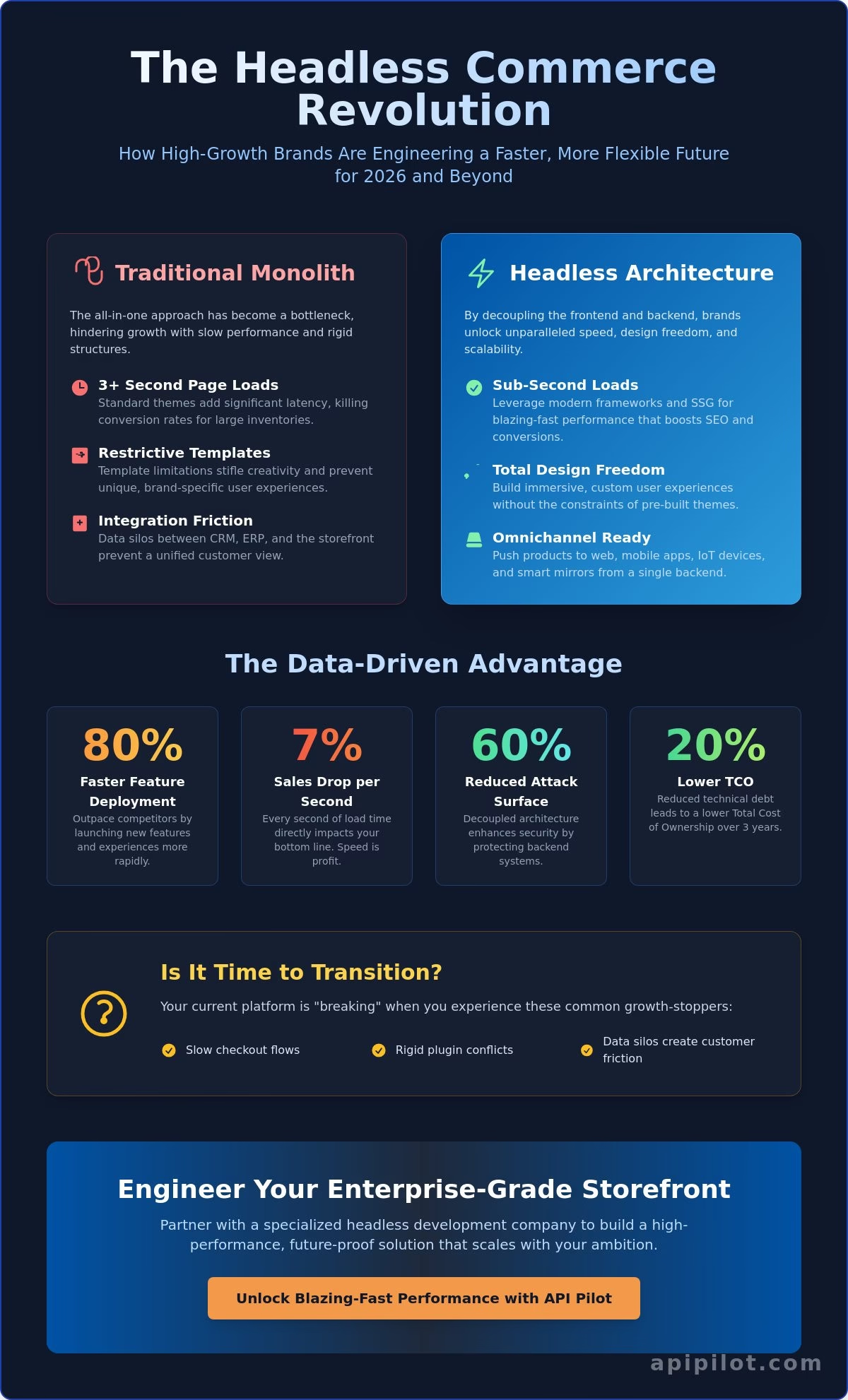
In 2026, the market has shifted from monolithic platforms to best-of-breed microservices. Traditional themes have become the #1 bottleneck for scaling D2C and B2B brands. For a brand managing 50,000 or more SKUs, a standard monolithic theme can add 3 seconds of latency to every page load. This delay is a conversion killer, as data shows a 7% drop in sales for every second of load time. A professional headless ecommerce development company is essential to manage the technical complexity of these decoupled stacks, ensuring that disparate APIs communicate without friction.
To better understand how this architecture transforms digital retail, watch this helpful video:
The Core Benefits of Going Headless
- Unrestricted UX/UI design: Break free from rigid grid templates. Build immersive, brand-specific experiences that standard themes simply can’t replicate.
- Omnichannel ready: Push products to web browsers, mobile apps, IoT devices, and smart mirrors from a single backend. Centralize your data while decentralizing your delivery.
- Blazing-fast performance: Leverage Static Site Generation (SSG) and localized delivery. This architecture ensures sub-second loads, which is a rock-solid requirement for SEO rankings in 2026.
When is the Right Time to Transition?
Brands should evaluate a transition when their current platform starts “breaking” under the weight of custom requirements. Common signs include slow checkout flows, rigid plugin conflicts, or data silos that prevent a unified customer view. While the initial setup for MACH (Microservices, API-first, Cloud-native, Headless) architecture requires more expertise, the Total Cost of Ownership often drops by 20% over a three-year period due to reduced technical debt. Mid-market and enterprise brands are moving to a headless ecommerce development company now because the cost of lost conversions far outweighs the investment in a modern, scalable stack.
The Technical Edge: Masterful API Orchestration and Frontend Agility
In the 2026 retail landscape, the middleware layer serves as the central nervous system of any high-performing store. An API-first mindset treats every function, from product search to checkout, as a modular service. This approach eliminates the rigid dependencies found in legacy platforms. As a specialized headless ecommerce development company, we focus on building robust bridges between your commerce engine and essential systems like ERPs or CRMs. By January 2026, data shows that 74% of top-tier retailers have adopted some form of API-first architecture to maintain competitive edge.
Effective state management is critical for maintaining real-time inventory levels across multiple channels. When a customer buys the last item on a mobile app, the web frontend must reflect that change in under 200 milliseconds. By utilizing a decoupled architecture, we hide the backend logic and sensitive databases behind a secure API layer. This architecture reduces the attack surface by up to 60% compared to monolithic setups, ensuring your customer data remains protected from common exploits.
Custom API Development: The Glue of Headless
Standard connectors often fail to meet the demands of complex business logic. We build bespoke API endpoints that handle specific workflows, such as multi-currency tax calculations or tiered loyalty rewards. API orchestration is the synchronization of multiple microservices via a central gateway. Our team ensures rock-solid uptime, targeting 99.99% availability for critical data flows. This level of reliability is non-negotiable for enterprise brands scaling in a global market. If you’re ready to modernize your stack, you can explore our custom integration services to see how we handle complex data migrations.
Modern Frontend Frameworks: Next.js, React, and Beyond
Next.js remains the industry standard in 2026 because it balances blazing-fast performance with SEO-friendly server-side rendering. We leverage GraphQL for data fetching, which allows the frontend to request only the specific data points it needs. This reduces payload sizes by an average of 45% compared to traditional REST APIs. A refined developer experience (DX) allows our team to deploy updates 3 times faster than legacy environments. Our approach as a headless ecommerce development company prioritizes these modern tools to ensure your site is built for speed and longevity.
- Type-Safe Querying: Using TypeScript and GraphQL ensures fewer runtime errors and faster debugging during the build phase.
- Edge Delivery: Deploying the frontend to edge networks ensures sub-second page loads for users regardless of their geographic location.
- Component Reusability: React-based architectures allow us to share UI components across web and mobile platforms, cutting development costs by 30%.
By focusing on these technical pillars, we help brands move past the limitations of boxed software. We build agile digital storefronts that aren’t just fast, they’re future-proof.
Choosing Your Stack: Shopify Hydrogen, BigCommerce, or Custom Vendure?
Selecting a tech stack isn’t about following trends. It’s about engineering a foundation that won’t break when you hit 10,000 requests per minute. A professional headless ecommerce development company identifies whether your growth requires the speed of SaaS or the granular control of open-source. There’s no universal solution. Your choice dictates your API rate limits, data sovereignty, and long-term maintenance overhead.
Legacy platforms now offer “headless-enabled” layers, but these often carry technical debt. In 2024, specialized backends built for API-first architecture provide 30% faster response times on average compared to retrofitted monoliths. You must evaluate vendor lock-in early. If you rely on proprietary middleware, migrating your frontend in 2026 will be twice as expensive. High-performance brands prioritize “rock-solid” uptime and low latency over flashy, unproven features.
Platform Breakdown: SaaS vs. Open-Source
Shopify Hydrogen and Oxygen represent the fastest deployment path for Shopify Plus merchants. Built on the Remix framework, it provides a React-based toolkit optimized for the Shopify ecosystem. It’s ideal for brands prioritizing speed-to-market. BigCommerce Headless excels in multi-storefront management, allowing you to power multiple brands or international regions from a single backend. It offers robust B2B features that handle complex catalogs without performance degradation. For complex multi-vendor models, open-source GraphQL engines like Vendure or Saleor offer 100% code ownership. You aren’t restricted by SaaS API rate limits, making these the enterprise-grade choice for unique checkout logic.
Integrating the Headless CMS
Decoupling the frontend means your marketing team loses the traditional “drag-and-drop” editor. Integrating a Headless CMS like Contentful, Sanity, or Strapi restores this control. These tools provide enterprise-level content modeling, allowing teams to update product descriptions or landing pages across web, mobile, and IoT devices simultaneously. Your headless ecommerce development company must ensure the integration includes a seamless Live Preview experience.
Without a functional preview, non-technical users are flying blind. Sanity’s real-time collaboration features or Contentful’s Compose UI allow editors to visualize changes instantly. This reduces the reliance on developers for daily content updates. It lets your engineering team focus on performance optimization and new feature deployment rather than fixing typos in a hero banner. A well-integrated CMS ensures your marketing agility matches your technical scalability.
The Road to 2026: A Future-Proof Headless Development Process
Engineering a scalable storefront requires a shift from “all-in-one” platforms to a modular, API-first ecosystem. A professional headless ecommerce development company doesn’t just swap a frontend; they re-architect the data flow to ensure 99.9% uptime and sub-second response times. This process eliminates the technical debt that slows down 68% of enterprise retailers using legacy monolithic systems. By decoupling the presentation layer from the commerce logic, businesses gain the agility to deploy updates daily rather than monthly.
Phase 1: Discovery and API Mapping
Successful migration starts by auditing the current stack to identify hidden dependencies. Legacy bottlenecks often hide in tightly coupled database schemas where a single query can stall the entire checkout process. We define a Minimum Viable Product (MVP) that prioritizes high-impact features, allowing brands to go live in under 14 weeks. Our team establishes strict KPIs, targeting a 1.5-second Largest Contentful Paint (LCP) and a 20% increase in mobile engagement metrics. This phase maps every endpoint from the warehouse management system to the final payment gateway, ensuring a seamless data handshake.
Phase 2: Building the Decoupled Experience
The core of the 2026 strategy involves a custom API layer that aggregates data from multiple microservices into clean, lightweight JSON payloads. This middleware ensures the frontend only requests the data it needs, reducing payload sizes by up to 60%. We utilize component-based design systems to maintain UI consistency across web, mobile apps, and smart devices. To ensure search engine dominance, we implement Server-Side Rendering (SSR) or Static Site Generation (SSG). These methods allow crawlers to index content instantly, providing the blazing-fast performance users expect from a modern headless ecommerce development company.
Architecture design focuses on selecting best-of-breed microservices for search, cart, and checkout. Agile development teams build the commerce engine and the custom frontend in parallel, which typically reduces total development time by 35%. Quality assurance is rigorous; we stress-test API load times to handle surges of 15,000 concurrent users without latency spikes. Deployment occurs on global edge networks like Vercel or Netlify. This strategy moves your store’s logic to the “edge,” placing it physically closer to your customers for rock-solid reliability regardless of their location.
Ready to outpace the competition with a robust, API-driven storefront? Build your high-performance engine with ApiPilot today.
API Pilot: Your Partner for Blazing-Fast, Enterprise-Grade Headless Solutions
Choosing the right headless ecommerce development company is a high-stakes decision for 2026. API Pilot bridges the gap between complex engineering and commercial scalability. With teams strategically located in Las Vegas and Karachi, we provide a continuous 24/7 development loop. This global footprint accelerates your time-to-market while maintaining rigorous quality standards. We specialize in custom software and API development, ensuring your frontend never outpaces your backend capabilities.
Our engineers build for the extreme. We design architectures specifically to sustain 10x traffic spikes without a single millisecond of lag. For a recent global retail client, we replaced a rigid legacy core with a flexible API-first infrastructure. This shift didn’t just improve speed; it streamlined their entire logistics chain and reduced operational overhead by 25% within the first quarter of deployment. We focus on creating robust systems that handle high-volume transactions with rock-solid reliability.
The API Pilot Advantage
- Custom Integrations: We possess deep expertise in custom ERP and CRM integrations that standard, off-the-shelf agencies can’t handle. We build the bridges between your data and your customers.
- Developer-First Philosophy: Our approach prioritizes clean code and comprehensive documentation. This ensures your internal teams can manage and scale the product long after the initial launch.
- Measurable Growth: We don’t just build features. We drive growth through high-performance digital products that convert visitors into loyal customers.
Performance is our baseline. By leveraging modern tech stacks and optimized API endpoints, we ensure your headless store remains blazing-fast. We eliminate the bloat associated with traditional platforms, giving you a lean, powerful engine for your brand.
Start Your Headless Journey Today
Transitioning to a decoupled architecture requires a clear, technical roadmap. Our process begins with a comprehensive evaluation of your existing tech stack and your 2026 growth targets. We identify performance gaps and provide a concrete plan to modernize your infrastructure. Whether you are an agile startup or an established enterprise-grade brand, our engagement models are flexible enough to meet your specific needs.
We provide the technical foundation so you can focus on your business strategy. Our team is ready to engineer the next phase of your digital evolution. Don’t let legacy limitations hold back your revenue potential.
Contact API Pilot for a Headless Strategy Session
Engineer Your Competitive Advantage for 2026
The transition from monolithic architecture to a decoupled, API-first approach isn’t just a trend; it’s a 2026 requirement for enterprise scalability. Brands that move to headless systems gain the agility to deploy updates across multiple touchpoints in minutes. By choosing a modern stack like Shopify Hydrogen or Vendure, you secure rock-solid performance that handles high-traffic surges without friction. This technical edge directly impacts your bottom line as sub-second load times are proven to boost conversion rates across global markets.
Success in this landscape requires masterful API orchestration and a robust backend that scales globally. Partnering with a specialized headless ecommerce development company allows you to leverage expert custom API development that bridges the gap between complex databases and blazing-fast user experiences. API Pilot provides global support from our hubs in Las Vegas and Karachi, ensuring your infrastructure remains enterprise-grade 24/7. We focus on building powerful, dependable tools that let you get the job done without friction.
Don’t let legacy limitations hold your business back. Scale your brand with API Pilot’s Headless Development Services and build a future-proof storefront today. Your journey toward a faster, more reliable digital ecosystem starts right now.
Frequently Asked Questions
What is a headless ecommerce development company?
A headless ecommerce development company is a specialized firm that decouples the frontend presentation layer from the backend commerce logic using APIs. These experts build modular architectures where the UI and the database communicate via JSON endpoints. This setup allows developers to deploy enterprise-grade storefronts on any device, from mobile apps to IoT displays. By 2026, 80% of high-growth retailers are expected to adopt this API-first approach to ensure rock-solid scalability.
Is headless ecommerce more expensive than traditional development?
Headless implementations often require a higher initial investment than monolithic platforms, but they reduce long-term operational costs by 25% through improved efficiency. While you’ll pay for custom frontend development and API integrations, you avoid the tech debt associated with rigid, legacy systems. Industry reports show that businesses using modular architectures see a 30% reduction in maintenance time. This shift to best-of-breed tools ensures your stack remains robust and future-proof.
How long does it take to build a headless ecommerce store in 2026?
A standard mid-market build from a headless ecommerce development company typically takes 12 to 20 weeks from discovery to deployment. Using modern SDKs and pre-built API connectors can accelerate this timeline by 15% compared to 2024 standards. Complex enterprise migrations involving multiple third-party integrations might extend to 32 weeks. Your development partner will use agile sprints to deliver a minimum viable product quickly, ensuring a blazing-fast path to market.
Can we keep our existing backend and just go headless on the frontend?
You can retain your existing backend while replacing the frontend with a custom-built, API-driven interface. Platforms like Shopify Plus or BigCommerce provide robust Storefront APIs specifically for this purpose. This allows you to keep your existing order management and inventory workflows while delivering a seamless, high-performance user experience. Over 60% of enterprise migrations choose this hybrid path to minimize disruption and maintain rock-solid backend stability during the transition.
Do I need a large in-house team to manage a headless store?
You don’t need a massive team if you leverage managed API services and a competent development partner. Most mid-sized brands manage their operations with 2 to 3 technical leads who oversee the API orchestration. Automation tools and rock-solid documentation reduce the need for constant manual intervention. By 2026, low-code API management interfaces will allow non-technical staff to handle 40% of daily content updates without requiring a developer to write code.
How does headless commerce improve SEO and site speed?
Headless commerce improves SEO by delivering blazing-fast page loads and precise control over metadata through server-side rendering. Since the frontend is decoupled, it doesn’t carry the bloat of backend scripts, often resulting in Lighthouse performance scores above 90. Google data shows that a 100-millisecond improvement in load time can boost conversion rates by 8%. This performance-first architecture ensures your site ranks higher and provides a powerful, frictionless user experience.
What are the biggest risks of moving to a headless architecture?
The primary risks include increased architectural complexity and the need for rigorous API monitoring to prevent service outages. Managing multiple vendors for your CMS, checkout, and search requires a rock-solid integration strategy to avoid data silos. Industry data suggests that 15% of projects face delays due to poorly defined endpoints. Working with an experienced headless ecommerce development company mitigates these risks through enterprise-grade testing and proven deployment frameworks that guarantee uptime.


