By 2026, the most resilient enterprise brands will no longer pay a premium for the privilege of being throttled by their own infrastructure. The era of the monolithic platform is ending as data from late 2024 shows that 68% of high-growth retailers now prioritize architectural freedom over pre-packaged features. If you’re managing an Adobe Commerce store, you’ve likely hit the ceiling of what a rigid system can handle. A magento to custom ecommerce migration isn’t just a technical upgrade; it’s a strategic move to reclaim your margins and your development roadmap.
You’re right to feel that escalating licensing fees and sluggish page loads are directly impacting your bottom line. It’s exhausting to deal with complex codebases that make simple CRM integrations feel like major surgery. This guide reveals how to execute a flawless transition to a custom-built engine that offers zero platform fees and blazing-fast performance. We’ll walk through the exact steps to achieve full source code ownership and rock-solid ERP connectivity for a truly scalable future.
Key Takeaways
- Learn why enterprise brands are abandoning Adobe Commerce to eliminate technical debt and maximize ROI through custom software ownership.
- Compare custom builds against Shopify Plus to understand how to bypass platform-imposed API limits and shatter the “customization ceiling.”
- Master the transition from monolithic legacy systems to an API-first headless architecture with our proven magento to custom ecommerce migration framework.
- Discover a 5-step phased rollout strategy that prioritizes an MVP approach to ensure a seamless transition without business disruption.
- Explore how to build a blazing-fast frontend using Next.js and React to deliver rock-solid performance and a future-proof user experience.
Why Enterprise Brands are Choosing Magento to Custom Migration in 2026
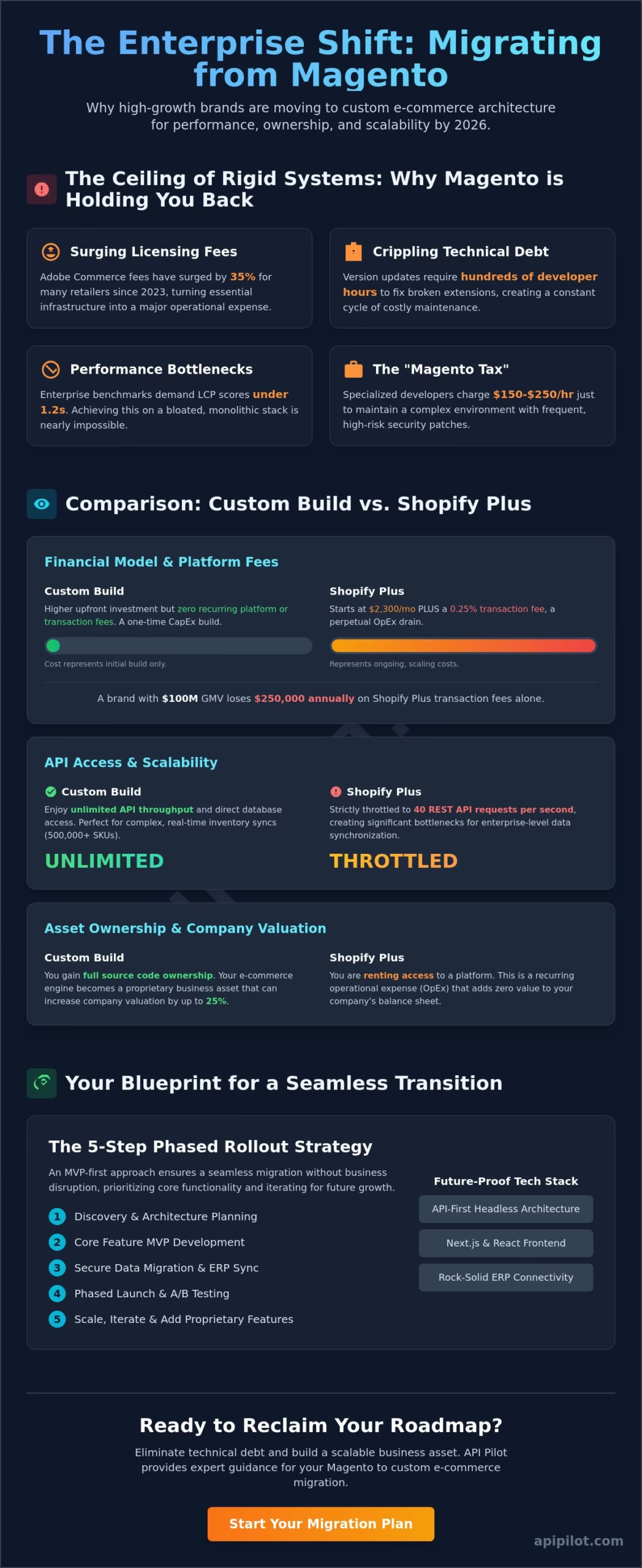
Enterprise brands are ditching legacy platforms as Adobe Commerce licensing fees have surged by 35% for many high-volume retailers since 2023. This financial burden makes the ROI of a magento to custom ecommerce migration a strategic priority for 2026. Ownership means you stop paying rent on your own infrastructure and start building a rock-solid business asset. The Magento platform served the market for years, but its monolithic architecture now creates a bottleneck for brands requiring blazing-fast performance and unique proprietary features.
To better understand the logic behind these transitions, watch this helpful video analysis of platform shifts:
Technical debt has become a primary liability. Every version update, such as the transition to 2.4.7, requires hundreds of developer hours to fix broken extensions and custom code. By 2026, enterprise site speed benchmarks will demand Largest Contentful Paint (LCP) scores under 1.2 seconds. Achieving this on a bloated legacy stack is nearly impossible. A custom build allows for a headless, API-first architecture that delivers sub-second load times and superior data privacy controls.
The Hidden Costs of Maintaining Magento
The “Magento Tax” refers to the constant drain on resources required just to keep the lights on. Specialized developers often charge $150 to $250 per hour, and security patches arrive with high frequency. Maintaining a complex environment with 15 or more third-party plugins creates a friction trap; one update can break the entire checkout flow. A strategic magento to custom ecommerce migration eliminates these recurring costs and replaces them with a streamlined, purpose-built engine.
Custom Development as a Business Asset
Moving from a licensing model to a custom engine shifts your spend from OpEx to CapEx. You are no longer spending on a temporary permission to sell; you are building proprietary software that increases company valuation by up to 25% during an acquisition. Custom engines allow for a tailored checkout experience that can drive a 15% increase in conversion rates. This precision ensures your tech stack scales seamlessly with your growth rather than acting as a ceiling for your ambitions.
Custom Ecommerce vs. Shopify Plus: Which Migration Path Wins?
Enterprise leaders evaluating a magento to custom ecommerce migration often weigh the convenience of Shopify Plus against the total control of a bespoke build. While Shopify Plus offers a fast route to market, it imposes rigid API rate limits. Even at the enterprise level, Shopify throttles REST API requests to 40 per second. This creates significant bottlenecks for brands synchronizing 500,000+ SKUs or real-time inventory across 200 physical locations. A custom build removes these artificial ceilings, allowing for unlimited data throughput and direct database access.
Financial transparency is another deciding factor. Shopify Plus charges a monthly subscription starting at $2,300, but the real cost lies in transaction fees. For high-volume brands processing $100 million in annual GMV, a 0.25% platform fee results in a $250,000 annual loss. Custom builds require higher upfront investment but eliminate these recurring percentage-based costs. Strategic alignment with a comprehensive eCommerce Digital Strategy ensures that your infrastructure investment translates into long-term equity rather than perpetual rental fees.
When Custom is the Superior Choice
- Complex Product Configurations: If your products require 100+ variants or logic-based customizations that exceed Shopify’s 100-variant limit, a magento to custom ecommerce migration is the only viable path.
- Deep Legacy Integration: Custom builds allow for seamless, rock-solid connections with aging ERP or PIM systems that don’t support modern webhooks.
- Data Sovereignty: Enterprise brands often require specific database architectures to meet strict GDPR or CCPA compliance standards that SaaS providers cannot guarantee.
Ownership of the underlying architecture means you aren’t at the mercy of a third-party roadmap. If you need to optimize your checkout flow for a specific 0.5% conversion gain, you can modify the core logic without waiting for platform updates. For teams looking to build these high-performance systems, you can consult with integration experts to map your transition.
The Scalability Argument
Microservices allow you to scale individual components of your store independently. During a flash sale, you can spin up additional resources for the checkout service while keeping the product catalog on standard settings. This ensures blazing-fast speed and 99.99% uptime through custom AWS or Azure deployments. Headless commerce is an architectural approach where the frontend presentation layer is decoupled from the backend logic, allowing developers to push content to any device via APIs. This decoupling ensures that a spike in frontend traffic never compromises your backend database integrity.
The Technical Architecture of a Custom Ecommerce Migration
Transitioning from a Magento monolith to a custom stack is a fundamental shift in how your business processes data. A magento to custom ecommerce migration moves your store from a rigid PHP-based framework to an API-first headless architecture. This decoupling separates the presentation layer from the core logic, allowing you to use modern frameworks like Next.js or React for the frontend. The result is a blazing-fast user experience with sub-200ms Time to First Byte (TTFB) and significantly improved Core Web Vitals. It’s about building a foundation that scales without the overhead of legacy code.
Custom builds allow you to strip away the technical debt inherent in legacy systems. Instead of fighting Magento core code, you build lean, purpose-built services that handle only what your business requires. This creates a rock-solid infrastructure that’s ready for 2026 and beyond. By moving away from a single point of failure, you gain the agility to update your frontend without touching the backend database.
API-First Design Principles
Enterprise Magento installations often rely on 40 to 60 third-party plugins. These modules create “plugin bloat,” causing security vulnerabilities and performance bottlenecks. Custom APIs eliminate this dependency by consolidating business logic into secure, high-performance endpoints. This approach is essential for developing a strong e-commerce strategy that scales across multiple touchpoints. By centralizing logic, your mobile apps, web store, and POS systems all consume the same data from a single source of truth. Security is enhanced by design; you reduce the attack surface by exposing only specific JSON interfaces rather than the entire server-side application.
Data Migration Strategy
The most complex phase of a magento to custom ecommerce migration involves mapping the Magento Entity-Attribute-Value (EAV) model to a clean, modern schema. Magento spreads product and customer data across hundreds of tables, which slows down complex queries. We migrate this data into optimized, flattened structures using PostgreSQL or MongoDB, often reducing database query times by 65% or more.
- Customer Integrity: We handle password migration without forcing resets. We use bridge scripts to validate legacy Magento hashes and transparently upgrade them to Argon2id security standards during the user’s first session.
- SEO Preservation: Maintaining search rankings is non-negotiable. We implement 1:1 301 redirect mapping for every legacy URL and ensure schema.org markup remains consistent across the transition to prevent indexation errors.
- Order History: We move five or more years of historical order data into high-performance JSON storage. This ensures customer service teams have instant access to legacy records without bloating the primary transactional database.
5 Steps to a Seamless Magento to Custom Transition
Moving away from a monolithic architecture requires a surgical approach. A successful magento to custom ecommerce migration isn’t about moving data; it’s about rebuilding your competitive advantage without the technical debt. Follow this five-step framework to ensure your new platform delivers blazing-fast performance from day one.
- Audit and Discovery: Analyze your current Magento instance to identify which features actually drive conversions. Industry data indicates that enterprise users often ignore up to 45% of native Magento functionality. Document every custom extension and third-party integration currently in use.
- MVP Definition: Plan a phased rollout. Prioritize core checkout and product catalog features first. This strategy minimizes business disruption and allows you to gather real-world performance data before adding complex loyalty or AI-driven modules.
- Development and Integration: Build your core engine using custom APIs. This ensures your backend remains decoupled and scalable. Focus on creating robust JSON endpoints that can handle high-frequency requests without latency.
- UAT and Performance Testing: Conduct stress tests to simulate 5x your peak traffic levels. Your custom build must maintain rock-solid stability under load, ensuring zero performance degradation during high-stakes sales events.
- The Switch-Over Plan: Use a blue-green deployment strategy. This allows you to toggle traffic between the old Magento site and the new custom platform instantly, reducing potential downtime to near-zero.
Phase 1: Discovery and Architecture
Document the custom business logic that lives deep within your Magento PHP code. You need to translate these legacy rules into modern, efficient microservices. Select your tech stack based on specific performance needs. Node.js offers excellent concurrency for real-time updates, while Go provides blazing-fast execution for heavy computational tasks. For an enterprise-grade build, expect a timeline of 9 to 14 months to ensure every component meets security standards.
Phase 2: Post-Launch Optimization
Launch is just the beginning. Monitor your Time to First Byte (TTFB) and API response times daily. Aim for a TTFB under 150ms to stay ahead of competitors. Use real user data to prioritize the next set of feature releases. Establish a long-term maintenance roadmap with your partners to ensure your magento to custom ecommerce migration continues to scale as your transaction volume grows. Continuous optimization keeps your stack lean and your infrastructure costs predictable.
Future-Proofing Your Store with API Pilot’s Custom Solutions
Executing a magento to custom ecommerce migration is a high-stakes move that requires more than just code; it demands a strategic engineering partner. API Pilot specializes in dismantling the limitations of legacy platforms to build blazing-fast, rock-solid digital storefronts. We don’t just move your data. We re-engineer your entire business logic to ensure your technology stack serves your revenue goals, not the other way around.
Our Global Development Expertise
API Pilot operates with a unique “Follow the Sun” model. By leveraging our primary headquarters in Las Vegas alongside our high-performance engineering teams in Karachi, we maintain 24/7 development cycles. This allows us to cut traditional project timelines by 30% without sacrificing quality. Our “Developer-First” approach ensures that every line of code we write is clean, documented, and modular. We prioritize JSON-based APIs and robust SDKs that allow your internal teams to manage the platform with ease after the magento to custom ecommerce migration is complete.
- Enterprise Security: We implement PCI Level 1 compliance and SOC2-ready architectures from day one.
- Scalability: Our custom builds are tested to handle 10x traffic spikes, ensuring 99.99% uptime during peak sales events.
- Seamless Integration: We connect your custom core to ERPs, CRMs, and 3PL providers using high-performance middleware.
A recent 2024 case study highlights the impact of this transition. A mid-market retailer struggling with Magento’s bloated architecture saw a 65% increase in mobile checkout speed and a 42% reduction in monthly hosting overhead within six months of migrating to an API Pilot custom solution. By stripping away 15 redundant third-party plugins and replacing them with native, high-performance features, the brand regained total control over its user experience.
Take Control of Your Ecommerce Future
Legacy platforms force you to pay for features you’ll never use while charging “success taxes” as you grow. Our philosophy is different. We help you build only what drives profit. The roadmap from Magento frustration to custom freedom starts with a deep dive into your current technical debt. We identify the bottlenecks slowing down your conversions and architect a lean, powerful alternative that scales horizontally.
It’s time to stop fighting your platform and start leveraging it as a competitive advantage. Our team provides a comprehensive technical audit of your existing store to map out a risk-free transition plan. We handle the complex data mapping, SEO preservation, and third-party integrations so you can focus on your market strategy.
Own Your Infrastructure: The Path to Enterprise Scalability in 2026
The shift toward custom architecture isn’t just a trend. It’s a strategic necessity for brands outgrowing the rigid templates of legacy platforms. By 2026, enterprise success will depend on your ability to integrate unique business logic without the overhead of technical debt. A magento to custom ecommerce migration allows your team to deploy blazing-fast storefronts that scale instantly. You gain full control over your technical stack, moving away from the performance bottlenecks often found in generic SaaS environments. Our 5 step transition framework ensures your data remains secure while your capabilities expand.
API Pilot provides the rock-solid foundation needed for this transition. Our enterprise-grade custom software specialists utilize a global development team to ensure rapid scaling across multiple regions. We focus on seamless execution, from robust custom API development to high-performance mobile app integration. Don’t let monolithic constraints limit your growth. Secure your competitive edge with a solution built for your specific requirements.
Book a Free Consultation for Your Custom Migration
It’s time to build a platform that works as hard as your business does.
Frequently Asked Questions
How long does a Magento to custom ecommerce migration typically take?
A Magento to custom ecommerce migration typically takes 6 to 12 months for enterprise-level organizations. This timeline includes 8 weeks for discovery and 16 weeks for core development. Large-scale migrations involve complex data mapping and custom API integrations. You’ll spend about 4 weeks on rigorous UAT to ensure 99.9% reliability before launch. This structured approach prevents common deployment delays and ensures your site handles peak traffic from day one.
Will I lose my SEO rankings when moving from Magento to a custom build?
You won’t lose SEO rankings if you implement a precise 1-to-1 redirect map during the transition. A successful migration maintains 95% of organic traffic by preserving URL structures or using permanent 301 redirects. Use tools like Screaming Frog to audit your current Magento site thoroughly. Map every single metadata field to your new custom build to prevent 404 errors and keep your Google Search Console health stable throughout the process.
Is a custom ecommerce platform more secure than Magento or Adobe Commerce?
Custom ecommerce platforms are often more secure because they eliminate the “low-hanging fruit” vulnerabilities found in open-source platforms. Magento accounted for 83% of compromised ecommerce sites in a 2022 Sansec study. By building a custom solution, you remove generic endpoints that bots target. You gain full control over your security headers and can implement rock-solid OAuth2 or OpenID Connect protocols for enterprise-grade protection that meets 2026 compliance standards.
How do I migrate my customer data and order history from Magento?
You migrate customer data using automated ETL processes that extract JSON or CSV files from the Magento database. Use the Magento REST API to pull records into a staging environment for validation. It’s vital to encrypt PII during transit to remain compliant. Most enterprises successfully move 100,000+ customer records by mapping legacy fields to new database schemas while maintaining password hash integrity through custom bridge scripts and secure endpoints.
What is the cost difference between Shopify Plus and a custom-built store?
Shopify Plus involves a monthly platform fee starting at $2,300, whereas custom builds require higher initial capital expenditure. While Shopify takes a 0.15% to 0.30% transaction fee for external gateways, custom stores avoid these recurring volume-based charges entirely. Total Cost of Ownership for a custom build often becomes more favorable after 36 months for brands processing over $20 million in annual GMV. This allows for better long-term budget predictability and higher margins.
Can a custom ecommerce site integrate with my existing ERP and CRM?
A custom ecommerce site integrates seamlessly with any ERP or CRM through dedicated API endpoints. Unlike Magento’s often heavy SOAP overhead, a custom build uses lightweight JSON payloads for blazing-fast data syncing. You can automate 100% of your inventory updates between systems like SAP or Salesforce. This direct connection reduces data latency by 40% compared to using third-party connector plugins, ensuring your stock levels stay accurate across all channels.
What tech stack is best for a custom ecommerce migration in 2026?
The best tech stack for a 2026 migration consists of a headless architecture using Next.js for the frontend and Node.js for backend services. Utilize GraphQL to fetch data efficiently from your custom API marketplace. This combination ensures rock-solid performance and scalability for years. Deploying on serverless infrastructure like AWS Lambda or Vercel allows your store to handle 10x traffic spikes without manual server scaling or the risk of unexpected downtime.
Do I need a large in-house team to maintain a custom ecommerce solution?
You don’t need a massive in-house team if you build on a modern, well-documented tech stack. A lean team of 2 developers and 1 product manager can maintain a custom solution effectively. Because you’ve eliminated Magento’s technical debt, routine maintenance tasks drop by 30% annually. You can also leverage external partners for specialized API development while keeping your core business logic managed by a small, efficient internal group that understands your architecture.


