
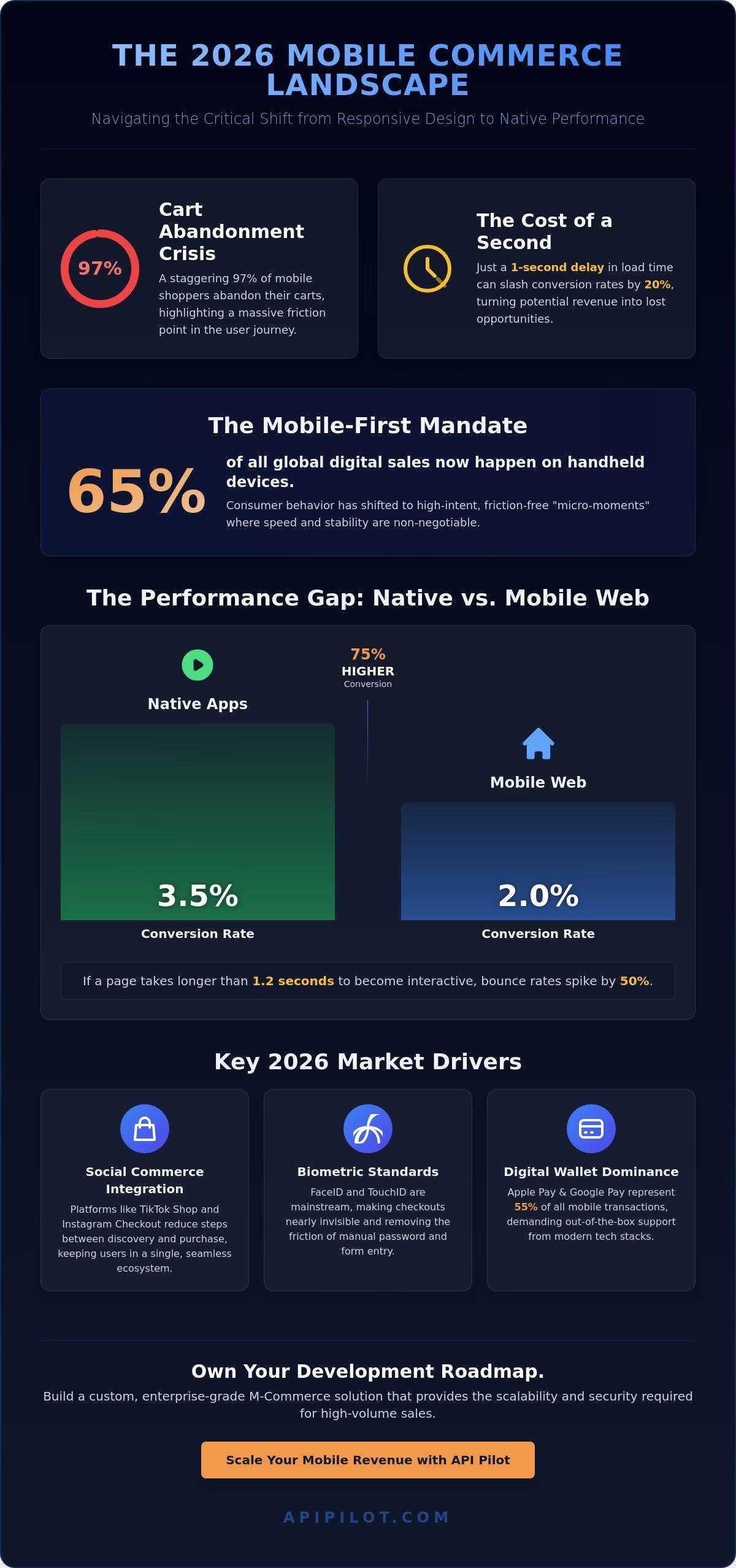
97% of mobile shoppers abandon their carts before completing a purchase, according to recent retail benchmarks. You likely already feel the pressure of this friction, as a single-second delay in load time can slash your conversion rates by 20%. It’s a frustrating reality for developers and stakeholders who see traffic surge but revenue stall due to sluggish performance and fragmented inventory sync. Staying ahead of mobile commerce trends 2026 means moving beyond basic responsive design to build rock-solid, blazing-fast architectures that handle high-concurrency demands without breaking.
Planning a project like this? See how our ecommerce development services work, from a free scope to a fixed quote in 48 hours.
We’ll show you how to master the technical shifts and consumer behaviors necessary to build high-performance, future-proof shopping experiences. You’ll get a clear roadmap for 2026 mobile investment, including a deep dive into the ROI of native apps versus PWAs. We’ll also identify which specific AI features drive actual sales rather than just adding bloat to your stack. By the end of this article, you’ll have the technical blueprint to eliminate cart abandonment and scale your mobile revenue with confidence.
Key Takeaways
- Bridge the performance gap by mastering the 2026 mobile-first ecosystem, where native app architectures drive significantly higher conversion rates than standard mobile web.
- Implement headless commerce and API-first architecture to create a blazing-fast, decoupled frontend that ensures a seamless omnichannel experience.
- Leverage AI-native predictive UX and visual search tools to transform your mobile storefront into a proactive shopping assistant that anticipates user needs.
- Evaluate the critical mobile commerce trends 2026 to choose between Flutter, React Native, and PWAs for building a rock-solid, future-proof tech stack.
- Discover how to own your development roadmap with custom, enterprise-grade builds that provide the scalability and security required for high-volume digital sales.
The 2026 Mobile Commerce Landscape: From Responsive to Native
By 2026, the digital storefront lives primarily in the palm of the hand. Handheld devices now account for 65% of all global digital sales, marking a definitive shift in how brands must architect their tech stacks. This evolution isn’t just about screen size; it’s a fundamental change in consumer psychology. Users don’t browse for fun anymore. They engage in high-intent, friction-free “micro-moments” where a transaction must be completed in seconds or the lead is lost. In this environment, Mobile commerce has transitioned from a supporting channel to the primary engine of retail growth.
One of the most critical mobile commerce trends 2026 reveals is the persistent “Performance Gap.” While mobile web conversion rates linger at a stagnant 2%, native mobile apps achieve a 3.5% conversion rate. This 75% performance difference exists because apps provide superior stability and deeper integration with device hardware. Blazing-fast load times are no longer a competitive edge; they’re a rock-solid baseline requirement. If a page takes longer than 1.2 seconds to become interactive, bounce rates spike by 50%. Developers must prioritize performance as a core feature rather than an optimization afterthought.
The Death of the Mobile-Responsive Website
Responsive design often fails to deliver the rock-solid stability users require for complex checkouts in 2026. While “mobile-friendly” was the goal a decade ago, it often results in bloated code and layout shifts that kill conversion. Brands are now pivoting to App-First strategies to secure high retention and long-term loyalty. M-commerce in 2026 is an API-driven, native-first experience. This shift allows for more robust interactions and ensures that the UI remains consistent regardless of network fluctuations. Developers are moving away from monolithic web structures toward headless architectures that feed data directly into native iOS and Android environments.
Key 2026 Market Drivers
The mobile commerce trends 2026 ecosystem is powered by three primary technical drivers:
- Social Commerce Integration: TikTok Shop and Instagram Checkout have become primary traffic sources. These platforms keep users within a single ecosystem, reducing the steps between discovery and purchase.
- Biometric Standards: FaceID and TouchID have replaced manual password entry. This mainstreaming of biometrics makes the checkout flow nearly invisible, removing the friction of traditional form-filling.
- Digital Wallet Dominance: Apple Pay and Google Pay now represent 55% of all mobile transactions. The rise of decentralized finance options also provides new flexibility for global users who demand alternative payment methods beyond traditional credit cards.
To compete, businesses must build enterprise-grade systems that support these integrations “out of the box.” Relying on legacy web wrappers is a recipe for high churn. Success requires a commitment to native performance and a tech stack that can scale with the demands of a mobile-first world.
Trend 1: Headless Commerce and API-First Architecture
Headless commerce is no longer a luxury for brands tracking mobile commerce trends 2026. It’s a technical requirement. This architecture decouples the frontend presentation layer, like your mobile app or progressive web app, from the backend logic and database. By separating these components, developers gain the freedom to build blazing-fast user interfaces without being tethered to the limitations of a monolithic platform. It’s about speed and agility in a market where a one-second delay in mobile load times can drop conversion rates by 20%.
APIs serve as the essential glue in this ecosystem. They allow for a seamless omnichannel experience that feels unified to the customer but is technically complex behind the scenes. In 2026, the focus shifts from simple data transfer to intelligent orchestration. Custom APIs allow brands to sync inventory across Shopify, Amazon, and native mobile apps in real-time. This level of synchronization is vital; IHL Group reports that inventory distortions cost retailers over $1.1 trillion globally. Reliable API development prevents overselling and ensures that “out of stock” messages are accurate across every touchpoint.
Security benefits are equally compelling. Enterprise-grade API development protects sensitive customer data by creating a hardened layer between the user and the database. This isolation reduces the attack surface, making it significantly harder for malicious actors to access core business logic or private payment information.
Enabling Hyper-Personalization via APIs
Headless setups allow for dynamic UI changes that react to user behavior data instantly. If a customer consistently browses high-end athletic gear, the API instructs the mobile frontend to reorganize the home screen layout for that specific user. Integrating third-party data enrichment APIs helps predict customer needs based on external factors like weather or local events. Building rock-solid backend systems to support these millions of API calls requires custom software tailored to specific business goals rather than generic templates.
Omnichannel Consistency
A seamless cart experience is the gold standard for 2026. A customer should be able to add an item to their cart on a mobile app, view it on a smart mirror in-store, and complete the purchase on a desktop site without friction. Standard plugins often struggle with the state management required for these complex enterprise needs. Custom API development offers a superior path, providing the flexibility to handle unique logic that off-the-shelf tools can’t support. For brands ready to scale their technical infrastructure, API Pilot offers specialized expertise in Custom API Development to ensure your stack is ready for the future of mobile trade.
Trend 2: AI-Native Shopping Experiences and Predictive UX
AI in 2026 isn’t a bolt-on feature; it’s the core engine of the mobile experience. Mobile commerce trends 2026 show a shift toward generative UI, where the application’s layout adapts in real-time to user behavior. Instead of a static grid, the app uses machine learning to prioritize specific categories, payment methods, and content based on historical intent. This level of personalization requires powerful APIs that can deliver custom data sets in milliseconds.
Visual search has moved from a novelty to a necessity. Research from 2024 indicates that visual search queries have increased by 25% year-over-year. Users now expect to point their mobile camera at a real-world object and find a matching product instantly. For developers, this means integrating sophisticated image recognition models via enterprise-grade SDKs. The technical challenge lies in maintaining rock-solid performance. A latency of more than 200ms during an AI inference cycle can frustrate users and lead to cart abandonment. Optimizing your JSON payloads and using efficient endpoints is the only way to keep the experience seamless.
Dynamic pricing and inventory management also rely on these AI layers. By analyzing 2026 market demand and competitor data in real-time, apps can adjust prices to maximize revenue without manual intervention. This requires a robust backend that can handle thousands of concurrent requests without flinching.
Predictive Cart Replenishment
Machine learning models now analyze consumption cycles to prompt reorders before the customer realizes they’re low on stock. This “zero-click” commerce relies on blazing-fast data processing to trigger notifications at the exact moment of need. To maintain app responsiveness, developers are increasingly implementing AI at the edge. By moving computation away from central servers and closer to the device, you reduce server load and ensure the UI remains fluid even during peak traffic periods.
Conversational Commerce
The 2026 tech stack prioritizes Natural Language Processing (NLP) to handle complex sales queries. Integrating Large Language Models (LLMs) allows your app to act as a digital concierge, answering detailed questions about product specifications or shipping logistics without human intervention. This isn’t just about support; it’s about conversion. AI in 2026 is an infrastructure layer, not just a feature. You must build your mobile architecture to support these robust, real-time interactions from the ground up to ensure scalability and reliability.
Future-Proofing Your Tech Stack: Flutter vs. React Native vs. PWA
By early 2026, mobile commerce trends 2026 indicate that 82% of enterprise retailers have abandoned the “one-size-fits-all” development mentality. Efficiency now dictates the tech stack. You need a framework that supports blazing-fast load times and rock-solid reliability to maintain conversion rates above the 4.5% industry benchmark. The market has shifted toward cross-platform tools for speed; however, native remains the gold standard for hardware-heavy features like advanced AR fitting rooms or complex biometric security layers.
Comparing 2026 Mobile Frameworks
- Flutter: This remains the favorite for high-end retail because of its Impeller rendering engine. It delivers 120fps UI consistency across iOS and Android. This ensures that brand aesthetics remain identical regardless of the device, which is critical for luxury retailers.
- React Native: It leverages a massive ecosystem. By 2026, the “New Architecture” is the global standard, offering seamless synchronous communication between JavaScript and native layers. It’s the go-to for teams already deep in the React web environment who need to deploy updates in minutes.
- Native Swift/Kotlin: Use this when your app requires 100% performance for intensive tasks. If your 2026 roadmap includes complex background processing or deep sensor integration, native code is the only way to ensure zero-latency execution.
The PWA Evolution
Browser standards in 2026 have transformed Progressive Web Apps (PWAs) into powerful tools for low-friction discovery. With WebAssembly (Wasm) and expanded API access, a PWA can now handle offline carts and push notifications with 95% of the efficiency of a native app. They are perfect for the discovery phase where users don’t want to commit to a 100MB download just to browse a catalog. Data from Q2 2025 shows that while PWAs excel at acquisition, native apps retain customers 3.2 times longer.
The tradeoff remains clear: move from a PWA to a full native mobile application when you need persistent user engagement and high-frequency transactions. Check out our Mobile App Development Services to see which fits your business model best.
Enterprise-grade solutions often require a hybrid approach to stay competitive with mobile commerce trends 2026. This means using a PWA for SEO-driven discovery and a Flutter or React Native app for the core loyalty experience. This dual-path strategy ensures you capture top-of-funnel traffic while providing a robust, enterprise-grade environment for your most valuable customers. Ready to optimize your performance? Build your high-conversion stack with our expert developers today.
Building the Future of M-Commerce with API Pilot
Off-the-shelf platforms won’t keep pace with the shifting mobile commerce trends 2026. Generic software limits your ability to innovate; it forces your brand into a pre-built box that doesn’t account for unique user behaviors or specific business logic. To truly own your roadmap, custom software development is the only viable path. API Pilot delivers the technical foundation needed to dominate the market with solutions built to evolve alongside your business goals.
Our approach centers on developer-centric builds that prioritize high performance without compromising security. We understand that in a high-stakes environment, you need blazing-fast delivery to beat competitors to market. However, speed shouldn’t lead to fragile code. We focus on rock-solid stability, ensuring your application remains robust as it scales from its first thousand users to its first million. This balance allows you to deploy new features quickly while maintaining a flawless user experience.
Enterprise-Grade Mobile Solutions
API Pilot specializes in building custom CRMs and ERPs that integrate directly with your mobile interface. This creates a unified data ecosystem where inventory, customer profiles, and logistics feed into the app in real-time. We provide global support through our offices in Las Vegas and Karachi, offering 24/7 reliability for businesses operating across multiple time zones. Our architecture is designed for extreme scalability. Whether it’s a localized flash sale or a massive global traffic surge during Black Friday, your app will handle peak loads with zero friction.
- Custom Integration: Connect your legacy systems to modern mobile frontends via secure API endpoints.
- Global Reliability: Dual-continent support teams ensure your stack stays online and optimized.
- Frictionless Scaling: Cloud-native builds that automatically adjust to traffic demands.
Your 2026 Mobile Strategy Starts Here
Success in the next era of retail requires moving beyond simple ideation to high-performance deployment. We don’t just write code; we build digital products that drive measurable growth and long-term brand loyalty. By focusing on custom builds, you eliminate the technical debt associated with bloated, third-party plugins. You gain a streamlined, efficient stack that responds to mobile commerce trends 2026 instantly. Contact API Pilot today to build your 2026 mobile commerce solution.
Our process focuses on quantifiable value. We help you transition from a basic shopping app to a comprehensive commerce ecosystem that captures data, simplifies checkouts, and retains customers. Don’t let your technology stack become a bottleneck. Build a foundation that supports your vision for 2026 and beyond.
Future-Proof Your Mobile Strategy for 2026
The shift toward headless architecture and AI-native predictive UX isn’t just a forecast; it’s the baseline for enterprise success. By 2026, leading brands will move away from rigid, monolithic systems to adopt API-first stacks that prioritize sub-second latency and seamless integration. Whether you deploy via Flutter, React Native, or PWA, your tech stack must handle the complex demands of real-time data processing and predictive shopping cycles. Staying ahead of mobile commerce trends 2026 requires a commitment to performance and a technical foundation that supports global scalability.
API Pilot delivers the technical expertise needed to master this evolution. Our global team provides rock-solid uptime and blazing-fast delivery for custom enterprise-grade software and APIs. We focus on driving measurable business growth and maximizing user engagement through robust, scalable solutions. Don’t let legacy infrastructure throttle your potential in a competitive market. It’s time to build a mobile experience that converts at scale and dominates the digital landscape.
Build your high-performance 2026 mobile app with API Pilot. Your vision for the future of mobile commerce starts today.
Frequently Asked Questions
What is the biggest mobile commerce trend in 2026?
The most dominant trend is AI-driven hyper-personalization at the edge. By 2026, 80% of leading retailers will use real-time behavioral data to modify app interfaces for each user instantly. This shift requires robust APIs to pipe data between your CRM and mobile frontend without latency. You’ll move beyond simple product suggestions to dynamic UI adjustments that cater to individual shopping habits.
Should I build a native app or a mobile website for my store in 2026?
Build a Progressive Web App (PWA) to capture the widest audience while maintaining enterprise-grade performance. PWAs in 2026 offer 36% higher conversion rates than traditional mobile sites because they use service workers for offline functionality and push notifications. If your store requires deep hardware integration like advanced biometric sensors, go native. For most high-conversion stacks, a PWA provides a blazing-fast, cross-platform solution.
How much does it cost to develop a custom m-commerce app in 2026?
Developing a custom m-commerce app typically costs between $50,000 and $250,000 based on 2024 industry benchmarks from Clutch. High-end enterprise apps with custom machine learning integrations and multi-regional support often exceed the $300,000 mark. You can reduce these costs by leveraging pre-built API endpoints for common functions like currency conversion or geolocation instead of building every microservice from scratch.
How can AI improve my mobile commerce conversion rates?
AI improves conversion rates by automating visual search and predictive cart replenishment. Implementing AI-driven search can lead to a 20% increase in average order value as customers find relevant products faster. Use machine learning models to analyze user clickstreams in real-time. This allows your app to surface relevant items via a JSON response before the user even reaches the checkout screen.
What is headless commerce and why does it matter for mobile?
Headless commerce is the decoupling of your store’s frontend presentation layer from its backend commerce logic. This architecture matters for mobile because it allows you to deliver content via APIs to any device, whether it’s a smartphone or a smart wearable. It provides the rock-solid scalability needed to handle 2026’s high-traffic events. You gain total control over the mobile UX without being limited by rigid, monolithic platform templates.
Is social commerce on TikTok and Instagram still relevant in 2026?
Social commerce remains essential, with Accenture projecting the market to reach $1.2 trillion globally by 2026. TikTok and Instagram have evolved into full-funnel sales platforms where 60% of Gen Z users prefer shopping directly within the app. Your mobile commerce trends 2026 strategy must include seamless API integrations with these social marketplaces. This ensures inventory levels and pricing stay synchronized across every social endpoint in your stack.
How do I reduce cart abandonment on my mobile app?
Reduce cart abandonment by implementing one-tap checkouts and biometric authentication to eliminate friction. Baymard Institute data shows that complex checkout processes cause 18% of users to abandon their carts. Use powerful payment APIs that support saved credentials and automatic address autocomplete. Minimizing the number of form fields is the fastest way to turn a browsing session into a completed transaction.
What are the best payment methods to offer on mobile in 2026?
Digital wallets like Apple Pay and Google Pay are the top choices, as they account for over 54% of global e-commerce spend according to Worldpay reports. You should also integrate Buy Now Pay Later (BNPL) options like Klarna or Affirm, which can boost conversion by 30%. To stay competitive with mobile commerce trends 2026, ensure your payment gateway supports local methods like Pix or UPI for international scalability and seamless user experiences.