
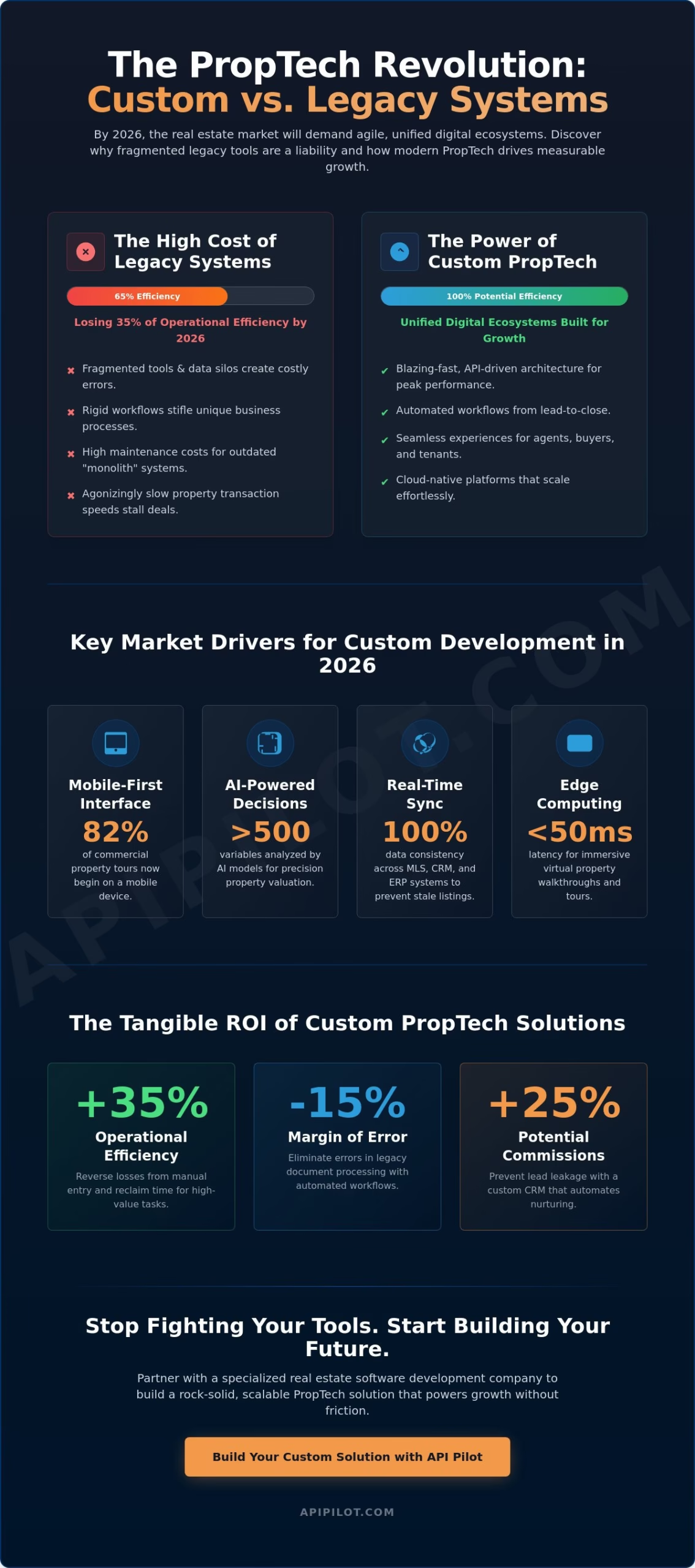
By 2026, real estate firms relying on fragmented legacy systems will lose an estimated 35% of their operational efficiency to data silos and manual entry errors. You likely already feel the strain of watching high-value deals stall because your CRM won’t sync with your transaction management tools. Off-the-shelf software often forces you to bend your unique workflows to fit its rigid limitations, leading to high maintenance costs and agonizingly slow property transaction speeds.
Choosing a specialized real estate software development company changes that dynamic immediately. In this guide, you’ll discover how to build blazing-fast, rock-solid PropTech solutions that drive measurable ROI and automate complex property workflows. We’ll show you how to transition from fragmented tools to a unified digital ecosystem that scales effortlessly. We provide a deep dive into the architecture of powerful mobile and web applications that automate lead-to-close processes and deliver seamless experiences for agents and tenants alike. It’s time to stop fighting your tools and start leveraging enterprise-grade technology that powers growth without the friction.
Key Takeaways
- Understand why legacy monolithic systems are failing and how to transition to scalable, custom digital ecosystems designed for the 2026 property market.
- Identify the essential CRM and PMS features needed to automate tenant communication and property maintenance for maximum operational efficiency.
- Evaluate the total cost of ownership to see why a specialized real estate software development company provides more long-term value than generic, bloated SaaS subscriptions.
- Follow a battle-tested roadmap from strategic discovery to high-conversion UI/UX design to ensure your software drives measurable business growth.
- Learn how a dual-presence development model ensures your PropTech solution is built with blazing-fast speed and rock-solid reliability.
The Evolution of Real Estate Software Development in 2026
Real estate software development is the engineering of custom digital ecosystems designed to manage property life cycles with precision. By 2026, the market has outgrown legacy “monolith” systems. These outdated structures fail because they lack the elasticity to scale during peak transaction windows. Modern firms now prioritize cloud-native, API-driven architectures that ensure rock-solid uptime and blazing-fast performance. Choosing the right real estate software development company is now a strategic requirement for firms that need to process the 40% increase in real-time data traffic seen since 2024.
To better understand the technical architecture behind these modern platforms, watch this detailed guide:
The shift toward mobile-first interfaces is no longer optional. In 2026, 82% of commercial property tours begin on a mobile device, demanding seamless integration between front-end apps and back-end databases. Data-driven decision-making now dictates property valuation. AI models analyze over 500 variables in seconds to provide precision that manual appraisals can’t match. This evolution allows a Property technology (PropTech) stack to function as a unified intelligence layer rather than a collection of siloed tools.
PropTech vs. Traditional Real Estate IT
Traditional IT focused on static record-keeping. Modern PropTech acts as a proactive, AI-enhanced engine for growth. PropTech is a catalyst for real estate liquidity. By replacing manual entry with automated workflows, developers eliminate the 15% margin of error common in legacy document processing. This transition ensures that high-stakes transactions remain secure and verifiable through immutable digital ledgers and robust API integrations.
Key Market Drivers for Custom Development
A specialized real estate software development company must address the rising demand for frictionless tenant experiences. Whether in residential or commercial sectors, users expect instantaneous responses and 99.99% system availability. Custom development allows for the integration of specialized APIs that power these features without the bloat of off-the-shelf software. Key technical requirements in 2026 include:
- Real-time synchronization: Bi-directional data flow between MLS, CRM, and ERP systems is mandatory to prevent stale listings.
- Regulatory compliance: Systems must automate SOC2 and GDPR updates to mitigate the risk of data breaches.
- Edge Computing: Processing data closer to the user reduces latency to under 50 milliseconds for virtual property walkthroughs.
By focusing on modular architecture, businesses can swap out components as technology advances, ensuring their investment remains relevant well beyond the initial deployment phase.
Essential Software Solutions for Modern Real Estate Firms
Modern firms require more than off-the-shelf tools to stay competitive in a high-stakes market. Partnering with a specialized real estate software development company allows businesses to build systems that handle the industry’s complex 6 to 18 month lead cycles. Custom CRM systems use advanced lead scoring to prioritize high-intent buyers, while automated follow-ups ensure agents stay top-of-mind without manual intervention. This prevents “lead leakage,” a common issue that costs brokerages an average of 25% in potential commissions annually. Seamless integration with third-party portals keeps data flow consistent and real-time across all platforms.
Custom CRM and Lead Management
Effective lead management isn’t just about data storage; it’s about performance and accountability. Custom CRMs provide granular agent performance tracking, allowing managers to monitor response times and conversion rates in real-time. By automating the nurturing process, firms scale their operations without bloating their headcount. These systems integrate directly with listing portals to capture data instantly, creating a rock-solid pipeline that converts cold inquiries into closed deals. It’s the most efficient way to maintain a high-volume sales floor.
Mobile-Native Real Estate Applications
Agents in 2026 spend 80% of their working hours away from a desk. High-performance iOS and Android apps are no longer optional. These mobile-native tools must support immersive virtual tours, instant messaging, and digital document signing to close deals on the spot. Integrating these features reduces closing times by as much as 40% compared to traditional paper-based methods. For property portals, a well-designed app drives brand loyalty and keeps users engaged through push notifications and personalized property alerts.
The Power of Custom API Development
Custom APIs act as the glue for disparate data sources, connecting financial gateways, map services, and government property databases into a single, cohesive interface. This API-first design is the key to future-proofing any platform. The Evolution of Real Estate Software shows how unified data platforms are rapidly replacing siloed legacy systems to improve decision-making. For large-scale developers, Enterprise Resource Planning (ERP) systems and Property Management Software (PMS) automate rent collection and maintenance requests, ensuring 99.9% operational uptime. If you want to stay ahead of the curve, you can explore scalable PropTech architectures to begin your digital transformation. A professional real estate software development company ensures these integrations are blazing-fast and secure, providing a powerful foundation for growth.
Custom Real Estate Software vs. Off-the-Shelf SaaS
Deciding between a monthly subscription and a custom build determines your firm’s technical trajectory for the next decade. Most off-the-shelf SaaS platforms suffer from chronic feature bloat. They bundle dozens of tools your team will never use, which clutters the interface and degrades performance. A specialized real estate software development company eliminates this friction by engineering a lean, purpose-built stack. While SaaS offers a lower entry price, the per-seat licensing models become a massive liability as you scale. Custom builds require upfront capital, but they reach a break-even point quickly. By year three, the lack of recurring fees often results in a 35% to 50% lower Total Cost of Ownership compared to enterprise SaaS tiers.
Owning your intellectual property (IP) provides a distinct competitive advantage. A Proven Roadmap for Real Estate Software demonstrates that firms with proprietary tech see higher valuation multiples. You aren’t just renting a tool; you’re building a company asset. This is critical for global brands that need to bypass the limitations of generic software, such as rigid API rate limits or the inability to handle complex, cross-border property regulations.
Scalability and Long-Term ROI
Custom software grows alongside your user base without the penalty of per-seat licensing. It allows you to automate highly specific workflows, such as automated lead-to-escrow transitions, that generic tools can’t handle. The SaaS ceiling is the point where generic tools stop providing value because their rigid architecture prevents further optimization. Partnering with a real estate software development company ensures your platform remains blazing-fast and responsive, even as you process millions of data points across international markets. This flexibility ensures your technology stack remains a driver of growth rather than a bottleneck.
Security and Data Sovereignty
Data is the most valuable asset in modern PropTech. Multi-tenant SaaS environments pose inherent risks because your data lives on shared servers with potential competitors. Custom infrastructure provides dedicated, rock-solid security tailored to your specific needs. This isolation is vital for enterprise-grade financial transactions and protecting sensitive client PII. Owning your data also enables advanced business intelligence. You can’t build robust, predictive AI models if your data is trapped in a third-party vendor’s black box. Custom builds give you total data sovereignty, allowing for seamless integration with external APIs and internal analytics engines without compromising on privacy.
A Proven Roadmap for Real Estate Software Development
Successful PropTech doesn’t happen by accident. It requires a structured engineering approach to handle the 2026 market demands. As a dedicated real estate software development company, our roadmap focuses on five critical phases to ensure your platform is blazing-fast and rock-solid from day one.
- Phase 1: Discovery and Strategic Consulting. We align technology with your business goals to eliminate waste.
- Phase 2: UI/UX Design. We build interfaces that prioritize high-conversion property browsing and frictionless management.
- Phase 3: Agile Development. We use an API-first focus to ensure your core systems remain stable and extensible.
- Phase 4: Quality Assurance (QA). Our team conducts rigorous security penetration testing to protect sensitive financial data.
- Phase 5: Deployment and Optimization. We launch your product and use real-world data to refine performance continuously.
Discovery and Requirements Engineering
We start by identifying must-have features that drive immediate ROI. For example, integrating AI-driven lead scoring can increase agent productivity by 25% compared to legacy sorting methods. We map out complex user journeys for buyers, sellers, agents, and admins to ensure no friction points exist. Our team defines a tech stack using React, Node.js, and Python. This combination delivers the enterprise-grade performance needed to process thousands of concurrent property searches without lag.
Agile Execution and API Integration
Speed to market is vital. We utilize iterative releases so you can launch a functional MVP while we build secondary features. This phase requires a real estate software development company that understands the complexity of legacy MLS systems. We handle these integrations via robust API layers, ensuring data flows seamlessly between your app and external financial databases. Our DevOps protocols maintain 99.9% uptime, providing the scalability required for sudden traffic spikes during peak buying seasons.
Security isn’t an afterthought. We implement SOC2-compliant protocols and end-to-end encryption for all user communications. By the time we reach the deployment phase, your software is a high-performance asset ready for global scale. We don’t just build and leave; we optimize your platform based on 2026 user behavior patterns to keep you ahead of the competition.
Ready to build a platform that scales with your ambition?
API Pilot: Your Strategic Real Estate Development Partner
API Pilot is a global leader in custom software and high-performance mobile applications. We specialize in helping enterprises navigate the complexities of modern PropTech with precision. Our unique dual-presence in Las Vegas and Karachi enables 24/7 development cycles. This operational model ensures that your project never hits a standstill. By leveraging global time zones, we accelerate time-to-market by up to 40% compared to localized teams. We provide a “blazing-fast & rock-solid” promise to every client. This isn’t just a slogan; it’s our standard for uptime, performance, and engineering excellence.
Real estate enterprises often struggle with fragmented data and siloed information. We help you transform legacy systems into modern, scalable digital assets that actually work for your bottom line. As a premier real estate software development company, we focus on building tools that integrate seamlessly with your existing workflow. We don’t just build apps; we build high-performance engines for business growth.
Why Real Estate Leaders Choose API Pilot
Industry leaders trust us because we build powerful, enterprise-grade software. Our developer-first approach ensures that every line of code serves a specific business purpose. We focus on scalability and security from day one. In 2025, data breaches in the real estate sector rose by 15%, making robust security non-negotiable. We implement high-level encryption and secure endpoints to protect your sensitive property data and client information.
- Scalable Architecture: We build systems that handle 10x growth without breaking.
- Seamless Integration: Our products connect with your existing CRMs and ERPs via robust APIs.
- Measurable Growth: We prioritize features that reduce operational costs and increase lead conversion.
Our team builds tailored digital products that drive measurable growth. Whether it’s a custom CRM or an AI-driven valuation tool, we prioritize ease of use. This allows your team to focus on closing deals instead of fighting with outdated software interfaces.
Get Started with a Custom PropTech Audit
Your current tech stack might be the only thing standing between you and your next phase of growth. We offer a comprehensive consultation to evaluate your current infrastructure. We identify bottlenecks that slow down your operations and find opportunities for automation. Choosing a real estate software development company that understands the global market is essential for success in 2026. We’ve helped dozens of firms modernize their operations with custom API solutions and robust mobile platforms.
Don’t let technical debt accumulate while your competitors innovate. We provide the technical expertise needed to turn your vision into a functional, revenue-generating reality. Take the first step toward a more efficient future by assessing your current digital maturity.
Ready to modernize your infrastructure? Scale your real estate business with API Pilot and secure your place at the forefront of the industry.
Scale Your PropTech Vision for 2026
The real estate market in 2026 demands more than simple digital listings. It requires high-performance architecture and seamless API integrations to maintain a competitive edge. Selecting a specialized real estate software development company ensures you avoid the limitations of rigid, off-the-shelf SaaS products. Success in this decade depends on a roadmap that prioritizes custom scalability and enterprise-grade security from the first line of code.
API Pilot provides the technical expertise needed to launch and grow modern property platforms. We deliver blazing-fast and rock-solid enterprise-grade solutions designed for high-traffic environments. Our global presence across the USA and Pakistan allows us to support diverse market needs with precision. We’re proud to be trusted by 1,000,000+ developers who rely on our robust infrastructure to power their applications. You don’t have to settle for slow deployments or unstable systems when expert engineering is within reach.
Build your rock-solid real estate platform with API Pilot
Your journey toward a market-leading platform starts with the right technical partner. Let’s turn your 2026 vision into a functional, scalable reality today.
Frequently Asked Questions
What is real estate software development?
Real estate software development is the process of engineering custom digital solutions like CRMs, property management portals, and IDX platforms tailored for the housing market. A specialized real estate software development company builds these tools to automate workflows and handle high-volume property data. These systems use robust APIs to connect buyers, sellers, and agents through a single, unified interface.
How much does it cost to develop a custom real estate app?
Development costs vary based on feature complexity and integration requirements. According to 2024 industry benchmarks from Clutch, small-scale PropTech MVP projects typically start around $40,000, while enterprise-grade platforms often exceed $150,000. These figures include backend engineering, UI/UX design, and initial API integrations for property listings. You shouldn’t guess your specific project cost without a formal technical audit.
How long does the development process take for a real estate CRM?
Building a custom real estate CRM takes between 4 to 9 months on average. A basic version with lead management and email automation usually launches within 16 weeks. More complex systems requiring AI-driven analytics or deep third-party integrations often require 36 weeks of engineering to ensure rock-solid performance and data integrity. This timeline includes rigorous QA testing phases to ensure stability.
Can custom real estate software integrate with existing MLS data?
Yes, custom software integrates with MLS data through RESO Web API standards or older RETS protocols. This allows your platform to pull real-time property listings directly into your database. A professional real estate software development company ensures these integrations are blazing-fast, providing users with up-to-the-minute availability and pricing information. This seamless data flow is essential for maintaining competitive listing accuracy across your platform.
Why is an API-first approach important for real estate companies?
An API-first approach ensures your PropTech stack is modular and ready for future expansion. It allows developers to connect disparate services like payment gateways, e-signatures, and mapping tools in minutes. This strategy prevents vendor lock-in and ensures your platform remains scalable as user traffic grows by 200% or more. It’s the most efficient way to build modern, interconnected software for a digital-first market.
What are the security requirements for real estate software?
Real estate software must comply with SOC2 Type II standards and GDPR or CCPA regulations to protect sensitive user data. Systems must implement AES-256 encryption for data at rest and TLS 1.3 for data in transit. Multi-factor authentication is mandatory for 95% of enterprise applications to prevent unauthorized access to financial records and personal identity information. Security remains a non-negotiable priority for any reliable platform.
Does API Pilot provide ongoing support after the software is launched?
API Pilot offers dedicated maintenance packages that include 24/7 server monitoring and regular security patches. Our support teams provide rock-solid uptime by resolving technical glitches within a defined 4-hour SLA window. We also handle API versioning and performance tuning to keep your application running at peak efficiency long after the initial deployment. You don’t have to worry about technical debt or outdated dependencies.
What tech stack is best for real estate web development in 2026?
The most efficient stack for 2026 combines Next.js for the frontend with Node.js or Go for high-performance backend services. PostgreSQL remains the standard for relational property data, while Redis handles blazing-fast caching. Deploying on AWS or Google Cloud with Kubernetes ensures your infrastructure scales automatically to meet the demands of modern PropTech users. This combination delivers enterprise-grade speed and reliability for any global application.