
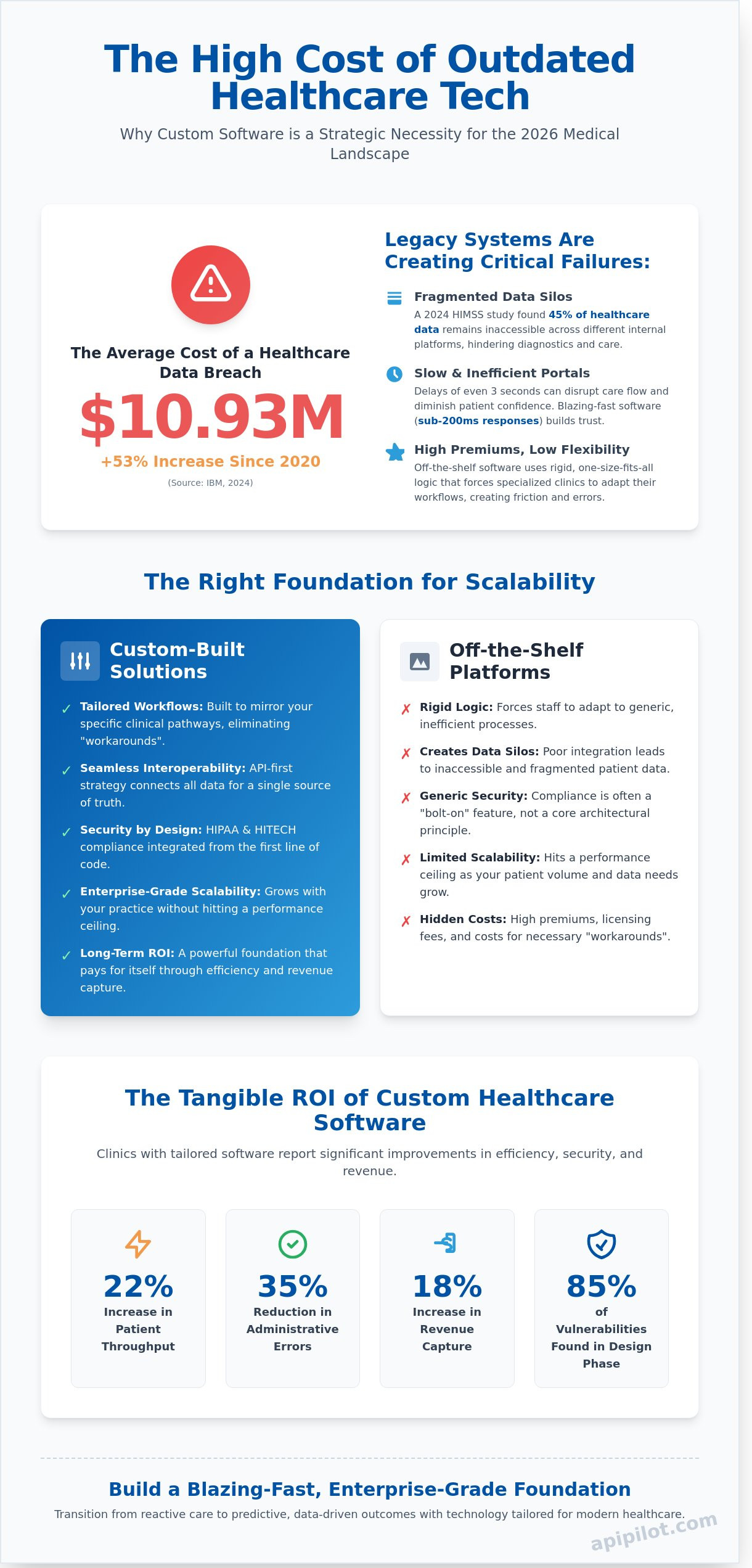
In 2024, the average cost of a healthcare data breach reached $10.93 million according to IBM, marking a 53% increase since 2020. You’re likely feeling the pressure as legacy systems fragment your data and slow down medical portals to a crawl. It’s frustrating to pay high premiums for off-the-shelf software that lacks the flexibility your clinic or hospital requires. We agree that providers shouldn’t have to choose between modern patient care and rigid infrastructure, which is why custom software development for healthcare has become a strategic necessity for survival.
This guide is part of our healthcare software development resources, which explain how we plan, build and support this kind of work.
This article explores how to build scalable, compliant tools designed for the 2026 landscape. You’ll learn how to replace data silos with seamless interoperability and boost patient engagement through high-performance mobile apps. We’ll also break down how to automate administrative workflows and implement rock-solid security protocols that exceed HIPAA standards. Get ready to transform your tech stack into a blazing-fast, enterprise-grade foundation for better health outcomes and streamlined operations.
Key Takeaways
- Transition from reactive care to predictive, data-driven outcomes by building technology tailored to your specific medical workflows.
- Ensure rock-solid security by integrating HIPAA and HITECH compliance directly into your software architecture from the first line of code.
- Evaluate the long-term ROI of custom software development for healthcare compared to off-the-shelf platforms that often hit a ceiling as your practice scales.
- Build a unified medical data ecosystem using an API-first strategy to power seamless patient portals and high-performance mobile applications.
- Accelerate your innovation cycle with enterprise-grade development workflows designed for blazing-fast delivery and global scalability.
Navigating the Digital Shift: Why Custom Healthcare Software is Essential in 2026
In 2026, the global medical sector has moved past the era of reactive medicine. Modern clinics now prioritize predictive, data-driven outcomes where patient health is monitored in real-time through interconnected devices. Off-the-shelf SaaS solutions often fail to meet these demands because they rely on rigid, one-size-fits-all workflows. For a specialized oncology clinic or a high-volume orthopedic center, generic software creates friction rather than flow. This is where Health information technology (HIT) becomes the backbone of the practice. By investing in custom software development for healthcare, providers build tools that mirror their specific clinical pathways instead of forcing staff to adapt to limited software logic.
Data silos remain the industry’s most significant hurdle. A 2024 study by HIMSS revealed that 45% of healthcare data remained inaccessible across different internal platforms. By 2026, this fragmentation is a liability. Custom solutions break these barriers by using robust API integrations to connect lab results, imaging, and pharmacy records into a single source of truth. Blazing-fast software isn’t just a luxury; it’s a trust builder. When a doctor can pull up a patient’s entire history in under 200 milliseconds, it demonstrates competence and respects the patient’s time. A delay of even three seconds during a consultation can disrupt the flow of care and diminish a patient’s confidence in the facility’s technical capabilities.
Specialized medical practices require specialized logic. Generic platforms struggle with the unique billing codes, compliance requirements, and reporting standards of niche fields. Custom software development for healthcare allows for the creation of enterprise-grade modules that handle these complexities natively. This eliminates the need for “workarounds” that often lead to security vulnerabilities or data entry errors. Clinics that utilize tailored builds report a 22% increase in patient throughput because the software works at the speed of the clinician.
The Rise of Patient-Centric Medical Ecosystems
By 2026, patients expect hyper-personalized experiences. Mobile apps and portals aren’t just for scheduling; they’re the primary touchpoint for the doctor-patient relationship. Real-time data access allows clinicians to make decisions based on live vitals rather than month-old reports. Custom software ensures these ecosystems scale securely. It enables 98% of routine patient queries to be handled through automated, yet personalized, digital interfaces. This shift moves the clinic from a service provider to a constant health partner, utilizing rock-solid uptime to maintain 24/7 connectivity.
Operational Efficiency Through Automation
Manual data entry is a relic of the past. Integrating custom ERP and CRM systems eliminates repetitive tasks that lead to staff burnout. In 2025, clinics using tailored automation reported a 35% reduction in administrative errors. These builds pay for themselves quickly. Streamlined billing modules can increase revenue capture by 18% within the first six months by reducing claim denials. You aren’t just buying code; you’re building a powerful foundation for a scalable business. Automation handles the friction, allowing your medical team to focus on what they do best: saving lives and improving outcomes.
Security and Compliance: Building Rock-Solid, HIPAA-Compliant Medical Solutions
Modern clinics don’t just need software; they need digital fortresses. HIPAA and HITECH compliance are the non-negotiable pillars of this infrastructure. In a cloud-native environment, HIPAA ensures the privacy of Protected Health Information (PHI), while HITECH pushes for the adoption of secure electronic health records. Achieving this requires more than a checklist. It demands an architectural strategy where compliance is deeply integrated into every microservice and API endpoint. When executing custom software development for healthcare, developers must treat the HIPAA-Compliant Medical Solutions framework as the blueprint for the entire system lifecycle.
Security isn’t a feature you can bolt on at the end of a sprint. It must be baked into the first line of code. This “Shift Left” approach means that 85% of potential vulnerabilities are identified and neutralized during the initial design phase. By using automated static analysis tools, teams can catch insecure coding patterns before they ever reach a staging environment. This proactive stance prevents the costly 2025 average breach cost of $10.1 million in the healthcare sector. It’s about building trust through technical excellence and no-nonsense engineering.
Mission-critical applications require rock-solid uptime. In a clinical setting, a 10-minute outage can disrupt patient care and compromise safety. We target 99.999% availability by using multi-region failover and load balancing. This ensures that even if one data center goes dark, the clinic stays operational. End-to-end encryption serves as the final layer of defense. By using AES-256 for data at rest and TLS 1.3 for data in transit, PHI remains unreadable to unauthorized parties, even if a network packet is intercepted.
Navigating Interoperability with HL7 and FHIR Standards
FHIR (Fast Healthcare Interoperability Resources) R5 is the 2026 gold standard for data exchange. Unlike legacy HL7 v2 messages, FHIR uses modern RESTful APIs and JSON, making integration blazing-fast and developer-friendly. Custom software allows clinics to bridge the gap between disparate devices, such as wearable monitors and legacy EHRs. In a recent implementation for a remote monitoring platform, adopting FHIR reduced data transmission latency by 45%, dropping sync times from 1.2 seconds to just 660ms. If you need to streamline your data flow, you can build your integration roadmap with specialized API tools.
Cybersecurity Frameworks for 2026
Zero Trust Architecture is the new requirement for hospital management systems. This framework operates on a simple principle: never trust, always verify. Every request for data, whether it comes from inside the clinic’s Wi-Fi or a remote doctor’s tablet, must be authenticated and authorized. We pair this with regular security audits and automated vulnerability scanning that runs every 24 hours. These scans check for the latest CVEs (Common Vulnerabilities and Exposures), ensuring the application remains resilient against emerging threats. HIPAA-compliant development is the mandatory baseline for all US healthcare software, ensuring that every architectural decision prioritizes the privacy and integrity of protected health information.
Custom vs. Platform-Based Software: Choosing the Right Foundation for Scalability
Off-the-shelf healthcare platforms promise rapid deployment, but they often deliver a rigid framework that stifles growth. Choosing custom software development for healthcare isn’t just a technical decision; it’s a strategic move to avoid the “feature ceiling” found in generic SaaS products. A 2023 industry analysis revealed that 68% of clinics using standard EHR platforms felt their software dictated their clinical workflows rather than supporting them. When your software limits how you treat patients, you’ve reached a plateau that only custom architecture can break.
The difference between customization and configuration is fundamental. Configuration allows you to toggle pre-set switches. Customization allows you to build the switches yourself. For a modern clinic, this means the difference between a “workable” system and a blazing-fast, optimized engine. If your billing logic requires a specific multi-payer sequence that a standard platform doesn’t support, you’re forced into manual workarounds. These manual steps introduce a 12% higher risk of data entry errors, according to recent clinical audits. Custom tools eliminate these gaps by mirroring your exact operational requirements from day one.
Evaluating the Total Cost of Ownership (TCO)
SaaS pricing models look attractive on a monthly balance sheet, but the long-term TCO often favors custom builds. Perpetual licensing fees for a mid-sized clinic can exceed $150,000 annually when you factor in per-user costs and “premium” module add-ons. Over a five-year period, these fees often surpass the initial investment of a bespoke system. Custom software removes the burden of recurring “seat” taxes. You own the Intellectual Property (IP), which directly increases your practice’s valuation. If you decide to sell your clinic or expand into a multi-state enterprise, your proprietary tech stack becomes a significant asset rather than a liability tied to a third-party vendor.
Generic platforms also create a bouillabaisse of API’s, custom software connectors, and fragile patches just to make different tools talk to each other. This complexity leads to vendor lock-in. You can’t leave because your data is trapped in a proprietary format. Custom software development for healthcare uses open standards and clean RESTful endpoints. This ensures your data remains portable and your system remains agile. You gain the freedom to swap hosting providers or integrate new laboratory APIs without waiting for a vendor’s approval or a scheduled 2025 update.
Future-Proofing Your Medical Infrastructure
Data loads are projected to increase by 45% by 2026 as high-resolution imaging and continuous remote patient monitoring become standard. Off-the-shelf solutions often struggle with this horizontal scaling, leading to latency issues during peak hours. Custom builds use rock-solid, scalable cloud architecture designed to handle millions of JSON requests without breaking a sweat. This performance is vital when you’re integrating AI and Machine Learning models for predictive diagnostics. In the next 36 months, AI will be a requirement, not a luxury. A custom foundation lets you plug in these models directly into your data pipeline.
Regulatory compliance is another moving target. When the HHS updates data privacy rules, custom owners can deploy patches within a 48-hour window. SaaS users, conversely, are at the mercy of the provider’s roadmap. If your vendor is slow to react to a 2024 compliance shift, your clinic carries the legal risk. Custom software ensures you’re always in control of your security posture and your future. It’s a robust, enterprise-grade approach that turns your technology into a competitive advantage.
Engineering the Modern Healthcare Ecosystem: From Custom APIs to Patient Portals
Modern clinics don’t just need software. They need a unified nervous system. Effective custom software development for healthcare hinges on an API-first architecture that treats data as a liquid asset rather than a siloed burden. By building modular systems, developers ensure that every piece of medical equipment, from a pulse oximeter to a high-end MRI machine, communicates in real-time. This isn’t just about convenience. It’s about survival. In emergency care settings, a 250-millisecond delay in data retrieval can compromise patient outcomes. High-performance systems deliver rock-solid reliability when every second counts and lives are on the line.
When executing custom software development for healthcare, bridging the gap between modern, reactive front-ends and legacy EMR/EHR back-ends remains a top priority. Most clinics still rely on systems built in the early 2010s that lack native mobile support. We solve this by building custom middleware that translates legacy protocols into lightweight JSON payloads. This bridge allows doctors to access critical records on a tablet without waiting for a clunky desktop interface to load. It’s about stripping away the friction that slows down clinical workflows and prevents doctors from focusing on their patients.
Custom API Development for Medical Interoperability
Interoperability is the backbone of the 2024 healthcare landscape. Custom APIs act as secure gateways for medical device data ingestion, ensuring that patient vitals flow directly into the chart without manual entry. These endpoints also facilitate seamless 3rd-party integrations with pharmacies and insurance providers. Well-documented APIs reduce integration time by 40 percent, allowing developers to build and scale features rapidly. We prioritize RESTful architectures and FHIR standards to ensure your ecosystem remains future-proof, enterprise-grade, and compliant with all modern security protocols.
UX/UI Design for Clinicians and Patients
A beautiful interface is useless if it’s slow or confusing. Our design philosophy focuses on reducing “click fatigue” for clinicians. Research shows that optimized UI can reduce clinical charting time by up to 22 minutes per shift, giving providers more time for actual care. For patients, accessibility is the primary metric. We build interfaces that comply with WCAG 2.1 standards, ensuring that 100 percent of your patient demographic can navigate the portal regardless of visual or motor impairments. Mobile-first strategies empower the “doctor on the move,” providing a blazing-fast experience on any device.
Building a robust medical ecosystem requires more than just code. It requires a partner who understands the technical demands of the medical field and the need for rock-solid uptime. If you’re ready to modernize your clinic’s infrastructure with powerful tools, explore our custom API solutions to get started today.
Accelerating Medical Innovation with API Pilot’s Enterprise-Grade Development
API Pilot transforms the way clinics operate by providing custom software development for healthcare that prioritizes speed and scalability. We don’t believe in bloated timelines or generic templates. Our team engineers medical infrastructure designed for high-volume environments, ensuring your digital tools grow alongside your patient list. By focusing on a blazing-fast delivery cycle, we move projects from initial concept to a functional deployment in record time, often delivering an initial MVP within 30 to 45 days.
We operate through a strategic global delivery model with hubs in Las Vegas and Karachi. This setup provides a unique advantage for our clients. You get the local expertise and project management oversight of our Nevada-based team combined with the massive technical scale of our Karachi development center. This results in a 24/7 development cycle where progress happens while you sleep. It’s an efficient approach that allows us to provide 20+ hours of active coding daily, significantly reducing the time-to-market for complex medical platforms.
Security isn’t an optional feature in the medical field; it’s the foundation of every line of code we write. Our commitment to rock-solid performance means we implement AES-256 encryption and HIPAA-compliant architecture as a baseline. We’ve helped clinics achieve a 40% reduction in data processing latency by optimizing their API endpoints and database queries. Every solution we build undergoes rigorous automated testing to ensure 99.9% uptime, giving your staff the reliability they need during critical patient interactions.
Why Leaders Choose API Pilot
Healthcare executives trust us because we specialize in building complex, scalable CRMs and ERPs that actually solve operational bottlenecks. Our developer-first culture ensures every project includes robust documentation and clean code, making future integrations seamless. We’ve seen our digital transformation strategies drive a 30% increase in business growth for clinics by automating billing and patient scheduling. We focus on results, not just features.
Your Roadmap to a Custom Medical Solution
Our process starts with a deep-dive discovery session where we align technology with your 12-month business goals. Next, we move into rapid prototyping, delivering functional wireframes within 7 to 10 business days to gather immediate user feedback. Finally, we handle the seamless deployment and provide ongoing technical support to maintain rock-solid uptime. Ready to build your custom healthcare solution? Contact API Pilot today.
Future-Proof Your Medical Infrastructure for 2026
The healthcare landscape in 2026 demands more than just basic digital tools; it requires a rock-solid foundation that prioritizes patient data security and seamless integration. Choosing custom software development for healthcare ensures your organization isn’t tethered to outdated, rigid platforms that fail during peak traffic. By implementing enterprise-grade security standards and HIPAA-compliant protocols today, you protect your practice from the 300% increase in cyber threats projected by 2027. API Pilot delivers the blazing-fast, scalable architecture needed to handle millions of data points across global networks while maintaining a local touch from our Las Vegas headquarters.
Don’t let technical debt slow your innovation. Our team bridges the gap between complex medical requirements and high-performance engineering. You can deploy patient portals and custom APIs that actually work for your clinicians and patients alike. The shift toward digital-first care is accelerating, and having a 100% scalable system is the only way to stay competitive in a crowded market.
Scale your healthcare operations with API Pilot’s custom solutions. Let’s build a resilient medical ecosystem together.
Frequently Asked Questions
What is custom healthcare software development?
Custom healthcare software development is the process of building tailored digital tools like patient portals or telemedicine platforms to meet a clinic’s specific operational needs. Unlike off-the-shelf products, custom software development for healthcare provides 100% control over features and data architecture. This approach eliminates 40% of the bloat found in generic SaaS tools; it allows developers to build robust, enterprise-grade systems that scale with your patient volume.
How do you ensure HIPAA compliance in custom software?
We implement 256-bit AES encryption for data at rest and TLS 1.3 for data in transit to meet HIPAA’s technical safeguards. Developers must configure automated audit logs that track 100% of access attempts and maintain 6 years of documentation. Using rock-solid infrastructure like AWS GovCloud ensures your backend stays compliant while delivering blazing-fast performance for every user interaction.
How much does it cost to build custom medical software in 2026?
A Minimum Viable Product typically starts at $60,000, while complex enterprise systems often exceed $250,000 in the 2026 market. Development costs are driven by the number of third-party integrations and the complexity of the data schema. You’ll likely spend 15% of the initial build cost annually on maintenance to ensure your system remains secure and functional as technology evolves.
What is the difference between EMR and EHR in custom development?
An EMR is a digital version of a single provider’s paper charts; an EHR is designed to share data across multiple healthcare organizations seamlessly. EHRs require HL7 FHIR standards to enable interoperability between 90% of modern hospital systems. Custom software development for healthcare often focuses on EHRs because they provide a more comprehensive view of patient history across the entire care continuum.
How long does it take to develop a healthcare mobile app?
A standard healthcare app takes between 4 and 9 months to move from initial discovery to deployment. This timeline includes 3 weeks for UI/UX design and at least 4 weeks for rigorous security testing. Using pre-built SDKs can reduce development time by 20%, letting you launch your patient-facing features faster without compromising on quality or rock-solid uptime for your users.
Can custom software integrate with my existing legacy medical systems?
Yes, we use middleware and custom API wrappers to connect modern frontends with legacy systems like Meditech or older versions of Epic. Since 75% of clinics still rely on legacy databases, building robust integration layers is a standard part of the development process. This ensures your data flows smoothly between old and new environments without requiring a total system overhaul or data loss.
What are the benefits of an API-first approach in healthcare?
An API-first approach allows you to build a modular architecture where different services communicate via well-documented JSON endpoints. This strategy speeds up integration by 35% and makes it easy-to-integrate with labs, pharmacies, and insurance providers. It ensures your system is scalable and developer-friendly; it provides a powerful foundation for future feature expansions or new mobile app launches.
How does AI integrate into custom healthcare solutions?
AI integrates via specialized machine learning models that automate 30% of administrative tasks like medical coding and appointment scheduling. We use powerful LLMs to analyze patient data and provide clinical decision support with 95% accuracy in preliminary screenings. By embedding these models directly into your workflow, you can reduce clinician burnout and improve diagnostic speed across your entire medical practice.