
Did you know that 40% of enterprise applications now integrate task-specific AI agents to meet rising user expectations? As the global market hits $391.3 billion in 2026, the traditional approach to mobile app development is no longer enough to stay competitive. You’re likely feeling the pressure of rising development costs and the constant debate between native performance and cross-platform speed. It’s a frustrating balance to strike when technical debt looms over every architectural decision. We know you want to build something that doesn’t just look good but actually performs under pressure.
This guide provides the blueprint you need to master scalable, API-driven architectures that deliver blazing-fast user experiences. We’ll show you how to leverage Swift 6.3 and Jetpack Compose 1.11 alongside strategic frameworks that eliminate friction. You’ll learn to navigate the mandatory iOS 26 SDK requirements and the new Liquid Glass design language without sacrificing speed. We’re diving deep into the exact tech stacks required to drive measurable business growth through rock-solid backend architecture and superior mobile engagement.
Key Takeaways
- Learn why shifting to an AI-native design philosophy is essential for modern mobile app development in 2026.
- Compare Native and Cross-platform stacks to determine the most efficient framework for your specific performance and scalability requirements.
- Discover how an API-first approach decouples logic from the frontend, creating a rock-solid foundation for enterprise-grade growth.
- Master the full development lifecycle from strategic discovery to seamless UI/UX design that drives measurable user engagement.
- Gain insights into building blazing-fast, scalable solutions by integrating professional strategic frameworks and global technical depth.
The State of Mobile App Development in 2026
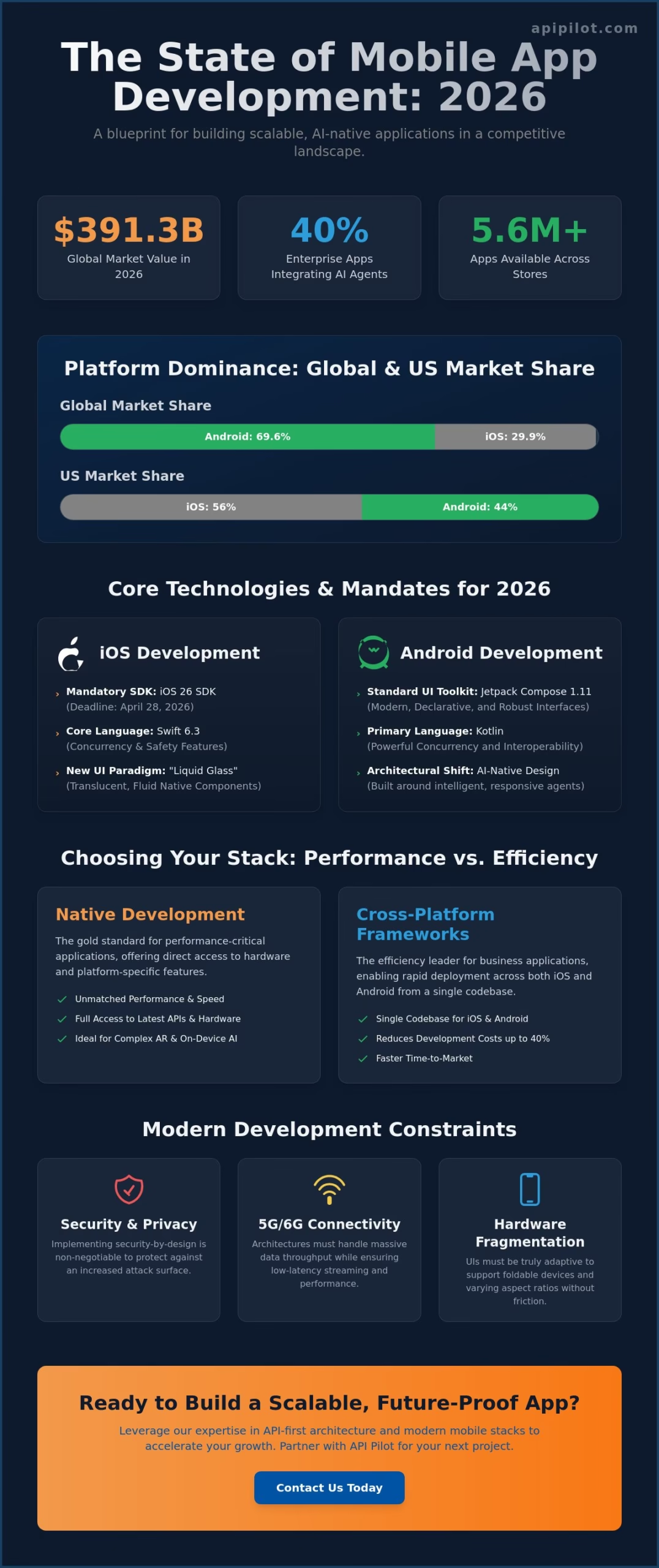
In 2026, mobile app development has evolved from building isolated utilities into orchestrating complex multi-platform ecosystems. The global market, valued at $391.3 billion this year, demands more than just responsive layouts. We’ve moved past the “mobile-first” era. Now, we’re in the “AI-native” phase. Applications are designed around intelligent agents rather than static menus. Users expect blazing-fast speed and rock-solid uptime as baseline features, not premium upgrades. If your app doesn’t respond instantly, users won’t hesitate to find an alternative among the 5.6 million apps available across the major stores.
To better understand the architectural shifts required for engineers this year, watch this comprehensive roadmap overview:
The current landscape requires technical precision. Android maintains a 69.6% global market share. iOS holds 29.9% globally but leads the US market with a 56% share. As of April 28, 2026, all App Store submissions must use the iOS 26 SDK. This update introduces the “Liquid Glass” design language. It applies a translucent, fluid aesthetic to native UI components automatically. For Android, Jetpack Compose 1.11 is the standard for building robust, declarative interfaces. Swift 6.3, released March 24, 2026, provides the powerful concurrency and safety features required for these modern architectures.
Modern Constraints: Beyond CPU and RAM
Security and privacy are the primary constraints for 2026. It’s no longer just about managing CPU cycles or RAM usage. 5G is now the global standard, and 6G research is already influencing how we handle data streaming. This connectivity allows for massive data throughput, but it also increases the attack surface. Developers must implement security-by-design from the first line of code. You’re also building for fragmented hardware. Foldable devices and varying aspect ratios mean your UI must be truly adaptive. Static designs are obsolete. Your code must handle fluid transitions across diverse display technologies without friction.
The Role of AI in 2026 Mobile Apps
AI is the heartbeat of the 2026 app. It’s predicted that 40% of enterprise applications will incorporate task-specific AI agents by year-end. Integrating Large Language Models (LLMs) into mobile workflows is now a standard requirement for user retention. We see a massive shift toward Edge AI. Processing tasks directly on the device enhances privacy and reduces latency. This on-device inference allows for powerful personalization engines that work offline. It ensures a seamless experience that scales effortlessly while keeping server costs low and user data secure.
Choosing Your Stack: Native vs. Cross-Platform vs. PWA
Selecting a tech stack determines your app’s trajectory for years. In 2026, mobile app development requires a strategic choice between raw power and development speed. While native code remains the gold standard for intensive tasks, cross-platform tools are now the default for most business applications. Your decision hinges on whether you need deep hardware integration or a blazing-fast rollout to capture a share of the 292 billion expected downloads this year. It’s about finding the right balance between user experience and engineering efficiency.
Native Development: When Only the Best Suffices
Native development using Swift 6.3 for iOS and Jetpack Compose 1.11 for Android offers unmatched performance. As of April 28, 2026, all App Store updates must target the iOS 26 SDK. This requirement ensures apps can handle the new Liquid Glass UI components with rock-solid stability. If your project requires complex AR, heavy on-device AI processing, or low-latency background tasks, native is the only viable path. It provides direct access to the latest APIs and hardware sensors without an intermediary layer. This performance premium is essential for gaming and high-end enterprise tools where every millisecond counts.
Cross-Platform Frameworks: The Efficiency Leader
Frameworks like Flutter and React Native have narrowed the performance gap significantly in 2026. They allow you to maintain a single codebase for both iOS and Android, which often reduces development costs by up to 40% compared to separate native builds. This efficiency is critical for companies aiming for a seamless user experience across platforms with a unified team. Managing platform-specific UI/UX is simpler now with adaptive components that respond to the host OS design language automatically. For the majority of consumer apps, the difference in speed is now imperceptible to the average user.
Progressive Web Apps (PWAs) remain the most cost-effective option for content-heavy services that don’t need app store presence. However, for most businesses, the real scalability comes from an API-First Approach. This strategy ensures your backend can serve a PWA, a mobile app, and even future hardware without a total rewrite. Managing developer velocity against long-term maintenance is the ultimate challenge. While native builds offer the best performance, they often double the maintenance burden. If you need help deciding which path fits your budget, exploring custom mobile solutions can help align your tech stack with your business growth goals.
The API-First Approach: Building Scalable Mobile Foundations
In 2026, your mobile app is only as strong as the backend powering it. We’ve moved beyond simple database wrappers. Modern mobile app development demands a decoupled architecture where the frontend acts as a thin client. This separation allows you to scale your backend services independently to handle the 292 billion global app downloads projected for this year. By treating the API as a first-class citizen, you ensure enterprise-grade scalability and future-proof your product against changing frontend trends. A robust backend ensures your application remains responsive under heavy loads.
Efficiency is the core of high-performance mobile systems. Use JSON-based RESTful endpoints for standard operations and GraphQL for complex, nested data queries. GraphQL is particularly effective in 2026 for preventing over-fetching; it delivers only the exact data the client requests. This keeps your app snappy even on congested networks. Security is non-negotiable. Implement OAuth2 and JWT (JSON Web Tokens) to manage user sessions securely across devices. All data transmission must be encrypted using TLS 1.3 to protect user privacy and meet strict global security regulations. This creates a dependable foundation for any digital product.
Custom API Development for Mobile
API-first development is the practice of designing the interface before the implementation. This approach ensures that your endpoints are tailored specifically for mobile constraints from day one. You must build endpoints that minimize data consumption by aggregating responses on the server side. This results in fewer network requests and a blazing-fast user experience for your customers. Building with this level of technical precision is the only way to guarantee the rock-solid uptime users expect in a competitive market. It streamlines the integration process and reduces friction during the development lifecycle.
Offloading Processing to the Cloud
Modern mobile devices are powerful, but battery life remains a significant bottleneck. You can drastically reduce battery drain by moving heavy computational logic to the server. Use serverless architectures like AWS Lambda or Google Cloud Functions to handle intensive tasks such as image processing or complex AI inference. For apps requiring offline functionality, implement real-time data synchronization strategies. This ensures that users can interact with the app without a connection, with data syncing seamlessly once they’re back online. This strategy is essential for building high-performance applications that scale across millions of global devices without sacrificing speed.
The Mobile Development Lifecycle: From Concept to Deployment
Modern mobile app development in 2026 is no longer a linear path; it’s a continuous, iterative loop designed for speed and reliability. Success starts with discovery and strategy. You must align every app feature with specific business growth goals to avoid technical debt. If a feature doesn’t drive engagement or revenue, it’s a distraction. UI/UX design follows, focusing on creating seamless, intuitive user journeys that minimize friction. In a market where 98% of revenue comes from free apps with in-app purchases or subscriptions, your user experience must be flawless to convert and retain customers.
Agile methodology is the engine of modern delivery. You need two-week sprints and robust CI/CD pipelines to ensure blazing-fast iterations. This allows your team to push updates and security patches without disrupting the user experience. Testing and quality assurance are equally critical. You can’t rely solely on simulators. You must combine automated testing scripts with manual testing on physical devices to account for the fragmentation of the 2026 hardware landscape. Deployment is just the beginning. You need aggressive App Store Optimization (ASO) and consistent maintenance to stay visible among the 3.7 million apps on the Google Play Store.
Prototyping and MVP Development
Startups must embrace the ‘Build-Measure-Learn’ feedback loop to survive. Don’t try to build the final product on day one. Instead, identify your ‘must-have’ features for version 1.0 and move everything else to the roadmap. Use low-fidelity wireframes to validate user flow early. This saves time and prevents expensive rewrites. An MVP allows you to gather real-world data from your first 1,000 users, providing the insights needed to refine your product before a full-scale launch.
Scaling to Enterprise-Grade Software
As your user load increases, you’ll need to refactor your code for higher performance. Enterprise-grade software requires more than just a pretty frontend. You must implement custom CRM and ERP integrations to streamline your business operations and automate data flow. Continuous monitoring and crash reporting are essential for maintaining rock-solid reliability. If you want to build a solution that transitions seamlessly from a startup concept to an enterprise powerhouse, you should partner with a specialized development team that understands high-scale architecture. This ensures your app remains responsive as you scale to millions of global users.
Partnering for Success: Custom Mobile Solutions by API Pilot
Building a successful product in a market valued at $391.3 billion requires more than just a functional interface. It demands a strategic partner who understands the deep technical requirements of 2026. API Pilot delivers high-performance native and cross-platform applications designed to scale alongside your business. We bridge the gap between high-level business strategy and technical execution. Our global model combines the strategic insight of our Las Vegas headquarters with the technical depth of our Karachi development center. This unique structure allows us to provide mobile app development services that are both innovative and cost-effective.
Our focus remains on driving measurable engagement and long-term brand loyalty. We don’t just build apps; we create digital ecosystems. This includes seamless integration with your existing custom software, robust APIs, and enterprise-grade e-commerce platforms. Whether you’re targeting the 69.6% Android market share or the high-spending US iOS audience, our solutions ensure your brand remains competitive. We prioritize blazing-fast speed and rock-solid uptime to meet the non-negotiable expectations of modern users.
Why Choose API Pilot for Your Mobile Project?
Enterprise-grade security and scalability are baked into every line of code we write. We understand that a single vulnerability can derail your growth. Our team has a proven track record in custom software development and complex system integration. You won’t get lost in a sea of junior developers. When you work with us, you get direct access to senior developers and project managers. This ensures clear communication and a transparent development lifecycle. We focus on building a dependable foundation that allows your application to handle millions of users without friction.
- Direct access to senior architectural expertise for complex decision-making.
- Security-first approach to protect user data and maintain compliance.
- Proven experience integrating apps with custom CRM and ERP systems.
- Scalable backend foundations that grow with your user base.
Get Started on Your Mobile Journey
Our process turns complex business requirements into simple, intuitive mobile solutions. We navigate the 2026 tech landscape so you don’t have to. From managing the mandatory iOS 26 SDK updates to implementing on-device AI personalization, we handle the technical heavy lifting. We help you identify the core features that drive ROI and eliminate the fluff that causes technical debt. A professional partner is essential for navigating shifting regulations and hardware fragmentation. Stop worrying about technical debt and start focusing on your business growth. Contact API Pilot for a custom mobile app consultation to begin your project today.
Future-Proof Your Mobile Strategy for 2026 and Beyond
The landscape of mobile app development has fundamentally shifted toward AI-native architectures and decoupled backend systems. Success in 2026 requires more than just a functional UI. It demands rock-solid uptime and an API-first foundation that scales to meet the demands of a global audience. Whether you leverage the raw power of Swift 6.3 or the cross-platform efficiency of Flutter, your architecture must prioritize performance. Security-by-design is no longer optional.
Building enterprise-grade solutions doesn’t have to result in technical debt. API Pilot brings global expertise from our offices in Las Vegas and Karachi to streamline your development lifecycle. We’re trusted by 1,000,000+ developers through our Idera partnership and specialize in integrating complex custom CRMs and ERPs into seamless mobile experiences. Scale your business with a blazing-fast mobile app from API Pilot and deliver the robust, high-performance experience your users deserve. It’s time to turn your complex requirements into a powerful, scalable reality.
Frequently Asked Questions
How much does it cost to develop a mobile app in 2026?
Total development costs vary based on complexity, feature set, and your chosen tech stack. You must account for mandatory platform fees, such as the $99 annual Apple Developer Program fee or the $299 enterprise version. Google Play requires a one-time $25 developer account fee. High-performance apps with custom API integrations and enterprise-grade security layers require a larger investment than simple MVPs. Choosing cross-platform frameworks can often reduce initial costs by up to 40%.
How long does the mobile app development process take?
A standard development lifecycle typically spans 3 to 9 months from discovery to deployment. Simple applications or MVPs might launch in as little as 12 weeks using agile sprints. Complex enterprise solutions that require custom CRM integrations and robust backend architectures often take 6 months or longer. Using modern CI/CD pipelines ensures a blazing-fast iteration process, allowing teams to push updates without disrupting the user experience.
Should I build an iOS or Android app first?
Your choice should depend entirely on your target audience’s geographic location and demographics. In the US, iOS leads with a 56% market share, making it the preferred starting point for many domestic businesses. Globally, Android dominates with a 69.6% market share. Many modern mobile app development projects now utilize Flutter or React Native to target both platforms simultaneously, which significantly reduces time-to-market and maintenance overhead.
What is the difference between a native app and a hybrid app?
Native apps are built specifically for one platform using Swift 6.3 or Kotlin, providing the best performance and deep hardware access. Hybrid apps use web technologies wrapped in a native shell, which often results in slower speeds and limited functionality. In 2026, the performance gap has narrowed due to advanced cross-platform frameworks, but native remains the gold standard for applications requiring intensive on-device AI or complex graphics.
Can a mobile app work without an internet connection?
Yes, apps can function offline by implementing an offline-first architecture. This involves using local storage and databases to allow users to interact with the app’s core features without a connection. Once the device reconnects, real-time data synchronization strategies ensure that local changes are merged with the cloud backend. This approach is essential for maintaining a seamless user experience and reducing friction in areas with unreliable network coverage.
How do I ensure my mobile app is secure?
Security must be baked into the code using an mobile app development strategy focused on security-by-design. Use robust authentication protocols like OAuth2 and JSON Web Tokens (JWT) to manage user sessions. You must also ensure all data transmission is encrypted using TLS 1.3. Regular automated testing and the implementation of encrypted local storage help create a dependable foundation that protects sensitive user data from unauthorized access.
What are the benefits of custom mobile app development over off-the-shelf solutions?
Custom development allows you to align every feature with your specific business growth goals and existing workflows. Unlike off-the-shelf products, custom builds offer enterprise-grade scalability and seamless integration with your internal CRMs or ERPs. This eliminates technical debt caused by unnecessary features and gives you full ownership of the source code. It ensures a rock-solid foundation that can evolve as your business requirements change over time.
How often should I update my mobile app after launch?
You should release updates at least once a month to maintain security, fix bugs, and improve performance. Regular maintenance is mandatory to stay compliant with OS requirements, such as the April 28, 2026, deadline for the iOS 26 SDK. Frequent updates based on the Build-Measure-Learn feedback loop keep your app competitive. This consistent attention ensures your application remains compatible with new hardware and continues to deliver a blazing-fast experience.