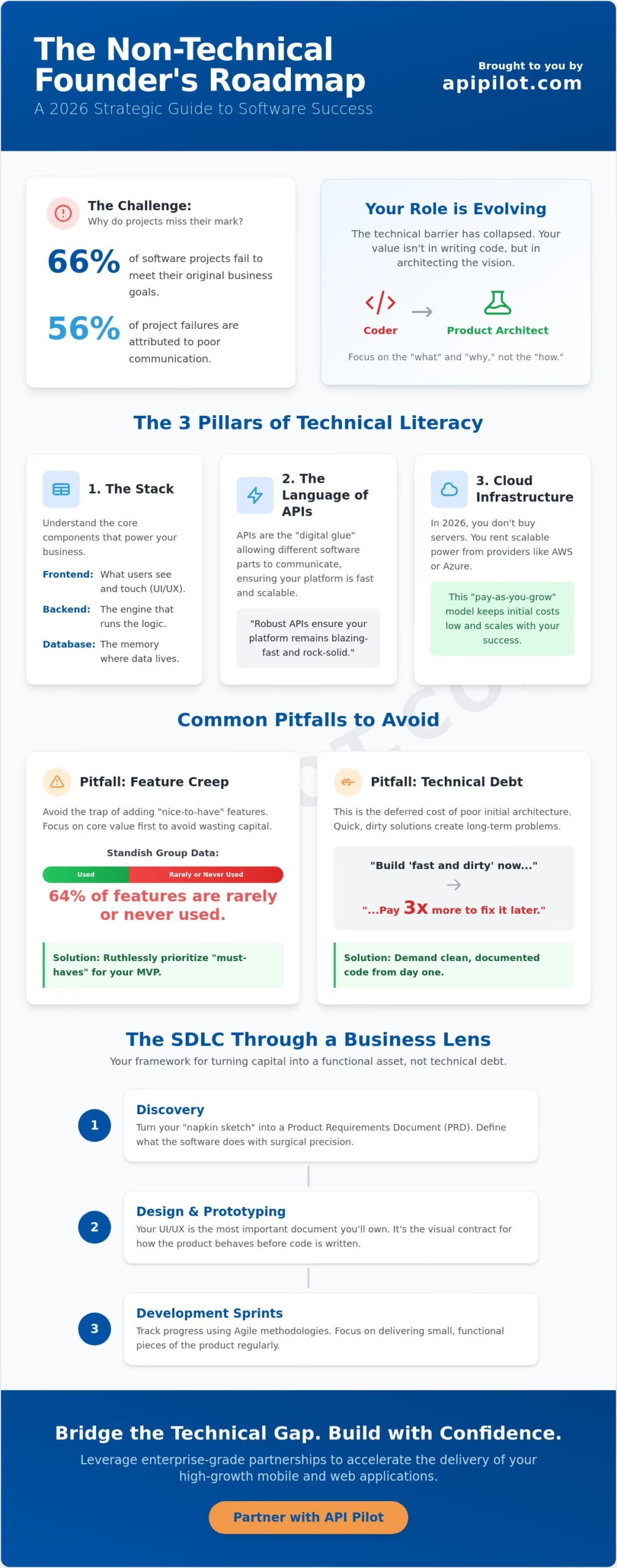
Why do 66% of software projects fail to meet their original business goals? For many entrepreneurs, the primary barrier isn’t a lack of vision. It is the complex reality of software development for non-technical founders. You likely feel overwhelmed by technical jargon or fear that a single bad hire will lead to crippling technical debt. It’s a valid concern when a 2023 Project Management Institute report highlights that poor communication accounts for 56% of project failures.
You know that building a robust, enterprise-grade product shouldn’t feel like a high-stakes gamble with your seed capital. This 2026 strategic guide changes that dynamic. You’ll master the technical landscape and lead your project to success without writing a single line of code. We provide a clear roadmap from your initial idea to a scalable MVP. You’ll gain the confidence to vet developers, manage relationships with blazing-fast efficiency, and protect your intellectual property with rock-solid precision.
Key Takeaways
- Transition from a coder mindset to a “Product Architect” role by focusing on business logic and user outcomes rather than technical implementation.
- Implement an “API-First” approach to build a rock-solid foundation that ensures your software remains scalable and future-proof.
- Navigate the complexities of software development for non-technical founders by identifying the right hiring model and debunking the technical co-founder myth.
- Establish a single “Source of Truth” using tools like Jira or Linear to translate your vision into user stories that developers can execute with precision.
- Leverage enterprise-grade partnerships to bridge the technical gap and accelerate the delivery of high-growth mobile and web applications.
Demystifying the Role: What a Non-Technical Founder Actually Does
A non-technical founder functions as a Product Architect. You aren’t there to write lines of code; you’re there to design the business logic that the code serves. In 2026, the technical barrier has collapsed. With AI-driven agents now generating 80% of boilerplate code, your primary value is your ability to translate market needs into functional requirements. You must master the Software Development Lifecycle to ensure your vision aligns with technical execution. Your mindset must shift from “how do we build this” to “what outcome does the user need.”
To better understand the mindset shift required for this role, watch this helpful video:
The current year represents the best era for software development for non-technical founders. Gartner predicts that by 2026, 70% of new applications will use low-code or no-code technologies, making rapid prototyping accessible to everyone. Your core responsibilities involve vision, resource allocation, and market alignment. You manage the “what” and the “why,” ensuring every dollar spent on engineering delivers measurable user outcomes. You don’t need to be a coder, but you must be a decisive leader who understands how to leverage technical tools to solve real-world problems.
The 3 Pillars of Technical Literacy for Founders
You don’t need to write Python, but you must understand the architecture that powers your business. Focus on these three areas:
- The Stack: Understand that the Frontend is what users touch, the Backend is the engine, and the database is the memory. If the database is poorly structured, your app won’t scale.
- The Language of APIs: APIs are the “digital glue” that allow different software components to talk to each other. Integrating robust, enterprise-grade APIs ensures your platform remains blazing-fast and rock-solid.
- Cloud Infrastructure: In 2026, you don’t buy servers. You rent scalable power from providers like AWS or Azure. This allows for a “pay-as-you-grow” model that keeps initial costs low.
Common Pitfalls and How to Avoid Them
Avoid the “Feature Creep” trap by keeping your MVP painfully simple. Data from the Standish Group shows that 64% of software features are rarely or never used. Focus on the core value proposition first to avoid wasting capital. Success in software development for non-technical founders requires a ruthless prioritization of “must-have” over “nice-to-have” features. Be wary of technical debt, which is a deferred cost of poor initial architecture. If you build “fast and dirty” now, you’ll pay 3x more to fix it during your first major scale-up. Demand clean, documented code from day one to ensure long-term reliability.
The Software Development Lifecycle (SDLC) Through a Business Lens
Software development for non-technical founders often feels like a black box. It shouldn’t. The SDLC is your framework for executive oversight. It ensures your capital transforms into a functional asset rather than technical debt. By 2026, the gap between business intent and technical execution has narrowed thanks to better documentation tools, but the core phases remain the same. You don’t need to write code to lead a team. You need to manage the milestones.
From Discovery to Deployment: A Step-by-Step Roadmap
The discovery phase is where you translate a business vision into functional requirements. Data from 2024 industry reports shows that 74% of failed startups attribute their collapse to premature scaling or poor requirement definition. Don’t skip this. Use this phase to define your “Minimum Viable Product” (MVP) with surgical precision.
- Discovery: Turn your “napkin sketch” into a PRD (Product Requirements Document). This defines what the software does for the user.
- Design and Prototyping: Your UI/UX is the most important document you’ll own. It’s a visual contract of how the product behaves before a single line of code is written.
- The Development Sprint: Track progress using Agile methodologies. You should see working features in a staging environment every 14 days.
Why Custom API Development is Your Secret Weapon
An API-first approach builds a rock-solid foundation for future growth. Instead of building a monolithic block of code, your team creates independent services that communicate through APIs. This ensures scalability. If you need to add a mobile app or a partner portal later, you won’t have to rebuild your core logic from scratch. Custom APIs are the connective tissue of modern enterprise software.
This architecture allows for seamless third-party integrations. You can connect your proprietary logic to blazing-fast payment processors, enterprise-grade CRMs, or the latest AI models without friction. By decoupling the backend from the frontend, you gain roughly 40% more flexibility when market demands shift. For founders looking to streamline this architecture, exploring automated API generation can significantly reduce initial overhead.
Validation doesn’t require reading code; it requires Demo-Driven Development. If a feature isn’t visible or testable in a demo, it isn’t finished. This approach keeps teams accountable and keeps you in control of the budget. Pair this with robust Quality Assurance (QA). A single critical bug can lead to a 30% drop in user retention within the first 24 hours of launch. QA is not a luxury; it’s brand protection. It ensures your software is as reliable as the business vision behind it.
Effective software development for non-technical founders relies on these clear boundaries. When you focus on the “what” and the “why,” you empower your technical team to handle the “how” with precision and speed.
Hiring Your Tech Team: Agency vs. Freelancer vs. In-House
Searching for a technical co-founder often stalls progress for months. This is a common trap. Data from 2024 indicates that 40% of successful early-stage startups launched their first version using outsourced teams rather than a permanent partner. You don’t need a unicorn partner to start; you need execution. Effective software development for non-technical founders focuses on choosing a delivery model that matches your current funding and speed requirements.
Choosing the Right Partner for Your Stage
Different stages of growth require different talent structures. Selecting the wrong one leads to wasted capital and technical debt. Consider these three paths:
- Freelancers: These are ideal for small, isolated tasks or building a basic 1.0 prototype. While cost-effective, 65% of founders report management friction when coordinating multiple independent contractors. Use them for quick fixes, not complex architectures.
- Custom Software Agencies: This is the most reliable path for software development for non-technical founders who need to move quickly. Agencies provide a managed, enterprise-grade team including designers, developers, and project managers. They deliver blazing-fast builds with rock-solid oversight.
- In-house teams: Start the hiring process only after securing Series A funding or hitting predictable revenue. The average developer salary now exceeds $150,000 in many tech hubs. Hiring internally too early creates a high burn rate that can kill a startup before it finds product-market fit.
The Vetting Checklist: 5 Non-Negotiables
Vetting a partner requires looking past a polished sales pitch. You need to verify their ability to handle complex logic and high-traffic environments. Use these criteria to filter your options:
- Portfolio Complexity: Don’t just look at pretty interfaces. Ask to see a system they built involving 50+ API endpoints or complex data integrations. High-performance backends matter more than aesthetic buttons.
- Communication Protocols: Demand a specific schedule. Will they provide a weekly demo? Do they use Slack and Jira for real-time updates? Clarity prevents expensive mid-project pivots.
- Post-launch Support: Code eventually breaks. Ensure your contract includes a Service Level Agreement (SLA) for 2 AM emergency fixes. A robust support plan is non-negotiable for maintaining uptime.
- Technical Stack Alignment: Ensure they use modern, scalable frameworks like React, Node.js, or Python. Avoid proprietary languages that lock you into a single vendor.
- Testing Rigor: Ask about their automated testing processes. A team that doesn’t prioritize QA will deliver a product full of regressions.
Your code is your primary asset. Every contract must include a “Work Made for Hire” clause to ensure you own 100% of the intellectual property. Demand access to the private GitHub repository from day one. Secure your environment by enforcing multi-factor authentication for every team member. This proactive approach ensures your seamless transition when you eventually bring development in-house.
Managing the Build: Communication and Project Oversight
Successful software development for non-technical founders relies on a single source of truth. You shouldn’t manage a complex build through scattered emails or fragmented Slack threads. Adopt a robust project management tool like Jira, Trello, or Linear to track every ticket and milestone. This centralizes documentation and ensures your team remains aligned on priorities without constant manual follow-ups. High-performing teams use these platforms to maintain transparency, making the development process visible rather than a mystery.
The art of the user story is your most powerful tool for clarity. Avoid writing technical specifications that you don’t fully understand. Instead, focus on user outcomes. A standard format like “As a user, I want to reset my password so I can regain account access” prevents developer confusion. Clear stories reduce rework by 25% based on 2025 project management data. You must also account for the “black box” of technical debt. Budget a 20% contingency fund for every phase. Unexpected API integration hurdles or architectural shifts are common, and this financial buffer prevents project stalls when technical roadblocks emerge.
Effective Communication Protocols
Schedule a weekly sync to review progress against the strategic roadmap. Ask your lead developer: “What are the current blockers?” and “Are we on track for the sprint goal?” Use Loom for asynchronous updates to save your team hours of unnecessary meeting time. To maintain rock-solid quality, establish a strict “Definition of Done” for every task. This ensures that no feature is considered complete until it passes code review, meets design specs, and functions in the staging environment.
Risk Mitigation and Quality Control
Never push code directly to your live environment. Use a staging environment to test features in a sandbox that mirrors your production setup exactly. This is where you perform User Acceptance Testing (UAT). As a founder, your final check-off is the last line of defense, ensuring the product meets business goals before deployment. Modern teams implement Continuous Integration and Continuous Deployment (CI/CD) pipelines to automate these checks. These pipelines ensure blazing-fast updates and enterprise-grade stability by running automated tests every time code is changed. Effective software development for non-technical founders demands this level of rigorous oversight to turn a vision into a scalable reality.
Looking for a team that prioritizes transparency and speed? Connect with expert developers to manage your build with precision.
Partnering with API Pilot: Enterprise-Grade Solutions for Visionaries
Software development for non-technical founders often feels like a high-stakes gamble. API Pilot removes the uncertainty by implementing a transparent, milestone-based process that keeps you in control. We don’t just write code; we architect business solutions that act as long-term assets. Our team specializes in custom software and mobile app development designed for high-growth startups that need to scale rapidly without accumulating technical debt.
We provide what we call the API Pilot Advantage. This framework combines blazing-fast delivery with rock-solid security protocols. Based in Las Vegas, our reach is truly global, bridging the gap between local accountability and international technical muscle. Whether you’re building a niche internal tool or a global consumer platform, our infrastructure is engineered to handle the demand. We prioritize performance and ease of use, ensuring your product is ready for the market in record time.
Turning Your Idea into a Scalable Asset
- Custom CRM and ERP solutions: We build tools tailored to your specific business logic. Most off-the-shelf software forces you to change your workflow, but we do the opposite by building code that mirrors your operations.
- Mobile App Development: Our team creates native and cross-platform apps built for user engagement. We focus on performance metrics that drive retention and long-term growth.
- E-commerce Platforms: We deliver systems optimized for conversion. Our architectures handle high-volume traffic spikes with 99.9% uptime, ensuring you never miss a sale during peak periods.
Start Your Journey Today
Our discovery process ensures your vision is perfectly translated into code. We spend the necessary time mapping out every requirement and business rule before development begins. This ensures the final product aligns exactly with your strategic goals. It’s the kind of professional, managed development approach that provides the peace of mind you need to lead your company with confidence.
You don’t need to be a CTO to launch a world-changing product. You get the peace of mind that comes with a partner who understands software development for non-technical founders inside and out. We handle the technical complexity so you can focus on building your brand and serving your customers.
Launch Your 2026 Technical Roadmap
Success in software development for non-technical founders hinges on your ability to translate business vision into functional requirements. You’ve learned that mastering the Software Development Lifecycle (SDLC) and choosing the right hiring model are the most critical steps to avoid technical debt. Effective oversight isn’t about writing code; it’s about establishing clear communication channels and setting measurable milestones that keep your project on track. By focusing on these strategic pillars, you’ll transform from a visionary with an idea into a leader of a scalable digital product.
API Pilot delivers the blazing-fast and rock-solid infrastructure you need to compete in today’s market. We’re specialists in custom API and mobile development, currently trusted by 1,000,000+ developers worldwide. Our global team operates from offices in Las Vegas and Karachi to provide 24/7 expertise for your build. Don’t let technical complexity stall your growth when enterprise-grade solutions are within reach. It’s time to turn your roadmap into a high-performance reality.
Build your enterprise-grade software with API Pilot today
Frequently Asked Questions
Do I need a technical co-founder to start a software company?
You don’t need a technical co-founder to launch a successful software company. While technical leadership is vital, 40% of successful startups in 2025 began with non-technical founders who leveraged external agencies or fractional CTO models. This approach allows you to focus on market fit while experts handle the architecture. Just ensure you have a clear roadmap and a rock-solid development partner to manage the technical debt effectively.
How much does it cost to build a custom software MVP in 2026?
A custom software MVP in 2026 typically ranges from $40,000 to $120,000 based on Clutch industry benchmarks. It’s common for high-complexity apps involving AI or real-time data processing to sit at the higher end of that scale. You can control costs by prioritizing essential features and using enterprise-grade APIs to handle complex functionalities like payment processing. This strategy ensures you get a powerful product without overspending on custom-coded backend logic.
How do I protect my software idea if I hire an outside agency?
Protect your intellectual property by signing a Mutual Non-Disclosure Agreement (NDA) and an IP Assignment Agreement before sharing project details. These documents ensure that 100% of the code and assets created belong to your company upon payment. Most professional agencies include these clauses as standard practice. Always verify that the contract covers “work for hire” status under relevant copyright laws to secure your enterprise-grade assets and trade secrets.
What is the difference between a web app and a mobile app for a startup?
Web apps run in browsers via URLs, while mobile apps require installation from stores like Google Play or the App Store. Web apps are often the best choice for software development for non-technical founders because they offer faster deployment and lower maintenance costs. Mobile apps provide better access to device hardware like cameras or GPS. Choose a web app if you want to reach 2.5x more users quickly during your initial launch phase.
How long does the average custom software development project take?
The average custom software project takes between 4 and 9 months from discovery to launch. According to a 2025 GoodFirms report, simple applications take approximately 3 to 4 months, while complex enterprise-grade systems require 9 months or more. You can accelerate this timeline by using pre-built integrations and modular architectures. Clear communication and a well-defined scope are the most effective ways to avoid delays and maintain a blazing-fast development pace.
What happens if my developer leaves in the middle of the project?
You mitigate the risk of a developer leaving by maintaining strict version control and up-to-date documentation. Ensure all code is pushed daily to a repository you own, such as GitHub or GitLab. This practice allows a new developer to step in and resume work within 48 hours. Professional agencies provide rock-solid continuity plans that guarantee a replacement developer will be assigned immediately if a team member becomes unavailable during the build.
How can I tell if my software code is high quality?
High-quality code is identified through automated testing results, clear documentation, and regular peer reviews. You should request a SonarQube report or a similar static analysis to check for technical debt and security vulnerabilities. Software development for non-technical founders is easier when you insist on modular code structures. Clean, well-structured code reduces long-term maintenance costs by 50% and ensures your application remains scalable as your user base grows across different regions.
Should I build for iOS or Android first?
Build for iOS first if you’re targeting high-spending users, as iOS users spend 2.5x more on in-app purchases according to 2025 market data. If you’re targeting global markets or high-volume usage, Android is the better choice due to its 70% global market share. Alternatively, use cross-platform frameworks like Flutter or React Native. These tools allow you to launch on both platforms simultaneously using a single codebase, which is a highly efficient strategy for startups.


