
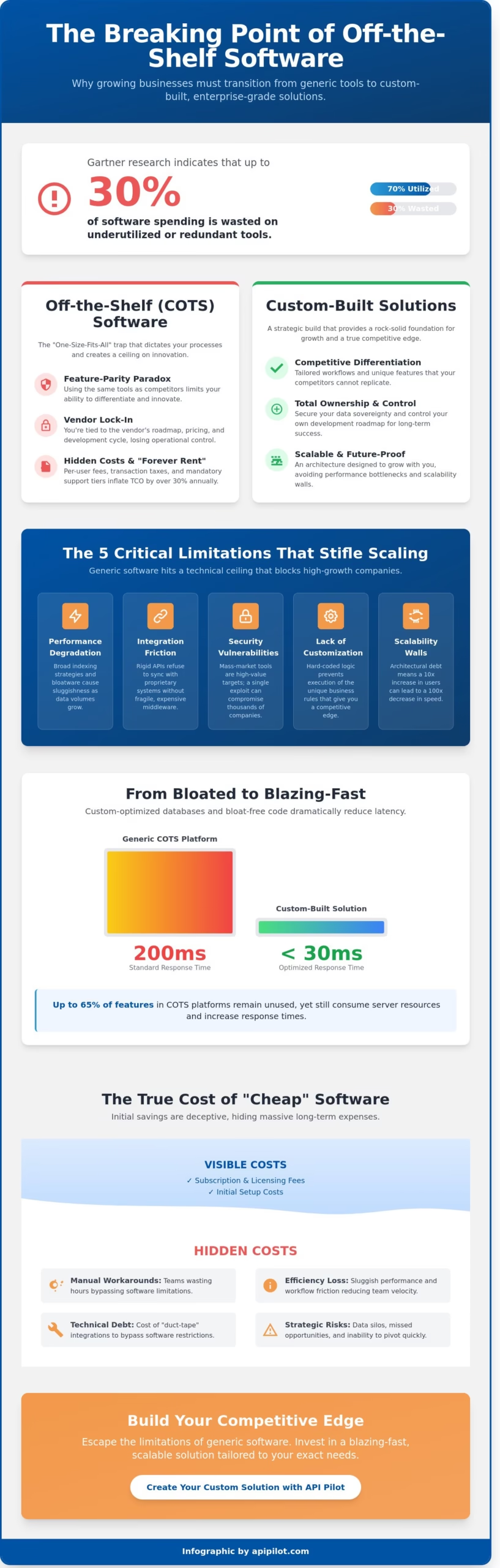
Is your tech stack actually an anchor? Research from Gartner indicates that up to 30% of software spend is wasted on underutilized or redundant tools. You likely invested in your current suite for a quick launch and a predictable price point. It’s a logical choice during early growth. However, as your operations expand, the limitations of off the shelf software start to create friction in your workflows. Rigid architectures, poor integration with legacy systems, and sluggish performance at high data volumes aren’t just minor inconveniences; they’re structural barriers to your success.
You deserve a rock-solid foundation that scales as fast as your ambitions. This article explains exactly why generic solutions eventually fail high-growth companies and provides a clear framework to justify the ROI of custom development. We’ll show you how to identify the precise breaking point of your current tools. You will gain a roadmap for a seamless transition to a tailored, enterprise-grade solution that delivers blazing-fast results without the bloat of unused features.
Key Takeaways
- Identify why pre-packaged COTS solutions create a “Feature-Parity Paradox” that halts your competitive differentiation.
- Understand the technical limitations of off the shelf software, specifically regarding performance degradation and rigid API integration friction.
- Assess the strategic risks of vendor lock-in and learn how to secure your data sovereignty and long-term operational control.
- Calculate the true Total Cost of Ownership (TCO) by uncovering hidden expenses like manual workarounds and efficiency loss.
- Discover how to build a blazing-fast, enterprise-grade competitive edge with tailored, scalable software solutions.
What is Off-the-Shelf Software and the “One-Size-Fits-All” Trap?
Commercial-off-the-shelf (COTS) software describes ready-made solutions built for the mass market. These products satisfy the broadest possible audience. Businesses choose them for speed. You sign up, pay a fee, and start working immediately. It’s a “Tactical Buy” designed to solve operational gaps without a heavy engineering lift. While 90% of small businesses rely on these tools initially, they often fall into the “One-Size-Fits-All” trap. This happens when your software dictates your business processes instead of supporting them.
Using these tools creates a Feature-Parity Paradox. If your tech stack is identical to your competitor’s, your ability to differentiate is limited. You’re locked into the vendor’s development cycle. This creates a ceiling on innovation. Scaling becomes difficult because you’re fighting the software’s inherent design. To truly master the limitations of off the shelf software, you must recognize when a generic tool stops being an asset and starts being a bottleneck.
To better understand the difference between these pre-packaged tools and custom builds, watch this helpful video:
Common Examples of Off-the-Shelf Solutions
Generic CRM and ERP systems are the biggest culprits. They often require complex workarounds to fit niche industry workflows. This friction reduces team velocity. Standardized e-commerce platforms like Shopify provide ease of use but charge “success taxes.” As your revenue grows, transaction fees and app subscriptions eat into margins. Project management tools also cause issues. They often lack robust API endpoints, creating data silos where critical information is trapped in a single, disconnected platform.
The Illusion of Lower Costs
Initial pricing is deceptive. The subscription model creates a “forever rent” scenario where you never own the asset. Per-user licensing fees and mandatory premium support tiers can increase total cost of ownership by 30% or more annually. You also face the burden of limitations of off the shelf software through technical debt. In rigid architectures, technical debt is the accumulated cost of building “duct-tape” integrations to bypass software restrictions. These hidden expenses eventually outweigh the savings of a rapid deployment. Modern enterprises now favor a “Strategic Build” mindset, focusing on ownership and blazing-fast, custom integrations that provide a rock-solid foundation for growth.
The 5 Critical Technical Limitations That Stifle Scaling
While Commercial Off-The-Shelf (COTS) solutions offer a quick start, they often hit a technical ceiling that prevents long-term growth. The limitations of off the shelf software become a bottleneck when your user base exceeds 10,000 concurrent sessions or your data processing needs move into the terabyte range. Generic architectures are built for the average user, which means they lack the precision required for specialized enterprise workflows.
- Performance degradation: Generic databases use broad indexing strategies that struggle with high-volume, complex query patterns.
- Integration friction: Rigid COTS endpoints often refuse to sync with proprietary internal APIs without expensive, fragile middleware.
- Security vulnerabilities: Mass-market software is a high-value target. A single exploit in a popular CRM can compromise 50,000 different organizations simultaneously.
- Lack of customization: Hard-coded logic prevents you from executing unique business rules that give you a competitive edge.
- Scalability walls: Many systems suffer from architectural debt where a 10x increase in users leads to a 100x decrease in speed.
Performance and “Blazing-Fast” Requirements
Custom-built architectures outperform generic ones because they eliminate “bloatware.” In a 2023 audit of enterprise COTS platforms, researchers found that up to 65% of loaded features remained unused, yet they still consumed server memory and increased response times. Custom-optimized databases reduce latency from a standard 200ms down to sub-30ms for web applications. This efficiency is vital for maintaining rock-solid uptime during peak traffic periods. When every millisecond affects your conversion rate, generic overhead is a liability you can’t afford.
The Integration Nightmare
The “Standard Connectors” promised by vendors often fail when faced with complex data mapping. Moving information between disparate systems requires flexible API development that COTS platforms rarely support. You’re often forced to change your business processes to fit the software’s rigid structure. This creates significant strategic risks of off-the-shelf software, as you lose control over your data sovereignty and become dependent on a third-party vendor’s update schedule. If their API goes down or changes its schema, your entire workflow halts.
Scaling requires a foundation that grows with you. Relying on the limitations of off the shelf software means you’re building on rented ground. To achieve enterprise-grade results, your tech stack must be as unique as your business logic. Transitioning to custom-tailored modules allows you to bypass these five technical hurdles and maintain peak performance regardless of your growth trajectory.
Strategic Risks: Vendor Lock-in and Data Sovereignty
Building a business on a foundation you don’t own is a calculated risk that often backfires as you scale. One of the most glaring limitations of off the shelf software is the total loss of control over your technical infrastructure. You’re effectively renting your business logic. If the vendor pivots their product strategy or shifts their focus to a different market, your operations are at the mercy of their new direction. This lack of ownership extends to data sovereignty. You might have access to your data, but the vendor controls the schema, the export frequency, and the cost of retrieval. If you cannot move your data freely between systems, you don’t truly own your business insights.
The Danger of the Third-Party Roadmap
Your growth shouldn’t wait for a third-party developer’s update cycle. When a software provider discontinues a feature your team relies on, your business processes can stall instantly. There is also the persistent risk of price hikes; in 2023, major SaaS vendors increased subscription costs by an average of 12% across the board. You become a “captive customer” because the technical debt and cost of migrating data to a new platform often exceed the cost of the price increase. Building proprietary technology creates a competitive moat. It ensures you have unique, enterprise-grade capabilities that your competitors cannot simply buy from a marketplace.
Data Silos and Intelligence Gaps
OTS software often prevents a “Single Source of Truth” for business intelligence. Data stays trapped in proprietary silos, making it nearly impossible to get a unified view of your operations. Extracting raw data for custom AI or machine learning models is a common bottleneck. Most generic tools offer limited API endpoints that throttle data throughput, preventing the blazing-fast integration needed for real-time analytics. Custom-built ERPs and CRMs provide superior visibility. They allow you to structure data exactly how your business needs it, ensuring robust reporting and rock-solid reliability for your data science teams.
Compliance and regulatory hurdles present another significant challenge. Generic tools often struggle to meet specific industry standards like HIPAA or GDPR in niche use cases. A 2023 industry report indicated that 38% of organizations found it difficult to map generic software controls to specific, high-stakes regulatory requirements. These limitations of off the shelf software force businesses to implement messy workarounds. Custom solutions allow you to build compliance directly into the architecture, ensuring you meet every standard without compromise. This precision is essential for maintaining trust and avoiding the heavy fines associated with data mismanagement.
Cost-Benefit Analysis: When Does “Cheap” Become Expensive?
Off-the-shelf (OTS) solutions often lure businesses with low entry costs. A standard SaaS license might cost $50 per user, which looks attractive compared to a $100,000 custom build. However, the limitations of off the shelf software become financially visible when you project the Total Cost of Ownership (TCO) over a five-year period. While initial setup is fast, the recurring subscription fees, per-user escalations, and paid “add-on” modules frequently exceed the cost of a proprietary build by year three.
The TCO Evaluation Framework
To understand the true price of generic software, you must look beyond the monthly invoice. Direct costs are only the tip of the iceberg. You need a robust framework to calculate the long-term impact on your bottom line.
- Direct Costs: Monthly or annual licenses, hosting fees for “on-prem” versions, and tiered support packages.
- Indirect Costs: Employee hours spent on complex workarounds, manual data entry errors, and the 15% to 20% productivity dip during the 40-hour training cycles required for non-intuitive interfaces.
Custom software acts as a capital asset rather than a recurring expense; it builds equity in your business infrastructure and scales without increasing per-seat costs. It provides a rock-solid foundation that grows with your specific data requirements.
Efficiency loss is where the limitations of off the shelf software hit hardest. If your team spends just 30 minutes a day manually syncing data between two incompatible systems, a department of 50 people loses 6,250 hours annually. At an average loaded cost of $45 per hour, that is a $281,250 “hidden tax” on your operations. Custom automation eliminates this friction, delivering a measurable ROI through reduced manual labor and blazing-fast data processing.
Signs Your Business Has Outgrown Its Software
Growth often breaks generic tools. If your workflows feel like they’re held together by duct tape, it’s time to evaluate your tech stack. Look for these three critical indicators:
- Your team spends more time managing data in Excel than using your primary software platform.
- You’re turning down complex, high-value contracts because your current system can’t handle custom billing or unique reporting requirements.
- “Shadow IT” is rampant, with different departments buying their own mini-solutions to fix gaps in the main software.
The opportunity cost of staying with a limited system is staggering. When a competitor launches a new feature in weeks and your vendor’s roadmap says “maybe next year,” you lose market share. Custom solutions provide the agility to pivot and deploy enterprise-grade features on your own timeline.
Building Your Competitive Edge with API Pilot
Generic solutions often hit a ceiling when your business needs to scale. The limitations of off the shelf software become obvious when you’re forced to change your proven workflows to fit a rigid template. API Pilot eliminates these bottlenecks by building scalable, secure, and blazing-fast applications from the ground up. We don’t believe in one-size-fits-all. Our tailored solution approach ensures your technology stack aligns perfectly with your specific operational requirements.
Owning your source code is a fundamental advantage in a competitive market. When you rely on a subscription model, you’re essentially renting your infrastructure. With API Pilot, you own the intellectual property. Our bespoke API architecture provides rock-solid uptime and seamless integration capabilities that third-party platforms simply can’t match. Based in Las Vegas, our team combines local expertise with a high-performance global delivery model to execute complex projects with precision.
Our Process: From Concept to Deployment
We start by aligning our development strategy with your core business goals. We don’t just write code; we solve the structural problems that prevent growth. Security isn’t an afterthought in our process. We build enterprise-grade security into every layer, from data encryption to user authentication protocols. Whether you’re a global brand requiring a robust e-commerce engine or a startup needing a high-performance mobile app, our execution is consistent. We’ve optimized our workflow to handle high-traffic environments, ensuring your web and mobile platforms remain responsive under heavy loads.
- Phase 1: Discovery and Strategic Alignment
- Phase 2: Architecture Design and Security Layering
- Phase 3: Blazing-fast Development and Iteration
- Phase 4: Global Deployment and Performance Monitoring
Why Custom Software is the Ultimate Growth Engine
The most successful companies have shifted from viewing software as a tool to treating it as a core strategy. Custom solutions drive brand loyalty by providing a superior user experience (UX) that off-the-shelf products can’t replicate. When your software is built specifically for your users, engagement rates often increase by 40% or more compared to generic alternatives. You escape the limitations of off the shelf software by creating a platform that evolves as your market changes.
By investing in a custom build, you’re choosing a path of long-term efficiency and rock-solid reliability. You won’t deal with unnecessary features that slow down your system or missing functions that stall your team. It’s time to take full control of your digital infrastructure and build a foundation that supports unlimited growth. Contact API Pilot today for a custom software consultation and start building your bespoke solution.
Build an Unrestricted Path to Enterprise Growth
Relying on pre-packaged tools often feels efficient initially, but the limitations of off the shelf software become apparent the moment you hit scaling milestones or require absolute data sovereignty. Rigid architectures stifle innovation and create technical debt that eventually outweighs any initial savings. Enterprises need more than a generic dashboard; they need rock-solid infrastructure that scales horizontally without friction. It’s about moving from a one-size-fits-all trap to a system that adapts to your specific business logic.
API Pilot provides the technical foundation for businesses that refuse to settle for restricted growth. With a global presence in Las Vegas and Karachi, we specialize in custom ERP, CRM, and API development designed for blazing-fast, enterprise-grade performance. Our team eliminates vendor lock-in by building solutions you own completely, ensuring your data remains your most valuable asset. We help you transition from being a software user to a platform owner. Don’t let your tools dictate your strategy.
Ready to build a software solution that actually scales? Consult with API Pilot today.
Frequently Asked Questions
What are the main disadvantages of off-the-shelf software for startups?
The main disadvantages include a lack of competitive differentiation and rigid feature sets that don’t adapt to unique business models. 60% of startups struggle with rigid workflows that force them to change their internal processes just to fit the software’s logic. This creates technical debt early in the company’s lifecycle. Relying on generic tools means you’re using the same stack as your competitors, which limits your ability to innovate or offer unique user experiences.
How long does it typically take to transition from off-the-shelf to custom software?
Transitioning from off-the-shelf to custom software typically takes 4 to 9 months depending on the system’s complexity. A 2023 industry survey by GoodFirms indicates that a Minimum Viable Product usually requires 3 to 5 months of active development. Full migration of legacy data and team training adds another 2 to 4 months to the schedule. Planning for this timeline ensures a seamless move without disrupting your blazing-fast operations or daily productivity.
Is custom software development always more expensive than a subscription?
Custom software is more expensive upfront but often cheaper over a 5 year lifecycle compared to per-user SaaS fees. According to 2024 Gartner reports, enterprise SaaS costs increase by 15% to 20% annually due to seat expansions and tier upgrades. Custom builds eliminate these recurring per-head costs entirely. You trade high initial capital expenditure for long-term operational efficiency and predictable maintenance budgets that don’t scale with your headcount.
Can custom software be integrated with the off-the-shelf tools I already use?
Yes, custom software integrates with existing tools through robust API endpoints and standard webhooks. By building a custom layer, you can connect your legacy CRM with 2,000+ modern apps via standard RESTful architectures. This allows you to overcome the limitations of off the shelf software that often lacks native support for niche industry tools. It’s a rock-solid way to maintain your current workflow while adding bespoke functionality that powers your specific business needs.
What is the “Scalability Wall” in commercial software?
The Scalability Wall refers to the point where a commercial application’s performance degrades because it wasn’t built for your specific data volume. 45% of growing enterprises hit this wall when their database queries exceed the software’s hardcoded limits. It results in slow response times and frequent system downtime. Moving to a custom architecture allows you to scale horizontally and maintain blazing-fast speed as your user base grows beyond the original vendor’s expectations.
How does owning my source code benefit my business valuation?
Owning your source code increases business valuation by 20% to 30% because it represents a proprietary intangible asset. Investors view custom intellectual property as a rock-solid moat that protects your market share from competitors. When you own the code, you aren’t beholden to a third-party vendor’s roadmap or potential bankruptcy. It turns a monthly expense into a powerful balance sheet asset that enhances your exit strategy and provides enterprise-grade control over your tech stack.
What security risks are associated with mass-market software solutions?
Mass-market software is a high-value target for hackers because a single vulnerability can expose millions of users simultaneously. The 2023 Verizon Data Breach Investigations Report highlights that 80% of basic web application attacks target popular commercial platforms. Since the source code is often widely known, attackers have more time to find exploits. Custom solutions offer security through obscurity, making them less attractive targets for automated botnets and large-scale data harvesting operations.
When is the right time to switch from a SaaS tool to a custom build?
You should switch when your SaaS subscription costs exceed 15% of your annual revenue or when you spend more than 10 hours a week on manual workarounds. These workarounds are clear indicators of the limitations of off the shelf software hindering your growth. If your current tool can’t support a core business process required by 25% of your customers, it’s time to build. A custom solution provides the enterprise-grade control needed to scale.