
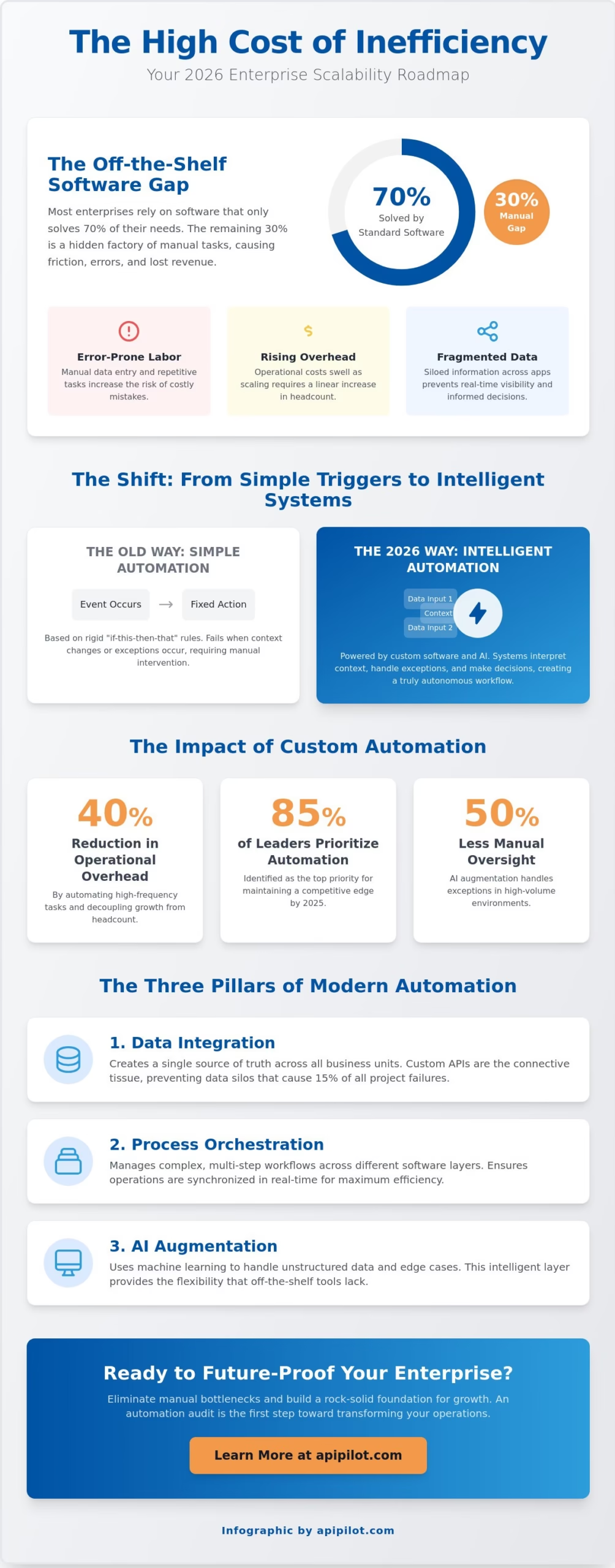
Most enterprises are currently paying for off-the-shelf software that only solves 70% of their operational needs; the remaining 30% is often filled with expensive, error-prone manual labor. You’ve likely felt the friction of fragmented data across multiple apps and the rising cost of repetitive tasks that keep your team from high-value work. It’s natural to worry about breaking core systems during a digital transition, but relying on manual bottlenecks is the fastest way to lose your competitive edge. This 2026 scalability guide explains exactly how to automate business processes with software to transform your organization into a high-performance, automated enterprise.
We’ll move past generic solutions to explore custom software and API-first architectures that provide a rock-solid foundation for growth. You’ll learn how to achieve real-time data visibility across every department and reduce operational overhead by a projected 40% according to recent 2024 productivity reports. We are diving into the technical roadmap for building a seamless, enterprise-grade infrastructure that delivers blazing-fast results without the friction of legacy systems.
Key Takeaways
- Master the shift from simple triggers to intelligent automation, leveraging AI-driven decision-making to eliminate manual bottlenecks.
- Conduct a systematic “Automation Audit” to prioritize high-frequency workflows that deliver blazing-fast results and immediate operational efficiency.
- Discover how to automate business processes with software using custom-built solutions that offer rock-solid scalability and a unique competitive advantage.
- Navigate a technical roadmap for architecture design, helping you choose between monolithic and microservices structures to support long-term growth.
- Future-proof your enterprise-grade infrastructure by implementing custom APIs as the essential connective tissue for seamless global integration.
What is Business Process Automation (BPA) in 2026?
In 2026, Business Process Automation (BPA) is the strategic deployment of custom software to execute recurring tasks with zero human intervention. It isn’t just about saving time anymore. It’s about building a rock-solid infrastructure that operates at a scale humans can’t match. Understanding how to automate business processes with software has become the primary differentiator between market leaders and those struggling with legacy overhead. By early 2025, 85% of enterprise leaders identified intelligent automation as their top priority for maintaining a competitive edge.
The industry has shifted from “Simple Automation” based on basic triggers to “Intelligent Automation” powered by AI-driven decision making. This transition allows systems to interpret context rather than just following binary commands. To better understand this concept, watch this helpful video:
2026 is the year of the API-first enterprise. Speed, reliability, and data integrity are no longer optional. Custom software drives a blazing-fast ROI by eliminating manual bottlenecks that historically caused a 20% drag on annual revenue. When you integrate powerful, enterprise-grade tools, you ensure your data flows seamlessly across every department without friction. This approach allows you to build systems that are both robust and flexible enough to handle the 2026 market demands.
The Three Pillars of Modern Automation
- Data Integration: This ensures a single source of truth across all business units, preventing the silos that lead to 15% of all project failures.
- Process Orchestration: You need to manage complex, multi-step workflows across different software layers to keep operations synchronized in real-time.
- AI Augmentation: Modern systems use machine learning to handle exceptions and unstructured data, reducing the need for manual oversight by 50% in high-volume environments.
Signs Your Business is Ready for Custom Automation
Your team might be drowning in tasks that software could handle in seconds. If your staff spends more than 10 hours a week on manual data entry, you’re wasting valuable talent and increasing error rates. Most off-the-shelf SaaS tools start requiring messy “workarounds” once you hit a certain complexity, which is a clear signal you need a custom approach. If scaling your operations currently requires a linear increase in headcount, your growth is unsustainable. Learning how to automate business processes with software will decouple your revenue growth from your payroll costs, allowing for exponential scalability.
Auditing Your Workflows: Identifying What to Automate First
Learning how to automate business processes with software begins with a cold, data-driven audit of your current operations. You can’t optimize what you haven’t mapped. A systematic automation audit requires documenting every touchpoint where data moves between departments, from the initial lead capture to the final financial reconciliation. According to McKinsey, 45% of current work activities can be automated using demonstrated technologies, but success depends on identifying the right starting point.
Prioritize tasks using the “High Frequency, Low Complexity” rule. These are the low-hanging fruits that offer immediate ROI and build organizational momentum. When automating complex business processes, organizations must first strip away the hidden bottlenecks often disguised as quality control. In 2026 digital infrastructure, a bottleneck is any synchronous latency point where data flow stops to wait for manual human validation before triggering the next API call. If a human is only clicking “approve” based on pre-set criteria, that’s a prime candidate for a robust software logic gate.
The 80/20 Rule of Process Automation
Focus your resources on the 20% of repetitive tasks that generate 80% of your operational delays. Common candidates for this enterprise-grade overhaul include automated invoicing, lead routing, real-time inventory updates, and payroll processing. These functions are often data-heavy and follow rigid rules, making them perfect for seamless integration. This audit provides the roadmap for how to automate business processes with software without disrupting existing revenue streams. If you’re looking to bridge these gaps quickly, you might consult with automation experts to identify your highest-impact endpoints.
Mapping the “As-Is” vs. “To-Be” States
Visualizing your current workflow is mandatory to find redundant steps that drain capital. The “As-Is” state often reveals “shadow processes” where employees use manual spreadsheets to fix software gaps. Your “To-Be” state should represent a future with zero manual input for data entry. Before writing a single line of code, you must document Standard Operating Procedures (SOPs). Digital transformation fails when you automate a broken process; instead, use this phase to simplify the logic before deploying powerful software solutions.
To ensure your automation strategy is performing at peak efficiency, establish clear KPIs from day one. Track these specific metrics to validate your investment:
- Error Rates: Target a 99.9% reduction in manual data entry mistakes.
- Cycle Times: Measure the time from process trigger to completion; automated workflows should be blazing-fast compared to manual queues.
- Employee Satisfaction: Survey teams to ensure they’re moving from “data pushers” to “strategy drivers.”
- Throughput: Quantify the increase in volume your system handles without adding headcount.
By focusing on these rock-solid metrics, you turn automation from a vague goal into a scalable business asset.
Build vs. Buy: Why Custom Software Wins for Complex Workflows
Choosing between purchasing a pre-built solution or developing a bespoke platform is a critical decision for 2026. While SaaS options offer immediate deployment, they often fail to address the specific nuances of a scaling enterprise. If you want to know how to automate business processes with software that actually drives ROI, you must look at the long-term architectural fit. Off-the-shelf tools are designed for the average user. This means they lack the flexibility to handle high-performance, proprietary workflows that provide your market edge. According to a 2024 Gartner report, 75% of organizations will favor custom-built applications over generic software for core business differentiation by 2026.
When Off-the-Shelf Software is Enough
- Standardized processes: 90% of small to mid-sized firms use generic accounting software because tax laws and financial reporting are universal.
- Low-volume tasks: If a process only happens twice a month, the development cost of custom software won’t be recouped for 5 or more years.
- Short-term projects: For a 3-month marketing campaign, a standard tool is more efficient than building a dedicated engine.
The Case for Custom Enterprise Solutions
Custom builds allow you to own your logic and intellectual property. According to this comprehensive overview of Business Process Automation, the primary goal of automation is to increase efficiency through specialized technology. This is where custom software excels. It integrates legacy systems using blazing-fast APIs and eliminates the “SaaS sprawl” that currently forces organizations to manage an average of 130 different applications, according to 2024 BetterCloud data. Custom solutions provide several rock-solid advantages:
- Proprietary Edge: You can code specific business logic that your competitors cannot access through a public subscription.
- Seamless Integration: Custom software talks directly to your existing database via enterprise-grade endpoints, avoiding the “integration tax” of third-party middleware.
- Reduced TCO: While the upfront cost is higher, you avoid per-user licensing fees that can cost enterprises over $18,000 per employee annually in wasted SaaS spend.
Scalability is the final piece of the puzzle. When your business grows, custom software scales horizontally and vertically without waiting for a vendor’s roadmap. You don’t have to change your operations to fit the software; the software evolves to fit you. By building, you ensure that how to automate business processes with software remains a strategy you control, rather than a limitation imposed by a third-party provider’s API constraints.
The Technical Roadmap: How to Implement Automation Software
Scaling an enterprise in 2026 requires a repeatable, high-performance framework. To master how to automate business processes with software, you must move beyond simple scripts and build a robust, enterprise-grade architecture. Following a structured five-step roadmap ensures your system remains reliable under heavy loads and provides a clear path for future growth.
- Step 1: Requirements Gathering. Define the technical scope and map out every user role. Precision at this stage prevents scope creep and ensures 100% alignment between business goals and code.
- Step 2: Architecture Design. Choose between monolithic structures for initial simplicity or microservices for maximum scalability. Microservices allow you to scale high-demand modules independently without affecting the entire system.
- Step 3: Custom Development. Build the core logic using modular codebases. Focus on creating a user interface that eliminates manual data entry and prioritizes high-speed performance.
- Step 4: Integration & Testing. Connect your system to external APIs to enrich data. Use automated stress-testing to ensure the platform maintains 99.9% uptime even under extreme traffic spikes.
- Step 5: Deployment & Optimization. Roll out the software in iterative stages. Use real-time telemetry data to identify bottlenecks and optimize the workflow based on actual user behavior.
Integrating AI Agents into Your Workflow
Modern automation relies on AI agents to handle unstructured data. Use natural language processing (NLP) to automate 70% of customer support tickets and internal documentation tasks. Predictive automation goes further by analyzing historical data patterns to trigger workflows before a human identifies the need. Security is non-negotiable. Maintain rock-solid protection by training AI models on internal data within isolated, encrypted environments to prevent leaks.
The Importance of a Developer-First Approach
High adoption rates depend on how developers and employees interact with the system. Clean, comprehensive documentation is the backbone of long-term software maintenance. Build blazing-fast front-ends that respond in under 100 milliseconds to keep users engaged. This focus on frictionless user experiences ensures teams actually use the tools instead of reverting to manual spreadsheets. When software feels like an asset rather than a chore, internal adoption rates typically increase by 45% within the first six months.
Future-Proofing with Custom APIs and API Pilot
APIs serve as the essential connective tissue for every modern operation. They allow disparate systems to communicate, ensuring data flows across your organization without manual intervention. When you investigate how to automate business processes with software, you quickly discover that generic, off-the-shelf connectors eventually hit a ceiling. Custom API development removes these technical bottlenecks. It builds a permanent bridge between your proprietary internal data and the global digital ecosystem, allowing for a seamless exchange of information.
API Pilot focuses on building digital products that remain scalable, secure, and powerful as your user base grows. We don’t just write code; we engineer enterprise-grade endpoints designed to handle high-concurrency environments. This shifts your strategy from basic task automation to total digital transformation. It’s the difference between fixing a single leak and building a modern, high-pressure plumbing system for your entire business. Our solutions provide the rock-solid foundation needed to support millions of requests with blazing-fast speed.
Scaling Beyond 2026: The Modular Enterprise
By 2026, the most competitive firms will function as modular entities. Your software must be ready to integrate with emerging technologies like Web3 protocols, IoT sensor arrays, and Edge Computing nodes. Custom CRMs and ERPs are no longer just administrative tools. They are your competitive moat. These systems protect your unique workflows from being copied by competitors using standard SaaS tools. API Pilot delivers these robust solutions for global brands, leveraging a developer-first mindset to ensure your architecture is ready for the next decade of innovation. We build for performance, ensuring your stack can handle the data loads of tomorrow.
Next Steps: Your Automation Journey Starts Here
Moving from manual processes to a fully automated environment shouldn’t disrupt your current daily operations. We recommend a phased transition that targets high-impact bottlenecks first. A long-term partnership with a custom development firm acts as a strategic asset, providing the technical expertise required to scale your infrastructure as market demands shift. You don’t have to overhaul your entire stack in a single day. Instead, focus on building a resilient framework that evolves with you. Efficiency is a marathon, not a sprint. Real growth happens when your tools work as hard as your team does.
Ready to transform your operations? Schedule a consultation with API Pilot to automate your business today.
Scale Your Operations with API-First Automation
The 2026 business environment leaves no room for manual bottlenecks or fragmented workflows. You’ve seen why custom software outperforms generic, off-the-shelf alternatives for complex business logic. It’s about creating a robust, API-driven architecture that grows alongside your company. Mastering how to automate business processes with software starts with a rigorous internal audit and culminates in a technical roadmap that prioritizes custom APIs and seamless data flow.
API Pilot provides the specialized engineering power needed to turn these automation strategies into reality. We operate from global hubs in Las Vegas and Karachi, bringing deep expertise in custom ERP and CRM development to every partnership. Our team focuses on building scalable, API-first solutions that ensure your digital infrastructure remains blazing-fast and rock-solid under pressure. Don’t let legacy systems or manual data entry hold your team back from achieving peak performance.
Ready to build rock-solid automation? Contact API Pilot for a custom software quote.
We’re here to help you build the future of your business today.
Frequently Asked Questions
Is custom business automation software more expensive than SaaS?
Custom software requires a higher upfront investment than SaaS, but it offers a lower total cost of ownership for enterprise operations. According to a 2024 Forrester report, SaaS subscription costs often increase by 15% annually. Understanding how to automate business processes with software requires evaluating this TCO over a five year period. You own the IP and build exactly what’s needed. This avoids the feature bloat that affects 80% of standard SaaS users.
How long does it take to build a custom automation solution?
A robust custom automation project usually takes 3 to 9 months from discovery to deployment. Simple internal tools might launch in 12 weeks; complex enterprise-grade systems requiring deep API integrations often span 36 weeks. Using pre-built API endpoints and SDKs can accelerate this timeline by 30%. We recommend an agile approach to release a Minimum Viable Product within the first 90 days. This allows you to capture immediate ROI while refining the final product.
What is the difference between RPA and custom software automation?
RPA mimics human actions on a UI level, while custom software automation interacts directly with data layers and APIs. RPA is ideal for legacy systems without accessible backends, but it breaks if the UI changes. Custom software provides a rock-solid, blazing-fast foundation that’s 5 times more scalable than RPA bots. It’s the superior choice for high-volume data processing. It ensures long-term stability and performance for your mission-critical business operations.
Can custom software integrate with my existing legacy systems?
Custom software integrates with 95% of legacy systems through middleware, custom APIs, or database connectors. Even systems from the 1990s can often be bridged using modern RESTful services to extract and sync data. This is a core part of how to automate business processes with software without replacing your entire infrastructure. You’ll gain modern functionality while preserving the data integrity of your established backend systems. It’s a pragmatic way to scale efficiently.
Will automating my business processes lead to job losses?
Automation typically shifts roles rather than eliminating them. The World Economic Forum predicts 97 million new roles will emerge by 2025 due to the new division of labor between humans and machines. Employees spend 40% of their time on repetitive tasks that software can handle. By automating these workflows, your team can focus on high-value strategy and creative problem solving. It’s about augmenting human capability. It isn’t about replacing your talented workforce.
How do I ensure the security of my data when using automated software?
Ensure your automation software utilizes AES-256 encryption for data at rest and TLS 1.3 for data in transit. Implementing OAuth 2.0 for API authentication and conducting quarterly penetration tests are industry standards for enterprise-grade security. Since 60% of data breaches involve compromised credentials, using a centralized identity provider is essential. These layers create a robust shield against unauthorized access. They ensure your business remains compliant with GDPR or SOC2 regulations at all times.
What are the best practices for training staff on new automation software?
Effective training requires a hands-on approach, starting with a pilot group of power users who represent 10% of your workforce. Provide concise, searchable documentation and hold 30-minute micro-learning sessions rather than day-long seminars. Studies show that employees retain 75% more information when practicing in a sandbox environment. Focus on how the software solves their specific pain points. This encourages rapid adoption and minimizes friction during the transition to new automated systems.