
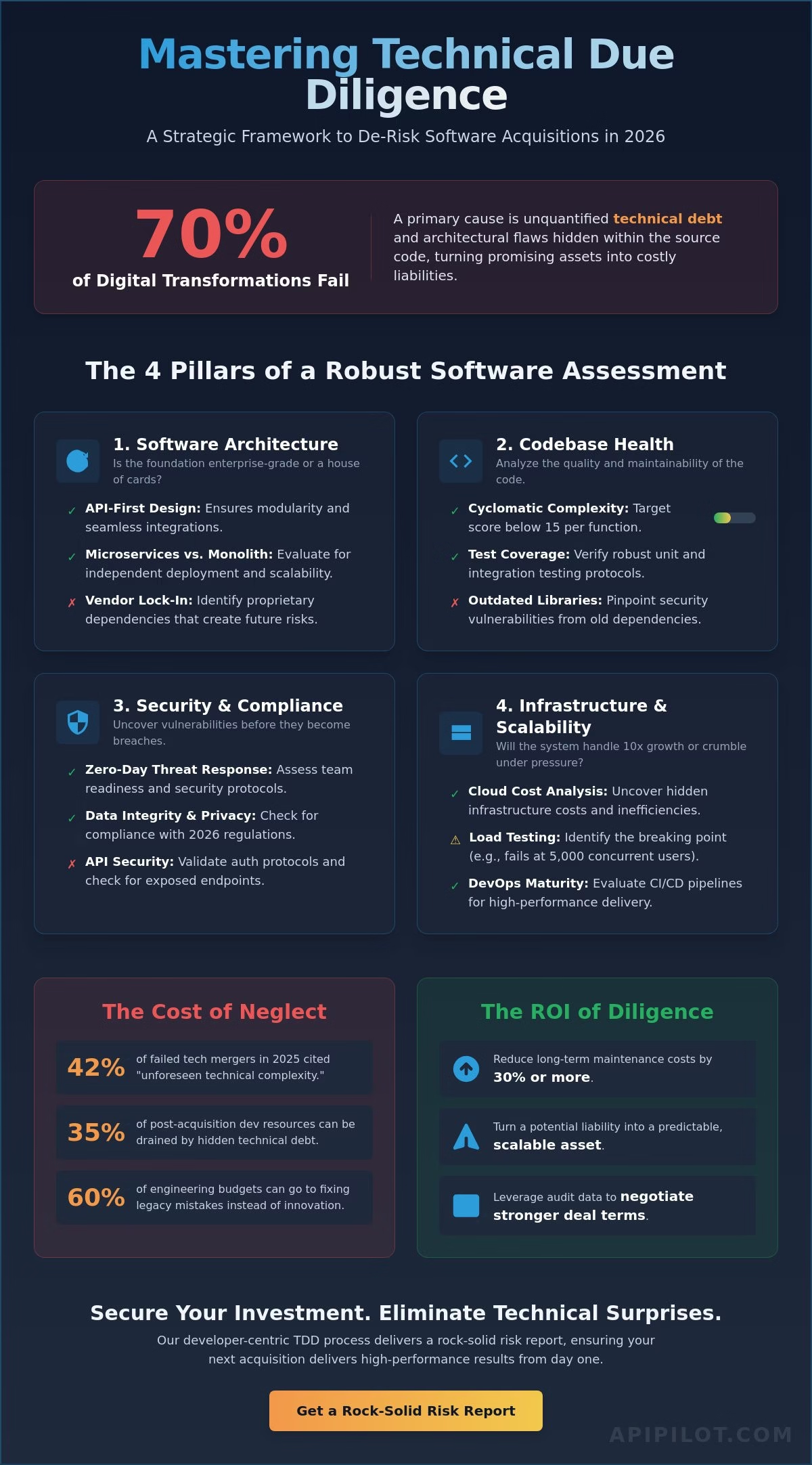
A 2024 report by McKinsey reveals that 70% of digital transformations fail to meet their objectives, frequently because of unquantified technical debt buried deep within the source code. You’ve likely felt the pressure of evaluating a target asset while wondering if the underlying architecture is actually enterprise-grade or just a house of cards. It’s a valid concern because inheriting a legacy mess can stall your growth for years and drain your engineering resources. You need more than a surface-level glance to protect your capital and ensure long-term stability.
This strategic guide empowers you to master technical due diligence for software projects with surgical precision. You’ll gain the tools to uncover hidden security vulnerabilities, evaluate team productivity metrics, and identify the exact levers that drive future scalability. We’re moving beyond basic checklists to provide a robust, developer-centric framework for 2026. This article provides a clear roadmap to validate any product vision and quantify technical risks. You’ll learn how to generate a rock-solid risk/reward report that ensures your next acquisition delivers high-performance results from the moment the deal closes.
Key Takeaways
- Establish a robust risk-mitigation framework to secure technical transparency amidst 2026’s market volatility.
- Evaluate the four pillars of software health—from modular architecture to cyclomatic complexity—to ensure enterprise-grade scalability.
- Master the art of technical due diligence for software projects to expose “toxic” technical debt and hidden cloud infrastructure costs before they impact your ROI.
- Assess engineering culture and DevOps maturity to determine if a team is truly capable of delivering high-performance, rock-solid results.
- Leverage audit findings to prioritize critical risks and negotiate stronger deal terms based on verifiable technical data.
The Strategic Value of Technical Due Diligence in 2026
Technical due diligence for software projects has evolved into a mandatory risk-mitigation framework. By 2026, market volatility has surged by 18% compared to 2024 levels, and investors now demand absolute technical transparency. You can’t rely on surface-level metrics or optimistic founder pitches. Due diligence ensures that every line of code and every architectural decision supports the long-term business goals. It’s about building trust through verifiable, rock-solid data.
To better understand how this process impacts SaaS valuations, watch this helpful video:
The shift from “code auditing” to “architectural viability” defines modern M&A. In 2025, 42% of failed tech mergers cited “unforeseen technical complexity” as the primary cause of failure. TDD protects your capital from “black swan” technical failures that often hide beneath a polished UI. These failures include unscalable database schemas, outdated security protocols, or proprietary dependencies that create vendor lock-in. Identifying these risks early prevents post-acquisition disasters and ensures your investment remains robust.
TDD vs. Standard Code Audits
Standard code reviews often stop at syntax and style. Enterprise-grade projects demand deeper scrutiny. You need to validate the business logic against real-world performance requirements. While a review might catch a missing semicolon, TDD reveals structural architectural flaws that prevent 10x scaling. A thorough assessment focuses on:
- API performance: Validating response times under 200ms for high-traffic endpoints.
- Data integrity: Inspecting database indexing and schema normalization for billion-row tables.
- Integration logic: Assessing how seamlessly the system connects with third-party SDKs and cloud environments.
The ROI of a “Rock-Solid” Technical Assessment
Technical due diligence for software projects prevents the overvaluation of tech assets by exposing the true cost of modernization and maintenance. You’ll avoid the “legacy trap” where 60% of your engineering budget goes toward fixing old mistakes rather than building new features. Identifying legacy tech debt early can reduce long-term maintenance costs by 30% or more. A rock-solid assessment provides the blueprint for a blazing-fast integration. It turns a potential liability into a predictable, scalable asset that delivers value from day one.
The 4 Pillars of a Robust Software Assessment
Executing technical due diligence for software projects in 2026 requires a forensic approach. We don’t just look at what works today. We identify what will break under 10x load in 2027. A truly enterprise-grade assessment focuses on four critical pillars that define long-term viability and ROI.
- Software Architecture: We evaluate modularity and microservices. If the system isn’t built with an API-first design, it’s already legacy code.
- Codebase Health: We look past simple linting. Our teams analyze cyclomatic complexity, aiming for scores below 15 per function to ensure maintainability.
- Security and Compliance: We assess the blazing-fast response capabilities of the team against emerging zero-day threats and 2026 regulatory shifts.
- Infrastructure and Scalability: We find the breaking point. If the current stack fails at 5,000 concurrent users, it’s a liability, not an asset.
Rigorous technical due diligence for software projects uncovers hidden technical debt that can drain 35% of post-acquisition dev resources. We prioritize rock-solid foundations over flashy features.
Architecture and API Integrity
Custom API development is the backbone of modern system interoperability. We examine whether endpoints are documented using OpenAPI 3.1 or if they’re a “spaghetti code” mess of undocumented routes. Using a robust Technical Due Diligence Checklist helps our team identify vendor lock-in risks where third-party SDKs create dangerous, costly dependencies. We ensure every integration is seamless and documented.
Data Governance and AI Readiness
By Q2 2026, every codebase must be AI-ready. This means data pipelines are clean, logic is modular, and data accuracy sits at 99.9% or higher. We verify full compliance with GDPR 2.0 and the latest global data privacy standards. If the logic isn’t decoupled from the data layer, integrating Large Language Models (LLMs) becomes an expensive, uphill battle. We ensure the data strategy supports future innovation.
Security and Vulnerability Scanning
Automated CVE scanning must be integrated directly into the CI/CD pipeline for real-time protection. We review encryption standards, requiring AES-256 for data at rest and TLS 1.3 for data in transit. We also assess the human element. If MFA isn’t enforced for 100% of production access, the system isn’t secure. Security isn’t a one-time check; it’s a continuous, blazing-fast process. If you’re looking to strengthen your integration layer, you can explore our API solutions to keep your infrastructure rock-solid.
Evaluating Engineering Culture and DevOps Maturity
A codebase is a static snapshot; the team behind it is the engine that drives future value. During technical due diligence for software projects, auditors must verify if the engineering culture supports long-term scalability or if it’s a house of cards held together by a single developer. High-performing teams in 2026 leverage automated systems to maintain a rock-solid pace without burning out. Code doesn’t maintain itself, so the processes used to write, test, and deploy it are just as critical as the logic itself.
Assess the Software Development Lifecycle (SDLC) by looking at DORA metrics rather than vanity stats like “commits per day.” Developer velocity should reflect the time from code commit to production. If a team takes 14 days to ship a minor feature, the SDLC is broken. Documentation culture reveals even more. Tribal knowledge is a liability. If the system architecture only exists in one person’s head, the project has a high “bus factor” risk. Modern projects require centralized, searchable documentation that allows new hires to contribute within 48 hours.
DevOps and Automation Pipelines
Reliability isn’t a happy accident. It’s the result of automated testing and enterprise-grade CI/CD pipelines. We look for 95% test coverage on critical paths and a Mean Time to Recovery (MTTR) under 60 minutes. Infrastructure as Code (IaC) using tools like Terraform or Pulumi is mandatory for modern technical due diligence for software projects. It ensures environments are reproducible and eliminates the “it works on my machine” excuse. Automated pipelines should trigger on every pull request, ensuring blazing-fast feedback loops for the team.
Team Dynamics and Knowledge Transfer
Key person risk can sink an acquisition. If 80% of the commits come from one architect, the intellectual property is fragile. We evaluate the onboarding process to see how quickly a junior developer becomes productive. A healthy team maintains a ratio of roughly one senior architect to every three or four mid-level or junior developers. This balance ensures mentorship and prevents senior staff from becoming bottlenecks. Robust knowledge transfer happens through peer code reviews and shared ownership, transforming individual expertise into a collective asset that stays with the company.
Identifying Red Flags: Technical Debt and Scalability Bottlenecks
Technical debt isn’t always a dealbreaker, but you must distinguish between strategic and toxic varieties. Strategic debt involves conscious trade-offs to hit a specific 2026 market window. Toxic debt is the result of poor engineering discipline that creates a high interest rate. According to a 2024 report by Consortium for Information & Software Quality, the cost of poor software quality in the US has grown to $2.41 trillion. When 40% of every development sprint goes toward fixing old bugs instead of shipping new features, you’re facing a toxic debt crisis.
Cloud infrastructure often hides a “Cloud Tax” that erodes margins. A 2023 survey by Flexera revealed that 32% of cloud spend is wasted on over-provisioned instances and forgotten storage volumes. During technical due diligence for software projects, look for inefficient data transfer patterns. AWS egress fees, which can reach $0.09 per GB, often surprise buyers who didn’t account for high-volume data movement between regions.
The danger of outdated frameworks is equally critical. Using libraries like Python 3.7, which reached End-of-Life (EOL) in June 2023, or AngularJS, which stopped receiving updates in 2022, creates massive security vulnerabilities. These dependencies require immediate, expensive replacement. They are not just “old” code; they are active liabilities that prevent rock-solid security compliance.
Quantifying Technical Debt
The interest rate of unaddressed debt is the measurable slowdown in feature velocity. Use automated tools like SonarQube, Snyk, or CodeScene to identify code smells and high duplication rates. These tools provide a transparent view of the codebase’s health. We calculate the “Refactor Cost” by estimating the developer hours required to reach enterprise-grade standards. If the refactor cost exceeds 50% of the original build cost, the system might require a complete rewrite rather than a repair.
Scalability and Performance Limits
Systems fail because teams confuse load testing with stress testing. Load testing verifies if the app handles 10,000 concurrent users. Stress testing finds the exact point where the server crashes. Common bottlenecks include N+1 query patterns in the database and a lack of horizontal scaling capabilities. A robust architecture should be blazing-fast under pressure. If doubling your user base triples your infrastructure costs, the software isn’t scalable. It’s a financial drain. Effective technical due diligence for software projects ensures that the current architecture supports a 5x growth spike without a seamless migration to a new stack.
Ready to uncover hidden risks in your codebase? Use our tools to audit your software architecture and ensure enterprise-grade performance.
From Audit to Action: Leveraging Findings for Growth
A comprehensive technical due diligence for software projects provides more than just a list of risks. It serves as a strategic execution plan for the first year of ownership. To extract maximum value, you must categorize findings into actionable tiers. Critical findings, such as 2025-level security vulnerabilities or non-compliant data handling, require immediate remediation before the deal closes. Informational findings, like code style inconsistencies or minor documentation gaps, are secondary priorities for the post-merger integration phase.
Use these technical discoveries as leverage during deal negotiations. If an audit uncovers a legacy database architecture that limits throughput to 500 transactions per second, it represents a tangible cost for future scaling. Smart acquirers use these metrics to negotiate holdbacks or price adjustments. This ensures capital is available for the necessary modernization efforts without draining the target’s existing operational budget. A 15% to 20% adjustment based on “tech debt debt” is a common strategy in high-stakes software acquisitions.
The Remediation Roadmap
The first 90 days post-acquisition are vital for establishing technical momentum. Start by transforming every red flag from the audit into prioritized Jira tickets. Don’t let these findings sit in a static PDF. You should follow a structured 30-60-90 day plan:
- Days 1-30: Patch critical security holes and stabilize the production environment.
- Days 31-60: Implement blazing-fast architectural upgrades to resolve bottlenecked APIs or slow database queries.
- Days 61-90: Begin the transition from legacy systems to modern, scalable microservices.
Allocate roughly 30% of your initial engineering capacity specifically to tech debt repayment. This investment prevents the “death by a thousand cuts” scenario where new features are delayed by a crumbling foundation. You need a rock-solid infrastructure before you can focus on aggressive market expansion.
Partnering for Success
Custom software solutions are often the fastest way to bridge the gaps identified during the technical due diligence for software projects. An external partner brings an unbiased technical assessment and the specific skills needed for complex integrations that internal teams might be too overwhelmed to handle. API Pilot specializes in this transition, helping businesses move from audit results to high-performance custom development without friction.
Our team understands how to implement enterprise-grade solutions that align with your strategic growth objectives. We focus on scalability and performance to ensure your software remains a competitive advantage rather than a liability. Whether you need to refactor a monolithic core or build new, seamless integrations, we provide the technical expertise to get it done.
Future-Proof Your Tech Stack for 2026
Success in the coming years requires moving beyond simple audits to deep architectural insights. By focusing on the 4 pillars of assessment, you can identify scalability bottlenecks before they impact your 10x growth goals. Research shows that addressing technical debt during the evaluation phase reduces post-merger integration time by up to 40%. Effective technical due diligence for software projects isn’t just a safety net; it’s a strategic roadmap for engineering excellence and DevOps maturity.
API Pilot brings a global perspective with technical roots in Las Vegas and Karachi to every evaluation. We specialize in enterprise-grade custom software development, building the blazing-fast and rock-solid APIs that modern businesses demand. Our team translates complex findings into actionable growth plans that protect your investment and accelerate your time-to-market. Don’t leave your software’s integrity to chance when you can leverage a proven track record of engineering success.
Get a Professional Technical Due Diligence Assessment from API Pilot and build your next venture on a foundation that’s ready to scale. It’s time to turn your technical findings into your greatest competitive advantage.
Frequently Asked Questions
How long does a typical technical due diligence process take?
A standard technical due diligence for software projects typically takes 2 to 4 weeks to complete from start to finish. Small startups with simple architectures might finish in 10 days, while enterprise mergers involving complex legacy systems often extend to 60 days. This timeline includes 5 days for initial document review and 3 days for deep-dive interviews with the engineering team. Efficiency depends on the target’s readiness and how quickly they provide access to their rock-solid API documentation.
What are the most common red flags in software startups?
The most critical red flag is technical debt exceeding 30% of the total codebase, which often leads to 50% slower feature delivery compared to industry benchmarks. Other warnings include automated testing coverage falling below 70% and a high dependence on a single lead developer for core system knowledge. If there’s no clear disaster recovery plan or documentation for critical endpoints, it’s a sign of a fragile architecture that won’t scale. These issues often indicate that the team has prioritized short-term speed over long-term stability.
Can technical due diligence be performed on legacy systems?
Yes, performing technical due diligence on legacy systems is vital for identifying hidden maintenance costs and security vulnerabilities that could derail an acquisition. Auditors focus on the 2026 standard for modernization, assessing if the system can still integrate with modern JSON-based APIs and enterprise-grade infrastructure. They evaluate the risk of “dead code” and check if the stack supports blazing-fast performance requirements. This process determines if a complete rewrite is cheaper than a 3-year maintenance plan based on current developer salary data.
What documents should a company prepare for a technical audit?
Companies must provide architecture diagrams, a full tech stack inventory, and comprehensive API documentation for all internal and external endpoints. You should also include your product roadmap for the next 12 months and SOC2 or ISO 27001 compliance reports from the last calendar year. Having these 5 core document sets ready can reduce the audit duration by 25%. A robust documentation set proves your team values clarity and follows professional, developer-centric standards.
How does AI impact technical due diligence in 2026?
By 2026, AI-driven tools automate 60% of code quality reviews and vulnerability scanning during the audit process. These systems provide blazing-fast analysis of technical debt and identify proprietary code leaks in seconds rather than hours. Auditors now focus on “AI transparency,” checking if the startup’s models comply with the 2024 EU AI Act and other global regulations. This shift ensures that the software’s intelligence is both powerful and legally compliant for future growth.
Is it possible to perform due diligence without access to the source code?
It’s possible through “black-box” testing, though it only reveals about 40% of the total risk profile compared to a full audit. Auditors analyze external API performance, review existing documentation, and conduct intensive interviews with the CTO to understand the logic. They also use network sniffing tools to verify security and rock-solid uptime claims without seeing the underlying scripts. While you won’t see the exact code quality, you can still validate if the system is robust under heavy load.
What is the difference between a security audit and technical due diligence?
A security audit focuses strictly on vulnerabilities and compliance, while technical due diligence for software projects covers the entire technical ecosystem and business alignment. TDD evaluates scalability, team composition, and long-term maintainability alongside basic security protocols. While a security report might find 10 open ports, a TDD report explains why those ports affect the business’s 5-year growth strategy. It’s a holistic look at technical health rather than a simple checklist of patches.
Who should be involved in the technical due diligence process?
The process requires the target company’s CTO, at least 2 lead architects, and a neutral third-party auditor to ensure objective results. The target’s DevOps lead should be available to discuss infrastructure and rock-solid deployment pipelines during the second week of the audit. On the buyer’s side, a senior developer and a product manager ensure the technology aligns with specific commercial goals. This group of 5 to 7 experts ensures every endpoint and database is properly vetted for future integration.