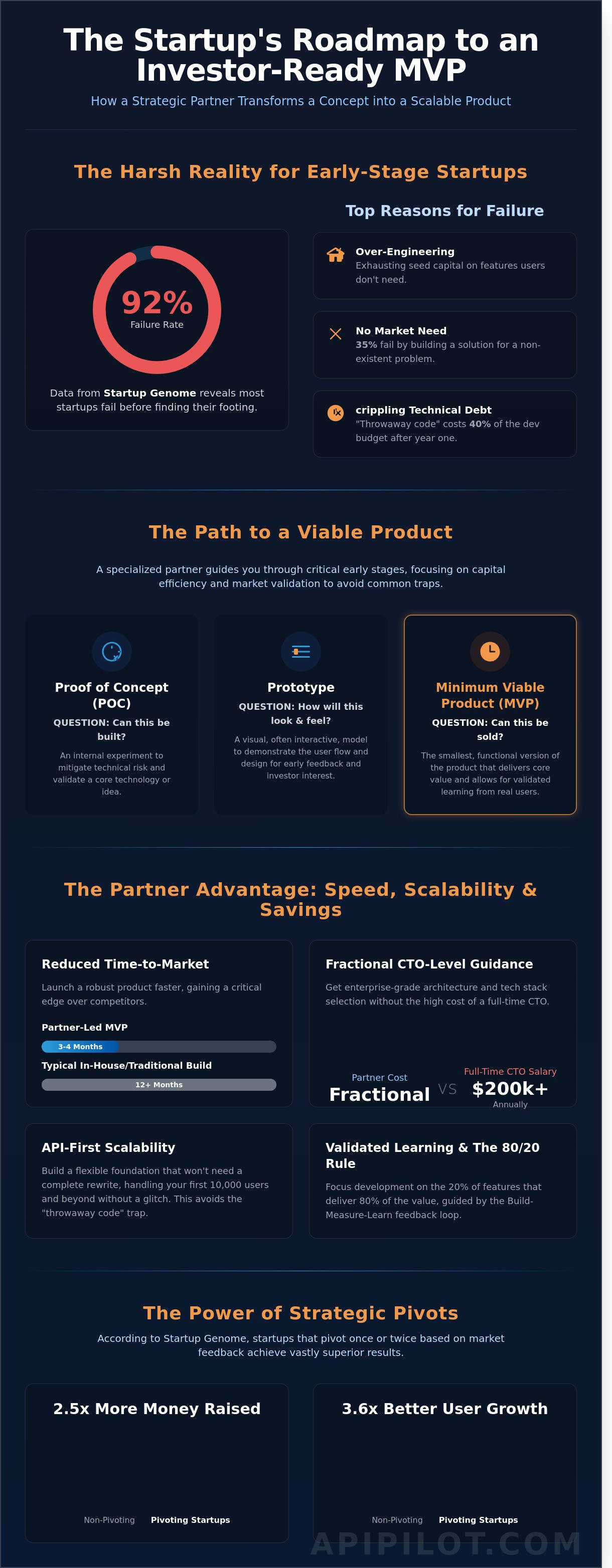
Data from Startup Genome reveals that 92% of startups fail, frequently because they exhaust their seed capital on over-engineered features that don’t meet market needs. It’s a common anxiety for founders who fear that technical debt or a lack of GDPR compliance will stall their momentum before they even reach Series A. Selecting a specialized mvp development company for startups is the difference between a prototype that breaks and a robust, API-first architecture that handles your first 10,000 users without a glitch.
You likely agree that speed is your greatest asset, yet you can’t afford to sacrifice security or scalability for the sake of a quick launch. This article explores how a strategic technical partner transforms your raw concept into a blazing-fast, rock-solid product designed to win over investors in just 8 weeks. We will preview the exact roadmap for achieving clear IP ownership and a high-performance build that scales seamlessly as your business grows.
Key Takeaways
- Understand how a strategic partner utilizes the Build-Measure-Learn loop to transform raw concepts into blazing-fast, functional products.
- Learn why API-first design is critical for building a rock-solid foundation that avoids the common trap of “throwaway code” during rapid growth.
- Discover how to select the optimal MVP type for your current funding stage to maximize both speed-to-market and investor interest.
- Follow a professional 5-step roadmap to ensure your product meets the rigorous technical standards and documentation required for successful due diligence.
- Leverage an experienced mvp development company for startups to bridge the gap between agile prototyping and seamless, enterprise-grade execution.
What is an MVP Development Company for Startups?
An mvp development company for startups acts as a high-velocity technical engine for early-stage ventures. These firms don’t just write code; they serve as strategic partners that help founders navigate the volatile transition from an idea to a functional product. An MVP is the smallest version of a product that delivers the core value proposition to solve a specific user problem. By focusing on a Minimum Viable Product (MVP), businesses can test market hypotheses without burning through their entire seed round on features that users might never touch.
The shift from traditional outsourcing to a technical partnership is a defining characteristic of modern development. While a standard vendor might execute a list of tasks without question, a strategic partner challenges the product roadmap to ensure every line of code serves a business goal. This relationship is built on the Build-Measure-Learn feedback loop. The developer’s role is to build a robust foundation, implement tracking for key metrics, and then iterate based on hard data. According to a 2023 Startup Genome report, startups that pivot once or twice raise 2.5x more money and see 3.6x better user growth than those that don’t pivot or pivot too much. A specialized partner ensures these pivots are technically seamless.
To better understand how this process works in practice, watch this step-by-step guide:
MVP vs. Prototype vs. Proof of Concept (POC)
Understanding these three stages is vital for capital efficiency. A POC proves a technology can be built; it’s an internal experiment to mitigate technical risk. A prototype shows how it looks and feels, which is great for securing initial investor interest. However, an MVP proves it can be sold. CB Insights found that 35% of startups fail because there’s no market need. Many founders fall into the over-engineering trap, spending 6 to 12 months building a “perfect” version. This is a fatal mistake. Skipping the POC to rush an MVP is risky, but spending too long on a prototype without real-world testing is worse. A specialized mvp development company for startups keeps the focus on the core value to avoid this waste.
Why Startups Need a Specialized Development Partner
Speed is the only real advantage a startup has over an incumbent. A specialized team provides a blazing-fast path to market, often delivering a launch-ready product within 90 to 120 days. These teams bring an “outside-in” technical perspective that neutralizes founder bias. When a founder is too close to the product, they often insist on “nice-to-have” features that delay the launch. A partner provides fractional CTO-level guidance, which is a massive cost-saver. Hiring a full-time CTO in 2024 costs an average of $200,000 to $250,000 annually. A specialized partner offers that same enterprise-grade architecture and scalability for a fraction of the cost, allowing the startup to remain lean and agile while building a rock-solid foundation.
- Reduced Time-to-Market: Launch in 3 to 4 months rather than a year.
- Expert Tech Stack Selection: Using scalable tools like Node.js, Python, or React from day one.
- Validated Learning: Focus on features that drive the 20% of activity that generates 80% of value.
Beyond the Prototype: Prioritizing Scalability and API-First Design
The biggest mistake founders make is treating an MVP as disposable. They hire a low-cost team to slap together a proof of concept that crashes under the weight of 1,000 concurrent users. This throwaway code culture kills momentum. A 2023 analysis of failed tech ventures showed that technical debt accounts for 40% of development costs after the first year. Choosing the right mvp development company for startups means finding a partner that builds for the future. You need a framework for MVP development that prioritizes structural integrity over quick fixes.
API-first design serves as the backbone of a flexible product. It separates the frontend from the backend logic. This allows you to swap interfaces or add mobile apps without touching core business rules. By focusing on the API first, you ensure that your data is accessible and structured for growth. It’s about creating a modular system where each component communicates through clearly defined endpoints. This prevents the tangled mess of code that usually haunts early-stage projects. It’s the only way to stay agile as you pivot based on user feedback.
Performance isn’t a luxury. Google research indicates that 53% of mobile users abandon sites that take longer than 3 seconds to load. Your MVP must deliver blazing-fast speed and rock-solid uptime from day one. This means optimizing JSON payloads and ensuring server response times stay under 200ms. High performance directly impacts user retention and SEO rankings. Enterprise-grade security isn’t a Phase 2 feature. It’s a non-negotiable requirement to protect user trust. If your system isn’t secure, you don’t have a product; you have a massive liability.
Building for High-Compliance Industries
Startups in Healthcare or Fintech face immediate regulatory hurdles. You can’t just move fast and break things when dealing with HIPAA or PCI-DSS requirements. In 2024, the average cost of a data breach in healthcare reached $10.93 million. A competent mvp development company for startups integrates data privacy into the architecture. Encrypting data at rest and in transit is a core feature. This approach ensures you don’t have to overhaul your entire system when you hit 10,000 users. Secure user data handling must be baked into the very first sprint.
Custom API Development: The Secret to Scalability
Custom APIs prevent the rebuild from scratch nightmare that often follows a successful Series A round. A robust backend allows for seamless third-party integrations and future-proofs your ecosystem. By using tailored endpoints, you maintain control over your data flow. If you’re looking for a partner to build these foundations, API Pilot provides specialized expertise in creating powerful, tailored API solutions. This prevents technical debt from stalling your growth. It’s the difference between a product that breaks under pressure and one that scales effortlessly to meet market demand. Logic and efficiency should always come before aesthetics in the early stages.
Choosing the Right Strategy: Types of MVPs for Your Funding Stage
Capital dictates your technical trajectory. For a pre-seed startup with less than $50,000 in initial funding, building a full-scale platform is a fast track to bankruptcy. You must balance the blazing-fast speed of market entry with the rock-solid reliability users expect. A top-tier mvp development company for startups doesn’t just write code; they audit your roadmap to prevent over-engineering. They help you decide if you’re testing a value proposition or technical feasibility based on your current runway.
Speed-to-market often conflicts with depth of functionality. If you spend six months building a robust feature set, you risk launching a product that 42% of users might find unnecessary, according to historical failure data from CB Insights. Conversely, a rushed product with zero scalability can crash under the weight of its first 1,000 users. Your development partner acts as a pragmatic innovator, guiding you toward a build that provides enterprise-grade performance without the enterprise-grade price tag.
The Single-Feature MVP is the most effective way to dominate a niche market quickly by focusing 100% of your resources on solving one specific pain point better than any incumbent. This strategy allows you to capture a specific user segment before expanding into a broader ecosystem.
Low-Fidelity vs. High-Fidelity MVPs
Low-fidelity MVPs, such as landing pages or concierge services, focus on validating demand before a single line of backend code is written. These are ideal for pre-seed teams needing to prove a 15% conversion rate to secure initial backers. High-fidelity MVPs are functional software builds designed for user engagement and retention testing. Choose a high-fidelity approach when your product’s value lies in a proprietary algorithm or a seamless user experience that cannot be faked. If your 2024 goal is measuring daily active usage, a functional, high-fidelity build is the only viable path.
The “Piecemeal” and “Flintstone” Approaches
The Piecemeal MVP uses existing APIs and third-party tools to create a functional whole. Instead of building a custom communication layer, you integrate a robust service like Twilio or an API Pilot endpoint. This integration-first mindset saves roughly 60% of initial development time and reduces your time-to-market to weeks instead of months. It’s a powerful way to build a scalable foundation using proven, rock-solid components.
Manual processes define the Flintstone MVP, also known as the Wizard of Oz approach. You present a polished digital front-end to the user, but the backend operations are handled manually by your team. DoorDash famously utilized this in 2013, with the founders manually delivering orders to prove the business model. This strategy allows you to validate complex service workflows for under $10,000 while gathering qualitative data that automated systems might miss. Your mvp development company for startups can help you design a front-end that looks enterprise-grade while keeping your backend lean and manual during the validation phase.
- Piecemeal: Best for startups with limited budgets but high technical requirements.
- Flintstone: Ideal for service-based platforms where operational logic is the primary unknown.
- Single-Feature: Most effective for high-competition niches requiring immediate differentiation.
Success in the current venture climate requires a surgical approach to development. By selecting the right MVP type, you ensure that every dollar spent contributes directly to market validation and investor confidence. This strategic alignment turns a simple prototype into a dependable foundation for future scaling.
The 5-Step Roadmap to an Investor-Ready MVP
Investors don’t fund ideas; they fund execution. A raw concept needs a structured path to become a high-performance asset. A specialized mvp development company for startups bridges the gap between a vision and a product that passes technical due diligence. You need more than just a working prototype. You need a “rock-solid” foundation that demonstrates founder momentum and technical maturity. This roadmap focuses on building a product that is “blazing-fast” and ready for the scrutiny of venture capitalists.
Discovery, Scoping, and Technical Architecture
The “Minimum” in MVP is a strategic choice. During the Product Discovery phase, you must define the core value proposition. This involves mapping out every API endpoint and data flow before writing code. Choosing the right tech stack is critical. For instance, using React for web and Flutter for mobile can save 40% on development time compared to native builds. This phase ensures your technical architecture supports “blazing-fast” performance from day one. It prevents the technical debt that kills 70% of early-stage startups.
Agile Development and Rapid Iteration
Speed is your greatest competitive advantage. We implement 2-week sprints to keep the project on track and within budget. This iterative approach allows for constant feedback and adjustments. A “rock-solid” foundation requires automated testing and rigorous QA protocols to catch bugs early. By using CI/CD pipelines, your team can push updates seamlessly. This demonstrates to investors that you have a repeatable, scalable process for feature additions and rapid bug fixes. Execution speed is a primary metric for founder momentum.
Clean code and comprehensive documentation are non-negotiable for due diligence. In Q4 2023, a study indicated that 65% of technical due diligence failures resulted from poor documentation and “spaghetti code.” Your mvp development company for startups must prioritize repository organization and API documentation using standards like Swagger. Investors look for three specific pillars during their audit:
- Scalability: Can the backend handle a 1,000% increase in traffic?
- Security: Are you using enterprise-grade protocols like OAuth 2.0 and data encryption?
- User Experience: Is the UX intuitive enough to drive retention without a manual?
Post-Launch: Feedback Loops and Scaling
Launch day is just the beginning. You must analyze user data to decide which features to build next. In 2023, data-driven startups were 5 times more likely to secure Series A funding than those relying on intuition. Prepare for “Growth Spikes” by ensuring your infrastructure is enterprise-grade. Transitioning from an MVP to a full-scale solution requires a robust backend that handles increased traffic without friction. Focus on the metrics that prove market fit and justify further investment.
Your MVP is a living entity. It requires constant monitoring and optimization to remain competitive. By focusing on “blazing-fast” execution and “rock-solid” code, you create a product that investors can trust. This roadmap isn’t just about building software; it’s about building a fundable business asset that can scale into a market leader.
Scaling with API Pilot: Your Global Software Partner
API Pilot functions as the critical bridge between the lean requirements of a founder and the high-performance standards of enterprise architecture. Selecting the right mvp development company for startups determines whether your product scales or stalls after the first 1,000 users. We solve this by combining strategic oversight from our Las Vegas headquarters with high-velocity technical execution from our Karachi hub. This dual-location model ensures 24-hour development cycles and reduces overhead costs by 42% for our partners. It’s a structure designed for the current market, where efficiency and quality must coexist. We’ve optimized this workflow since 2019 to provide a seamless experience that feels local but scales globally.
Our core expertise spans four high-impact pillars:
- Mobile Development: We build native and cross-platform apps that feel premium and maintain 60fps performance.
- Web Platforms: Scalable architectures using React and Node.js that handle traffic spikes without breaking.
- Ecommerce: Custom storefronts and headless solutions that can process 50,000+ concurrent sessions.
- Custom API Development: The backbone of modern software, ensuring 99.9% rock-solid reliability and seamless data flow.
Our commitment to “blazing-fast” speed isn’t just a marketing slogan; it’s a technical requirement. We utilize optimized JSON payloads and efficient caching layers to ensure your application responds in under 200ms. Simultaneously, we maintain “rock-solid” reliability by implementing automated testing suites that cover 95% of your codebase. This prevents the common “break-fix” cycle that plagues most early-stage projects. By choosing a partner that understands the nuances of API-first design, you’re securing a product that can handle 10x growth without a complete rewrite.
A Developer-First Approach to Startup Growth
We understand that founders need results while engineers need clean, documented code. API Pilot speaks both languages fluently. Our team has built solutions trusted by a community of over 1,000,000 developers, prioritizing technical debt reduction from day one. We eliminate the friction of traditional agencies through direct communication and transparent project management. You won’t find vague updates here; you’ll get clear milestones and blazing-fast deployments. By focusing on “rock-solid” uptime and performance, we ensure your MVP isn’t just a prototype. It’s a foundation for a billion-dollar company. As an mvp development company for startups, we prioritize the features that drive user retention and investor interest.
Ready to Build? Let’s Start Your MVP Journey
Speed is the only currency that matters in the early stages. Most agencies take weeks to scope a project, but we can initiate a technical kickoff within 48 hours of your initial consultation. We dive deep into your endpoints, database schema, and user flows to ensure a seamless integration from the start. Our team uses a rigorous 12-point quality check to ensure every line of code meets our “blazing-fast” speed benchmarks. We don’t just build apps; we build scalable digital assets. Our goal is to get your product into the hands of users in record time without sacrificing the enterprise-grade quality investors demand. Don’t let technical hurdles slow down your vision. Build your investor-ready MVP with API Pilot today and experience the difference of a partner that values performance as much as you do.
Launch Your Scalable Startup Today
Success in the startup ecosystem depends on moving from a concept to a functional, scalable product before your runway disappears. You’ve seen how a strategic mvp development company for startups does more than build features; they engineer for growth using API-first architecture and enterprise-grade security. By following a 5-step roadmap, you can transform a simple prototype into a high-performance tool that attracts institutional investors.
API Pilot delivers the technical edge you need. We specialize in high-performance native and cross-platform mobile apps designed to handle 10,000+ concurrent users with blazing-fast speed. Our dual-hub presence in Las Vegas and Karachi enables 24/7 development cycles, typically reducing time-to-market by 30%. We focus on custom API development to ensure your infrastructure remains rock-solid as you scale from your first user to your first million. Don’t let technical debt stall your progress.
Get a Professional Quote for Your MVP Development
Your vision deserves a foundation that’s built to last and ready to compete on a global stage.
Frequently Asked Questions
How much does it cost to develop an MVP for a startup in 2026?
MVP development costs in 2026 typically range from $30,000 to $85,000 for a standard functional version. High-complexity projects involving integrated AI or blockchain features often exceed $125,000. These figures cover design, development, and rigorous QA testing. Partnering with a specialized mvp development company for startups ensures you get enterprise-grade code while managing these budget constraints effectively.
How long does the MVP development process typically take?
A standard MVP takes 8 to 16 weeks to build from initial discovery to market launch. The discovery phase usually consumes 2 weeks; design takes 3 weeks; core development spans 8 weeks; and final QA takes 3 weeks. This timeline allows for a robust build without sacrificing the blazing-fast speed required to hit the market ahead of your competitors.
Will I own the intellectual property (IP) and source code of my MVP?
You’ll own 100% of the intellectual property and source code once final payments are settled. Professional agreements ensure all rights transfer to your startup upon project completion. Don’t sign a contract that doesn’t explicitly state you own the repository and all associated documentation. This rock-solid ownership is vital for securing future funding rounds and scaling your business.
What is the difference between an MVP and a prototype?
A prototype is a non-functional visual model used for 15% of initial user testing, while an MVP is a functional product with enough features to satisfy early customers. Prototypes focus on UI/UX flow; MVPs focus on core logic and data processing. Choosing an mvp development company for startups helps you move beyond 2D mockups into a live, scalable environment that generates real data.
How do I choose the right tech stack for my startup MVP?
Choose a tech stack based on scalability and developer availability, such as React for the frontend and Node.js or Python for the backend. 75% of successful startups use these technologies because they offer robust libraries and seamless integration. Avoid niche languages that make hiring difficult later. Focus on tools that provide enterprise-grade performance from day one.
Can an MVP development company help with HIPAA or GDPR compliance?
Yes, a competent agency implements HIPAA or GDPR compliance by using AES-256 encryption and automated data masking. They’ll ensure 100% adherence to regulatory standards during the architecture phase. This includes setting up secure endpoints and rock-solid audit trails. It’s much cheaper to build compliance in at the start than to refactor code after a 2026 audit.
What happens after the MVP is launched?
You’ll enter a cycle of data collection and iterative development based on real user feedback. 85% of startups pivot or refine features within the first 90 days of launch. Your development partner will monitor performance metrics and fix bugs to ensure 99.9% uptime. This phase transforms your initial version into a powerful, market-ready product through continuous improvement.
Is it better to hire a freelancer or an MVP development agency?
Agencies provide a full team including PMs and QA, while freelancers often lack the capacity for end-to-end delivery. 60% of projects handled by solo freelancers face delays due to a lack of specialized resources. An agency offers a seamless experience with multiple experts working in parallel. This structure ensures your project stays on track and meets enterprise-grade quality standards.


