A stunning UI means nothing if your backend architecture collapses under 50,000 concurrent users. By 2026, the gap between “pretty apps” and “functional engines” will widen, as 65% of enterprise projects fail due to poor API orchestration. You likely understand the frustration of seeing a beautiful mockup that lacks the functional logic to actually perform. Choosing the right mobile app design and development services is no longer just about aesthetics; it’s about building a robust, enterprise-grade foundation that scales from day one.
You want a blazing-fast MVP that integrates with your existing business systems without the usual 12 month wait. We’ve built this guide to help you master the complexities of modern app creation. You’ll learn how to combine strategic design with high-performance development and rock-solid API integration. We are diving into the technical blueprint for creating digital engines that drive measurable user engagement and eliminate the fear of hidden technical debt. This is how you build for the future without breaking your current workflow.
Key Takeaways
- Learn how to navigate the 2026 landscape by evolving simple utility apps into complex, integrated business platforms through a proven 5-step delivery process.
- Compare Native and Cross-Platform tech stacks to find the blazing-fast and rock-solid foundation needed for your specific enterprise performance requirements.
- Understand the API-first advantage and how custom backend development ensures seamless data synchronization across multiple devices and platforms.
- Scale your vision globally by partnering with expert mobile app design and development services that prioritize high-performance delivery and technical excellence.
- Master the art of user-centric design, from strategic wireframing to high-fidelity prototyping, to create intuitive digital experiences that drive engagement.
What are Mobile App Design and Development Services?
By 2026, professional mobile app design and development services have shifted from building simple utilities to engineering complex, integrated business platforms. These services now encompass the entire product lifecycle, from initial discovery to rock-solid deployment. Modern apps aren’t just standalone tools; they’re high-performance gateways that connect users to enterprise data, AI-driven insights, and real-time cloud services. A structured Mobile app development process is the only way to ensure these platforms remain stable under heavy loads.
The shift is visible in the numbers. In Q4 2024, mobile consumer spend reached $171 billion, driven largely by apps that provide seamless, multi-functional experiences. To capture this value, businesses need more than just a functional interface. They require an end-to-end strategy that treats the mobile app as a central pillar of their digital infrastructure.
Watch this breakdown to see how modern engineering teams structure these projects:
Success starts with strategy-led design. Research from 2025 indicates that 25% of apps are only used once after download. To combat this, elite services prioritize user retention through deep psychological profiling and frictionless workflows. Technical architecture also plays a vital role. Building on a scalable foundation ensures the app doesn’t crash when traffic spikes from 1,000 to 50,000 concurrent users. We focus on blazing-fast response times and enterprise-grade security to protect both the user and the brand.
The Core Components of a Successful App Project
Effective projects rely on three pillars. First, market research and user persona development use concrete data from the last 12 months to define exactly who the user is. Second, UI/UX design creates layouts that eliminate cognitive load. Third, frontend and backend synchronization ensures that the visual interface and the server logic communicate via robust, well-documented APIs. This synchronization is what makes an app feel fast and responsive.
Why Businesses Invest in Custom Development Over Templates
Off-the-shelf software often fails to meet 40% of a company’s unique business requirements. Investing in custom mobile app design and development services ensures that the product fits the specific goals of the organization. Custom builds provide 100% ownership of the source code and intellectual property; this is a critical asset for long-term valuation.
Scalability is another decisive factor. While a template might handle a few hundred users, custom architecture is built to scale from 1,000 users today to 1,000,000 tomorrow without a complete rewrite. We use modular codebases and cloud-native environments to ensure your app grows alongside your business. This approach delivers a powerful, rock-solid product that outperforms generic solutions in every metric.
The 5-Step Process for High-Performance App Delivery
High-performance mobile app design and development services start with a foundation of data, not just aesthetics. We begin with a discovery phase that defines the technical “Why” behind every feature. This isn’t just about brainstorming; it’s about building a technical specification that scales. We analyze market trends and competitor performance using data points similar to those found in research on mobile app marketing to ensure your product finds its niche. We map out the technical ecosystem, identifying every JSON endpoint and third-party SDK required to power your vision. Our approach to mobile app design and development services centers on a developer-first methodology that prioritizes speed and reliability from day one.
Discovery: Turning Ideas into Technical Specifications
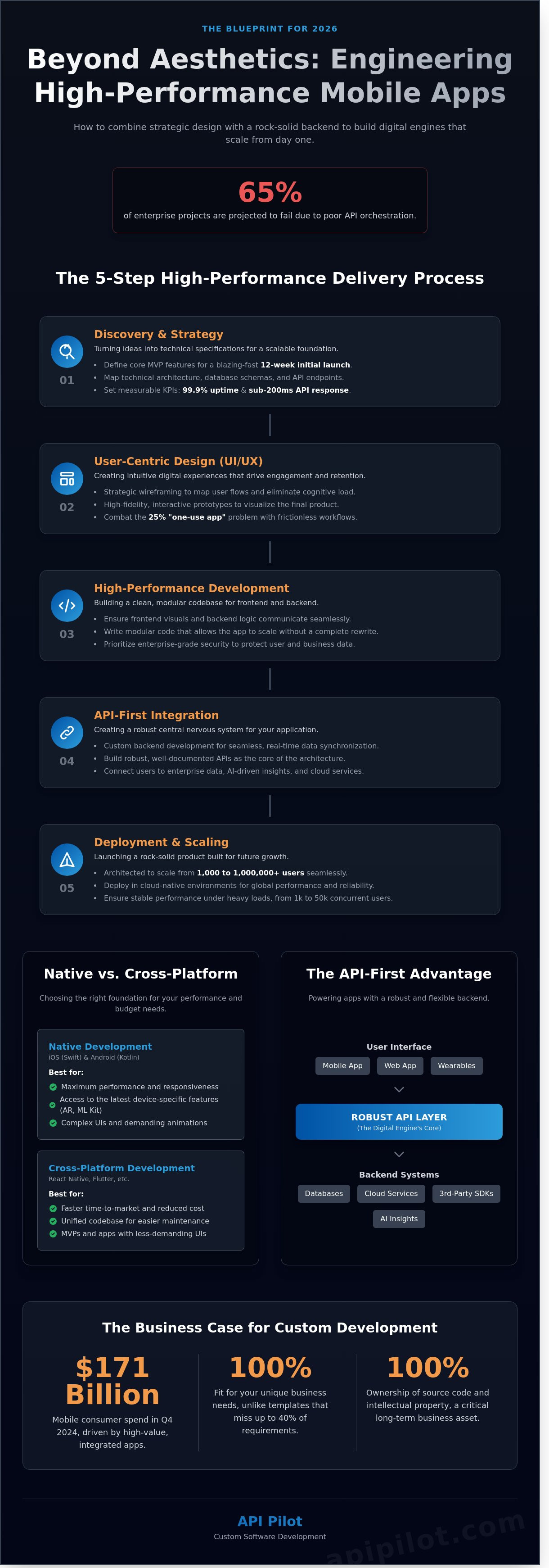
We focus on defining core features for a Minimum Viable Product (MVP) to ensure a 12-week initial launch cycle. Our team maps out the technical architecture, including database schemas and API integrations. We set measurable KPIs like a 99.9% uptime target and sub-200ms API response times. This clarity prevents scope creep and keeps the project on a rock-solid trajectory that respects your budget and timeline.
The Design-to-Development Handover
High-fidelity prototypes act as a living blueprint for our engineers. We ensure design consistency across iOS and Android by using shared component libraries and standardized design tokens. Before writing a single line of code, we conduct user testing on these interactive prototypes. This process validates the interface and helps us fix 85% of usability issues before the first development sprint begins, saving hundreds of engineering hours.
Our Agile development process relies on blazing-fast sprints that turn technical specifications into functional modules in 14-day cycles. We don’t just write code; we build for scale. Every sprint includes a review session where stakeholders see progress in real-time. This iterative approach ensures the final product aligns perfectly with your business goals. We use modern tech stacks like Flutter or React Native to achieve cross-platform efficiency without sacrificing the native performance users expect.
Rigorous QA is non-negotiable for high-performance apps. We implement a dual-layer testing strategy. First, automated scripts run against every build to catch regressions in seconds. Second, manual testers perform exploratory sessions on at least 20 different physical devices to ensure the UI feels fluid. This combination results in a rock-solid stable release that maintains a crash-free rate of 99.9% or higher. We also conduct stress tests to ensure the app handles 10,000 concurrent users without latency spikes.
Deployment and optimization mark the transition from development to market entry. We manage the entire submission process for the App Store and Google Play, ensuring compliance with evolving privacy guidelines from 2024 and 2025. Once live, we monitor performance metrics to optimize the user experience based on real-world interaction data. By integrating these five steps, our mobile app design and development services provide the scalability required for enterprise-grade performance.
If you’re ready to start your journey, you can consult with our technical leads to map out your project roadmap.
Native vs. Cross-Platform: Choosing the Right Tech Stack for 2026
The performance gap between native and cross-platform solutions has shrunk significantly since 2022. By 2026, the choice isn’t just about raw speed; it’s about architectural alignment. Native development remains the gold standard for high-performance applications, but Flutter and React Native now power 42% of new enterprise-grade mobile app design and development services. These frameworks have evolved to handle complex asynchronous tasks and multi-threaded processing that previously required platform-specific code. They offer a pragmatic path for businesses that need to scale without doubling their engineering overhead.
A 2025 benchmark study showed that Flutter’s Impeller rendering engine achieves a consistent 120Hz refresh rate on modern ProMotion displays. This matches the native performance of Swift and Kotlin for most UI transitions and complex animations. However, native apps still hold a 15% edge in battery efficiency and memory management for background-heavy processes. Choosing the wrong stack can increase long-term maintenance costs by up to 25% if the app requires frequent hardware-level updates or low-level API access. Consider these technical requirements before committing to a stack:
- Runtime Performance: Native is still the king for math-heavy operations and real-time data processing.
- Code Reusability: Cross-platform frameworks allow for 90% code sharing between iOS and Android.
- Hardware Access: Native provides zero-latency access to the latest biometric, LiDAR, and neural engine sensors.
- Ecosystem Stability: React Native’s New Architecture, standardized in 2024, provides rock-solid reliability for complex state management.
When to Choose Native Development (Swift & Kotlin)
Opt for native languages when your roadmap includes cutting-edge hardware integration. If you’re building for Apple Vision Pro or utilizing advanced LiDAR sensors, Swift is non-negotiable. Native code provides direct access to the latest APIs the day they launch. This “No-Compromises” approach ensures 100% compatibility with system-level features. It’s the best path for flagship products where every millisecond of latency counts. High-end gaming and intensive video editing suites rely on this robust foundation to maintain peak performance.
When Cross-Platform Makes Strategic Sense
Cross-platform frameworks are the engine of modern business agility. Startups using React Native or Flutter report a 35% faster time-to-market compared to those managing two separate codebases. You maintain a single source of truth, which simplifies debugging and feature parity. Modern mobile app design and development services leverage these tools to deliver blazing-fast updates across both platforms simultaneously. By 2026, the elimination of the JavaScript bridge has allowed for near-native synchronous execution of modules, making it ideal for enterprise-grade tools.
Future-proofing requires looking at the three-year horizon. OS updates in 2026 will prioritize AI-driven edge computing and enhanced privacy layers. Native stacks receive these updates instantly. Cross-platform frameworks usually follow within 4 to 8 weeks. If your business model depends on being first-to-market with new iOS or Android features, native is your best bet. If your priority is scaling a reliable, high-quality tool efficiently across a diverse user base, cross-platform provides the best ROI. Both paths are viable, but the decision must be driven by your specific hardware needs and long-term maintenance capacity.
The API-First Advantage: Powering Apps with Robust Backends
High-performance applications aren’t built on luck; they’re built on custom API development. This is the secret sauce that separates a lagging interface from a blazing-fast user experience. When you invest in mobile app design and development services, the backend architecture determines whether your user stays or deletes the app within seconds. A 100ms delay in response time can drop conversion rates by 7% according to industry benchmarks from 2023. We design APIs that prioritize speed and efficiency, ensuring that data moves from the server to the screen without friction.
A well-architected backend is the foundation of scalability. It’s about more than just handling current traffic; it’s about preparing for 10,000 concurrent users without a system crash. We use an API-first philosophy to decouple the frontend from the data layer. This approach allows developers to build, test, and deploy features in parallel. By using JSON as our primary data exchange format and optimizing RESTful endpoints, we reduce the payload size. Smaller payloads mean faster load times and less data consumption for your users, which is critical for global markets with varying connectivity speeds.
Seamless data synchronization across multiple devices is another pillar of modern app success. Users don’t just use one device; they switch between phones, tablets, and desktops an average of three times per hour. Your backend must ensure that a “favorite” item on a smartphone appears instantly in the web browser. We implement WebSockets for real-time bi-directional communication and robust conflict resolution logic. This ensures that even if a user goes offline, their data remains consistent and syncs perfectly the moment they reconnect. It’s about providing a rock-solid experience that feels invisible to the end user.
Integrating with Your Business Ecosystem
Your app shouldn’t be an island. We connect mobile interfaces to legacy ERP systems and modern CRMs like Salesforce or Microsoft Dynamics. Statistics show that by 2025, 80% of enterprise data traffic will flow through APIs. We automate complex workflows through intelligent endpoints, ensuring your mobile app design and development services project adds tangible value. For logistics apps, this means real-time GPS tracking and inventory updates that sync every 15 seconds to maintain absolute accuracy.
Security and Compliance Standards
Security isn’t an afterthought; it’s a core requirement. We implement enterprise-grade encryption using AES-256 for data at rest and TLS 1.3 for data in transit. In 2023, the average cost of a data breach reached $4.45 million, making robust protection a financial necessity. We use OAuth 2.0 and multi-factor authentication to secure user access. Every build complies with global regulations like GDPR and CCPA. We perform monthly security audits and vulnerability patching to keep your infrastructure ahead of emerging threats.
Ready to build a backend that scales with your ambition? Connect your app to our high-performance API ecosystem and experience rock-solid reliability today.
Scaling Your Vision: Why API Pilot is Your Global Development Partner
API Pilot operates as a global engine for innovation. We connect the strategic oversight of our Las Vegas headquarters with the deep technical expertise of our Karachi development center. This creates a high-efficiency, 24-hour production cycle. Your project stays in motion around the clock. We’ve successfully delivered over 200 high-performance projects by utilizing this distributed model, ensuring that deadlines are met with precision. By sourcing talent across these regions, we provide a diversity of thought and a technical depth that local-only shops can’t match.
Our core philosophy centers on a “Blazing-fast & Rock-solid” delivery model. In a market where a one-second delay in load time can cost 7% in conversions, performance is everything. We utilize robust mobile app design and development services to ensure your application handles high-concurrency loads without breaking. For example, we recently helped a logistics client scale from 1,000 to 50,000 active daily users in under six months. We achieved this through optimized API endpoints and a serverless architecture that scales automatically. Every line of code is written with future growth in mind, preventing the need for expensive refactoring as your user base expands.
Our case studies demonstrate a consistent track record of taking concepts to market-leading status. In 2023, we worked with a healthcare startup to build a HIPAA-compliant platform in just 14 weeks. That application now serves 12,000 patients monthly. We don’t just build the app; we build the ecosystem around it. This includes post-launch support through automated CI/CD pipelines. We ensure that new features are rolled out weekly without compromising the stability of the existing environment. Our evolution-focused approach means your app stays relevant as technology shifts.
Development doesn’t end at the “Go-Live” button. We provide comprehensive post-launch support that includes continuous integration and feature evolution. We’ve maintained a 99.9% uptime record across our managed portfolio. Our team monitors performance metrics in real-time, deploying patches and updates without interrupting the user experience. This commitment to reliability is why enterprise clients and fast-growing startups trust us as their primary mobile app design and development services provider.
Custom Solutions Tailored to Your Growth
We solve the friction between aesthetic design and functional code. Many startups struggle with enterprise-grade complexity, but we simplify the stack. We’ve integrated complex payment gateways and biometric security for 25 different emerging brands this year alone. Our project management is direct. We use transparent reporting tools so you see every milestone as it happens. There are no black boxes; just clear progress and high-quality code.
Ready to Build Your Next Big Idea?
A great app requires a solid foundation. We start every partnership with a detailed project roadmap. This phase identifies technical risks early, saving an average of 15% on total development costs. Our expert team evaluates your vision through a lens of scalability and market fit. Don’t leave your technical success to chance. Start with a free consultation to see how we turn complex requirements into seamless digital experiences.
Future-Proof Your Growth with Scalable Architecture
Success in 2026 hinges on moving beyond basic functionality to embrace an API-first methodology. This approach ensures your application remains agile while handling complex custom CRM and ERP integrations without performance lag. Whether you select a native or cross-platform stack, the goal remains the same: building a digital engine that sustains high traffic and evolves with your business needs. High-quality mobile app design and development services must prioritize this scalability from day one to avoid costly re-platforming later.
API Pilot provides the technical expertise and infrastructure to turn your vision into a high-performance reality. We offer blazing-fast speed and rock-solid uptime, a combination that’s earned the trust of 1,000,000+ developers globally. Our 5-step process ensures every endpoint is secure and every integration is seamless. You’ve got the vision, and we’ve got the tools to make it scale. Let’s build something exceptional together.
Get a Free Consultation for Your Mobile Project
Your journey toward a market-leading application starts with a single conversation.
Frequently Asked Questions
How much does it cost to design and develop a mobile app in 2026?
In 2026, a high-quality mobile app costs between $60,000 for a basic MVP and $300,000 for a complex enterprise solution. These figures reflect a 15% increase in global developer rates over the last two years. Your final investment depends on features like real-time data sync or custom AI integrations. We provide transparent pricing to ensure your project stays within budget while delivering rock-solid performance.
How long does the mobile app development process typically take?
A standard mobile app takes between 4 and 10 months to move from initial concept to a public launch. Simple applications often reach the App Store in 16 weeks; however, complex platforms requiring deep backend integration usually take 40 weeks. We use agile sprints to ensure you see progress every 14 days. This keeps the project moving at a blazing-fast pace without sacrificing code quality.
What is the difference between mobile app design and mobile app development?
Mobile app design focuses on the visual interface and user experience, while development involves writing the functional code and server-side logic. Design covers 100% of the wireframes and prototypes that users see. Development builds the rock-solid architecture that powers those visuals. Our mobile app design and development services bridge this gap to create seamless, high-performance tools for your business.
Will my app work on both iOS and Android?
We build apps that run on both iOS and Android using cross-platform frameworks like Flutter or React Native to achieve 99% code sharing. This approach reduces your initial development costs by 35% compared to building two separate native apps. If your project requires maximum hardware performance, we offer native Swift and Kotlin development. You’ll reach 98% of the global smartphone market with our multi-platform strategy.
How do you ensure the security of my app and user data?
We secure your data using AES-256 encryption and implement OAuth 2.0 for all user authentication processes. Our team follows OWASP Top 10 guidelines to prevent 95% of common vulnerabilities like SQL injection or cross-site scripting. We also conduct penetration testing every 90 days to ensure your infrastructure remains rock-solid. Protecting user privacy isn’t just a feature; it’s a core requirement for every enterprise-grade application we build.
Do you provide maintenance and updates after the app is launched?
Post-launch maintenance costs typically average 20% of your original development budget annually to cover OS updates and security patches. We provide monthly performance audits to ensure 99.9% uptime for your backend services. If Apple or Google releases a major OS update, we update your code within 15 days to maintain full compatibility. You don’t just get an app; you get a long-term technical partner.
What is an “API-first” approach and why does it matter for my app?
An API-first approach means we build a robust set of endpoints before designing the user interface to ensure your backend is scalable. This method reduces integration errors by 40% and allows you to connect your data to web, mobile, or IoT devices simultaneously. It’s a developer-centric strategy that guarantees your app is blazing-fast and ready for future growth. By prioritizing the API, we make your data accessible and highly portable.
Can you help with app store optimization (ASO) and deployment?
We manage the entire deployment process, including App Store Optimization (ASO) to improve your visibility among the 2 million apps on the market. Our team optimizes your title, keywords, and screenshots to increase organic downloads by up to 25% within the first 60 days. We handle the 48-hour review process for both the Apple App Store and Google Play. Our mobile app design and development services ensure your product doesn’t just launch; it succeeds.


