
Asking “how much does a custom app cost?” can feel like shouting into the void. You’re met with vague answers, wildly different quotes, and a persistent fear of hidden costs that could derail your project. This ambiguity is a major roadblock, stopping powerful ideas from ever reaching the development stage. It’s time to replace that uncertainty with a clear, actionable financial roadmap for 2025.
This guide is engineered to deliver that clarity. We will break down the core components that dictate your final investment—from feature complexity and platform choice to the underlying tech stack and ongoing maintenance. You’ll get access to realistic, industry-backed price ranges and learn proven strategies to control your budget without compromising on building a robust, high-performance application. By the end, you won’t just have a number; you’ll have the confidence and knowledge to effectively evaluate development partners and bring your vision to market efficiently.
The Bottom Line: App Development Cost Ranges at a Glance
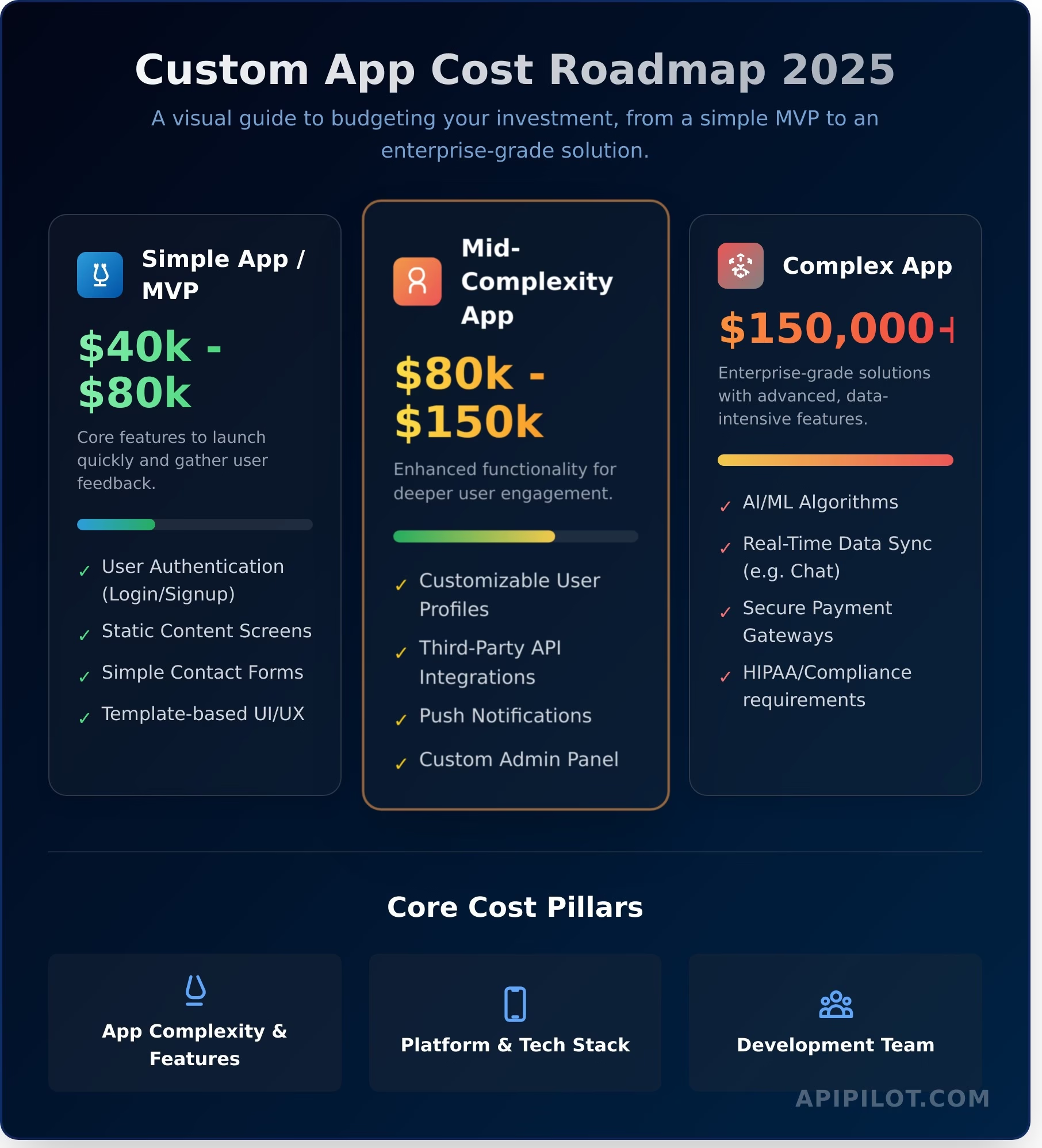
When businesses ask, “how much does a custom app cost?”, the answer typically ranges from $40,000 for a simple application to over $150,000 for a complex, enterprise-grade solution. It’s critical to view this as a strategic investment in your business’s scalability and market reach. A well-built application is not an expense; it’s a powerful asset designed to generate revenue, streamline operations, and drive customer engagement.
To get a clear visual overview of these cost factors, the following video breaks down the essentials.
Quick Cost Estimation Table
These figures represent industry averages for a single-platform (iOS or Android) application. They provide a baseline for initial budget planning, but your specific feature set and technical requirements will determine the final investment.
- Simple App (MVP, basic features): $40,000 – $80,000
- Mid-Complexity App (API integrations, user profiles): $80,000 – $150,000
- Complex App (AI, real-time features, enterprise-grade): $150,000+
Why ‘It Depends’ is the Most Honest Answer
Determining your custom app cost is like budgeting for a new house. The final price depends entirely on the size, the quality of materials, and the number of custom features. A simple one-story home has a vastly different budget than a multi-level smart home. Similarly, the entire mobile app development process is governed by three core pillars that dictate the final price: App Complexity, the chosen Platform & Tech Stack, and the Development Team’s location and expertise.
This guide will break down each of these factors in detail, providing the data you need to build an accurate and reliable budget for your project.
Core Factor 1: App Complexity and Features
When determining how much does a custom app cost, the single most significant driver is the scope and complexity of its features. Each function requires dedicated hours for UI/UX design, front-end and back-end development, and rigorous quality assurance testing. A larger, more complex feature set directly translates to a higher development timeline and, consequently, a greater investment.
A pragmatic approach to manage this is by launching a Minimum Viable Product (MVP). An MVP includes only the essential, core features needed to solve a primary user problem. This strategy allows you to enter the market faster, gather real-world user feedback, and make data-driven decisions for future development, all while controlling initial costs.
Breaking Down Feature Complexity
Functionality can be tiered by complexity, with each level demanding a different degree of engineering effort. A typical breakdown includes:
- Basic Features: Foundational elements like user authentication (login/signup), static content screens, and simple contact forms. These are standard and relatively fast to implement.
- Intermediate Features: Functionality that requires more logic, such as user profiles with customizable data, push notifications, and third-party API integrations for services like maps or social media.
- Advanced Features: Highly complex systems including real-time data synchronization for chat, secure payment gateway integrations, or custom AI/ML algorithms for personalization and data analysis.
The Impact of UI/UX Design
The user interface is another critical cost variable. A simple, template-based design is cost-effective but may lack brand identity. In contrast, a fully custom, branded UI/UX with intricate animations and unique interactions requires significant design and front-end development resources. However, investing in a seamless and intuitive user experience is proven to drive higher engagement and retention, delivering a superior long-term ROI.
Backend Infrastructure
The “engine” of your app, the backend, can range from a simple monolith to a robust, scalable microservices architecture. A complex app requires a powerful backend to handle data processing, user management, and API endpoints. Often, a custom admin panel is necessary to manage app content and view analytics. Furthermore, security and compliance requirements, such as implementing HIPAA-compliant data handling for a healthcare app, add substantial complexity and cost to backend development.
Core Factor 2: Platform and Technology Stack
The platform you target and the technology you build with are fundamental decisions that directly influence how much does a custom app cost. This choice dictates not just the initial investment but also long-term maintenance overhead and scalability. The right technology stack ensures your application is robust, performant, and future-proof, providing a solid foundation for your business logic and user-facing features.
iOS vs. Android (Native Development)
Native development means building separate, dedicated applications for each operating system—typically using Swift for iOS and Kotlin for Android. This approach delivers the highest level of performance, a seamless user experience that feels perfectly integrated with the device, and unrestricted access to all native APIs and hardware features like advanced camera controls or background processing. While it offers a premium result, maintaining two distinct codebases requires greater development effort, making it the most resource-intensive option.
- Pro: Unmatched performance and optimal UX.
- Pro: Full access to device hardware and the latest OS features.
- Con: Highest initial development cost and time.
- Con: Requires separate teams or specialized skill sets for each platform.
Cross-Platform Development (React Native, Flutter)
Frameworks like React Native and Flutter enable developers to write a single codebase that compiles and runs on both iOS and Android. This “write once, deploy anywhere” model can dramatically reduce development timelines and initial costs. It’s an efficient, powerful solution for many applications, especially for MVPs or standard business apps. The main trade-off can be minor performance compromises and potential limitations when accessing highly specific native device features, which may require custom modules or native code integration.
Web App and Progressive Web App (PWA)
A web app, accessible via any browser, sidesteps app store distribution and approval processes entirely. This offers the broadest accessibility and is often the most cost-effective way to launch a digital product. An evolution of this is the Progressive Web App (PWA)—a web app supercharged with modern APIs to deliver an experience similar to a native app. PWAs can work offline, send push notifications, and be “installed” on a user’s home screen, providing a powerful, low-friction alternative to traditional mobile development.
Core Factor 3: The Development Team and Engagement Model
Beyond features and complexity, the team you hire to build your application is one of the most significant cost drivers. Who builds your app, where they are located, and how you structure the engagement directly influences the final price. Understanding these variables is critical to accurately forecasting how much does a custom app cost.
Team Location: Hourly Rate Differences
Developer rates vary dramatically by region. A senior developer in San Francisco will cost significantly more than a developer with equivalent skills in Eastern Europe. This is a simple matter of market economics and cost of living. Here is a typical breakdown of agency hourly rates:
- North America (US/Canada): $150 – $250+ per hour
- Western Europe (UK/Germany): $100 – $180 per hour
- Eastern Europe & Asia: $40 – $80 per hour
At API Pilot, we leverage a hybrid model to optimize this for our clients. We combine US-based project management and strategic oversight with a global talent pool, delivering enterprise-grade quality without the prohibitive cost of a purely domestic team.
Freelancers vs. Agency: What’s the Difference?
Choosing between a solo freelancer and a full-service agency impacts both your budget and your level of involvement. Neither is universally better; the right choice depends on your project’s scale and your internal capacity.
- Freelancers: A cost-effective option for small, well-defined tasks or augmenting an existing team. However, the burden of project management, quality assurance, and team coordination falls entirely on you.
- Agency: Provides a complete, managed team—including a Project Manager, UI/UX designers, developers, and QA testers. This streamlined, all-in-one approach is less risky for complex projects and ensures a cohesive, high-quality final product.
Engagement Models: Fixed Price vs. Time & Materials
The payment structure also shapes the project’s cost and flexibility. The two dominant models are Fixed Price and Time & Materials (T&M).
- Fixed Price: You agree on a single, fixed cost for a precisely defined scope of work. This model is ideal for smaller projects or a Minimum Viable Product (MVP) where the requirements are crystal clear and unlikely to change.
- Time & Materials (T&M): You pay for the actual time and resources spent on the project. This agile model offers maximum flexibility, allowing you to adapt and evolve the app based on user feedback. It is the preferred model for complex, long-term projects where the full scope cannot be predicted upfront.
While a fixed price offers budget certainty, the T&M model often results in a superior, more market-aligned product for ambitious applications.
Beyond the Build: Planning for Ongoing and Hidden Costs
A common oversight when calculating development budgets is focusing solely on the initial build. The launch of your application is not the finish line; it’s the starting line. A successful app is a living product that requires continuous investment to remain functional, secure, and relevant. To accurately answer how much does a custom app cost over its lifetime, you must account for these post-launch expenses.
A reliable rule of thumb is to budget an additional 15-20% of the initial development cost for annual maintenance and support. This budget covers the critical operations that ensure your app delivers a robust, enterprise-grade experience long after its initial release. Factoring in these costs provides a transparent view of the total cost of ownership (TCO).
Essential App Maintenance
Your app must constantly adapt to a changing digital environment. Proactive maintenance prevents performance degradation, protects user data, and ensures a seamless user experience. Key maintenance tasks include:
- OS & Platform Updates: Regular patches to maintain compatibility with the latest iOS and Android releases and device hardware.
- Performance Monitoring: Continuous analysis of app speed, responsiveness, and resource consumption to identify and eliminate bottlenecks.
- Bug Fixes & Security: Swiftly addressing user-reported issues and applying security patches to protect against emerging vulnerabilities.
Infrastructure and Third-Party Services
Your application doesn’t exist in a vacuum. It relies on a robust backend infrastructure and various external services to function, each with its own associated costs. These often scale with your user base.
- Server & Hosting: Monthly or annual fees for cloud providers like AWS, Google Cloud, or Azure to host your app’s backend and data.
- Paid API Subscriptions: Costs for integrating third-party services, such as Google Maps for location features, Stripe for payment processing, or leveraging a powerful API marketplace for other functionalities.
- Database & CDN: Fees for managed database services and a Content Delivery Network (CDN) to ensure fast, reliable data access for users globally.
Marketing and User Acquisition
A powerful app is only valuable if people use it. Acquiring and retaining users requires a dedicated budget. Understanding these expenses is a critical part of calculating how much a custom app cost will truly be. Key areas include:
- App Store Optimization (ASO): Ongoing efforts to improve your app’s visibility and ranking within the Apple App Store and Google Play Store.
- Digital Marketing: A budget for paid advertising, content marketing, and social media campaigns to drive downloads and user engagement.
- Developer Account Fees: Annual fees required to maintain your app on the app stores, such as Apple’s standard $99/year fee.
How to Get an Accurate Quote and Start Your Project
Moving from the abstract question of how much does a custom app cost to a concrete number requires a strategic approach. The accuracy of any estimate you receive is directly proportional to the quality of the information you provide. Follow these steps to engage a development partner efficiently and start your project with confidence and clarity.
Step 1: Prepare a Detailed Project Brief
A comprehensive project brief is the foundational document for your app. It eliminates ambiguity and provides a clear roadmap for potential partners, enabling them to deliver a precise estimate. A detailed brief is the single most important tool for defining your project’s scope. Ensure it includes:
- Business Goals & Target Audience: Clearly define what problem this app solves and who you are building it for. What is the primary metric for success?
- Core Features & User Flows: List all essential functionalities (e.g., user authentication, data dashboards, payment processing) and map out the primary user journeys from start to finish.
- Inspirational & Competitor Apps: Provide examples of apps you admire and competitors you need to outperform. Note specific features or design elements you want to emulate or improve upon.
Step 2: Choose the Right Development Partner
With your brief in hand, you can effectively evaluate potential development agencies. Look beyond the price tag and assess their capability to deliver a robust, scalable product. Your evaluation criteria should include:
- Portfolio and Case Studies: Do they have proven experience in your industry or with similar technologies? Their past work is the best indicator of future performance.
- Client Reviews and References: Seek out testimonials on platforms like Clutch or G2. Don’t hesitate to ask for direct client references for high-stakes projects.
- Communication and Process: How do they manage projects? Do they use an Agile methodology? Clear communication protocols are critical for a smooth development cycle.
Step 3: Understand the Proposal
A professional proposal is more than just a number; it’s a blueprint for the project. A good partner will provide a detailed breakdown that clearly outlines deliverables, timelines, and the full scope of work. Before signing, be sure to ask clarifying questions about their development process, the team assigned to your project, and the proposed technology stack. This diligence ensures there are no surprises and aligns expectations for a successful partnership.
Ready to turn your brief into a robust development plan? Let our experts help you scope your project. Get a free consultation.
From Estimate to Asset: Finalizing Your App Development Budget
Navigating the world of app development pricing reveals that there is no single answer to how much does a custom app cost. As we’ve detailed, your final investment is a direct function of three core pillars: the complexity of your features, the technology stack you target, and the engagement model of your development team. A truly comprehensive budget also looks beyond the launch, strategically planning for the ongoing maintenance and updates that ensure long-term value and performance.
Transforming your concept into a tangible, high-performance application starts with a clear, accurate quote. At API Pilot, we excel at this process. Our expertise is in building powerful, scalable mobile and web applications designed for growth. With a global team dedicated to delivering high-quality results at a competitive price, we guarantee a transparent and collaborative process from initial discovery to final deployment. We provide the robust foundation your project needs to succeed.
Have an app idea? Let’s build it together. Get a free, no-obligation quote from API Pilot.
Frequently Asked Questions
Can I build an app for $10,000?
Building an app for $10,000 is possible only for the most basic applications. This budget typically covers a single-platform (iOS or Android) app with a minimal feature set, standard UI components, and no complex backend or API integrations. Consider it a functional prototype or proof-of-concept. For robust applications requiring user authentication, data processing, or scalability, a significantly larger investment is required to ensure a high-quality, market-ready product.
What is a Minimum Viable Product (MVP) and how does it save money?
A Minimum Viable Product (MVP) is a version of your app that includes only the essential core features needed to solve a primary user problem. This lean approach provides a powerful cost-saving advantage. By launching an MVP, you can validate your business idea with real users and gather data before investing in a full-scale build. This prevents wasted resources on non-essential features, reduces initial development time, and ensures future investment is data-driven and efficient.
How long does it take to build a custom app?
The development timeline is directly proportional to an app’s complexity. A simple MVP can often be developed in 3-4 months. A more feature-rich application with a custom backend, multiple API integrations, and a polished UI will typically require 6-9 months of development. Enterprise-grade solutions with advanced security, complex workflows, and multi-platform support can easily extend beyond a year. A detailed project scope is essential for an accurate timeline estimate.
Should I choose a fixed-price or an hourly (Time & Materials) contract?
A fixed-price contract is ideal for projects with a clearly defined, unchanging scope, such as a simple MVP. It offers budget predictability but lacks flexibility. A Time & Materials (T&M) model is superior for complex or long-term projects where requirements may evolve. It provides the agility to adapt and iterate but requires diligent project management to monitor scope and control costs. Your choice depends on the project’s clarity and your need for flexibility.
Why shouldn’t I just use a no-code app builder?
No-code builders are effective for simple prototypes or internal tools, but they have critical limitations for commercial products. They often lack the scalability, performance, and security required for a robust application. Furthermore, you are constrained by the platform’s features, making custom logic, unique UI/UX, and complex API integrations difficult or impossible. For a powerful, enterprise-grade app that you fully own and control, custom development is the superior solution.
What information do I need to provide to get an accurate quote?
To accurately answer how much does a custom app cost, a development partner needs a detailed project specification. This document should outline your business goals, target audience, a comprehensive feature list (user stories are ideal), and platform requirements (iOS, Android, Web). Providing wireframes or design mockups and specifying any required third-party API integrations will result in a more precise and reliable quote, minimizing ambiguity from the start.


