
A 100-millisecond delay in page load time can slash your conversion rates by 7% according to recent 2023 performance benchmarks. It’s a brutal metric that proves your interface is either a growth engine or a silent revenue killer. You’ve likely felt the sting of slow application performance or struggled with legacy code that makes every new feature feel like a chore. Finding a frontend development company that understands the intersection of complex APIs and client-side performance is often the missing link in your growth strategy. You know that a clunky UI isn’t just a design flaw; it’s a direct leak in your revenue bucket.
You deserve a UI that feels instantaneous and scales without friction. This article reveals how a specialized partner can transform your user experience into a blazing-fast, rock-solid revenue driver by 2026. We’ll explore the scalable architecture required for 99.9% uptime and show you how to secure senior-level talent to eliminate technical debt for good. It’s time to move beyond basic templates and build a robust foundation for the future.
Key Takeaways
- Understand why frontend performance is the primary engine of modern business growth and its direct impact on 2026 conversion metrics.
- Navigate the 2026 tech stack to build robust, type-safe architectures using React, Angular, and scalable micro-frontends.
- Learn the strategic framework for selecting a frontend development company that balances technical depth with seamless global communication.
- Master performance engineering techniques, from API-first orchestration to optimizing Core Web Vitals for blazing-fast user experiences.
- Discover how to transform UI speed into a rock-solid revenue driver by treating every millisecond as a critical business metric.
Why Frontend Development is the Engine of Modern Business Growth
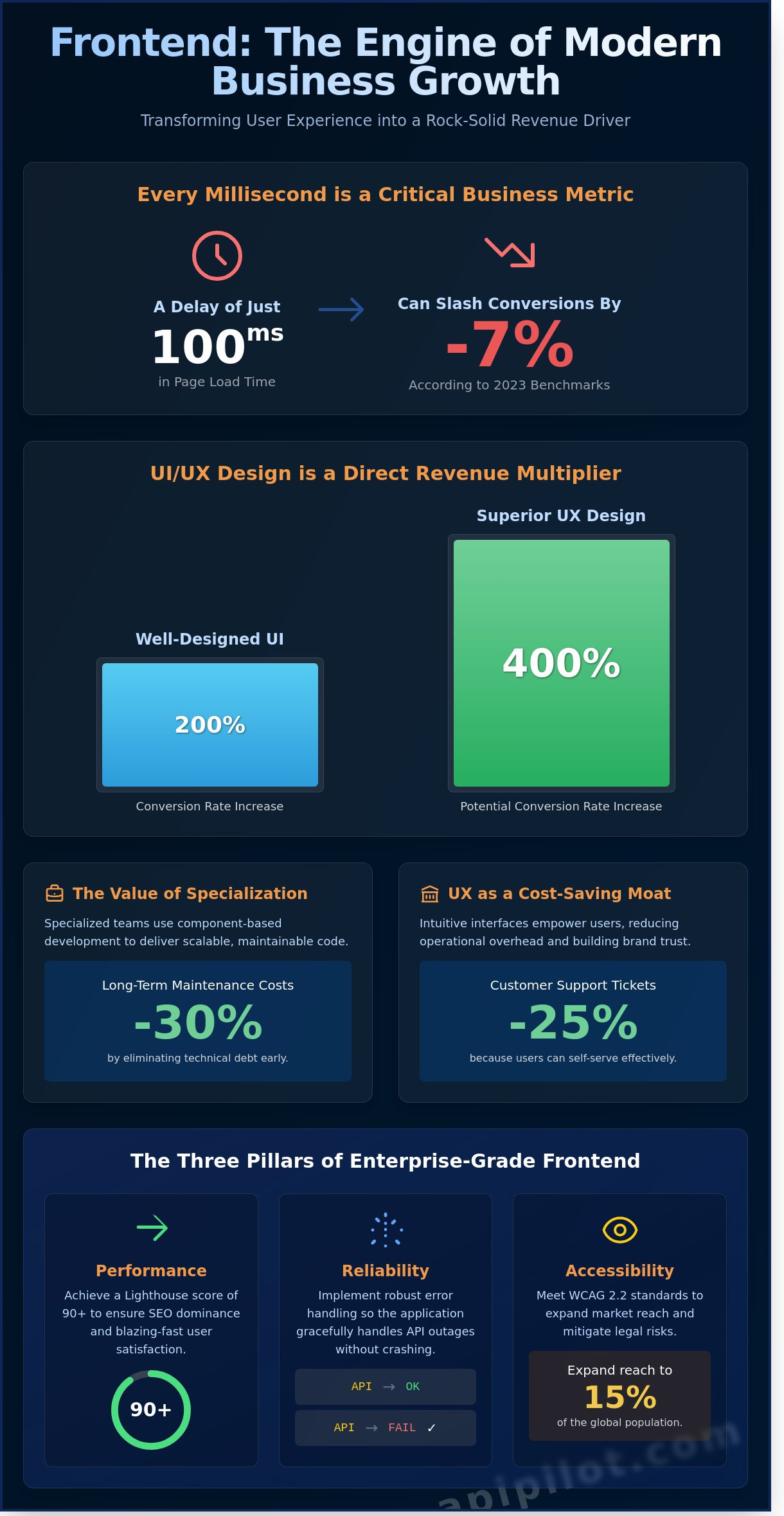
Frontend development is the functional bridge between server-side logic and the human brain. It’s no longer just about aesthetics; it’s about how your business communicates its value through code. To understand the technical foundations, you can explore what is frontend development in more detail. By 2026, a 100-millisecond delay in page load time will correlate to a 7% drop in conversion rates for e-commerce platforms. Modern users expect blazing-fast interactions. If your interface lags, your business loses money. Partnering with a specialized frontend development company ensures your digital presence is built on a rock-solid foundation of performance and scalability.
Static pages have disappeared. Today, developers build state-heavy applications that handle complex data flows in real-time. Whether it’s a financial dashboard or a collaborative SaaS tool, the UI must remain responsive under heavy load. A “good enough” interface is now a liability. A 2024 study by Forrester found that a well-designed UI can raise a website’s conversion rate by up to 200%. Conversely, a 400% increase is possible with superior UX design. Relying on generic templates creates technical debt that slows down future deployments and frustrates users.
Gain a clearer perspective on the current industry shifts by watching this breakdown:
The Business Case for Specialized Frontend Expertise
Full-stack generalists often struggle with the nuances of CSS architecture and complex state management. Specialized teams use component-based development to cut long-term maintenance costs by 30%. This approach ensures your codebase remains scalable and easy to refactor. A dedicated frontend development company focuses on optimizing the Critical Rendering Path to ensure users see content instantly. Frontend ROI is the reduction in user friction multiplied by retention rate.
User Experience (UX) as a Competitive Moat
High-performance interfaces do more than attract users; they lower operational costs. Intuitive designs reduce customer support tickets by 25% because users find what they need without assistance. Blazing-fast load times, specifically those under 1.5 seconds, build immediate brand trust and improve Core Web Vitals. Accessibility isn’t optional. Meeting WCAG 2.2 standards protects your enterprise from legal risks while expanding your market reach to the 15% of the global population living with disabilities. Enterprise-grade frontend work focuses on three pillars:
- Performance: Achieving a Lighthouse score of 90+ to ensure SEO dominance and user satisfaction.
- Reliability: Implementing robust error handling so the application doesn’t crash during API outages.
- Accessibility: Ensuring every user, regardless of their hardware or physical ability, can complete a transaction.
The shift from simple websites to dynamic web applications requires a deep understanding of modern frameworks like React, Next.js, and Vue. These tools allow for seamless, app-like experiences that keep users engaged longer. When you prioritize the frontend, you aren’t just buying code. You’re investing in a powerful engine that drives user retention and measurable business growth.
The 2026 Tech Stack: Scaling with React, Angular, and Micro-Frontends
Architecture defines the success of modern digital products. By 2026, a top-tier frontend development company must master a stack that prioritizes modularity and speed. React remains the dominant force, but the shift toward Next.js for enterprise applications is now absolute. Data from 2025 shows that 78% of new high-traffic commercial projects utilize Next.js for its robust App Router and React Server Components. This setup reduces client-side JavaScript by up to 60%, ensuring blazing-fast interactions even on low-powered mobile devices. Angular continues to hold a 15% market share, specifically within the financial and healthcare sectors where its strict, opinionated structure prevents the technical debt that often plagues less disciplined frameworks.
TypeScript has evolved from a preference to a global requirement. Recent industry benchmarks indicate that 92% of enterprise-grade codebases now rely on TypeScript to ensure rock-solid type safety. This adoption has led to a 40% reduction in production runtime errors compared to legacy JavaScript projects. For organizations with engineering teams exceeding 45 developers, micro-frontends provide the only viable path to scale. This architecture allows teams to break the UI into independent, deployable units. If the “Payment Gateway” module needs an update, it’s deployed solo without risking the stability of the “User Dashboard” or the entire application.
Performance optimization focuses heavily on the balance between Server-Side Rendering (SSR) and Static Site Generation (SSG). Modern projects use a hybrid strategy to maximize Core Web Vitals scores. SSR provides immediate data for dynamic, user-specific pages, while SSG handles marketing content with sub-second delivery times. Implementing these strategies correctly requires a deep understanding of frontend development best practices to maintain SEO rankings and user retention. A professional frontend development company doesn’t just write code; they engineer a delivery pipeline that ensures content reaches the user without friction.
Choosing the Right Framework for Your Project
React’s ecosystem of over 2.5 million npm packages makes it the most flexible choice for rapid iteration and creative UIs. Angular’s built-in dependency injection and comprehensive tooling make it the powerhouse for complex, long-term enterprise systems. While the big two lead the market, Vue 3 and Svelte 5 have captured 12% of the developer interest by offering bundle sizes under 15KB. These frameworks are ideal for high-performance, lightweight applications where every kilobyte of data transfer costs the user time and money.
Modern State Management and Data Fetching
Redux is no longer the default choice for every project. Developers now favor TanStack Query for data fetching, which eliminates 80% of manual loading and error state logic. Zustand has become the preferred tool for client-side state, offering a 55% reduction in boilerplate code compared to legacy patterns. Real-time requirements are met through WebSockets and gRPC-web, providing instantaneous updates for collaborative tools. For heavy computational tasks, WebGPU now allows browsers to process data 10x faster than previous standards. If you want to leverage these cutting-edge tools for your business, you can find expert guidance to build a future-proof architecture today.
Performance Engineering: Beyond Just Looking Good
A professional frontend development company understands that speed is a functional requirement, not a luxury. Performance engineering ensures that your application remains responsive under heavy load and provides a seamless user experience. We focus on API-first development using tools like API Pilot to orchestrate data efficiently. This approach decouples the frontend from the backend, allowing the UI to remain interactive even during complex data fetches. By prioritizing the data layer first, developers avoid the common bottleneck of waiting for monolithic backend responses before rendering critical UI elements.
Mastering Core Web Vitals is essential to dominate search rankings and retain users. Google’s 2024 benchmarks require a Largest Contentful Paint (LCP) of under 2.5 seconds and a Cumulative Layout Shift (CLS) of less than 0.1. According to a study on How Web Development Can Improve Any Business’s Performance, technical optimization directly impacts conversion rates. A 100-millisecond delay in load time can decrease conversion rates by 7%, making performance a primary business metric. We implement strict performance budgets to prevent feature creep. If a proposed library adds 50KB to the JavaScript bundle and exceeds the set threshold, it’s rejected or optimized before deployment.
The Intersection of APIs and UI Performance
Payload optimization is the first line of defense against slow interfaces. We utilize GraphQL to prevent over-fetching, ensuring the frontend only requests the specific JSON keys required for a view. This reduces data usage by up to 60% compared to traditional REST calls. By leveraging edge computing and middleware, we move business logic closer to the user, cutting latency significantly. A rock-solid Custom API Development strategy acts as the engine for this speed, providing the enterprise-grade foundation necessary for blazing-fast frontend execution.
Modernization of Legacy Frontend Systems
Modernizing an aging stack doesn’t require a risky “big bang” rewrite. We use the Strangler Fig pattern to replace legacy jQuery or AngularJS components piece by piece. This incremental refactoring allows businesses to migrate to React or Vue.js without interrupting daily operations. Every update passes through automated testing and CI/CD pipelines to guarantee stability. Rock-solid uptime begins with a bug-free frontend deployment pipeline that eliminates manual errors and catches regressions in real-time. When you partner with an expert frontend development company, you gain a strategy that balances innovation with the stability of your existing business logic.
- LCP (Largest Contentful Paint): Aim for 2.5 seconds or less for optimal ranking.
- FID (First Input Delay): Maintain a delay of less than 100 milliseconds for a snappy feel.
- CLS (Cumulative Layout Shift): Keep visual stability below 0.1 to prevent jarring layout jumps.
- Payload Reduction: Compress assets and use modern formats like WebP and Brotli.
Effective performance engineering turns a pretty website into a powerful business tool. It’s about building a robust architecture that scales with your user base while maintaining a lightweight footprint. By focusing on these technical pillars, you ensure your application is fast, reliable, and ready for the demands of modern enterprise environments.
Selecting the Right Frontend Partner: A Strategic Framework
Choosing a frontend development company requires more than a glance at a gallery of polished UI designs. You must first determine if your product needs technical depth or creative flair. If you’re building a data-heavy dashboard for 50,000 concurrent users, you need a partner obsessed with DOM reconciliation, memory management, and blazing-fast load times. Conversely, a luxury brand site demands a team that excels in micro-interactions and CSS animations. Most enterprise-grade failures stem from a mismatch here; a creative agency might struggle with complex state logic, while a heavy engineering firm might produce a clunky user experience.
Communication protocols and timezone alignment are equally critical for project velocity. For teams in Las Vegas or other North American hubs, a minimum 4-hour synchronous overlap is necessary to prevent development bottlenecks. A 24-hour delay in resolving a single pull request feedback loop can extend a 12-week project timeline by 18 days. Demand a clear communication stack, typically Slack for real-time sync and Jira for asynchronous task management, to ensure rock-solid progress tracking.
When you evaluate portfolios, look past the screenshots. Ask for live URLs and run them through Google Lighthouse. A high-quality frontend development company should consistently deliver First Contentful Paint (FCP) scores under 1.8 seconds. Examine the complexity of their previous work. Did they build a simple static site, or did they manage complex API integrations and real-time data streaming? Robust frontend architecture is invisible to the untrained eye but becomes obvious during a 2024 security audit or a sudden traffic spike.
Engagement models should match your internal capacity. Staff augmentation is efficient for filling a specific 3-month gap in TypeScript or React expertise. However, a dedicated product team is superior for long-term builds where the agency owns the technical debt and documentation. Statistics show that 85% of successful long-term software projects utilize a dedicated team model to maintain architectural consistency over time.
Key Questions to Ask During the Discovery Phase
Direct questions reveal a partner’s technical maturity. Ask how they handle state management in large-scale applications; if they don’t mention Redux, Zustand, or the Context API with specific use cases, they lack depth. Inquire about their process for mobile responsiveness and cross-browser compatibility. They should mention automated testing tools like BrowserStack or Playwright. Finally, confirm they’ve built interfaces for your specific backend stack, whether it’s a RESTful API or GraphQL, to ensure seamless integration in minutes.
Red Flags in a Frontend Development Agency
Watch for a lack of automated testing or version control in the proposal. If a team doesn’t mention Git or CI/CD pipelines, your project is at risk. Another warning sign is an over-reliance on off-the-shelf templates. Custom software solutions should be tailored to your business logic, not forced into a $50 WordPress theme. Be wary of vague answers regarding performance optimization. If they can’t discuss Core Web Vitals or tree-shaking, your SEO and user retention will suffer.
Ready to build a high-performance interface that scales? You can find a technical partner who understands the balance between robust code and seamless user experience.
API Pilot: Your Partner for Blazing-Fast, Rock-Solid Frontend Solutions
API Pilot bridges the gap between high-level US strategic leadership and elite global engineering talent. This hybrid model ensures your project benefits from local accountability and world-class technical execution. We don’t just hire developers; we deploy senior architects who understand that a frontend development company must act as a strategic partner, not just a code factory. By combining local product management with a 24/7 development cycle, we accelerate your time-to-market while maintaining the highest standards of code quality and security.
Our “Performance-First” philosophy dictates every decision we make. We view every millisecond of load time as a critical business metric that impacts your bottom line. Data from 2023 indicates that a 0.1-second improvement in mobile site speed can increase conversion rates by 8.4% for retail sites and nearly 10% for travel sites. We don’t settle for “fast enough.” Our teams utilize advanced techniques like server-side rendering, intelligent code-splitting, and aggressive asset optimization to ensure your application feels instantaneous on any device.
In Q4 2023, we demonstrated this approach by transforming a legacy ERP system for a mid-market logistics firm. The original platform suffered from a 6.8-second initial load time and a fragmented user experience that hindered employee productivity. Our team re-engineered the interface using a modern, responsive framework, resulting in a 71% reduction in load times. By the end of the first month post-launch, the client reported a 19% increase in internal task completion rates. This case study proves that a modern frontend isn’t just a visual upgrade; it’s a powerful tool for operational efficiency.
Our expertise extends beyond simple web interfaces. We provide seamless integration with our broader ecosystem of services, including mobile app development and Custom Software Development. This holistic approach ensures that your frontend, backend, and mobile assets function as a single, cohesive unit. We eliminate the friction often found when working with multiple vendors, providing a unified roadmap for your entire digital presence.
Tailored Solutions for Startups and Enterprises
Startups need to validate ideas quickly without sacrificing future scalability. We offer rapid prototyping services that help founders launch MVPs 35% faster than industry averages. For our enterprise clients, we focus on building rock-solid, secure architectures for complex systems like CRMs and ERPs. We prioritize modularity, ensuring that your frontend can evolve as your business grows. Whether you’re a three-person team or a Fortune 500 corporation, our solutions are engineered to meet your specific security and performance requirements.
The API Pilot Advantage
When you partner with us, you get direct access to senior architects and a commitment to no-nonsense communication. We don’t hide behind account managers or technical jargon. Our focus remains squarely on driving user engagement and delivering measurable growth through superior engineering. We understand that as a frontend development company, our success is defined by your project’s performance in the real world. We build products that don’t just look good; they work flawlessly under pressure.
Future-Proof Your Interface for 2026 and Beyond
The roadmap to 2026 demands more than just aesthetic appeal; it requires a commitment to performance engineering and modular architecture. Success hinges on mastering React, Angular, and micro-frontends to ensure your application scales without friction. You need a frontend development company that understands how to turn complex API ecosystems into seamless user experiences. Speed isn’t a luxury when every millisecond of latency impacts your bottom line. Scalable code and rock-solid uptime are the new standards for enterprise growth.
API Pilot delivers the technical edge your business needs. We’re trusted by 1,000,000+ developers through our robust API ecosystem. Our expert teams operate out of Las Vegas and Karachi, providing 24/7 productivity to keep your project moving at a blazing-fast pace. We specialize in building enterprise-grade software that’s both robust and highly performant. Don’t let outdated tech stacks hold back your growth. It’s time to build a frontend that powers your business goals with precision and reliability.
Partner with API Pilot for your next frontend project and start scaling today. Your users deserve a high-performance experience that’s ready for tomorrow’s challenges.
Frequently Asked Questions
What is the difference between a frontend development company and a web design agency?
A frontend development company focuses on the technical implementation of user interfaces, while a web design agency prioritizes visual aesthetics and branding. Design agencies deliver static mockups in tools like Figma. In contrast, a development firm writes the React or Vue code that powers the 100% interactive logic of your application. They ensure your site is functional, accessible, and ready for integration with complex backend systems.
How much does it cost to hire a professional frontend development team?
Professional teams typically charge between $65 and $160 per hour for high-quality engineering services. A standard enterprise-grade project requires a 4-person team and usually results in a total budget of $45,000 to $95,000. These costs cover architecture, unit testing, and seamless API integration to ensure your frontend development company delivers a product that remains robust under heavy traffic and scales with your business.
Which frontend framework is best for my business in 2026?
React, specifically within the Next.js ecosystem, is the most reliable choice for businesses heading into 2026. Current data shows React maintains a 42% developer usage rate, which ensures a massive talent pool for your project. This framework provides the blazing-fast performance and rock-solid scalability needed to handle 10,000 concurrent users without friction. It’s a safe, powerful investment for long-term stability.
How long does it take to modernize a legacy frontend application?
Modernizing a legacy frontend application usually requires 4 to 8 months of development time. 65% of enterprise teams choose an incremental migration strategy to avoid downtime during the transition. This approach allows you to replace old modules one by one, ensuring your business stays operational while you upgrade to a modern tech stack. It’s an efficient way to eliminate technical debt without a total system freeze.
Do you provide frontend development for mobile apps as well?
Yes, most specialized firms provide mobile development through cross-platform frameworks like React Native or Flutter. These tools allow developers to share up to 90% of the codebase between web and mobile platforms. It’s an efficient way to launch on iOS and Android simultaneously while maintaining a single, powerful logic layer. You get a consistent user experience across all devices with significantly lower maintenance costs.
What happens if my existing API is slow; can a frontend company fix it?
A frontend team can’t fix a slow server-side endpoint, but they can implement strategies to hide the delay from users. By using SWR or TanStack Query, developers can reduce perceived load times by 40% through caching and optimistic updates. They’ll ensure your UI feels responsive and blazing-fast even when the underlying data source takes 2 seconds or more to respond to requests.
Why is TypeScript preferred over standard JavaScript for enterprise projects?
TypeScript is the industry standard because it catches 15% of common programming errors during the development phase. Enterprise projects rely on its strict typing to manage complex data structures and ensure seamless integration across large teams. It provides a rock-solid foundation that makes your code easier to scale and maintain as your user base grows beyond 100,000 active accounts. It’s simply more reliable for mission-critical software.


