For a startup, choosing your mobile tech stack is a business-critical decision. With a limited runway and immense pressure to ship a high-performing MVP, the fear of betting on the wrong framework is a major roadblock. This brings us to the central debate in cross-platform development: the flutter vs react native for startups showdown. Both promise a single codebase, faster time-to-market, and reduced development costs, but their core architectures present different trade-offs that can significantly impact your product’s future.
This definitive 2025 guide is engineered to eliminate that uncertainty. We deliver a data-driven analysis comparing each framework on the metrics that matter most: raw performance benchmarks, developer availability, total cost of ownership, and long-term scalability. Forget the hype. By the end of this article, you will have the clarity to confidently select the robust, cost-effective framework that empowers you to build a blazing-fast app, delight your users, and scale without friction.
Speed to Market: Which Framework Delivers Your MVP Faster?
For startups, time is a finite and critical currency. Launching a Minimum Viable Product (MVP) ahead of the competition can define market leadership. Therefore, the choice of a development framework is a strategic business decision, not just a technical one. The debate over flutter vs react native for startups often centers on one pivotal question: which platform can transform an idea into a functional product in the shortest amount of time?
To see how these frameworks approach rapid development, the following overview provides a helpful comparison:
Developer Experience and Hot Reload
Both frameworks offer “hot reload” functionality, a feature that dramatically accelerates development. Flutter’s stateful Hot Reload injects updated source code files into the running Dart Virtual Machine, updating the UI instantly while preserving the app’s current state. This is incredibly efficient for tweaking UI and testing logic. React Native’s equivalent, Fast Refresh, is also robust, reloading only the components that have changed and maintaining state in functional components.
UI Component Libraries and Reusability
The availability of pre-built UI components is a massive accelerator. Here, the philosophies diverge significantly:
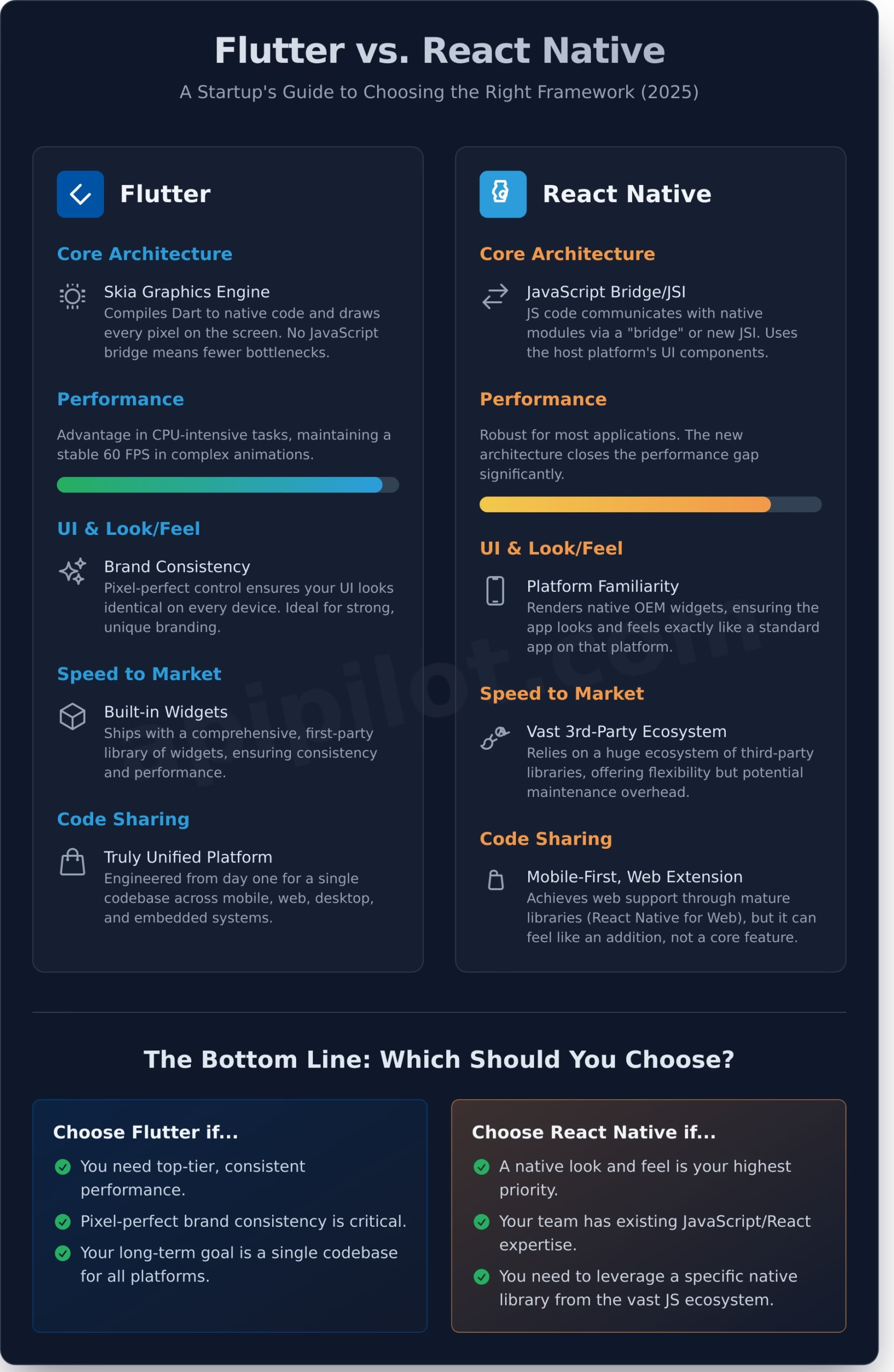
- Flutter: Ships with a comprehensive, enterprise-grade library of built-in widgets for both Material Design (Android) and Cupertino (iOS). This first-party ownership ensures consistency, high performance, and zero dependency conflicts.
- React Native: Relies on a vast ecosystem of third-party libraries like NativeBase and React Native Elements. While offering immense flexibility, this approach can introduce maintenance overhead and potential inconsistencies between packages.
Code Sharing Beyond Mobile
A true single-codebase strategy is the ultimate goal for resource-constrained startups. While both frameworks champion code reuse, Flutter’s core architecture was engineered from day one for platform agnosticism. It offers production-ready support for web, desktop, and embedded systems from a single Dart codebase. React Native achieves web support through the mature React Native for Web library, but it often feels like an extension rather than a natively integrated feature. For a truly unified, multi-platform MVP, Flutter currently provides a more seamless and robust path.
Performance & User Experience: The Native vs. Cross-Platform Debate
For any startup, user retention hinges on a fast, fluid, and responsive application. The fear of a ‘janky’ or slow cross-platform app is a valid concern that can make or break user adoption. Performance is not just about raw speed; it encompasses resource efficiency, including CPU and memory consumption, which directly impacts battery life and device temperature. When evaluating flutter vs react native for startups, understanding their core architectural differences is critical to predicting real-world performance.
Core Architecture: Skia Engine vs. JavaScript Bridge
Flutter’s performance edge stems from its fundamental design. It bypasses the operating system’s native UI components entirely. Instead, it compiles Dart code directly to native ARM or x86 machine code and uses its own high-performance 2D graphics engine, Skia, to draw every pixel on the screen. This eliminates the need for a “bridge” to communicate between the framework’s code and native modules, a common performance bottleneck. This direct rendering approach gives developers granular control and ensures blazing-fast, consistent UI across platforms.
React Native traditionally relied on a JavaScript bridge to serialize messages between the JavaScript thread and the native UI thread. While effective, this could lead to performance issues in complex animations or data-heavy lists. The introduction of the new architecture with the JavaScript Interface (JSI) has significantly improved this, allowing for direct, synchronous communication. While a major leap forward, it’s an evolution of an existing architecture, whereas Flutter was built for direct compilation from day one. Understanding these core differences is fundamental to the framework selection criteria for any new project.
Real-World Performance Benchmarks
In practice, both frameworks can produce high-performance applications. However, benchmarks often reveal nuanced differences. Studies consistently show Flutter having a slight advantage in CPU-intensive tasks and maintaining a more stable 60 frames per second (FPS) during complex animations, thanks to its Skia engine. For startups building graphically rich apps with heavy animations or data visualizations, this stability is a powerful advantage. React Native’s performance is robust for most standard business applications, and with the new architecture, the gap is closing, but Flutter often leads in scenarios requiring sustained, high-frame-rate rendering.
Achieving a ‘Native’ Look and Feel
The user experience debate centers on two distinct philosophies:
- React Native: Platform Familiarity. It renders using native OEM widgets. This means a button on iOS looks and feels exactly like a standard iOS button because it is one. This approach guarantees users feel instantly at home, but it can lead to minor inconsistencies between platforms that require specific code to manage.
- Flutter: Brand Consistency. It draws its own widgets, offering pixel-perfect control and ensuring your UI looks identical on every device. This is a massive win for brand-centric startups that want a unique, consistent user experience. The trade-off is that widgets may not perfectly mimic the subtle, platform-specific behaviors users are accustomed to.
Ultimately, the choice here is strategic: prioritize perfect brand consistency with Flutter or default platform familiarity with React Native.
Cost of Development & Talent Acquisition: A Startup’s Reality Check
For any lean startup, the total cost of ownership and access to talent are non-negotiable decision factors. Your choice of mobile framework directly impacts your budget, hiring timeline, and long-term maintenance costs. This is a critical calculation that extends far beyond initial development sprints, making the flutter vs react native for startups debate a pivotal one for resource allocation.
The Developer Talent Pool
React Native’s primary advantage is its foundation in JavaScript and React. This unlocks access to one of the largest developer communities on the planet. For a startup, this translates to a larger talent pool, faster hiring cycles, and potentially more competitive salary negotiations. Flutter, on the other hand, requires developers to learn Dart. While the Dart community is passionate and growing at an impressive rate, it is still significantly smaller, which can mean a longer and more expensive search for senior talent.
Learning Curve and Team Onboarding
If your startup already has a web development team proficient in React, onboarding them to React Native is a low-friction process. They can leverage existing skills to become productive in days, not months. Flutter introduces new concepts, like its declarative UI and widget-based architecture. While its documentation is excellent, the learning curve can be steeper for developers without a background in strongly-typed, object-oriented languages. A detailed analysis Comparing Flutter and React Native highlights that React Native’s familiarity often gives it an edge for teams needing to ship an MVP quickly.
Community and Long-Term Support
Both frameworks boast rock-solid corporate backing—Meta for React Native and Google for Flutter—which significantly mitigates the risk of abandonment. React Native benefits from a more mature ecosystem with a vast library of third-party packages built over many years. Conversely, Flutter’s community is incredibly vibrant and arguably has more momentum, with Google investing heavily to expand its tooling and capabilities for a true cross-platform future beyond mobile.
Ultimately, your decision hinges on your team’s existing skills and your hiring strategy. Our expert teams can build your app on any platform. Learn more.
UI/UX Flexibility: Building a Brand-Defining App
For a startup, user experience is not just a feature; it’s a competitive moat. A polished, unique, and memorable UI can be the deciding factor for user retention. The debate over flutter vs react native for startups is often most intense here, as each framework approaches UI/UX with a fundamentally different philosophy.
Pixel-Perfect Design Implementation
Flutter leverages its own Skia graphics engine to draw every pixel on the screen. This gives developers absolute control, enabling them to replicate complex Figma or Sketch designs with 100% fidelity across all platforms. The result is a rock-solid, consistent UI that looks and feels identical on any iOS or Android device, regardless of the OS version. React Native, by contrast, translates your code into native UI components, which can lead to subtle rendering variations and require platform-specific adjustments to achieve a custom look.
Branding vs. Platform Conventions
The right choice depends on your startup’s brand strategy.
- Flutter is the definitive choice for strong, brand-first applications. If your app’s identity is defined by a bespoke design system, custom controls, and a unique visual language (e.g., a cutting-edge fintech app), Flutter’s architecture is built for the job.
- React Native excels when adhering to platform conventions is critical. For apps that should feel like a natural extension of the operating system (e.g., a simple utility or a content app), using native components provides instant user familiarity.
Animation and Complex Gestures
Sophisticated animations create a perception of quality and performance. Flutter has a powerful, built-in animation library that is deeply integrated into its widget framework, making it straightforward to build fluid, physics-based animations that run at a smooth 60fps or higher. React Native offers the core Animated API, but for enterprise-grade performance, developers almost universally turn to the third-party Reanimated library. While extremely powerful, it introduces another dependency and a steeper learning curve compared to Flutter’s out-of-the-box solution.
Ultimately, a seamless UI needs a powerful backend. Ensure your app is supported by robust and scalable APIs from a trusted provider like apipilot.com to guarantee a blazing-fast user experience.
The Verdict: A Decision Framework for Your Startup
After analyzing performance, UI, and development speed, the ultimate choice in the flutter vs react native for startups debate is not about which framework is universally superior, but which is strategically right for your business. Your decision hinges on your team’s existing skills, your product’s core requirements, and your long-term vision. Use the following scenarios as a clear guide to making a robust technical decision.
Choose Flutter If Your Startup…
Select Flutter when your primary goal is a high-fidelity, custom user experience that feels identical everywhere. It is the powerhouse for performance-critical applications.
- Prioritizes a highly custom, branded UI and complex animations that need to run smoothly at 60 FPS.
- Needs guaranteed UI consistency across all platforms, operating system versions, and devices without exception.
- Is building an app where blazing-fast performance is a core feature, not just a benefit (e.g., gaming, intensive data visualization).
- Has access to developers skilled in Dart or is prepared to invest in training for a modern, type-safe language.
Choose React Native If Your Startup…
Opt for React Native when speed-to-market and leveraging existing web development talent are your top priorities. It excels at building functional, content-driven apps quickly.
- Has an existing team of proficient React/JavaScript developers, allowing you to leverage current skills for immediate productivity.
- Needs to launch an MVP as quickly as possible by tapping into a massive ecosystem of pre-built libraries and components.
- Is building an app that should feel deeply integrated with the OS by using native UI components.
- Prioritizes a larger talent pool for easier and faster hiring as your team needs to scale.
Beyond the Framework: The Importance of a Skilled Partner
Ultimately, the success of your mobile application depends less on the framework and more on the architects and developers building it. The debate over flutter vs react native for startups becomes secondary when you have a team that masters the chosen technology. A great development partner navigates any framework’s limitations and maximizes its strengths to deliver a robust, scalable product. An expert agency like API Pilot has the proven experience to deliver exceptional results on either platform, ensuring your vision is executed flawlessly.
Flutter vs. React Native: The Strategic Choice for Your Startup
The decision between Flutter and React Native is not about picking a “winner”—it’s about strategic alignment with your startup’s goals. React Native often accelerates your MVP launch due to its vast developer community, while Flutter offers unparalleled UI control and near-native performance for more ambitious, brand-centric applications. Ultimately, the right answer in the flutter vs react native for startups debate hinges on your unique balance of speed, budget, and long-term product vision.
Making this foundational decision can be complex, but you don’t have to make it alone. APILayer provides full-cycle development, guiding you from initial concept to a successful App Store launch. Our expert teams, proficient in both Flutter and React Native, have a proven track record of launching robust, scalable apps for startups just like yours. Let our experience become your competitive advantage.
Ready to transform your idea into a market-leading application? Have a project in mind? Get a free consultation with our mobile experts. Let’s build something exceptional together.
Frequently Asked Questions
Is React Native dying in 2025?
React Native is not dying in 2025; it is maturing. Backed by Meta and a massive community, its ecosystem remains one of the largest in mobile development. For startups with existing React and JavaScript talent, it offers a seamless and efficient path to building cross-platform applications. While newer frameworks gain traction, React Native’s stability and vast library support ensure it remains a powerful, enterprise-grade choice for rapid development cycles and delivering rock-solid user experiences.
Is Flutter significantly faster than React Native?
Flutter generally delivers superior out-of-the-box performance, especially for complex animations and UI-heavy applications. This is because it compiles directly to native ARM or x86 code and uses its own high-performance Skia rendering engine, bypassing the need for a JavaScript bridge. While React Native’s performance is robust for most applications, its reliance on the JS bridge can introduce bottlenecks. For startups prioritizing blazing-fast, 60 FPS user interfaces, Flutter holds a distinct architectural advantage.
Can I use a single codebase from Flutter or React Native for my web app too?
Yes, both frameworks provide powerful solutions for web deployment from a single codebase. Flutter’s web support compiles Dart code to run in the browser, offering a highly consistent UI across platforms. React Native utilizes the react-native-web library to translate React Native components into web-compatible DOM elements. For startups, this enables maximum code reuse, especially for internal tools, admin panels, or applications where a consistent, app-like experience on the web is the primary goal.
Which big companies are using Flutter and React Native?
Both frameworks power applications for major global companies, demonstrating their enterprise-grade reliability. React Native is trusted by industry leaders like Meta (Facebook, Instagram), Microsoft (Office, Skype), Shopify, and Tesla. Flutter has been adopted by Google for numerous apps (Google Pay), BMW for its vehicle infotainment systems, and other major brands like Alibaba and The New York Times. This widespread adoption provides robust social proof for the scalability and stability of both technologies.
How does the final app size (APK/IPA) compare between the two?
A minimal Flutter application often has a larger initial file size (APK/IPA) compared to a similar React Native app. This is because Flutter bundles its own rendering engine (Skia) and a core library within the app package. However, this size difference becomes less pronounced as application complexity and assets increase. For startups, it’s a trade-off: Flutter’s larger base size is exchanged for potentially superior and more consistent runtime performance across all devices.
Is it difficult to find developers for Flutter compared to React Native?
React Native currently has a larger developer talent pool due to its foundation in JavaScript, the most popular programming language. This can make hiring more straightforward. However, the Flutter community is growing at a blazing-fast pace, and its language, Dart, is modern and often considered easy for developers to learn. When evaluating flutter vs react native for startups, consider that while the React Native pool is wider, the Flutter community is highly engaged and expanding rapidly.


