Is your growth being throttled by a patchwork of applications that create more friction than they solve? Many small businesses find themselves wrestling with off-the-shelf software—tools packed with features you don’t need while missing the critical ones you do. This operational drag, fueled by manual data entry and disconnected systems, is a clear signal that it’s time to explore a more powerful alternative. For forward-thinking companies, the answer lies in robust custom software solutions for small business, engineered from the ground up to match your unique operational DNA and eliminate workflow bottlenecks for good.
While the idea of building your own software can seem daunting, this guide is designed to demystify the entire process. We provide a clear, no-nonsense framework to help you determine precisely when to choose a custom build, what it can do to power your productivity, and how to manage the project from initial idea to a measurable return on investment. Get ready to automate repetitive tasks, scale without limitation, and build a true competitive advantage through technology that works exactly the way you do.
When to Switch from Spreadsheets to Custom Software Solutions
For most small businesses, the journey begins with a combination of spreadsheets and off-the-shelf applications. These tools are accessible, familiar, and effective for managing initial operations. However, as your business scales, complexity grows exponentially. Processes that were once simple become bottlenecks, and the very tools that helped you start now begin to hinder your growth.
This is the tipping point where the hidden costs of inefficiency and manual work outweigh the price of a dedicated solution. Investing in custom software solutions for small business becomes the next logical step. Think of it as the difference between buying a suit off the rack versus having one tailored. While the former works, the latter is engineered for a perfect fit, enhancing performance and presenting a more professional image.
To better understand this transition, the following video provides a clear overview of the challenges and solutions.
Sign 1: Your Team is Drowning in Manual Work
Repetitive tasks like double data entry and copy-pasting information between applications are hallmarks of an outgrown system. These manual workflows are not just time-consuming; they are a significant source of human error that can lead to costly mistakes. For example, a service coordinator might spend hours each day manually confirming appointments and updating multiple calendars. A custom software solution automates these workflows, integrating scheduling, notifications, and billing into a seamless process that frees up valuable employee time for high-impact activities.
Sign 2: Off-the-Shelf Software Creates Workarounds
Generic software often forces your business to adapt its processes to the software’s limitations. You end up paying for a suite of features you never use while lacking the critical functions you desperately need. This leads to “software gymnastics”—inefficient workarounds and patchwork solutions just to get the job done. In essence, this is the core issue when asking, What is custom software? It’s about building a tool that conforms to your ideal process, rather than forcing your process to conform to a pre-built tool.
Sign 3: Disconnected Systems are Stifling Growth
When your CRM, inventory management, and accounting software don’t communicate, you operate with fragmented data. This lack of a single source of truth results in poor data integrity, misinformed decisions, and an inability to get a clear, real-time view of your business performance. Robust custom software solutions for small business centralize all critical data into a single, cohesive dashboard. This provides the clear, actionable insights required for strategic planning and sustainable scaling.
Off-the-Shelf vs. Custom Software: A Practical Comparison
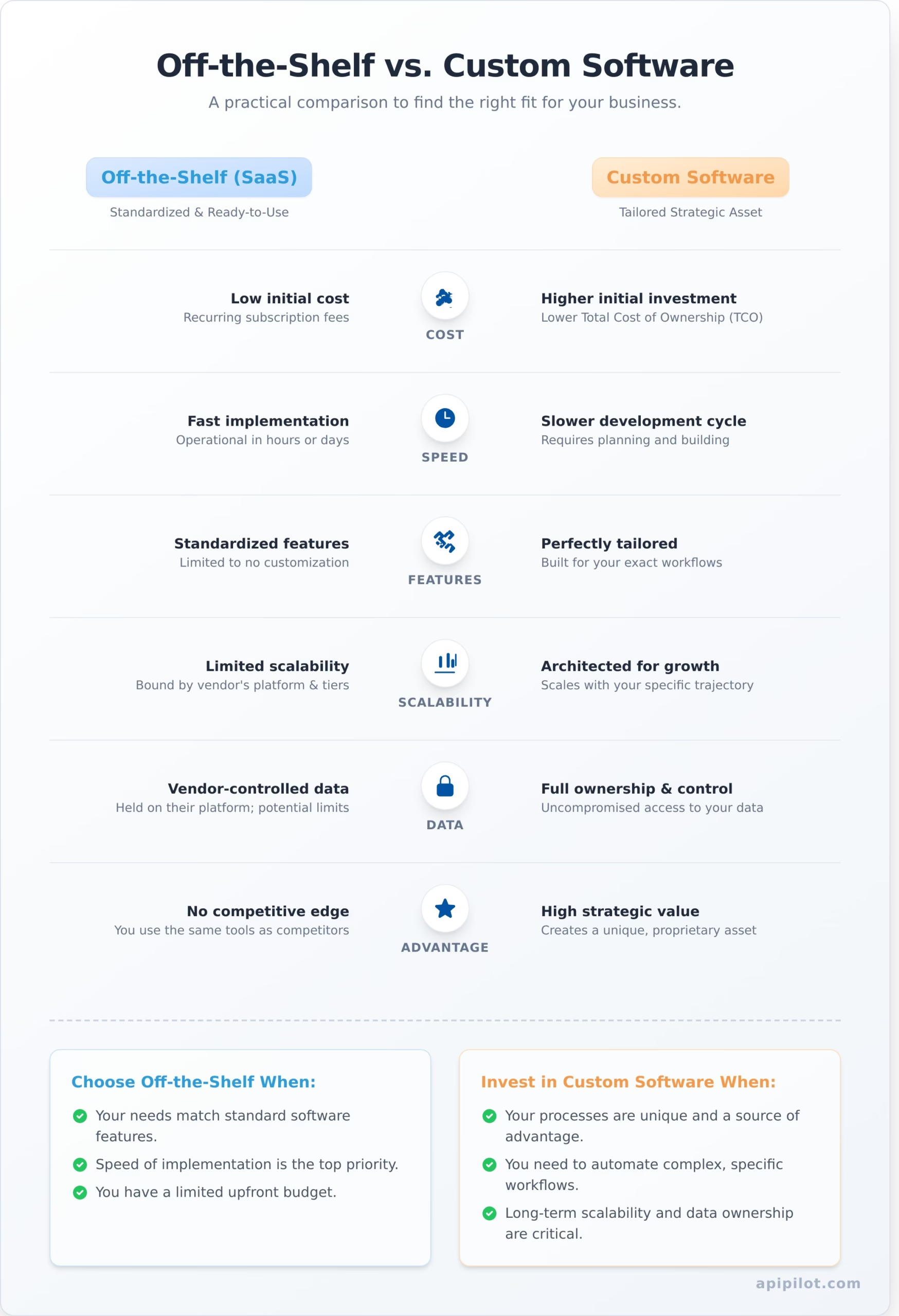
Selecting the right software foundation is a critical decision for any small business. The choice between a pre-built, off-the-shelf solution (often SaaS) and a custom-built application is not about which is universally “better,” but which is strategically right for your current needs and future goals. This comparison provides a clear framework to help you make an efficient, informed decision.
| Factor | Off-the-Shelf (SaaS) Software | Custom Software |
|---|---|---|
| Upfront Cost | Low initial cost; recurring subscription fees. | Higher initial investment; lower long-term TCO. |
| Implementation Speed | Fast. Can be operational in hours or days. | Slower. Requires a full development cycle. |
| Features & Flexibility | Standardized features; limited to no customization. | Perfectly tailored to your exact workflows. |
| Scalability | Limited by the vendor’s platform and pricing tiers. | Architected for your specific growth trajectory. |
| Data Ownership | Data is held on the vendor’s platform; potential export limits. | Full, uncompromised ownership and control of your data. |
| Competitive Advantage | None. You use the same tools as your competitors. | High. Creates a unique asset that streamlines your operations. |
The Case for Off-the-Shelf (SaaS) Solutions
Off-the-shelf software offers immediate value with minimal upfront investment. It’s an excellent choice for standard business functions like email, accounting, or generic CRM. The primary benefits are speed and cost-effectiveness for common problems. However, you trade control for convenience, often facing recurring fees, feature limitations that force inefficient workarounds, and potential issues with data integration and ownership.
The Power of Custom-Built Software
Investing in custom software solutions for small business means building a strategic asset. This path is for companies whose processes are their competitive advantage. A custom application is engineered to fit your unique operations perfectly, eliminating friction and automating complex workflows. While the initial investment and development time are higher, the result is a robust, scalable platform that you own completely, providing a powerful long-term advantage.
Decision Framework: Which Path is Right for You?
Analyze your operational needs with these critical questions. The more you answer “yes,” the stronger the case for a custom solution becomes:
- Does existing software force your team into inefficient, manual workarounds?
- Is your core business process a unique advantage you want to optimize?
- Are you paying for multiple SaaS subscriptions that fail to integrate seamlessly?
- Do you require absolute control over your data for security or compliance?
- Is your long-term growth plan likely to exceed the limits of pre-built tools?
If these questions highlight significant gaps in your current software stack, it’s time to explore a tailored approach. Talk to our experts to analyze your specific needs.
Real-World Examples of Custom Software for Small Businesses
Theoretical benefits are one thing; tangible results are another. To demonstrate the power of bespoke technology, let’s move from concept to application. The following examples showcase how custom software solutions for small business solve specific, high-stakes challenges across different industries. See if you recognize your own operational bottlenecks in these scenarios.
Automating Operations & Field Services
The Problem: A local plumbing company was losing efficiency and revenue due to manual dispatching, inefficient routing, and slow, paper-based invoicing. Technicians wasted time driving between jobs, and cash flow was hampered by billing delays.
The Solution: A robust, custom-built mobile and web application designed for field service management. The platform provided a central command center for dispatchers and an intuitive mobile app for technicians.
- Key Features: Real-time job scheduling, GPS-based technician tracking, on-site digital invoicing with payment processing, and mobile inventory management.
- The Result: The company achieved a 20% reduction in average travel time, accelerated its billing cycle from weeks to days, and saw a significant increase in positive customer reviews due to improved punctuality and professionalism.
Streamlining Client & Project Management
The Problem: A growing marketing agency struggled with project chaos. Communication was fragmented across countless email threads, file version control was a constant issue, and clients lacked clear visibility into project progress, leading to frequent status update requests.
The Solution: A secure, client-facing project portal that centralized all communication, files, and progress tracking. This single source of truth eliminated ambiguity and streamlined workflows for both the internal team and its clients.
- Key Features: A centralized communication hub, secure file sharing with version history, interactive milestone tracking, and automated reporting dashboards.
- The Result: A 40% reduction in project-related emails, enhanced client transparency that boosted trust, and a measurable increase in client retention rates.
Professional services with unique regulatory needs also benefit. For example, a specialized practice like an Israel Cross Border Law Firm could use a custom portal to manage complex client files, secure cross-jurisdictional communication, and track case-specific compliance requirements that off-the-shelf software simply cannot handle.
Optimizing Inventory & E-commerce
The Problem: A local retailer with both a physical storefront and an online shop constantly battled inventory discrepancies. Selling an item in-store that was already in an online cart—or vice versa—led to stockouts, cancelled orders, and customer frustration.
The Solution: A custom inventory management system that seamlessly integrated the point-of-sale (POS) system with the e-commerce platform. This is a prime example of how targeted custom software solutions for small business create a unified operational backbone.
- Key Features: A unified inventory database with real-time stock level synchronization, automated reordering triggers based on sales velocity, and advanced sales analytics.
- The Result: The retailer eliminated overselling entirely, made smarter, data-driven purchasing decisions, and grew online sales by 35% in the first year.
The Custom Software Development Process: A Step-by-Step Guide
Embarking on a custom software project can feel daunting, but it’s a structured, collaborative partnership. A transparent process is the hallmark of a reliable development partner, ensuring you are in control from concept to launch. This step-by-step guide demystifies the journey, clarifying your role at every critical stage and showing how effective custom software solutions for small business are built.
Phase 1: Discovery & Strategy
This foundational phase is the most critical for project success. It’s where we move from a high-level idea to a detailed, actionable plan. The goal is to define the ‘what’ and ‘why’ of your software with absolute clarity, ensuring the final product aligns perfectly with your business objectives.
- Your Role: Communicate your vision, business goals, current pain points, and must-have features. You are the expert on your business needs.
- Developer’s Role: To listen, ask probing questions, document technical requirements, and propose a robust technical strategy and architecture.
- Outcome: A comprehensive project scope document, a clear roadmap with milestones, and a precise cost-and-time estimate.
Phase 2: UI/UX Design & Prototyping
Here, the documented requirements are translated into a tangible user experience. We create visual blueprints (wireframes) and interactive models (prototypes) of your software. This isn’t just about aesthetics; it’s about engineering a seamless and intuitive workflow for your users.
Your feedback is vital here. By testing the prototype, you can validate the user flow and identify necessary adjustments. It is exponentially more efficient and cost-effective to make changes at this design stage than during active development.
Phase 3: Development, Testing & Deployment
With a validated design, the development team begins writing the code to build your application. We utilize an Agile methodology, which means the project is broken into short “sprints.” At the end of each sprint, you receive a progress update and a demo of the new functionality, allowing for continuous feedback.
Parallel to development, our Quality Assurance (QA) team conducts rigorous testing to identify and eliminate bugs. Once the software is built, tested, and approved, it is deployed to a live server, ready for your team and customers to use.
Budgeting for Custom Software: Understanding Costs & ROI
The most common question about custom software is straightforward: “What will it cost?” While the answer is always “it depends,” a transparent breakdown demystifies the process. Think of custom software not as an expense, but as a capital investment designed to generate a significant, measurable return. Understanding the key cost drivers and potential ROI is the first step in making a data-driven decision for your business.
What Factors Determine the Cost?
The final price of custom software solutions for small business is a direct result of the time and expertise required. The primary variables include:
- Project Complexity: A simple tool to automate a single workflow will cost significantly less than a multi-faceted platform with complex business logic, user roles, and a comprehensive dashboard.
- Integrations: Each third-party system your software needs to communicate with—like Stripe for payments, QuickBooks for accounting, or a CRM—adds a layer of development complexity and cost.
- Design (UI/UX): A standard, functional interface is efficient and cost-effective. A highly polished, custom-branded user experience requires dedicated design and front-end development resources, increasing the investment.
- Team Location: Development rates vary globally. Onshore (U.S./Western Europe) teams typically have the highest rates, while offshore and nearshore teams can offer more competitive pricing.
Calculating Your Potential Return on Investment (ROI)
The true value of custom software is measured by its ROI. You can build a robust business case by quantifying gains in three key areas:
- Time Saved: Calculate the value of automated tasks. If software saves an employee who earns $25/hour five hours of manual work per week, that’s a $500 monthly saving.
- Increased Revenue: How will the tool generate more income? A custom quoting system might increase your deal closing rate by 10%, directly boosting your top line.
- Reduced Costs: Consolidate your tech stack. Replacing three separate SaaS subscriptions that cost $75/month each with a single custom tool eliminates $2,700 in annual operational expenses.
Use this simple formula to frame your analysis: (Gains – Investment Cost) / Investment Cost = ROI.
Pricing Models: Fixed Price vs. Time & Materials
Development projects typically follow one of two models. A Fixed Price model is ideal for smaller projects with a crystal-clear scope, offering budget predictability. However, it can be rigid if changes are needed. The Time & Materials model is more flexible, billing for actual hours worked. This is better for complex, evolving projects but requires strong project management to control scope and budget.
Ready to see what’s possible? Get a transparent, no-obligation estimate for your project.
Scale Your Operations with a Tailored Software Solution
Moving beyond generic spreadsheets and off-the-shelf products is a pivotal moment for any growing company. The path to superior efficiency and scalability is paved with software built specifically for your unique workflows. While the initial investment requires careful budgeting, the long-term ROI from optimized processes and solved bottlenecks is undeniable. A structured development process is the key that translates your vision into a robust, high-performance tool.
Ultimately, investing in custom software solutions for small business is a strategic move to build a competitive advantage. To ensure success, you need a partner with a rock-solid track record. APIpilot’s global team of experts leverages a proven, client-focused process—from discovery to deployment—to deliver powerful applications on time and on budget.
Ready to build a solution that fits your business perfectly? Schedule a free consultation.
Take the next step toward building the exact tool your business needs to thrive.
Frequently Asked Questions
How long does it take to build a custom software solution for a small business?
The timeline to build custom software solutions for a small business varies based on complexity. A Minimum Viable Product (MVP) with core functionality can often be delivered in 2-4 months. More comprehensive, feature-rich applications may require 6-12 months or longer. Key variables include the intricacy of business logic, the scope of third-party integrations, and platform requirements (web, mobile). A clearly defined project scope is essential for an efficient build cycle.
Will I own the source code and intellectual property of my custom software?
Yes, absolutely. A professional development agreement must explicitly state that your business retains 100% ownership of the source code and all related intellectual property (IP). This is a non-negotiable standard. Ensure your contract clearly transfers all rights to you upon final payment, providing you with complete control over your digital asset for future scaling, modification, and use without restriction. This gives you a powerful, proprietary tool for your business operations.
What kind of ongoing maintenance and support is required after the software is launched?
Post-launch support is critical for ensuring rock-solid performance and security. This typically includes server monitoring, performance optimization, security patching, and bug fixes. Most development partners offer support retainers or managed service agreements. Proactive maintenance prevents downtime and ensures your application remains robust, secure, and compatible with evolving technologies, operating systems, and third-party API updates, protecting your investment for the long term.
How do I choose the right software development partner for my business?
Evaluate potential partners based on their technical expertise, relevant industry experience, and a transparent development process. Review their portfolio, case studies, and client testimonials. A strong partner will demonstrate a deep understanding of your business goals, communicate with clarity, and provide a detailed project roadmap. Look for a team that functions as a strategic technical partner, not just a vendor, to build powerful and effective solutions that drive real business outcomes.
Can custom software be built to scale as my business grows?
Scalability is a core principle of high-quality custom software development. By using a robust architecture, modern technology stacks, and cloud-based infrastructure (like AWS or Azure), your application can be engineered from day one to handle increased user loads, data volume, and feature complexity. This ensures the software performs seamlessly as your business expands, protecting your initial investment and supporting enterprise-grade growth without requiring a complete rebuild.
Is it possible to start with a small version (MVP) and add more features later?
Absolutely. Building a Minimum Viable Product (MVP) is a highly efficient and recommended strategy. An MVP includes only the core features necessary to solve a primary problem for your target users. This approach allows for a faster launch, enables you to gather real-world user feedback, and validates your concept with minimal initial investment. Future iterations and features can then be built based on data-driven priorities, ensuring your solution evolves effectively with market demands.