
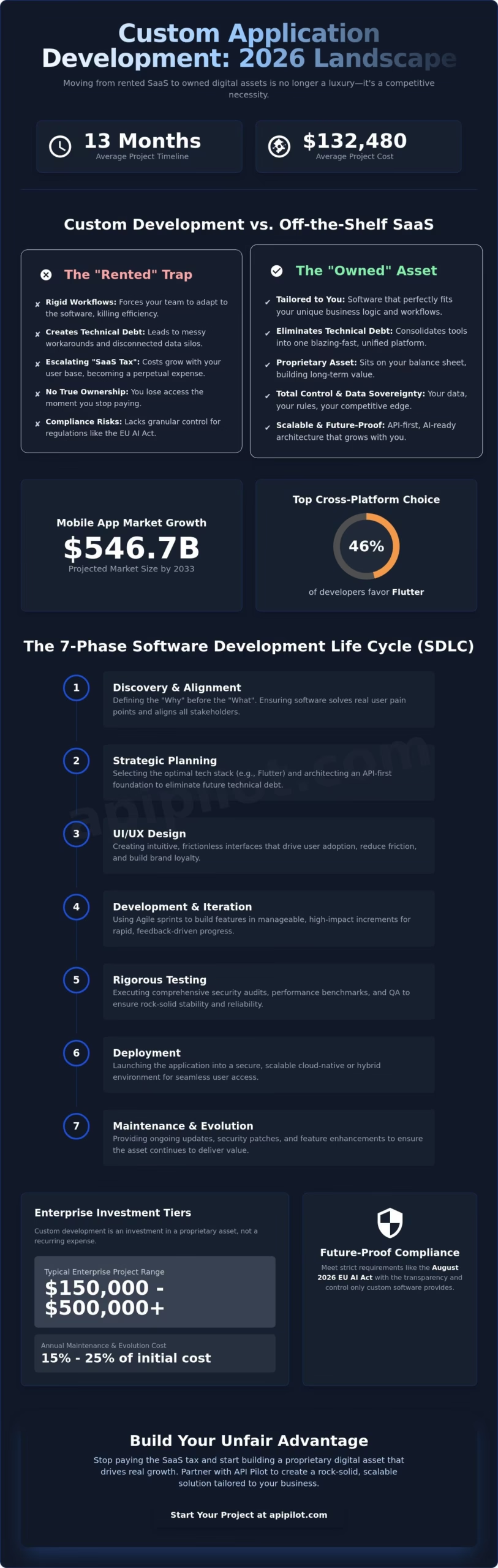
With the average custom software project now costing $132,480 and requiring a 13-month delivery timeline, the stakes for custom application development have never been higher. You’re likely tired of paying premium prices for generic SaaS tools that don’t fit your specific workflows or leave your data fragmented across disconnected silos. In 2026, building a proprietary asset isn’t just a luxury; it’s a requirement to stay competitive in a mobile app market projected to exceed $546.7 billion by 2033.
You know that off-the-shelf solutions often create more technical debt than they solve, forcing your team to adapt to the software rather than the other way around. This guide provides the strategic framework to build a rock-solid, API-driven ecosystem that eliminates that debt while ensuring your systems scale with blazing-fast efficiency. We’ll break down the 2026 cost tiers, explore why 46% of developers now favor Flutter for cross-platform speed, and show you how to meet the August 2026 EU AI Act requirements without stalling your product roadmap.
Key Takeaways
- Shift your strategy from simple feature lists to building an API-first, AI-ready architecture that ensures long-term scalability.
- Navigate the 7-phase SDLC to align stakeholders early and select a tech stack that proactively eliminates technical debt.
- Evaluate the total cost of ownership for custom application development against the rigid limitations and hidden costs of generic SaaS subscriptions.
- Implement enterprise-grade security protocols and robust connectivity to create a seamless, protected ecosystem for your business data.
- Discover how a hybrid development model combines high-level strategic planning with precise technical execution to deliver rock-solid enterprise ERPs.
What is Custom Application Development in 2026?
In 2026, custom application development has evolved from a luxury for tech giants into a fundamental survival strategy for the enterprise. It’s no longer just about building bespoke features. It’s about moving from a “rented” infrastructure to an “owned” architecture that is API-first and AI-ready. Companies that rely on generic SaaS often find themselves trapped in rigid workflows that don’t scale. These off-the-shelf tools carry hidden costs, including escalating licensing fees and the inability to adapt to your unique business logic.
To see how the landscape is changing even at the entry level, watch this helpful video:
Owning your code provides the ultimate competitive edge because it allows for total control over data sovereignty and performance. Generic tools come with a “SaaS tax” that grows alongside your user base. By 2026, high-risk AI system requirements under the EU AI Act mean your software must be transparent and accountable. Off-the-shelf solutions rarely offer the granular control needed for this level of compliance. Building custom ensures you aren’t at the mercy of a third-party vendor’s roadmap or security vulnerabilities.
Custom Software vs. Proprietary Digital Assets
Custom software represents a rock-solid digital asset that sits on your balance sheet rather than appearing as a never-ending monthly expense. Unlike subscription-based tools where you lose access the moment you stop paying, bespoke code is yours to keep, modify, and scale. Partnering with a specialized agency like Larasoft ensures your custom application is built on a scalable foundation that allows businesses to leverage their unique information as a competitive weapon. This transition from expense to asset is why enterprise-level projects often reach the $150,000 to $500,000 tier, as they provide a proprietary engine for long-term growth.
Addressing the Technical Debt Trap
Generic software forces teams to build manual workarounds, which are the primary drivers of technical debt. These inefficient patches and disconnected tools slow down operations and lead to project failure. Following a structured Software Development Life Cycle (SDLC) ensures that your custom build addresses these inefficiencies from day one. Instead of juggling five disconnected apps, a unified custom platform can consolidate your entire workflow into one blazing-fast interface. In the next section, we’ll explore how modern enterprises are moving from five fragmented tools to one unified custom platform to reclaim their productivity.
The 7-Phase Custom Software Development Life Cycle (SDLC)
Success in custom application development depends on a rigorous, repeatable framework. While the average project timeline in 2026 spans 13 months, high-performing teams use a structured SDLC to compress development cycles by 30% to 40% without sacrificing quality. This process isn’t just about writing code; it’s about Driving Business Growth through strategic alignment and technical precision. By following a disciplined path, you ensure that every line of code serves a specific business objective and eliminates the risk of project failure.
The 2026 SDLC standard consists of seven critical phases:
- Discovery and Stakeholder Alignment: Defining the “Why” before the “What” to ensure the software solves real user pains.
- Strategic Planning: Selecting the tech stack, such as Flutter for its 46% market leadership in cross-platform development.
- UI/UX Design: Creating intuitive interfaces that drive brand loyalty and reduce user friction.
- Development and Iteration: Using Agile sprints to build out features in manageable, high-impact increments.
- Rigorous Testing: Executing security audits and performance benchmarking to ensure rock-solid stability.
- Deployment: Launching the application into a cloud-native or hybrid environment.
- Maintenance and Evolution: Providing ongoing updates to manage the typical 15% to 25% annual maintenance cost.
Phase 1-3: From Concept to Prototype
Modern discovery phases must include a thorough API audit to map out how your new asset will communicate with existing tools. You can’t build in a vacuum. By prioritizing an API-first approach, you ensure your software is ready for the 2026 data economy. This is also where you define your Minimum Viable Product (MVP). For most enterprises, an MVP costing between $15,000 and $50,000 allows for rapid market testing. If you’re looking for a partner to guide you through this initial strategy, exploring expert development services can help clarify your roadmap.
Phase 4-7: Development, Deployment, and Beyond
The development phase typically accounts for 40% to 50% of your total budget. In 2026, this phase is dominated by Continuous Integration and Continuous Deployment (CI/CD) pipelines. These pipelines automate testing and deployment, allowing for blazing-fast updates that don’t break the production environment. Security is no longer a final step; it’s integrated into every sprint through DevSecOps. Once live, your focus shifts to performance. Optimized backend endpoints ensure your app remains responsive even as your user base scales, keeping your proprietary asset robust and reliable.
Custom Development vs. Off-the-Shelf: A Strategic Comparison
Deciding between custom application development and off-the-shelf software is a high-stakes choice for any 2026 enterprise. While the initial $132,480 average price tag for custom software might seem steep compared to a $200 monthly subscription, the Total Cost of Ownership (TCO) tells a different story. Off-the-shelf tools often come with a “SaaS tax” that grows alongside your user base. These generic platforms force your team into rigid workflows, creating operational friction that eventually erodes your competitive edge. Custom builds allow you to dictate the logic, ensuring the software bends to your business rather than the other way around.
Modern frameworks have fundamentally changed the speed-to-market debate. In the past, “bespoke” meant “slow.” Today, cross-platform leaders like Flutter reduce development efforts by 50% to 80%, allowing for rapid prototyping that rivals the setup time of complex enterprise SaaS. You get the speed of a template with the rock-solid performance of a custom engine. This shift enables businesses to launch proprietary assets that integrate seamlessly with existing data through bespoke APIs, rather than struggling with the restricted endpoints of third-party plugins.
Security and compliance also present a stark contrast. Generic software is a high-value target for hackers because a single vulnerability can expose thousands of companies. Custom environments are hardened to your specific needs. With annual compliance audit costs for HIPAA or SOC 2 ranging from $5,000 to $50,000, having a system built for these regulations from day one saves significant resources. You aren’t just buying features; you’re investing in an enterprise-grade fortress for your data.
When to Buy: Low-Stakes Business Functions
Buying makes sense for non-core processes that don’t provide a competitive advantage. Standard accounting, basic HR management, and internal messaging are prime candidates for SaaS. Over-customizing these standard tools often leads to unnecessary complexity. Maintaining a hybrid software ecosystem allows you to use generic tools for back-office tasks while focusing your custom application development budget on the tools that actually drive your revenue.
When to Build: Core Revenue Drivers
Build when the software is the product or the primary engine of your service. Custom CRMs and ERPs allow you to capture and leverage unique data points that generic tools simply ignore. As your user base grows, you’ll eventually hit the ceiling of “Pro” plan limits, where per-seat pricing becomes a financial drain. Investing in a proprietary software asset delivers a superior ROI compared to the compounding operational friction and financial drain of perpetual SaaS bloat. A custom build ensures your backend remains blazing-fast as you scale from 1,000 to 1,000,000 users without the fear of sudden vendor price hikes or platform deprecation.
Essential Pillars of Modern Custom Apps: Security and Connectivity
Low-code platforms often promise rapid deployment but fail when your enterprise hits real-world complexity. True scalability requires an API-first architecture. This approach ensures your custom application development project doesn’t become an isolated data silo. Instead, your software must communicate seamlessly with your entire tech stack through robust JSON endpoints and powerful SDKs. By prioritizing connectivity early, you eliminate the fragmentation that slows down 70% of digital transformation efforts.
Security in 2026 goes beyond the generic “built-in” features of a third-party cloud. Your proprietary apps need enterprise-grade hardening. This includes end-to-end encryption and OAuth2 authentication protocols to protect sensitive business logic. With the August 2026 EU AI Act deadline approaching, your backend must manage data transparency and privacy with absolute precision. Secure your assets by building on a foundation that exceeds standard compliance and protects against emerging AI-driven threats.
The Power of Custom API Development
Custom APIs act as the essential glue for modern enterprise software. They automate data synchronization across disconnected tools, removing the need for manual workarounds that create technical debt. API Pilot focuses on delivering blazing-fast endpoint response times to ensure your users experience zero lag, regardless of the complexity of the query. A well-designed API layer allows you to scale your operations without rebuilding your core infrastructure every year. If you want to build a truly connected digital ecosystem, consult with our API development experts to map out your architecture.
Future-Proofing with AI and Scalable Backends
Future-proofing your application means integrating custom AI models directly into your business workflows. Whether you’re automating customer support or optimizing supply chains, your backend must handle these intensive workloads without crashing. Cloud-native development on AWS, Azure, or Google Cloud provides the elasticity to grow from 1,000 users today to 1,000,000 users tomorrow. We use redundant server architectures to provide rock-solid uptime, ensuring your business remains operational through peak traffic and unexpected outages. This combination of mobile-first design and a robust backend creates a seamless experience on both iOS and Android.
Driving Business Growth with API Pilot’s Custom Solutions
Building a proprietary software asset requires more than just code; it requires a global strategy that balances high-level architecture with relentless technical execution. At API Pilot, we’ve refined a unique model that combines the strategic oversight of our Las Vegas headquarters with the deep technical expertise of our Karachi development hub. This synergy allows us to deliver custom application development projects that are both visionary and robust. It’s why our technology foundations are trusted by over 1,000,000 developers worldwide. We don’t just build apps; we build the scalable engines that power modern enterprise growth.
Our full-stack expertise spans the entire digital spectrum. Whether you need a high-performance mobile app for iOS and Android or a complex enterprise ERP to consolidate your global operations, we have the specialized talent to deliver. We’ve optimized our internal workflows to provide enterprise-grade software in minutes, not months. By leveraging pre-built, secure API modules and automated CI/CD pipelines, we bypass the common bottlenecks that stall traditional projects. You get a proprietary asset that is blazing-fast and rock-solid from the very first deployment.
Our Global Delivery Model: Efficiency Meets Quality
The synergy between our Las Vegas and Karachi offices creates a 24/7 development cycle that significantly accelerates your time-to-market. While your local competitors are offline, our global team is iterating, testing, and refining your codebase. This model provides you with direct access to high-level technical architects who understand your business goals, backed by a massive technical engine capable of handling high-complexity builds. This onshore-offshore mix ensures that quality is never sacrificed for speed. You receive the cost-efficiency of global talent without the communication barriers or project management headaches typically associated with traditional outsourcing.
Ready to Build Your Proprietary Asset?
Your journey toward eliminating technical debt and gaining a competitive edge starts with a comprehensive technical audit. We examine your existing infrastructure, identify fragmented data silos, and map out a roadmap for a unified digital ecosystem. We’re committed to providing rock-solid uptime and blazing-fast performance for every tool we build. Don’t let generic SaaS limitations hold your business back from its full potential in 2026. Schedule a consultation with API Pilot today to transform your vision into a high-performance software asset.
Future-Proof Your Enterprise Infrastructure
Transitioning from restricted SaaS tools to proprietary digital assets is the only way to maintain a competitive edge in 2026. By following a structured SDLC and prioritizing an API-first architecture, you eliminate the technical debt that slows down traditional enterprises. High-performing custom application development ensures your business logic remains flexible while your data stays secure within a hardened, enterprise-grade environment. You’ve seen how owning your code provides a superior long-term ROI compared to the compounding costs and operational friction of generic subscriptions.
API Pilot provides the technical foundation you need to scale with confidence. Trusted by 1,000,000+ developers, our global teams in Las Vegas and Karachi specialize in delivering blazing-fast API and mobile development. We combine strategic oversight with relentless technical execution to build software that drives real business growth. Don’t let rigid workflows or fragmented data stall your innovation. Build your rock-solid custom application with API Pilot and take full control of your digital future. It’s time to build something powerful and permanent.
Frequently Asked Questions
What is the average cost of custom application development in 2026?
The average cost for a custom software project in 2026 is $132,480. Pricing tiers depend on complexity; simple MVPs range from $15,000 to $50,000, while high-complexity enterprise solutions often exceed $500,000. These costs reflect the total investment required to build a proprietary asset that eliminates recurring SaaS fees and long-term technical debt.
How long does it take to build a custom enterprise application?
A typical custom enterprise application requires approximately 13 months to complete. However, the use of cross-platform frameworks like Flutter can accelerate development cycles by 30% to 40%. This timeline covers the entire 7-phase SDLC, ensuring your software is rigorously tested and ready for enterprise-grade performance from the first day of deployment.
Is custom software more secure than off-the-shelf solutions?
Custom software provides superior security because it allows for hardened environments tailored to your specific threat profile. Unlike generic SaaS, where a single vulnerability affects millions of users, custom builds use private API endpoints and bespoke encryption. This granular control is essential for meeting the August 2026 EU AI Act requirements and managing annual compliance audits.
What is the difference between a web app and a mobile app in custom development?
Web apps are accessed through browsers, while mobile apps are installed on iOS or Android to leverage native device hardware. In 2026, 46% of developers use cross-platform frameworks like Flutter to build for both simultaneously. This strategy reduces development efforts by 50% to 80% compared to building separate native applications for each platform.
Can I integrate custom software with my existing tools like Shopify or Magento?
Yes, you can integrate custom software with any existing tool that offers an API. Modern custom application development focuses on creating a seamless digital ecosystem where data flows automatically between your proprietary platform and tools like Shopify or Magento. This eliminates fragmented data silos and ensures your business operations remain synchronized and efficient.
What happens to the software if I stop working with the development agency?
You retain 100% ownership of the source code and intellectual property. Unlike subscription-based SaaS models, where you lose access if you stop paying, a custom build is a permanent asset on your balance sheet. You have the freedom to manage the code internally or move it to another partner without losing your data or functionality.
How do I choose the right tech stack for my custom application?
Choosing a tech stack depends on your specific performance and scalability needs. Python remains the dominant choice for AI and data analysis, while Flutter is the leader for cross-platform mobile builds. You should prioritize frameworks that offer blazing-fast response times and rock-solid uptime to ensure your application can scale from 1,000 to 1,000,000 users.
Why is an API-first approach important for my business software?
An API-first approach ensures your software acts as a connected hub rather than an isolated silo. By designing the API layer first, you guarantee that every feature is easy-to-integrate with future tools and internal systems. This architecture is essential for building a scalable foundation that supports automated workflows and seamless data synchronization across your enterprise.