Your mobile app has a unique vision. To bring that vision to life without compromise, you need a backend that’s as unique as your idea. While off-the-shelf solutions offer a quick start, they often become a roadblock to growth, security, and true innovation. This guide will show you why and when your mobile app needs a custom Application Programming Interface (API) for ultimate control, security, and scalability.
What is a Custom API for a Mobile App?
Think of an API as the central nervous system of your mobile application. It’s the secure, invisible bridge that connects your app’s user interface (the front end) with its server and database (the back end). The API dictates how information is requested, sent, and managed, enabling everything from user logins to complex data processing. Unlike third-party APIs that offer a standardized set of functions, a custom API is designed and built from the ground up, exclusively for your business logic and your app’s specific needs.
Why a Generic Backend Isn’t Always Enough
Off-the-shelf solutions, often called Backend-as-a-Service (BaaS), are fantastic for building simple Minimum Viable Products (MVPs) quickly. They handle common tasks like authentication and database management. However, for ambitious, unique applications that aim to disrupt a market, these generic platforms often become a bottleneck. They can limit your feature set, compromise performance under heavy load, and lock you into a pricing model you can’t control. A custom API, on the other hand, is a strategic asset, providing a rock-solid foundation for long-term growth and a competitive edge.
Custom API vs. BaaS (e.g., Firebase): A Strategic Decision Framework
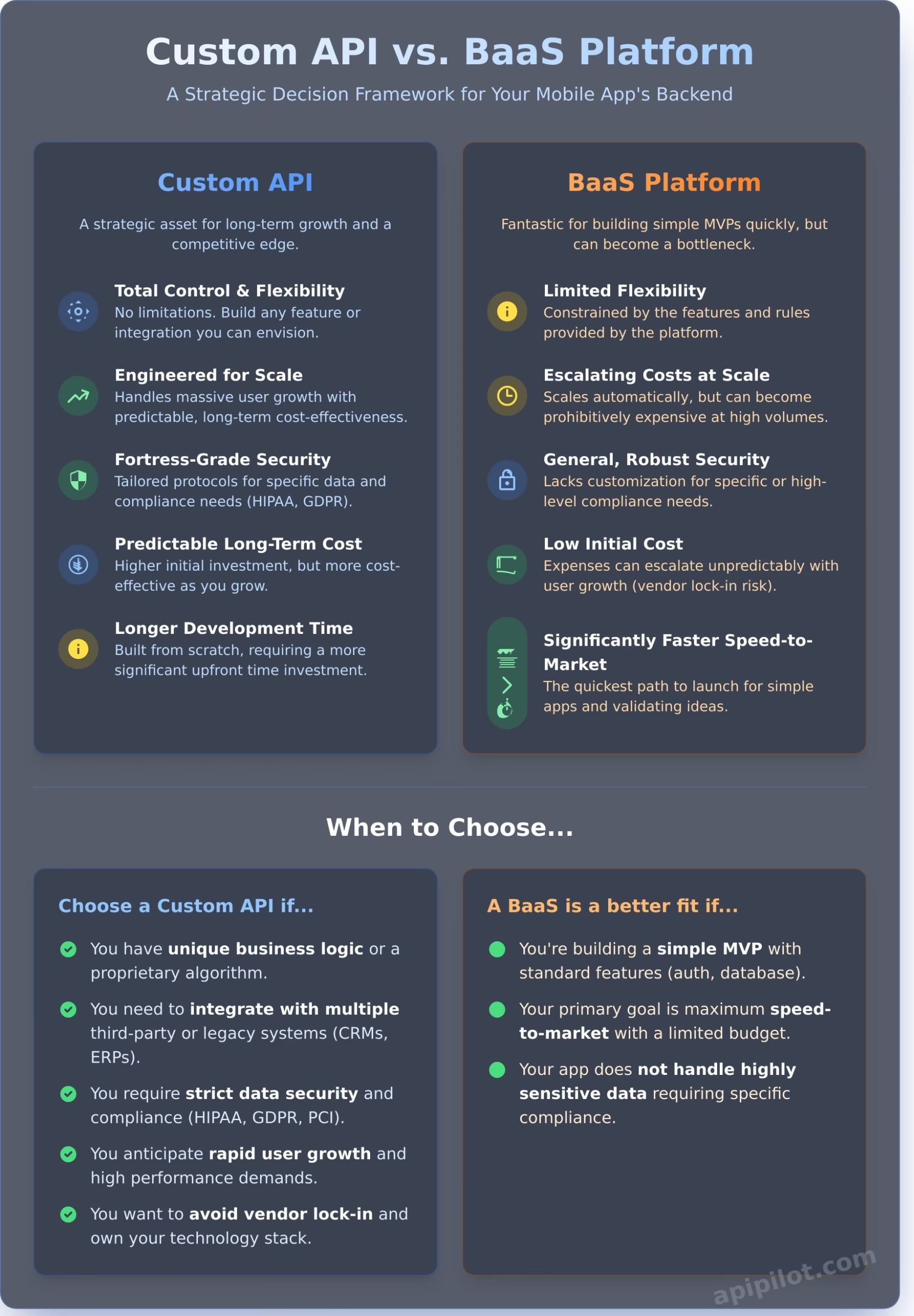
Choosing between a custom API and a BaaS platform is one of the most critical technical decisions you’ll make. The right choice depends entirely on your app’s goals, complexity, and long-term vision. Here is a side-by-side comparison to help you decide.
| Criterion | Custom API | BaaS Platform |
|---|---|---|
| Control & Flexibility | Complete control over features, logic, and integrations. No limitations. | Limited to the features and rules provided by the platform. |
| Scalability | Engineered specifically to handle your projected user growth and traffic. | Scales automatically, but can become prohibitively expensive at high volumes. |
| Security | Fortress-grade security protocols tailored to your specific data and compliance needs. | General, robust security, but lacks customization for specific compliance (e.g., HIPAA). |
| Cost | Higher initial investment, but more cost-effective and predictable in the long run. | Low initial cost, but expenses can escalate unpredictably with user growth. |
| Speed-to-Market | Longer development time as it’s built from scratch. | Significantly faster for simple applications and MVPs. |
When to Choose a Custom API: A Checklist
- You have unique business logic or a proprietary algorithm. If your app’s core value proposition relies on a function that can’t be replicated by generic services, a custom API is non-negotiable.
- You need to integrate with multiple third-party or legacy systems. A custom API can act as a central hub, orchestrating data flow between CRMs, ERPs, payment gateways, and other specialized software.
- You require strict data security and compliance. When handling sensitive user data that requires adherence to standards like HIPAA, GDPR, or PCI, a custom API gives you total control over security protocols.
- You anticipate rapid user growth and high performance demands. A custom architecture ensures your backend can handle the load from thousands or millions of users without compromising speed or user experience.
- You want to avoid vendor lock-in and escalating subscription costs. Owning your API means you control your technology stack and your budget, free from the pricing models of a third-party platform.
When a BaaS Platform Might Be a Better Fit
- You’re building a simple MVP with standard features. For apps that primarily need user authentication, a simple database, and file storage, a BaaS is often the quickest path to launch.
- Your primary goal is maximum speed to market with a limited budget. If you need to validate an idea quickly and inexpensively, the low initial barrier of a BaaS is a major advantage.
- Your app does not handle highly sensitive data. For applications where enterprise-level security and specific compliance are not primary concerns, the general security of a BaaS is typically sufficient.
The Core Business Benefits of Custom API Development
Investing in custom API development isn’t just a technical decision; it’s a business strategy that unlocks unparalleled performance, security, and scalability for your mobile app, creating a durable competitive advantage.
Fortress-Grade Security and Compliance
In an age of constant cyber threats, generic security is not enough. A custom API allows you to implement security protocols tailored to your specific application needs. You gain full control over data encryption, user authentication, access controls, and server infrastructure. This is critical for ensuring compliance with industry standards like GDPR, HIPAA, or PCI, protecting your users’ data and your company’s reputation.
Engineered for Performance and Scale
A sluggish app is a deleted app. With a custom API, you can design a backend architecture that grows efficiently with your user base. Our engineers optimize data queries and responses for a blazing-fast user experience, ensuring your app remains responsive even under heavy load. This prevents the performance degradation and lag common with generic solutions as they struggle to scale.
Total Control and Flexibility
Your imagination should be the only limit to your app’s features. A custom API frees you from the constraints of a third-party platform, allowing you to build any feature you can envision. You can integrate seamlessly with any third-party service or internal legacy system, creating a powerful, interconnected digital ecosystem. By owning your technology stack, you future-proof your business and retain the agility to pivot and innovate as the market evolves.
The Custom API Development Lifecycle: Our Phased Approach
At API Pilot, we believe in a structured, transparent process that turns a great idea into a powerful, enterprise-grade API. Our approach is divided into four distinct phases, ensuring alignment, quality, and a successful launch.
Phase 1: Discovery and Strategy
This is the foundational stage where we align on the vision. We work with you to define all app features, create detailed user stories, and map out the data they will require. We identify all necessary third-party integrations and create a comprehensive technical specification and project roadmap that will guide the entire development process.
Phase 2: Architecture and Design (REST vs. GraphQL)
With a clear roadmap, our architects design the blueprint for your API. This involves choosing the right API architecture—like REST for its simplicity and broad compatibility or GraphQL for its efficiency in handling complex data queries. We design a scalable database schema and system infrastructure, planning for performance and security from the ground up.
Phase 3: Development and Testing
Here, our developers bring the architecture to life. They write clean, efficient, and well-documented code for all API endpoints. We implement robust security measures, including authentication and authorization protocols. The code then undergoes rigorous testing—including unit, integration, and performance tests—to ensure it is bug-free, secure, and ready for production.
Phase 4: Deployment and Maintenance
Once the API passes all tests, we deploy it to a secure and scalable cloud environment (like AWS or Google Cloud). We provide your mobile developers with comprehensive API documentation to ensure a smooth integration process. But our partnership doesn’t end at launch. We offer ongoing maintenance, monitoring, and support to ensure your API remains performant and secure. Let’s architect an API that gives you a competitive edge.
Why Your Development Partner Matters More Than Your Tech Stack
The success of your API project ultimately hinges on the expertise, experience, and strategic insight of your development team. While technology choices are important, it’s the partner you choose who will navigate the complexities of building a secure, scalable, and maintainable system. Look for a partner with a proven track record in building enterprise-grade systems that solve real business problems. API Pilot delivers robust APIs that power business growth, leveraging our global team’s blend of strategic insight and deep technical expertise to build solutions that last.
Frequently Asked Questions
How much does it cost to build a custom API for a mobile app?
The cost varies widely based on complexity, the number of features (endpoints), third-party integrations, and security requirements. A simple API might start in the low thousands, while a complex, enterprise-grade API can be a significant investment. We provide a detailed estimate after the initial discovery phase.
How long does the API development process typically take?
Similar to cost, the timeline depends on complexity. A straightforward API for an MVP could take 4-8 weeks, whereas a more complex system with numerous integrations could take 3-6 months or longer. Our phased approach ensures clear milestones and predictable timelines.
What’s the difference between a REST and a GraphQL API?
REST is a widely adopted architectural style that uses standard methods (GET, POST, PUT, DELETE) to interact with resources. It’s simple and well-understood. GraphQL is a query language for APIs that allows the client to request exactly the data it needs and nothing more, making it highly efficient for apps with complex data needs.
Do I need a custom API for my Minimum Viable Product (MVP)?
Not always. If your MVP has standard features and your main goal is to test a market hypothesis quickly, a BaaS platform is often a better choice. However, if your MVP’s core feature relies on unique logic that a BaaS cannot support, a custom API is necessary from the start.
What kind of documentation will I receive with my custom API?
You will receive comprehensive, interactive API documentation (often using tools like Swagger/OpenAPI). This documentation clearly explains every endpoint, its required parameters, and the expected responses, making it easy for your mobile development team to integrate with the API.
A custom API is more than just code; it’s the engine that will power your app’s growth, protect your data, and enable you to deliver an exceptional user experience. It’s a strategic investment in the future of your business, giving you the freedom to innovate without limits.
Ready to build a powerful backend for your app? Contact API Pilot today.