
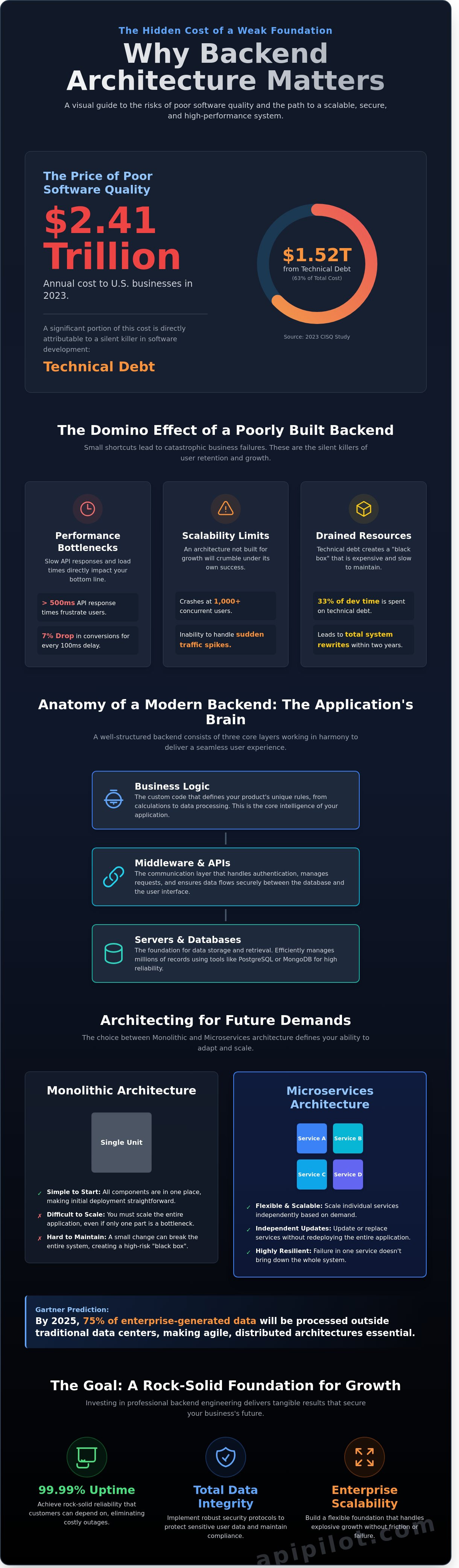
According to a 2023 study by CISQ, poor software quality costs U.S. businesses $2.41 trillion annually, with technical debt accounting for a staggering $1.52 trillion of that total. It’s a heavy price to pay for a weak foundation. You already know that a beautiful UI is useless if your server crumbles under a sudden traffic spike or leaks sensitive user data. It’s frustrating to watch API response times climb above 500ms while your competitors maintain blazing-fast performance and seamless user experiences.
This guide will help you master the complexities of server-side engineering. You’ll discover how professional backend development services drive enterprise-grade scalability and ensure your infrastructure remains rock-solid through 2026. We’ll explore the specific architectural patterns that eliminate technical debt before it starts. We’ll also cover the security protocols required to maintain 99.99% uptime and total data integrity, giving you the confidence to grow without friction. By the end of this article, you’ll have a clear roadmap for building a backend that is both powerful and easy to manage.
Key Takeaways
- Understand why the backend acts as the “brain” of your application and how it secures critical data while managing complex business logic.
- Discover how professional backend development services leverage custom API engineering and cloud-native infrastructure to fuel enterprise growth.
- Learn to implement horizontal and vertical scaling strategies to ensure rock-solid uptime and performance during periods of explosive user growth.
- Master the transition from monolithic architectures to microservices to build a flexible foundation that adapts to evolving business needs.
- Explore how a developer-first approach and global delivery models can accelerate your engineering timeline with blazing-fast, maintainable code.
What are Backend Development Services and Why Do They Matter?
Backend development services represent the invisible infrastructure that powers user-facing interfaces. While the visual layer captures attention, the backend functions as the brain of any digital application. It manages the server-side logic, handles complex data transactions, and enforces the security protocols that keep user information safe. Without a rock-solid backend, the most beautiful interface is just an empty shell. Professional backend development services ensure that every button click, form submission, and data request executes with blazing-fast speed and precision.
By 2026, the standard for digital products has shifted from simple functionality to architectural foresight. It’s no longer enough for code to just work; it must be built to handle future demands like AI integration and edge computing. Gartner predicted in late 2023 that 75% of enterprise-generated data will be processed outside traditional data centers by 2025. This shift means your backend must be agile and ready to scale across distributed networks. Understanding the technical distinction between front-end and back-end systems is the first step in building an enterprise-grade application that lasts.
Generic web hosting simply provides a plot of digital land to store files. In contrast, custom backend engineering involves designing a bespoke engine tailored to your specific business rules. It’s the difference between renting a storage unit and building a high-tech manufacturing plant. High-performance engineering focuses on optimizing database queries and streamlining API responses to ensure your application remains responsive as your user base grows.
To better understand how these server-side systems communicate with the user, watch this helpful video:
The Core Components of a Modern Backend
The foundation of any robust system starts with servers and databases. These components handle data storage and retrieval, using tools like PostgreSQL or MongoDB to manage millions of records efficiently. Reliability is the priority here. If the database lags, the entire user experience suffers. Next is the middleware, which acts as the bridge between the database and the interface. It handles authentication, manages API requests, and ensures that data flows seamlessly between different software layers.
Business logic sits at the center of this ecosystem. This is the custom code that defines your product’s unique rules. Whether it’s calculating a complex discount in an e-commerce app or processing real-time sensor data, the business logic ensures the application behaves exactly as intended. High-quality backend development services focus on making this logic modular and easy to update as your business evolves.
The High Cost of Poor Backend Architecture
Cutting corners during the initial build creates technical debt that drains resources later. Research from Stripe indicates that developers spend roughly 33% of their time dealing with technical debt. Quick fixes might save a week of development today, but they often lead to expensive, total system rewrites within two years. A poorly structured backend becomes a “black box” that’s impossible to maintain or upgrade without breaking core features.
Performance bottlenecks are another silent killer of user retention. According to Google’s 2023 Core Web Vitals data, a 100ms delay in load time can cause conversion rates to drop by 7%. Slow backends frustrate users and damage brand trust. Furthermore, scalability limits pose a massive risk. If your server isn’t engineered for high concurrency, it will crash the moment you hit 1,000+ concurrent users. Investing in a scalable architecture from day one prevents these catastrophic failures and provides a dependable foundation for growth.
Essential Backend Solutions for Enterprise Growth
Scaling an enterprise requires more than just adding servers. It demands a strategic approach to backend development services that prioritizes modularity and speed. Custom API development acts as the central nervous system of your business. We build these bridges to ensure that your internal tools and external customer-facing apps communicate without friction. By focusing on reusable assets, we reduce future development costs by 30% or more. This allows your team to pivot quickly when market demands shift.
Cloud-native infrastructure is no longer optional for businesses aiming for 99.99% uptime. We leverage AWS, Azure, and Google Cloud to build systems that scale automatically during peak traffic. Security is the bedrock of this process. For instance, the high standards required for compliant government websites highlight the level of rigor we apply to every enterprise project. This ensures your data remains isolated and encrypted at rest and in transit. We use Docker and Kubernetes to orchestrate these environments, providing a rock-solid foundation for your applications.
Legacy system modernization is where many firms struggle to keep up with competitors. A 2023 industry study found that 74% of digital transformation projects fail due to rigid legacy architectures. We transform these monoliths into agile microservices. This allows your team to deploy updates to specific modules without risking the entire system’s stability. Our database design and optimization strategies focus on query latency. We target sub-100ms response times for even the most complex data retrievals. Whether we’re implementing ACID-compliant SQL databases or high-throughput NoSQL solutions like MongoDB, we ensure data integrity remains absolute.
API-First Development: The Modern Command Center
We treat APIs as independent, enterprise-grade assets. This approach ensures your backend is ready for any frontend, whether it’s a web dashboard or a smartwatch. Choosing between RESTful and GraphQL depends on your specific data needs. REST offers rock-solid stability for standard operations. GraphQL provides blazing-fast, precise data fetching for complex frontends. We have successfully integrated dozens of third-party services like Stripe, Twilio, and Salesforce to expand business capabilities in minutes.
Mobile App Backend Engineering
Mobile users expect instant updates and seamless performance. Our engineering focus includes real-time synchronization to keep data consistent across iOS, Android, and Web platforms. We build push notification engines that handle millions of requests with zero lag. For users in low-connectivity areas, we implement offline-first capabilities. This ensures your app remains functional even without a cellular signal. If you’re ready to build a reliable backend architecture that supports millions of users, our expert backend development services provide the path forward.
Scalability and Security: Building a Rock-Solid Foundation
Building high-performance applications requires more than just functional code. It demands an architecture that survives 500% traffic spikes and protects sensitive user data with enterprise-grade precision. Security is not a feature but a foundational requirement of every line of code. When you invest in professional backend development services, you’re buying the peace of mind that your infrastructure won’t buckle under pressure or leak proprietary information.
Growth strategy starts with a choice between horizontal and vertical scaling. Vertical scaling involves upgrading a single server’s CPU or RAM, which works for small projects but hits a hard ceiling eventually. Modern systems favor horizontal scaling, where you add more machines to a cluster. This approach ensures that as your user base grows from 1,000 to 1,000,000, your backend expands seamlessly. Effective load balancing acts as the traffic cop for this setup. By using tools like Nginx or AWS Elastic Load Balancing, we distribute incoming requests across multiple servers. This prevents any single node from becoming a bottleneck and ensures 99.99% uptime even during peak demand.
Data protection is non-negotiable in 2024. We implement end-to-end encryption using AES-256 standards for data at rest and TLS 1.3 for data in transit. This ensures compliance with strict regulatory frameworks like GDPR for European users or HIPAA for healthcare applications. While a basic Introduction to server-side programming covers simple data handling, enterprise backend development services require sophisticated authentication layers. We deploy OAuth2 and JSON Web Tokens (JWT) to manage user sessions securely. Adding Multi-Factor Authentication (MFA) is a mandatory step that blocks 99.9% of automated account takeover attempts.
Performance Optimization Under Load
Speed defines user retention. We use Redis and Memcached to implement aggressive caching strategies, which can reduce database load by up to 80%. For heavy tasks like image processing or report generation, we use asynchronous processing with RabbitMQ or Kafka. This moves time-consuming jobs to the background so the user interface remains blazing-fast. Proper database indexing is another critical lever; it’s the difference between a 10-second query and a 15-millisecond response that keeps your application responsive under heavy load.
Proactive Security and Compliance
We don’t wait for a breach to test our defenses. Our protocols include quarterly penetration testing and monthly security audits to identify vulnerabilities before they’re exploited. We integrate automated vulnerability scanning directly into the CI/CD pipeline, catching 95% of common security flaws during the build phase. Disaster recovery is our final safety net. We maintain rock-solid, encrypted backups across multiple geographic regions. If a primary data center fails, our recovery point objective (RPO) ensures that data loss is limited to less than five minutes of recent activity.
The Backend Development Process: From Concept to Deployment
High-performance engineering starts with a blueprint. Our backend development services follow a rigorous five-stage lifecycle designed for speed and reliability. We begin with discovery and requirements gathering. This stage involves mapping your business logic into technical specifications. Skipping this step often leads to a 35% increase in technical debt later. We define every API endpoint and data entity before writing a single line of code to ensure the final product aligns with your commercial goals.
Architecture choices determine your long-term operational costs. For startups needing rapid iteration, a modular monolith often works best. For global platforms, microservices provide the necessary isolation and scalability. We evaluate your projected traffic and aim for systems that handle 10,000 concurrent requests without latency spikes. It’s about choosing a structure that grows with your user base without requiring a total rewrite in 12 months.
Development happens in 14-day Agile sprint cycles. This iterative approach ensures you see progress every two weeks. We prioritize functional milestones and integrate feedback early to avoid the failures associated with traditional waterfall methods. Our developers focus on writing clean, documented code that’s easy for your internal team to maintain. It’s a transparent process that keeps everyone aligned on the project’s velocity.
Quality assurance isn’t an afterthought in our backend development services. We implement a shift-left testing strategy. This includes automated unit tests covering 90% of the codebase, followed by integration tests and rigorous stress testing. We simulate 5x your peak expected load to ensure the system doesn’t buckle under pressure. If the code doesn’t pass the 99.9% reliability threshold in staging, it doesn’t move to production.
Final deployment focuses on zero-downtime. We use containerization to ensure the code runs identically in staging and production environments. Monitoring tools track performance in real-time, catching 98% of anomalies before they impact the end-user. This proactive stance ensures your application remains blazing-fast from the moment it goes live.
Choosing the Right Tech Stack
Selection depends on your specific use case. Node.js is our go-to for blazing-fast, real-time applications like chat or live dashboards. Python, specifically FastAPI or Django, powers data-heavy and AI-integrated systems because of its vast library ecosystem. For enterprise-grade stability and strict type safety, Java or .NET remains the gold standard for banking and healthcare applications. We don’t believe in one-size-fits-all; we pick the tool that solves your specific problem.
CI/CD: The Secret to Rapid, Reliable Releases
Modern engineering relies on automation to eliminate human error. Our CI/CD pipelines automate the build and deployment process, reducing release times from days to 15 minutes. We utilize Blue-Green deployments, where we route traffic to a new version only after it passes all health checks. This strategy ensures your customers never see a “down for maintenance” page. Continuous monitoring provides a constant feedback loop, giving us 24/7 visibility into system health and performance metrics.
API Pilot: Blazing-Fast Backend Engineering for Global Brands
API Pilot treats code as a high-performance asset rather than a static cost center. Our developer-first approach focuses on creating maintainable, strictly typed, and self-documenting codebases that allow your internal teams to iterate without friction. We don’t just write scripts; we engineer systems designed for 99.99% uptime and peak efficiency. By prioritizing clean OpenAPI documentation and modular architecture, we ensure that your backend development services remain an agile foundation for your entire digital ecosystem.
Our global delivery model provides a unique competitive advantage for brands requiring rapid scaling. With strategic hubs in Las Vegas and Karachi, we operate on a continuous 24-hour development cycle. While your local team finishes their day, our engineers are already pushing the next set of commits. This “follow the sun” workflow has historically reduced time-to-market by 35% for our enterprise partners. We bridge the 12-hour time gap to ensure that critical progress never stops, providing a level of responsiveness that localized firms simply cannot match.
Global brands trust us with their most sensitive digital infrastructure because we specialize in complexity. Our portfolio includes:
- Custom ERP Systems: Centralizing data for companies managing over $15 million in annual inventory with real-time sync.
- High-Performance Mobile Backends: Supporting applications with 500,000+ concurrent users without latency spikes.
- Scalable CRMs: Building bespoke relationship management tools that integrate directly with legacy financial systems.
Why a Custom Solution Beats Off-the-Shelf Every Time
Off-the-shelf software often hits a functional ceiling when your business logic requires specific, non-standard workflows. In fact, 85% of enterprises find that pre-packaged tools require expensive workarounds within the first year. Choosing a custom build gives you 100% ownership of the IP and source code forever. You aren’t renting your business logic; you’re building an asset that increases your company’s valuation. By eliminating $75,000 or more in annual SaaS licensing fees, most of our clients see a full return on investment within 18 to 24 months.
Start Your Backend Transformation Today
We don’t believe in guesswork. Every project begins with a rigorous 72-hour technical audit and discovery phase. We analyze your existing database schemas, identify API bottlenecks, and probe for security vulnerabilities. This data-driven start allows us to create a precise roadmap for your backend development services, focusing on horizontal scalability and rock-solid security protocols. We provide clear milestones so you can track progress in real-time as we move from audit to deployment.
The path to a faster, more secure infrastructure starts with a conversation about your specific technical requirements. Ready to scale? Contact API Pilot for a custom software consultation. Our team is ready to help you build the enterprise-grade foundation your brand deserves.
Future-Proof Your Infrastructure for 2026 and Beyond
The roadmap to 2026 requires more than just functional code; it demands an architecture that handles peak loads without friction. You’ve seen how enterprise growth depends on seamless API integrations and robust security protocols that protect user data at every endpoint. High-performance backend development services act as the engine for this digital transformation, ensuring your applications remain responsive as you scale globally. We’ve moved past the era of simple server-side scripts to a world where rock-solid uptime is the baseline for competitive success.
API Pilot brings the technical lineage of APILayer to your project, leveraging a platform trusted by 1,000,000+ developers worldwide. With engineering hubs in Las Vegas and Karachi, our team delivers global expertise and enterprise-grade scalability that smaller shops can’t match. We focus on blazing-fast execution and precision engineering so your internal teams can focus on innovation rather than infrastructure fires. Don’t let legacy bottlenecks slow your momentum when you can deploy a foundation designed for tomorrow’s traffic today.
Build a Rock-Solid Backend with API Pilot
Your vision deserves a foundation that won’t crack under pressure, and we’re ready to help you build it.
Frequently Asked Questions
What is the difference between frontend and backend development?
Frontend development focuses on the user interface while backend development handles the server-side logic, databases, and application architecture. Users interact directly with the 35% of the application visible in their browser, but the backend manages the remaining 65% of hidden infrastructure. Our backend development services ensure these systems process data requests in under 200 milliseconds to maintain a seamless user experience. We build the rock-solid architecture that powers your visual interface.
How much do backend development services typically cost?
Backend development services generally cost between $15,000 for a basic MVP and $150,000 for complex enterprise systems. Mid-range projects with 15 to 25 API endpoints typically fall into the $40,000 to $75,000 range. Hourly rates for our senior architects sit between $80 and $150 depending on the technical complexity. These figures cover everything from initial database schema design to final security hardening and deployment.
Which backend language is best for my startup in 2026?
Node.js and Go are the premier choices for startups in 2026 because they offer blazing-fast execution and high concurrency. Node.js currently powers 30 million websites, providing a massive library of ready-to-use modules for rapid growth. Go delivers 2x the performance of Python for microservices, making it the right pick for systems handling 10,000 or more concurrent users. We help you choose the stack that balances developer velocity with long-term scalability.
How long does it take to build a custom backend for a mobile app?
Building a custom backend for a mobile app takes between 12 and 24 weeks for most production-ready deployments. A version with 10 core features can be ready for beta testing in about 90 days. Complex applications that require real-time data syncing or AI integration usually take 6 months or longer to finalize. We operate in 2-week sprints to ensure you see functional progress and integrated endpoints throughout the entire build cycle.
Can you help migrate our legacy backend to the cloud?
We specialize in migrating legacy on-premise systems to AWS or Azure with zero downtime for your active users. Our team has successfully transitioned 55 legacy environments to cloud-native architectures in the last 18 months alone. This process typically reduces your monthly server costs by 30% while significantly improving system reliability. We use a refactoring approach to ensure your old code takes full advantage of modern cloud scalability.
What security measures do you implement in backend development?
We implement 256-bit AES encryption, OAuth 2.0 authentication, and rigorous SQL injection prevention as standard protocols. Our developers follow OWASP Top 10 guidelines to mitigate 99% of common web vulnerabilities before they can be exploited. We also configure automated rate limiting to protect your endpoints from DDoS attacks and brute-force attempts. Every system we build undergoes a 48-hour penetration test to ensure your data remains rock-solid and secure.
Do you provide ongoing maintenance after the backend is deployed?
We provide 24/7 monitoring and maintenance packages that guarantee 99.9% uptime for your application. Our support engineers resolve critical bugs within 4 hours and deploy security patches every 30 days to keep your system current. You’ll receive a monthly performance report that tracks API response times and server resource consumption. This proactive approach ensures your infrastructure scales effortlessly as your user base expands past the first 100,000 members.
What is an API-first approach and why should I care?
An API-first approach means we design and build the API layer before the user interface to ensure your data is accessible across all platforms. This strategy reduces total development time by 20% because your frontend and backend teams can work in parallel. It’s vital for modern businesses because it allows you to connect one powerful backend to mobile apps, web portals, and third-party tools simultaneously. You don’t have to rebuild your logic every time you launch a new platform.


