
What if your UI design matters less than your API’s ability to automate a PCI DSS v4.0 audit? In 2026, the real budget driver isn’t the front end; it’s the “Compliance-as-Code” architecture required to survive a proactive regulatory landscape. You already know that launching a financial product requires more than just a slick interface. You’re likely feeling the pressure of the July 1, 2026, MiCA deadline or the stricter authentication rules mandated by the latest security standards. It’s a high-stakes environment where hidden KYC and AML costs can quickly derail a pre-seed budget.
This guide is part of our MVP development services resources, which explain how we plan, build and support this kind of work.
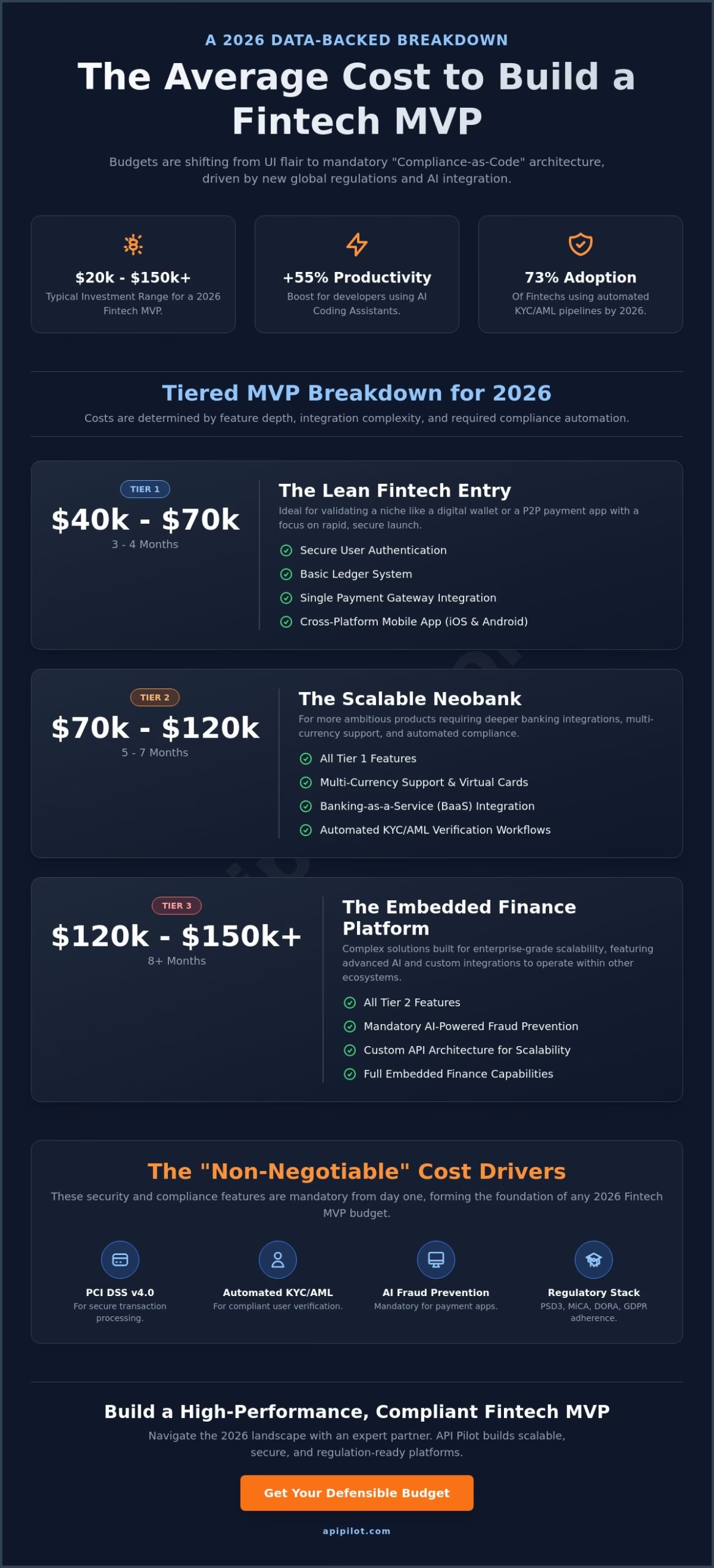
This guide provides a data-backed breakdown of the average cost to build fintech mvp 2026, covering everything from core feature development to the $25,000 required for basic transaction processing. You’ll get a clear, defensible budget for your investors that accounts for the latest tech stack requirements. We’ll explore how AI coding assistants, which now boost developer productivity by 55%, are reshaping the typical $20,000 to $150,000 investment range while helping you navigate the complex web of global regulations like DORA and GDPR.
Key Takeaways
- Map out the tiered investment requirements for 2026, distinguishing between $40,000 digital wallets and $150,000 full-scale neobank platforms.
- Navigate a landscape where the average cost to build fintech mvp 2026 is increasingly driven by PSD3 regulations and mandatory AI-powered fraud prevention.
- Quantify the budget impact of “non-negotiable” security features, including PCI-DSS compliance and robust, automated KYC/AML verification workflows.
- Execute a strategic hiring roadmap by comparing the efficiency of custom development agencies against the long-term overhead of in-house teams.
- Build for scalability using custom API architectures that ensure seamless integration and rock-solid performance across iOS and Android.
The 2026 Fintech Landscape: Why MVP Costs Have Shifted
The evolution of Financial technology (Fintech) reached a critical inflection point as we entered 2026. Building a “minimum” product no longer implies building a “simple” one. Regulators raised the floor, and user expectations followed. The average cost to build fintech mvp 2026 reflects this shift from experimental UI features to mandatory, high-stakes security protocols and “Compliance-as-Code” architectures. You aren’t just competing on features anymore; you’re competing on your platform’s ability to handle complex data flows without friction.
To better understand this concept, watch this helpful video:
The landscape is now defined by the full implementation of the MiCA regulation as of July 1, 2026, and the strict enforcement of PSD3. These frameworks demand that even the earliest versions of your software include robust data sharing and consumer protection layers. You can’t patch in security later. Modern startups must choose between a “Mobile-First” approach for rapid consumer adoption or an “API-First” architecture to ensure enterprise-grade scalability. While the average cost to build fintech mvp 2026 ranges from $20,000 to $150,000, this variability isn’t random. It depends on how deeply your product integrates with the global banking ecosystem and whether you’re building a basic wallet or a complex embedded finance solution.
Defining the Fintech MVP in 2026
In a market governed by the Digital Operational Resilience Act (DORA), a product must be production-ready from day one. We’ve seen a transition from simple wallets to embedded finance solutions that live inside other apps. Security is now a core feature. Your MVP must handle PCI DSS v4.0 requirements for ongoing monitoring and strict authentication. If it doesn’t meet these standards, it isn’t a product; it’s a liability. Regulators now use platform audits and algorithm reviews to supervise firms, making high-quality documentation and robust code non-negotiable.
The Impact of AI and Automation on Initial Budgets
AI coding assistants increased developer productivity by 55%, but the complexity of required features scaled even faster. Mandatory AI-driven fraud detection is now a standard requirement for any payment-related application. Integrating Large Language Models (LLMs) for document processing or customer support adds to the initial investment, but it’s essential for competing with established players. Automation of KYC and AML workflows is another major budget factor. By 2026, 73% of fintechs use these automated pipelines to reduce long-term operational overhead, ensuring that their blazing-fast performance isn’t bogged down by manual verification processes.
Tiered Breakdown: Average Cost to Build Fintech MVP 2026
Budgeting for a financial product in 2026 requires precision. You can’t rely on outdated estimates that ignore the current regulatory floor. The market now demands higher baseline security and performance from the first line of code. The average cost to build fintech mvp 2026 is divided into three distinct tiers based on feature depth, integration complexity, and the level of automated compliance required to go live.
Tier 1: The Lean Fintech Entry
This tier is designed for startups validating a specific niche, such as a localized digital wallet or a basic peer-to-peer payment app. The focus is on a blazing-fast launch with essential functionality. You won’t find complex AI here, but you will find a rock-solid foundation for future scaling.
- Budget Range: $40,000 – $70,000.
- Core Features: Secure user authentication, basic ledger system, and a single payment gateway integration.
- Tech Stack: Cross-platform frameworks like Flutter or React Native paired with a Node.js backend.
- Launch Timeline: 3–4 months.
Tier 2: The Scalable Neobank
Tier 2 products are more ambitious. They typically require multi-currency support and virtual card issuance. This tier involves deep integration with Banking-as-a-Service (BaaS) providers, which significantly impacts the budget due to the technical overhead of understanding fintech compliance and managing third-party risks. If you need a more robust infrastructure, investing in custom API development ensures your platform remains flexible as you add new financial services.
- Budget Range: $70,000 – $150,000.
- Advanced Features: Virtual/physical card provisioning, multi-currency wallets, and basic AI-driven spending insights.
- Infrastructure: Microservices architecture to handle concurrent transaction streams reliably.
- Launch Timeline: 5–7 months.
For organizations targeting Tier 3, the budget exceeds $150,000. These are complex enterprise-grade platforms featuring predictive analytics for credit scoring or high-frequency trading capabilities. These projects often involve custom-built fraud detection engines and extensive data encryption protocols to meet the March 2025 PCI DSS v4.0 standards that are now mandatory across all merchant tiers.
Development timelines in 2026 are increasingly efficient despite the complexity. While a Tier 1 MVP can hit the market in 12 weeks, a Tier 3 platform often requires 9 months or more for rigorous stress testing and regulatory audits. Success depends on choosing a partner who understands that speed is secondary to security in the financial sector.
The “Non-Negotiables”: Budgeting for Security and Compliance
Security is no longer a post-launch checklist item. In 2026, it’s the architectural foundation. Regulators shifted from reactive oversight to proactive reviews, meaning your MVP must be audit-ready before the first user signs up. This “Regulatory Tax” accounts for a significant portion of the average cost to build fintech mvp 2026, often adding 20% to 40% to the total budget. Ignoring these requirements doesn’t just risk a fine; it ensures your app will be delisted from major marketplaces under the strict enforcement of the Digital Operational Resilience Act (DORA).
Meeting the PCI DSS v4.0 standards is mandatory for any merchant processing card payments after the March 31, 2025 deadline. This involves implementing stricter authentication and ongoing monitoring of security controls. You’ll also need to budget for encryption protocols that ensure GDPR compliance. As of January 1, 2026, new regulations speed up cross-border enforcement, meaning data protection authorities now resolve cases within 12 to 15 months. Your technical stack must support seamless data portability and “Right to be Forgotten” requests from day one.
Third-party security audits are a prerequisite for bank-fintech partnerships in 2026. Sponsor banks now face increased accountability, leading to more detailed contracts and oversight. You should expect to conduct comprehensive penetration testing to prove your platform’s resilience. These audits verify your ICT risk management and incident reporting capabilities, which are core requirements under DORA. Building a robust, enterprise-grade system requires these deep-dive technical reviews to maintain rock-solid uptime and user trust.
KYC and Identity Verification Costs
Automating identity verification is essential for scaling. Integrating enterprise-grade providers like Onfido or Jumio ensures your onboarding is blazing-fast while maintaining rock-solid security. While third-party APIs have higher per-user fees, they significantly reduce the $7,000 to $15,000 initial development cost required for custom KYC logic. In 2026, KYC compliance costs are primarily driven by the need for real-time biometric verification and automated AML screening against global watchlists.
Regulatory Audits and Legal Fees
A legal-technical review is mandatory before your MVP hits the app store. This ensures your “Compliance-as-Code” pipeline accurately reflects the current regulatory landscape, including the MiCA authorization requirements for crypto-asset service providers by July 1, 2026. You must budget for continuous monitoring tools that provide real-time proof of compliance. This proactive approach prevents the massive costs associated with reactive fixes and keeps your operations running without friction.
Strategic Buying Guide: Agency vs. In-house vs. Freelancers
Choosing your development partner is the most consequential decision you’ll make. The average cost to build fintech mvp 2026 remains highly sensitive to your choice of labor. If you have a resident CTO, an in-house team offers maximum control, but the overhead is staggering. Annual salaries for fintech developers in 2026 range from $120,000 to $250,000. Add 30% for benefits and equipment, and your pre-seed budget vanishes before the first sprint. You must follow a structured audit process to ensure your capital isn’t wasted on inefficient execution models that fail to account for 2026 compliance standards.
- Step 1: Assess internal technical leadership. If you lack a full-time CTO, don’t hire individual freelancers. You need a partner that provides architectural oversight, technical direction, and a rock-solid roadmap.
- Step 2: Evaluate long-term maintenance. In-house teams are permanent liabilities. Agencies offer flexible scaling, allowing you to reduce costs after the initial launch while maintaining enterprise-grade performance.
- Step 3: Prioritize time-to-market. A 3-month launch with an agency beats a 7-month struggle with a cheaper remote team. Speed is a competitive advantage in a market where early adoption leads to dominance.
- Step 4: Audit for security certifications. ISO 27001 and SOC2 readiness aren’t optional. Your partner must prove they can handle sensitive financial data and survive proactive regulatory audits.
Why Custom Development Agencies Win in 2026
Agencies provide immediate access to specialized talent in AI and blockchain. They use pre-built modules and battle-tested APIs to slash development cycles by months. This efficiency is why 73% of companies now utilize flexible talent for core products. Contracts with established firms provide accountability during rigorous DORA audits. You get enterprise-grade performance without the long-term burden of a massive payroll. If you want a secure product, partner with an expert for custom software solutions.
The Hidden Risks of the Freelance Route
Freelancers appear cheaper with hourly rates between $75 and $200. However, the technical debt they leave behind is a silent killer. Scaling becomes impossible if the underlying code is fragile or poorly documented. One security vulnerability can end your startup instantly. Global remote teams also introduce communication friction that delays your launch and inflates the average cost to build fintech mvp 2026 through missed deadlines. A rock-solid foundation requires a cohesive team that understands your full regulatory obligations.
Maximizing ROI: How API Pilot Builds High-Performance Fintech
Building a financial product requires more than just a developer; it requires a strategic partner who understands the intersection of code and compliance. While the average cost to build fintech mvp 2026 provides a baseline for your initial budget, your real ROI comes from an “API-First” architecture. This approach decouples your core financial logic from the front end, allowing for seamless scaling across platforms. It reduces long-term maintenance costs by as much as 30% because you aren’t rebuilding the wheel for every new integration or regulatory update.
We deliver mobile excellence by focusing on native-level performance for both iOS and Android. Our development philosophy is simple: it must be blazing-fast and rock-solid. In a world where a three-second lag can lead to user churn, we prioritize low-latency endpoints and robust data handling. Our global delivery model bridges strategic leadership in Las Vegas with high-velocity execution in Karachi, ensuring you get enterprise-grade quality without the excessive overhead of a purely local team.
Our Approach to Custom Fintech Solutions
We handle the heavy lifting of compliance from concept to deployment. Our team builds scalable architectures that grow with your user base, ensuring your platform stays resilient as transaction volumes increase. We recently helped a Tier 1 startup launch a secure, PCI DSS v4.0 compliant digital wallet in exactly 12 weeks. By leveraging our custom API development expertise, we bypassed the common pitfalls that often inflate the average cost to build fintech mvp 2026 for less experienced teams.
- Custom API Development: We build the secure bridges that connect your app to the global financial ecosystem.
- Compliance-as-Code: We integrate automated audit trails and security protocols directly into your CI/CD pipeline.
- Native Mobile Apps: We deliver high-performance experiences that take full advantage of device-level security features.
Start Your Fintech Journey Today
A custom quote is always superior to an average estimate. Every fintech product has unique regulatory requirements and technical hurdles that a generic pricing sheet can’t capture. The API Pilot discovery process is designed to align your technical roadmap with your business goals, identifying the leanest path to a production-ready launch. We help you prioritize features that drive user adoption while ensuring your security posture is unassailable. Don’t leave your launch to chance. Schedule a consultation for your Fintech MVP and get a definitive roadmap for your 2026 launch.
Secure Your Competitive Edge in the 2026 Fintech Market
Launching a successful product requires navigating the complex intersection of high-performance code and strict regulatory mandates. We’ve explored how mandatory AI-driven security and frameworks like DORA have redefined the average cost to build fintech mvp 2026. You now have a tiered roadmap to justify your budget to investors and a strategic guide to choosing the right development model. Success in this market depends on building a rock-solid foundation that handles sensitive data with blazing-fast speed and unassailable security.
API Pilot specializes in custom API and enterprise-grade software designed for the high-stakes 2026 financial ecosystem. Our team is trusted by developers worldwide for delivering high-performance mobile applications that meet the highest standards of encryption and reliability. Don’t let hidden compliance costs or technical debt stall your innovation. Get a Custom Fintech MVP Quote from API Pilot and start building your scalable solution today. Your vision for a smarter financial future is within reach.
Frequently Asked Questions
Is $50,000 enough for a Fintech MVP in 2026?
$50,000 is sufficient for a Tier 1 digital wallet or payment app. This budget covers secure user registration and basic transaction logging within the $20,000 to $50,000 range. It won’t cover advanced features like predictive analytics or multi-currency support. You’ll need to focus on a single core assumption to stay within this investment level for a pre-seed startup.
How long does it take to build a Fintech MVP with regulatory compliance?
A production-grade MVP typically requires 3 to 7 months for development and auditing. Tier 1 launches take about 12 weeks. More complex platforms involving MiCA authorization or DORA compliance testing usually take 5 to 7 months. This timeline includes the mandatory security audits and legal-technical reviews required before your app hits the store in 2026.
What are the biggest hidden costs in Fintech development?
Compliance audits and third-party API integration fees are the most common hidden expenses. These can add 20% to 40% to your total budget. You must account for ongoing PCI DSS v4.0 monitoring and the “Compliance-as-Code” pipeline. Legal fees for jurisdiction-specific analysis and bank-fintech partnership oversight also contribute to these unexpected costs after your initial build is complete.
Can I use cross-platform frameworks like Flutter for a banking app?
Yes, cross-platform frameworks like Flutter and React Native are ideal for building high-performance banking apps. They deliver native-level speed and rock-solid security while reducing development time. These tools allow you to maintain a single codebase for iOS and Android, which is essential for managing the average cost to build fintech mvp 2026 effectively during the pre-seed stage.
Do I need to pay for a banking license for my MVP?
No, you don’t need your own license if you partner with a sponsor bank or BaaS provider. This “rented” license model is the standard approach for 2026 startups. It eliminates the massive capital requirements of a full banking charter. However, you’ll still face detailed contracts and oversight from your partner bank to ensure you meet their compliance standards.
What is the cost difference between a US-based and offshore Fintech team?
US-based developers command annual salaries between $120,000 and $250,000 plus 30% overhead. Offshore or hybrid teams typically reduce these costs by 50% or more. Many successful startups use a hybrid approach to access specialized talent while keeping their burn rate manageable. This strategy allows for enterprise-grade software development without the staggering costs of a purely local in-house team.
How much does it cost to maintain a Fintech app after launch?
Maintenance typically costs 20% of the original development price each year. This budget covers server infrastructure, security updates, and regulatory reporting tools. You’ll also need to fund continuous monitoring to satisfy proactive regulators who now conduct platform audits throughout the year. It’s a non-negotiable expense to ensure rock-solid uptime and maintain user trust in a competitive financial market.
How does AI integration affect the cost of a Fintech MVP?
AI integration increases the initial investment but is now mandatory for fraud detection and KYC workflows. While AI coding assistants boost developer productivity by 55%, the complexity of predictive analytics and LLM integrations for support adds to the average cost to build fintech mvp 2026. It’s a strategic trade-off that reduces long-term operational costs through automation and improved risk management.