
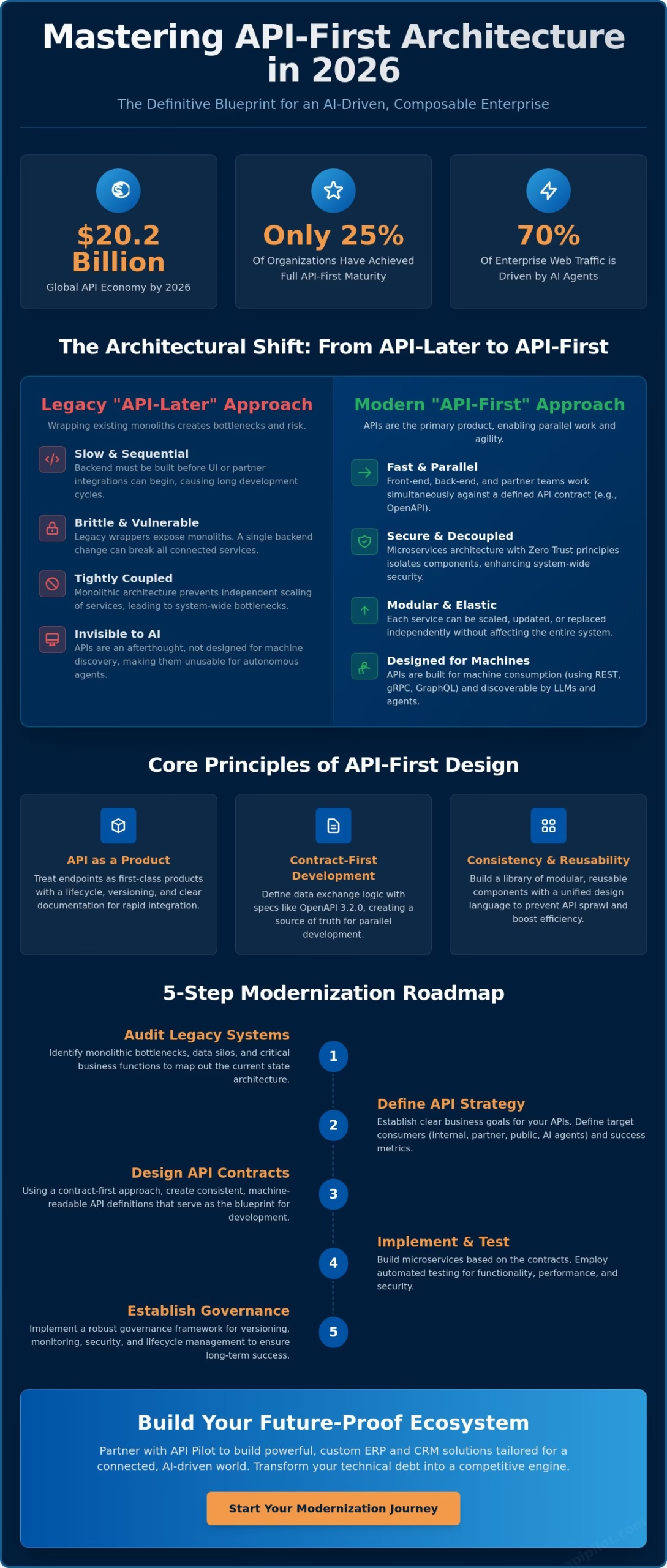
By the end of 2026, the global API economy will hit a staggering $20.2 billion, yet a mere 25% of organizations have achieved a fully API-first maturity level. If your team is battling slow time-to-market due to tightly coupled systems or struggling to secure legacy wrappers, you’re feeling the weight of a dying architectural era. You know that modern software must be more than just functional; it has to be a seamless, rock-solid foundation for the autonomous AI agents that now drive 70% of all enterprise web traffic.
This guide provides the definitive blueprint to master api-first architecture 2026 and transform your technical debt into a competitive engine. We’ll show you how to transition from monolithic bottlenecks to a future-proof, API-native environment that satisfies new mandates like the CMS-0057-F interoperability rule. You’ll gain a clear roadmap to build scalable systems, validate your ROI, and ensure your enterprise is ready for the next decade of AI-driven growth. Let’s explore the shift from being API-enabled to becoming API-native with blazing-fast efficiency.
Key Takeaways
- Learn how to pivot from legacy “API-later” wrapping to an API-native strategy where endpoints serve as your primary enterprise interface.
- Discover why designing for machine consumption is critical for supporting the autonomous AI agents that now drive over 70% of web traffic.
- Implement a robust api-first architecture 2026 to integrate Zero Trust security and eliminate system-wide bottlenecks through microservices.
- Follow a proven 5-step modernization roadmap to audit legacy systems and establish a high-performance API governance framework.
- Identify the strategic advantages of partnering with experts like API Pilot to build powerful, custom ERP and CRM solutions tailored for a connected ecosystem.
What is API-First Architecture in 2026?
In 2026, building software starts with the interface, not the user. An api-first architecture 2026 strategy represents a fundamental shift where developers design the API as the primary product before writing a single line of UI or backend code. This approach moves beyond the basic understanding of What is an API? to treat endpoints as the foundation of the “composable enterprise.” Instead of monolithic blocks, businesses now function as a collection of modular, rock-solid services that communicate through strictly defined, machine-readable contracts.
This year marks the tipping point for the API-native era. While 83.2% of organizations have adopted some level of API design, only 25% have achieved full architectural maturity. In an ecosystem where APIs account for over 70% of web traffic, the API acts as the official contract between business functions. It ensures that data flows with blazing-fast speed across internal teams and external partners, allowing companies to swap out backend components without disrupting the entire system.
To better understand the practical side of an API-first workflow, watch this helpful video from Postman:
API-First vs. API-Enabled: The Critical Distinction
Many enterprises still rely on an “API-later” approach, where they bolt a legacy wrapper onto an existing monolith. This strategy fails in 2026 because it creates security vulnerabilities and limits scalability. API-enabled systems are often brittle; a single change in the backend can break the entire integration. In contrast, API-native development ensures that systems are decoupled from the start. This allows teams to update, scale, and secure individual modules without risking a total system collapse. API-first design is the foundational requirement for modern digital decoupling and enterprise agility.
The Core Principles of API-First Design
Successful implementation of an api-first architecture 2026 relies on treating your technical infrastructure with the same care as your external brand. This involves three enterprise-grade principles:
- API as a Product: Stop viewing endpoints as technical exhaust. Treat them as a product with a lifecycle, versioning strategy, and clear documentation. This ensures that internal and external developers can integrate in minutes without needing constant support.
- Contract-First Development: Define the data exchange logic before writing backend code. By using the OpenAPI 3.2.0 specification, released on September 19, 2025, you create a source of truth that both front-end and back-end teams use to work in parallel.
- Consistency and Reusability: Build a library of modular components that follow a unified design language. This rock-solid approach prevents “API sprawl” and ensures that every new feature benefits from the security and performance of your existing ecosystem.
The AI Catalyst: Why 2026 Architectures Prioritize Machine Consumption
The user interface is no longer the primary gateway to enterprise data. In 2026, the real users are autonomous agents and Large Language Models (LLMs). While 89% of developers now use AI in their daily workflows, only 24% are actively designing endpoints for machine consumption. This gap represents a massive strategic risk for those failing to adopt an api-first architecture 2026. LLMs don’t navigate menus or click buttons; they discover, parse, and invoke endpoints. If your systems aren’t built for machine-to-machine discovery, they’re effectively invisible to the AI economy.
Moving beyond traditional REST is essential for these specialized tasks. While REST remains a staple, gRPC and GraphQL have seen a surge in adoption for machine-centric communication. gRPC provides the blazing-fast, low-latency performance required for high-speed data streaming between microservices. GraphQL allows AI agents to query exactly the data they need, reducing payload sizes and preventing over-fetching. By following modern API design principles, organizations ensure their data is accessible, structured, and ready for the 70% of web traffic that is now driven by non-human actors.
Designing for AI Agents and Autonomous Systems
Semantic API design is the new standard. Your endpoints must be self-describing so that an AI model can understand the context of a field without manual mapping. This requires comprehensive, machine-readable documentation and robust SDKs that serve as a manual for the LLM. Machines don’t sleep, and they don’t experience fatigue. Your infrastructure must implement enterprise-grade rate-limiting and fine-grained authorization to handle high-frequency machine requests. Without these rock-solid controls, a single autonomous agent could overwhelm your backend in seconds.
Event-Driven APIs and Real-Time Interoperability
The old request-response model is often too slow for instantaneous AI decision-making. In 2026, the focus has shifted toward event-driven architectures. By using Webhooks and WebSockets, your ecosystem becomes reactive. Instead of an agent constantly polling for updates, your system pushes data the moment a state change occurs. This creates a seamless flow of information that scales at machine speed. If your current systems struggle to maintain this level of connectivity, a specialized partner like API Pilot can help modernize your infrastructure for a connected, AI-ready future. Building a reactive ecosystem is no longer optional; it’s the only way to survive in a world where data moves at the speed of thought.
API-First vs. Traditional Architectures: Performance, Security, and Scalability
Traditional monolithic architectures are the primary source of technical debt in 2026. When your backend logic is tightly coupled with your user interface, a single update can trigger a system-wide failure. Shifting to an api-first architecture 2026 eliminates these bottlenecks by ensuring every service is an independent, modular unit. This decoupling allows your engineering teams to scale specific endpoints without over-provisioning the entire stack. It’s the difference between a rigid structure that cracks under pressure and a flexible ecosystem that expands on demand.
Reliability is no longer a luxury; it’s a requirement for survival. By using decoupled services, enterprises achieve rock-solid uptime because failures are isolated. If your payment gateway endpoint experiences a spike, your product catalog remains unaffected. This modularity also transforms the developer experience. Instead of wading through legacy spaghetti code, internal and external teams use standardized SDKs to integrate in minutes. Industry leaders are increasingly adopting an API-first approach to ensure their software remains performant and easy to maintain as it grows.
The Security Shift-Left in API Architecture
Security in 2026 has moved from the network edge directly into the design phase. Relying solely on Web Application Firewalls (WAFs) is insufficient when APIs account for 70% of enterprise traffic. Instead, developers implement a Zero Trust model at the endpoint level, using API Gateways to manage fine-grained authorization and encryption. Shift-Left is the integration of security audits into the CI/CD pipeline. By catching vulnerabilities during the design stage, you protect your data before a single line of code is deployed. This proactive stance ensures your enterprise-grade applications stay secure against modern threats.
Scalability and the MACH Movement
The MACH movement is the engine behind most successful digital transformations this year. MACH stands for Microservices, API-first, Cloud-native, and Headless. In the past year, 87% of organizations increased their adoption of this architecture to gain faster feature deployment and greater flexibility. A headless approach decouples the frontend from the backend, allowing you to deliver content across multiple platforms seamlessly. For example, a retailer can update their mobile app UI while the core inventory logic remains untouched. This separation of concerns ensures that your software is modular, scalable, and ready to handle the demands of an api-first architecture 2026.
Implementing API-First: A 5-Step Roadmap for Modernizing Legacy Systems
Transitioning to an api-first architecture 2026 requires more than a shift in code; it’s a total cultural and structural pivot. Most enterprises aren’t starting from scratch. They’re managing legacy systems that were never intended for the machine-centric world of 2026. Moving from a “bolted-on” API model to an API-native one requires a tactical, phased approach that minimizes risk while maximizing performance.
- Step 1: Audit and Isolate. Start by auditing your existing monolith to identify critical, “API-ready” business logic. Focus on high-value modules that external partners or AI agents need to access most frequently.
- Step 2: Establish Governance. Consistency is the enemy of complexity. Define a centralized governance framework that dictates security standards, naming conventions, and versioning protocols to ensure every endpoint feels like a part of a unified product.
- Step 3: Design the Contract. Use the OpenAPI 3.2.0 specification, released on September 19, 2025, to define your API logic before writing any backend code. This contract serves as the source of truth for all stakeholders.
- Step 4: The Strangler Fig Pattern. Don’t attempt a “big bang” migration. Use the Strangler Fig pattern to wrap legacy functionality in new API interfaces, gradually migrating services to a microservices model until the old system is obsolete.
- Step 5: Automate for Speed. Integrate automated testing and security audits directly into your CI/CD pipeline. This ensures a blazing-fast delivery cycle and rock-solid reliability for every deployment.
Overcoming the ‘Monolith’ Inertia
Justifying the ROI of an architectural overhaul to non-technical stakeholders is often the hardest part of the journey. Focus on the numbers. The API economy is projected to reach $20.2 billion this year, and companies that fail to modernize will face increasing costs from slow time-to-market. Start small by choosing a high-impact, low-risk pilot project. This provides a quick win that proves the value of digital decoupling. Managing the cultural shift requires moving engineering teams away from “feature-first” thinking toward a “contract-first” mindset where the API is the core product.
Tools and Technologies for the 2026 Stack
Your stack must be as modular as your architecture. Essential tools for 2026 include enterprise-grade API Gateways that handle global, multi-region deployments with ease. Google Apigee and Azure API Management remain top choices for managing high-traffic environments, with standard proxies costing around $20 per million calls. Low-code and no-code tools also play a vital role in 2026, allowing teams to prototype and mock API designs in minutes before committing to full-scale development. If you’re ready to move beyond legacy limitations, partner with API Pilot to execute your modernization roadmap and build custom software designed for a connected ecosystem.
Scaling with API Pilot: Custom Software Built for a Connected Ecosystem
Choosing the right partner is the difference between a failed digital transformation and a dominant market position. API Pilot is the preferred partner for organizations that demand more than just code. We provide a strategic blueprint for api-first architecture 2026, ensuring your custom software is ready for the high-frequency demands of autonomous agents. Our global reach, extending from Las Vegas to Karachi, allows us to provide localized support while maintaining enterprise-grade standards. We understand that your business needs to scale across borders, and our team is equipped to deliver robust solutions that work in every time zone.
The ‘API Pilot Method’ centers on three essential pillars: seamless integration, rock-solid security, and blazing-fast performance. We don’t just build apps; we architect ecosystems. By prioritizing the API as the core product, we ensure your systems can automate complex workflows and enrich data in real-time. This approach is vital for large enterprises where APIs now account for more than 70% of all web traffic. Our focus on quantifiable value means every line of code we write is designed to boost your ROI and future-proof your digital assets. We remove the friction from integration so your team can focus on growth.
Custom ERP and CRM Solutions Powered by API-First
Traditional ERP and CRM systems often act as data silos that slow down your time-to-market. At API Pilot, we build custom solutions powered by an api-first architecture 2026 to break these barriers and streamline your operations. Our tailored integrations allow your sales, finance, and logistics modules to communicate without friction. This modularity ensures your platform remains scalable as your business grows, preventing the system-wide bottlenecks common in legacy monoliths. Contact us to start your modernization journey and replace your rigid legacy software with a powerful, connected engine built for the next decade.
Mobile and E-commerce Excellence
In the competitive e-commerce sector, speed directly influences your conversion rates and customer retention. We leverage API-first design to build high-performance mobile applications that deliver content with blazing-fast speed. By decoupling the frontend from the backend, we optimize your platform for both security and user experience across all devices. This headless approach allows you to deploy new features in minutes rather than weeks, keeping you ahead of market trends. Explore our custom software solutions at API Pilot to see how we can power your next digital breakthrough and build a foundation for long-term growth.
Future-Proof Your Enterprise with API-Native Design
Adopting an api-first architecture 2026 is no longer a technical preference; it’s a survival requirement for the autonomous age. By prioritizing machine-readable contracts and modular design, you eliminate the bottlenecks of legacy monoliths and prepare your data for the $20.2 billion API economy. We’ve explored how transitioning to MACH principles and implementing a “shift-left” security model protects your infrastructure while ensuring blazing-fast delivery cycles. These aren’t just technical upgrades. They’re the strategic foundations of a resilient, AI-ready business.
API Pilot specializes in these high-stakes transitions. Our global team across Las Vegas and Karachi brings deep expertise in custom ERP/CRM development and rock-solid API integration. We help you build powerful, scalable software that doesn’t just keep up with the market but defines it. Scale your business with API-first custom software from API Pilot. Your modernization journey starts with a single modular step. Build for the future today.
Frequently Asked Questions
What is the main benefit of API-first architecture for businesses in 2026?
Accelerated time-to-market and organizational agility are the primary advantages. By designing the interface before the code, front-end and back-end teams work in parallel, often reducing development cycles by 30% compared to traditional models. This api-first architecture 2026 strategy ensures your business remains flexible enough to pivot as market demands shift, preventing the rigid constraints of legacy monoliths.
How does API-first architecture support AI and machine learning integration?
API-first design provides the structured, machine-readable endpoints that autonomous AI agents require to function. Since non-human actors now drive 70% of enterprise web traffic, your system must offer semantic discovery and robust rate-limiting. Designing for machine consumption ensures that Large Language Models can discover and invoke your services without manual intervention, turning your data into an AI-ready asset.
Is API-first more expensive than traditional software development?
Initial design costs are typically higher, but the total cost of ownership is lower due to reduced technical debt. While traditional development skips the rigorous design phase, it often leads to expensive system-wide failures later. An API-first approach prevents these bottlenecks, allowing you to scale individual modules independently and lowering long-term maintenance costs by up to 40% over a three-year period.
What is the difference between REST and GraphQL in an API-first approach?
REST provides a standardized, stateless interface ideal for broad interoperability, while GraphQL allows clients to request exactly the data they need. In a modern api-first architecture 2026, REST is the default for public endpoints due to its reliability. GraphQL is preferred for internal systems and AI agents where reducing payload size and preventing over-fetching is critical for blazing-fast performance.
Can legacy monolithic systems be converted to API-first architecture?
Legacy systems are successfully modernized using the Strangler Fig pattern to replace functionality incrementally. You don’t need a risky “big bang” migration. Instead, wrap existing logic in new API interfaces and migrate services one by one. This phased approach allows you to maintain rock-solid uptime while transitioning your entire ecosystem to a modern, decoupled environment without disrupting daily operations.
What role does API governance play in enterprise software development?
API governance ensures consistency, security, and reusability across your entire digital landscape. Without a centralized framework, organizations suffer from “API sprawl,” where redundant or insecure endpoints create massive vulnerabilities. Proper governance enforces naming conventions and Zero Trust security protocols, ensuring every service meets enterprise-grade standards before it reaches the CI/CD pipeline for deployment.
How do I choose between a public and private API strategy?
Choose a private strategy for internal decoupling and a public strategy to foster a developer marketplace or ecosystem. Private APIs secure your internal data flow, while public APIs turn your services into a revenue-generating product. Most successful enterprises in 2026 use a hybrid approach, keeping core logic private while exposing high-value modules to external partners for seamless integration.
Why is developer experience (DX) critical for API-first success?
Developer experience determines how quickly your tools are adopted and integrated by engineering teams. If your documentation is poor or your SDKs are brittle, developers will find alternatives. High-quality DX, featuring self-service portals and clear OpenAPI specifications, allows internal and external teams to integrate in minutes. This directly impacts your bottom line and the overall success of your architectural strategy.


