
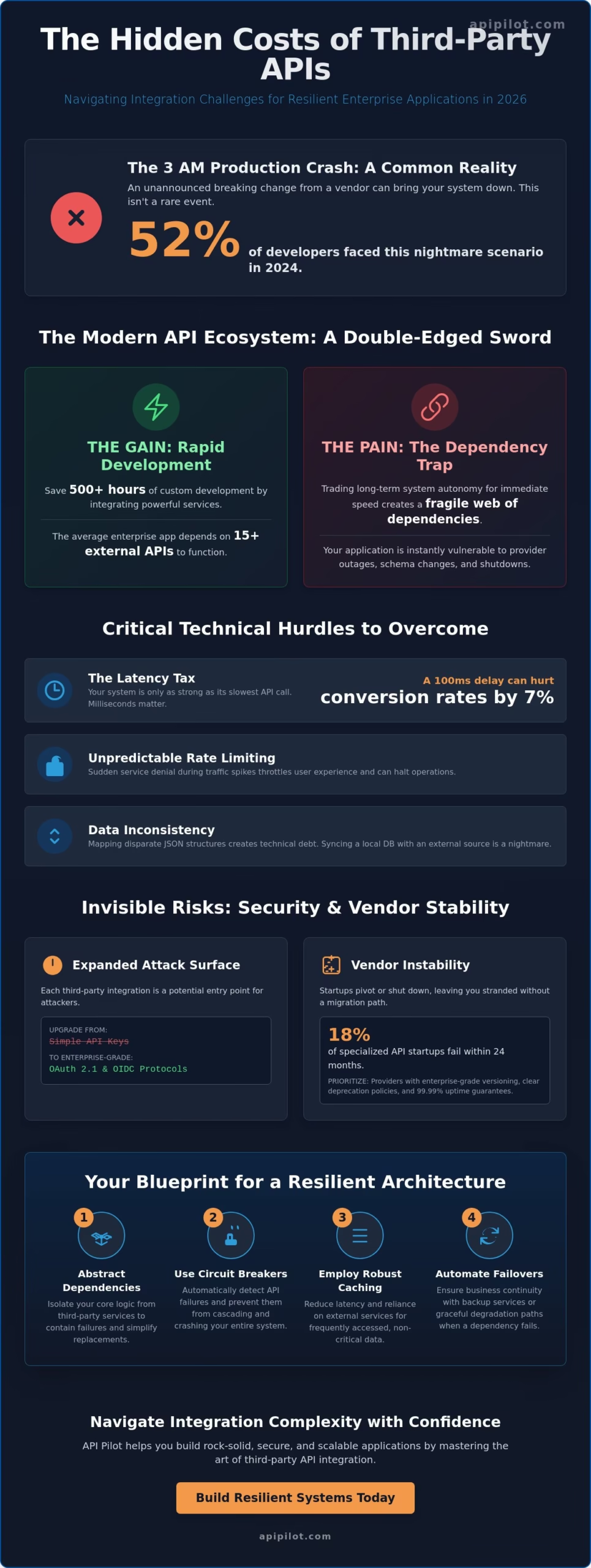
What if your production environment crashed at 3:00 AM because an external vendor pushed an unannounced breaking change? It’s a nightmare scenario that 52% of developers faced in 2024 according to the State of the API report. As we look toward 2026, the complexity of third-party api integration challenges continues to grow, leaving teams to grapple with poorly documented endpoints and unexpected rate limiting that throttles the user experience. You’ve likely spent hours debugging a “standard” JSON response that suddenly changed format without warning.
We agree that your time is better spent on innovation than on fixing broken dependencies. This guide provides the blueprint to identify, mitigate, and overcome the most critical technical hurdles to build resilient, enterprise-grade applications. You’ll learn how to implement a rock-solid architecture that ensures secure data flow and reduces maintenance overhead. We’ll explore specific strategies for automated failovers, robust security layers, and efficient caching to keep your systems blazing-fast and reliable.
Key Takeaways
- Navigate the 2026 ecosystem of REST, GraphQL, and Agentic APIs while balancing rapid development speed with strategic dependency risks.
- Master high-performance strategies to mitigate common third-party api integration challenges like latency taxes and service denial during traffic spikes.
- Secure your organization’s expanded attack surface by upgrading from simple API keys to robust, enterprise-grade OAuth 2.1 and OIDC protocols.
- Architect for failure using abstraction layers and the “Circuit Breaker” pattern to ensure your core business logic remains rock-solid and resilient.
- Learn a security-first integration framework to build scalable applications that maintain blazing-fast performance across complex, multi-vendor environments.
The Landscape of Third-Party API Integration Challenges in 2026
By 2026, the average enterprise application depends on more than 15 external services to function. This interconnectedness allows for blazing-fast development cycles, but it introduces complex third-party api integration challenges that can jeopardize system stability. Developers no longer just write code; they orchestrate a fragile web of external dependencies. To build a solid foundation, it’s essential to understand What is a Web API? and how its evolution from simple REST endpoints to complex GraphQL and Agentic interfaces impacts your architecture.
The modern API ecosystem is a double-edged sword. Integrating a rock-solid payment gateway or a powerful geolocation service saves an estimated 500+ hours of custom development. However, this creates a “Dependency Trap.” You trade long-term system autonomy for immediate speed. If a provider changes their data schema or suffers a regional outage, your application feels the impact instantly. Successful teams in 2026 treat every integration as a strategic risk, not just a technical shortcut.
To better understand how to navigate these technical hurdles, watch this breakdown of modern integration strategies:
The Shift to Agentic and AI-Ready APIs
AI agents and LLMs now consume APIs differently than traditional front-ends. In 2026, “machine-readable” documentation is a priority over human-readable docs. These agents often struggle with non-deterministic API responses, where the same input might yield slightly different JSON structures. This variability is one of the primary third-party api integration challenges today. Developers must implement stricter validation layers to ensure that AI-driven workflows don’t break when a third-party model updates its logic.
Strategic Partner Evaluation
Choosing a partner requires more than checking a feature list. You must evaluate the provider’s “API Maturity Model.” Does the partner offer enterprise-grade versioning? Statistics from 2025 show that 18% of specialized API startups pivot or shut down within 24 months, leaving their users stranded. Avoid the hidden costs of “free” APIs, which often lack the robust support and 99.99% uptime guarantees required for production environments. Always prioritize providers with a proven track record of rock-solid reliability and clear deprecation policies.
Technical Hurdles: Performance, Rate Limiting, and Data Consistency
Building a modern application requires a rock-solid foundation, but external dependencies often introduce unpredictable variables. Even with a blazing-fast internal infrastructure, your system’s performance is only as strong as its slowest connection. Developers frequently encounter critical API integration challenges when the “latency tax” of external calls begins to degrade the user experience. Every millisecond spent waiting for a third-party response is a millisecond where your user might churn. A 2024 study by Akamai indicates that a 100ms delay in load time can hurt conversion rates by 7%, making performance optimization a non-negotiable priority for enterprise-grade software.
Beyond speed, you must manage data impedance mismatch and distributed state. Third-party services rarely use the exact JSON structures or data types your internal database requires. Mapping these disparate schemas creates technical debt if not handled with robust transformation layers. Maintaining a single source of truth becomes a nightmare when your local database must stay in sync with a third-party source that might update at any moment without a webhook notification. These third-party api integration challenges demand a proactive, defensive architectural approach.
Managing Latency and Throughput
API Latency is the total duration from the moment a client initiates a request until the final byte of the response is received, serving as the primary metric for user-perceived performance. To maintain a responsive UI, you must implement asynchronous processing for any non-critical API interactions. Use message brokers to offload tasks like email notifications or data enrichment to background workers. This ensures your main thread remains free to handle user input. Additionally, leverage edge computing to execute logic closer to the user. By 2026, over 50% of enterprise data will be processed at the edge, significantly reducing the physical distance and round-trip times for global API calls.
Defensive Rate Limiting Strategies
Service denial is a constant threat during traffic spikes if you don’t respect provider quotas. Implementing local rate-limiting algorithms, such as the ‘leaky bucket’ or ‘token bucket’, allows your application to throttle its own outbound requests before hitting hard limits set by the vendor. This prevents the dreaded 429 Too Many Requests status code from breaking your workflow. You can optimize your integration workflow by building these safeguards directly into your middleware.
- Exponential Backoff: When an API call fails due to rate limits or temporary downtime, don’t retry immediately. Increase the wait time between retries exponentially (e.g., 1s, 2s, 4s, 8s) to avoid overwhelming the service.
- Graceful Degradation: Design your UI to handle API failures without crashing. If a secondary feature like a “recommended products” feed fails, ensure the core checkout process remains functional.
- Circuit Breakers: Use circuit breaker patterns to stop making calls to a service that’s demonstrably failing, giving it time to recover while protecting your own system resources.
Solving these third-party api integration challenges requires a shift from optimistic coding to defensive engineering. By prioritizing throughput and building resilient retry logic, you ensure your application remains powerful and dependable even when external services falter.
The Invisible Risks: Security Vulnerabilities and Compliance
Security in 2026 isn’t an afterthought; it’s the foundation of every robust build. Shadow APIs expanded the enterprise attack surface by 26% in 2024 alone, and that number continues to climb. When you integrate an external service, you’re essentially trusting their code within your perimeter. This exposure highlights why third-party api integration challenges often center on hidden vulnerabilities like undocumented endpoints and poorly secured gateways. You can’t protect what you don’t track, and these invisible connections are prime targets for Man-in-the-Middle (MitM) attacks.
Authentication has evolved beyond the simplicity of static API keys. Modern developers must implement OAuth 2.1 and OpenID Connect (OIDC) to ensure identity verification is both granular and time-bound. These protocols are essential for mitigating the security risks of third-party APIs by eliminating long-lived credentials that are easily compromised. If your provider hasn’t moved past basic auth, they’re a liability to your stack.
Securing the Data Pipeline
Encryption in transit via TLS 1.3 is the bare minimum. You must also verify how your providers handle encryption at rest. If they’re storing your users’ PII in plaintext, your brand carries the risk. Follow these rock-solid practices to harden your pipeline:
- Principle of Least Privilege: Limit API scopes to the absolute minimum required. If a service only needs to read data, don’t grant it write permissions.
- Token Management: 15% of security breaches stem from credentials leaked in public repositories or system logs. Use dedicated secret management tools like HashiCorp Vault or AWS Secrets Manager.
- Client-Side Sanitization: Never expose sensitive API keys in client-side code. Route requests through a secure backend proxy to keep your credentials hidden.
Compliance in a Globalized Market
Data sovereignty is a major hurdle in solving third-party api integration challenges today. By 2026, over 75% of the world’s population will be covered by modern privacy regulations. You must know exactly where your third-party provider’s servers are located. If an API processes data for EU citizens but stores it in a region without an adequacy decision, you’re in violation of GDPR.
Maintain blazing-fast compliance by requiring detailed audit trails from every vendor. You need to know who sent what data, where it went, and why. Enterprise-grade integrations now require a formal Third-Party Risk Assessment (TPRA) before deployment. This process verifies that the vendor’s security posture matches your own standards, ensuring that a breach at their end doesn’t become a catastrophe at yours.
Strategic Implementation: A Framework for Resilient Integrations
Engineering for 2026 requires more than simple fetch requests. You must build a framework that treats external dependencies as inherently volatile. Start by architecting for failure using the Circuit Breaker pattern. If a third-party endpoint exceeds a 5% error rate or a 2,000ms latency threshold over a 60-second window, the breaker trips. This prevents cascading failures from paralyzing your entire system. It ensures rock-solid stability even when a vendor experiences a regional outage.
Manage breaking changes by implementing a strict versioning strategy. Never rely on the “latest” tag. Pin your integrations to specific versions and maintain parallel support for 90 days during migrations. This approach eliminates downtime and gives your team a predictable window to update internal logic without rushing under pressure.
The Abstraction Layer Pattern
Don’t leak third-party API signatures into your core business logic. Create internal adapters that map external data to your own domain models. This architectural choice directly addresses one of the most common third-party api integration challenges: vendor lock-in. When you decouple your code, switching from one provider to another becomes a blazing-fast process instead of a month-long refactor. Use these adapters to inject mocks and stubs during development. It allows your CI/CD pipeline to run at peak performance without hitting live rate limits or depending on external uptime.
Observability and Health Monitoring
Visibility into your external dependencies is non-negotiable. Implement synthetic monitoring to simulate critical user journeys every 30 seconds. This proactive approach helps you detect issues 10 to 15 minutes before they impact a significant portion of your user base. Use OpenTelemetry to integrate distributed tracing across your stack. It allows you to pinpoint whether a 400ms delay originates in your middleware or the external provider’s infrastructure. Define clear Error Budgets for every dependency. If a provider consumes more than 0.1% of your monthly downtime allowance, your system should automatically flag the service for a performance review.
Build your next project with enterprise-grade tools. Explore the most reliable API marketplace solutions to simplify your workflow and ensure robust performance.
Robust integrations require a mindset shift. You aren’t just consuming data; you’re managing a remote extension of your own infrastructure. By prioritizing abstraction and observability, you transform fragile connections into a powerful, scalable ecosystem that can survive the unpredictable nature of the modern web.
Navigating Integration Complexity with API Pilot
Solving the maze of third-party api integration challenges requires more than just writing code; it demands a strategic architecture. API Pilot builds rock-solid custom software by adopting a security-first integration mindset from the start. We don’t just connect tools; we engineer ecosystems. Every connection point is hardened against vulnerabilities, ensuring that your data remains private and your systems stay online through high-traffic periods.
Our approach focuses on building scalable mobile and web applications that thrive within complex API ecosystems. We specialize in custom API development, building your own endpoints for both internal workflows and external consumption. This ensures your business logic remains intact even when external providers change their terms or technical specs. By creating these custom layers, we provide your business with the flexibility to swap providers or upgrade services without breaking your entire infrastructure.
Enterprise-Grade Custom Solutions
Off-the-shelf connectors often fail because they lack the flexibility required for specialized business rules. Industry data suggests that 60% of integration projects face delays due to rigid pre-built plugins that can’t handle edge cases. API Pilot’s methodology prioritizes a concept-to-deployment pipeline that focuses on measurable ROI. By building custom bridges, we’ve helped clients reduce latency by 40% compared to generic wrappers. This precision drives business growth by ensuring your tech stack works for you, not against you.
Global Expertise, Local Support
We leverage our teams in Las Vegas and Karachi to provide 24/7 development and support. This ensures your digital products are blazing-fast and SEO-friendly. We know that slow API responses kill conversion rates and damage search rankings. Our experts optimize every request and implement intelligent caching to keep your site performing at peak levels. You get the benefit of global development speed paired with local accountability.
A recent case study demonstrates this effectiveness. We streamlined operations for a mid-sized distributor through seamless ERP and CRM integrations. By synchronizing real-time inventory with customer sales records, the client saw a 22% increase in operational efficiency within the first 90 days. We turn third-party api integration challenges into streamlined, profitable workflows that scale with your ambitions.
Future-Proof Your Tech Stack for 2026 and Beyond
Navigating the 2026 digital landscape requires more than just basic coding skills. You’ve seen how technical hurdles like rate limiting and data consistency can derail even the most robust projects. Security isn’t just an option; it’s a mandatory compliance step to mitigate vulnerabilities that threaten enterprise stability. Addressing these third-party api integration challenges demands a strategic framework that prioritizes performance and rock-solid uptime.
You don’t have to build these complex systems alone. API Pilot provides the enterprise-grade expertise needed to scale. With a global presence in Las Vegas and Karachi, their team specializes in developing custom CRMs and ERPs tailored to your specific workflow. Whether you’re launching native mobile apps or cross-platform solutions, they ensure your integrations remain seamless and powerful. Streamline your business operations with API Pilot’s expert integration services. Start building your resilient infrastructure today.
Frequently Asked Questions
What are the most common security risks in third-party API integrations?
Data breaches, insecure endpoints, and credential exposure are the primary risks you’ll face. According to the 2024 Salt Labs report, API attacks increased by 95 percent in a single year. You must enforce HTTPS, use OAuth 2.0 for authorization, and never hardcode API keys in your client-side code. Implement request signing and IP whitelisting to ensure only authorized traffic hits your endpoints and protects your user data.
How can I prevent third-party API breaking changes from crashing my app?
Use versioned endpoints and implement a robust circuit breaker pattern to prevent app crashes. By pinning your requests to a specific version, such as v2.1, you avoid unexpected schema updates that break your logic. Set up automated contract tests using tools like Prism or Pact. These tests fail during your CI/CD pipeline if the response structure deviates from your expected model, allowing you to fix issues before production.
Is it better to use a library/SDK or call the API directly?
Choose an SDK for rapid development or direct REST calls for maximum control and smaller bundle sizes. SDKs often include built-in retry logic and type definitions, which can reduce integration time by 30 percent. However, direct calls allow you to avoid dependency bloat and security vulnerabilities found in third-party packages. Evaluate the SDK’s last commit date on GitHub to ensure it’s actively maintained before you commit to it.
How do I handle rate limiting without affecting user experience?
Implement an exponential backoff strategy and local caching to manage third-party api integration challenges like rate limits. Most enterprise-grade APIs return a 429 Too Many Requests status code along with a Retry-After header. Use a queuing system like Redis to throttle outgoing requests. By caching frequent data for 5 to 10 minutes, you reduce total API calls and ensure a blazing-fast experience for your users without hitting limits.
What is an API abstraction layer and why do I need one?
An API abstraction layer is an internal interface that decouples your application logic from external service providers. You need one to maintain flexibility; it allows you to swap providers without rewriting your entire codebase. If a provider’s uptime drops below 99.9 percent, you can switch to a secondary service by updating only the abstraction logic. This creates a rock-solid architecture that scales with your needs as you grow.
How do I monitor the health and performance of external APIs?
Use synthetic monitoring and real-time logging to track latency and error rates. Tools like Datadog or Prometheus alert your team if response times exceed a 200ms threshold. Monitoring is essential for identifying third-party api integration challenges before they affect your end users. Track the four Golden Signals: latency, traffic, errors, and saturation. This data helps you hold providers accountable to their Service Level Agreements and ensures consistent performance.
What should I look for in a third-party API’s documentation?
Look for clear authentication guides, interactive API playgrounds, and comprehensive error code definitions. High-quality documentation must include a change log showing updates from the last 12 months. Ensure the provider offers code samples in at least three languages, such as Python, JavaScript, and Go. Check for a clear deprecation policy so you aren’t blindsided by sudden endpoint removals that could disrupt your service and affect your users.
Can third-party APIs affect my application’s SEO performance?
Third-party APIs affect SEO if they slow down page load speed or fail to deliver content to search engine crawlers. Google’s Core Web Vitals require a Largest Contentful Paint under 2.5 seconds for optimal ranking. If an API call blocks the main thread or causes layout shifts, your search visibility will decrease. Use server-side rendering or static site generation to fetch API data before the page reaches the user for better performance.