
Every powerful mobile application starts not with a line of code, but with a critical question: is this idea viable? The ambiguity at this early stage often leads to scope creep, blown budgets, and technical hurdles that can derail a project before it begins. To build a rock-solid foundation for development and de-risk your investment, you need a comprehensive mobile app discovery phase checklist.
Planning a project like this? See how our MVP development services work, from a free scope to a fixed quote in 48 hours.
This guide provides exactly that-an actionable, step-by-step framework designed for 2025. We cut through the complexity, showing you precisely how to validate your market, define a clear feature set, and outline a robust technical architecture. By following these steps, you will transform uncertainty into a concrete plan, armed with an accurate budget, a realistic timeline, and the confidence to present a validated project to stakeholders or your development team.
Stage 1: Business & User Foundation Checklist
The mobile app discovery phase begins with a foundational, non-technical assessment of your project’s viability. This stage is critical for defining the ‘why’ behind your app and the ‘who’ it serves, ensuring a rock-solid business case before committing technical resources. It’s an indispensable part of the entire mobile app development process, as a failure here guarantees a flawed product. The primary objective is to distill your app’s core purpose into a single, powerful sentence and establish the key performance indicators (KPIs) that will define its success post-launch. Getting this right prevents costly pivots and ensures every future decision is aligned with a clear strategic vision.
To better understand the core components of this strategic stage, watch this helpful overview:
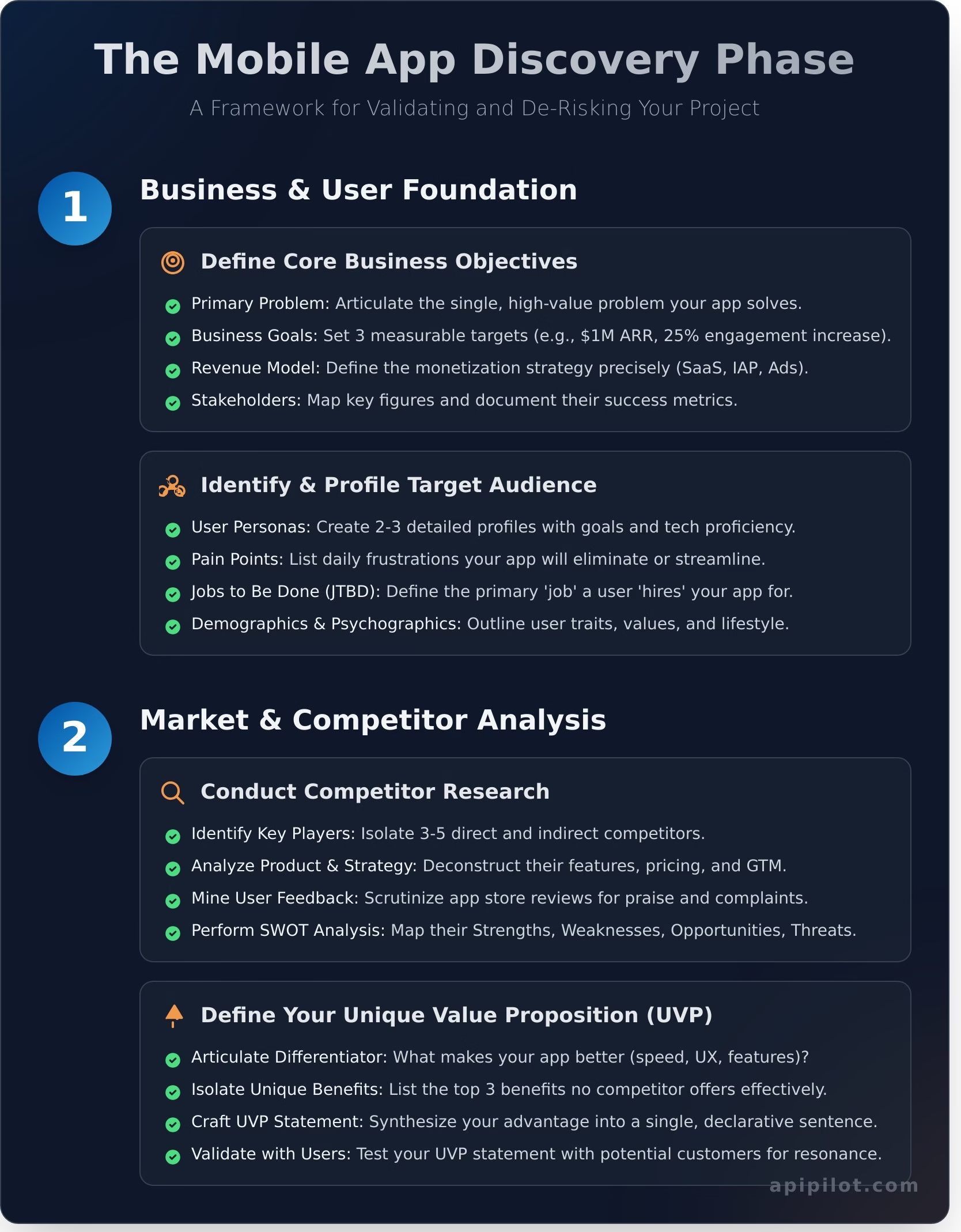
Define Core Business Objectives
Before exploring features or debating technology stacks, you must codify the business drivers. This crucial step transforms a vague idea into a strategic asset with measurable outcomes. A robust business case is the bedrock of a successful application, providing a clear North Star for the development team and stakeholders alike. Use this checklist to validate your core concept.
- Primary Problem: What specific, high-value problem does your app solve for its users? Articulate it in one clear sentence.
- Business Goals: Identify the top 3 measurable objectives (e.g., achieve $1M ARR, increase user engagement by 25%, reduce operational overhead by 15%).
- Revenue Model: Define the monetization strategy with precision (e.g., SaaS subscription tiers, in-app purchases, advertising, one-time payment).
- Stakeholders: Map all key stakeholders-from investors to internal teams-and document their core expectations and success metrics.
Identify and Profile Your Target Audience
An app built for everyone is an app built for no one. This part of your mobile app discovery phase checklist is dedicated to pinpointing your ideal user with high precision. Deeply understanding your audience is the only way to build an intuitive user experience and ensure powerful product-market fit from day one. Move beyond generic descriptions to create actionable user profiles.
- User Personas: Develop 2-3 detailed personas, including their roles, goals, and technical proficiency. Give them names and realistic backstories.
- Pain Points: What are the daily frustrations and challenges your personas face that your app will eliminate or streamline?
- Jobs to Be Done (JTBD): Describe the primary ‘job’ a user ‘hires’ your app to accomplish. For example, a user hires a budgeting app to “gain control over their finances.”
- Demographics & Psychographics: Outline key traits like age, location, and income, along with their values, interests, and lifestyle attributes.
Stage 2: Market & Competitor Analysis Checklist
No app is built in a vacuum. A successful launch requires a deep, pragmatic understanding of the competitive landscape. This stage of your mobile app discovery phase checklist is not about imitation; it is about strategic positioning. By analyzing the market, you can identify exploitable gaps, anticipate threats, and gather the critical data needed to build a robust application that stands out. This analysis is a foundational step in the broader mobile app development process, informing design, feature prioritization, and marketing strategy from day one. The objective is clear: find your unique space and build a defensible advantage.
Conduct Competitor Research
A systematic analysis of your competitors provides an actionable blueprint of market standards and user expectations. Focus on deconstructing their products and strategies to uncover opportunities. Your goal is to gather intelligence, not to copy features.
- Identify Key Players: Isolate 3-5 direct competitors (solving the same problem for the same audience) and indirect competitors (solving a similar problem differently).
- Analyze Product & Strategy: Deconstruct their core features, monetization models, and go-to-market channels. Document what they do well and where their execution is weak.
- Mine User Feedback: Scrutinize app store reviews for both praise and complaints. These are a goldmine for identifying user pain points, desired features, and critical performance issues.
- Perform a SWOT Analysis: For each primary competitor, map their Strengths, Weaknesses, Opportunities, and Threats. This framework provides a clear, strategic overview of the competitive environment.
Define Your Unique Value Proposition (UVP)
Your UVP is the concise, powerful answer to the question: “Why should a user choose your app over any other?” It’s the core promise you make to your audience, derived directly from your competitor research. A strong UVP is the foundation of your product and marketing.
- Articulate Your Differentiator: What makes your app fundamentally different and better? Is it blazing-fast performance, a unique feature set, a superior UI/UX, or a more efficient pricing model?
- Isolate Unique Benefits: List the top 3 features or benefits your app will offer that no competitor provides effectively. Focus on value, not just functionality.
- Craft Your UVP Statement: Synthesize your core advantage into a single, declarative sentence. For example: “Our app automates financial reporting for freelancers in under 60 seconds.”
- Validate with Users: Before committing, test your UVP statement with potential users. Does it resonate? Is the value immediately clear? This early feedback is invaluable for any mobile app discovery phase checklist.
Stage 3: Feature & Technical Scoping Checklist
With a validated concept, the next critical step is translating your idea into a tangible technical blueprint. This stage is where you define the precise scope of your Minimum Viable Product (MVP)-the version of your app with just enough features to be usable by early customers who can then provide feedback for future product development. Effective prioritization is the key to managing your budget and timeline efficiently. Making foundational technical decisions now is a core part of any robust mobile app discovery phase checklist, preventing costly refactoring and delays down the line.
Prioritize Core Features for MVP
To build a successful MVP, you must ruthlessly prioritize. This part of the mobile app discovery phase checklist is about launching quickly with a product that solves a core problem, not one that does everything. This process ensures you invest resources where they deliver maximum impact.
- Brainstorm & Map: List every conceivable feature for your app. Don’t hold back.
- Prioritize with a Matrix: Use a framework like the MoSCoW method (Must-have, Should-have, Could-have, Won’t-have) to rank features by necessity.
- Define the MVP Core: Isolate the absolute “Must-have” features required for a functional and valuable initial release.
- Create User Stories: For each core feature, write a simple user story (e.g., “As a new user, I want to create an account using my email so I can save my progress.”) to clarify its purpose and value.
Outline Preliminary Technical Requirements
Your feature list directly informs your technical architecture. Making the right choices early is crucial for building a scalable and robust application. Key decisions include the foundational platform, external service integrations, and your data management strategy.
- Platform Selection: Will you build for iOS, Android, or use a cross-platform framework like React Native or Flutter to optimize development resources?
- Third-Party APIs: Identify needs for external services. Will you require APIs for payment processing, maps, or social logins?
- Infrastructure: Consider your initial needs for data storage, security protocols, and scalability to handle future user growth.
Choosing the right architecture is complex. Our experts can help you choose the right tech stack.
Plan Your Monetization Strategy
Monetization should not be an afterthought; it must be integrated into your app’s core design and user experience. Define your primary revenue model from the start to ensure your feature set and technical architecture can support it effectively.
- Select a Model: Choose a primary strategy-freemium, subscription-based, one-time paid download, or in-app advertising.
- Detail Pricing Tiers: If using a freemium or subscription model, clearly define what features are included in each tier (e.g., Free, Pro, Enterprise).
- Map the Purchase Flow: Outline the user journey for upgrading their plan or making in-app purchases. This must be a seamless and intuitive process.
Stage 4: UX/UI & Design Planning Checklist
Before a single pixel is colored, you must architect the user experience. This stage prioritizes function over form, ensuring the app is intuitive, efficient, and solves the user’s problem without friction. A rock-solid UX foundation is the single most important factor in reducing churn and increasing long-term user retention. The deliverables from this stage serve as the initial technical blueprints for the development team, translating user needs into a logical structure.
Executing this part of the mobile app discovery phase checklist with precision prevents costly redesigns and ensures the final product is both powerful and easy to use.
Map User Flows and Journeys
User flow mapping visualizes the complete path a user takes to accomplish a task. This process is critical for identifying potential dead ends or points of friction before development begins. The goal is to create the most efficient path from intent to completion for every core feature.
- Chart Key Tasks: Create detailed flowcharts for primary user actions like onboarding, making a purchase, or completing a profile.
- Visualize the Path: Map every screen and decision point a user encounters to ensure a seamless, logical progression.
- Identify Friction: Proactively find and eliminate confusing steps, redundant screens, or missing calls-to-action (CTAs).
- Define Screen Purpose: Ensure every screen has a single, clear purpose and guides the user toward the next logical action.
Create Low-Fidelity Wireframes
Wireframes are the architectural schematics of your application. These basic, low-fidelity layouts focus exclusively on structure, content hierarchy, and functionality, intentionally ignoring visual elements like colors or fonts. They serve as the skeletal framework for designers and developers.
Use these black-and-white blueprints to test usability concepts and validate user flows with stakeholders early in the process. This step provides clarity for the entire team and minimizes expensive changes during the coding phase.
Prepare a Visual Identity Brief
Once the UX foundation is set, you can define the app’s visual language. The visual identity brief is a document that guides the UI designer in creating a look and feel that aligns with your brand. It translates abstract brand values into concrete design principles. This brief should clearly define your brand’s personality, target audience, and competitive positioning to ensure the final design is both appealing and authentic.
Stage 5: Final Deliverables & Next Steps
The discovery phase culminates in a set of powerful documents that guide the entire development project. This isn’t just paperwork; it’s your strategic blueprint for execution. A thorough discovery package eliminates ambiguity, sets rock-solid expectations with stakeholders, and is the single most important factor in receiving accurate, comparable quotes from development agencies. Completing this final stage of your mobile app discovery phase checklist ensures you can move from a validated idea to a robust build with confidence and efficiency.
Assemble Your Discovery Documentation
Consolidate your findings into a comprehensive package that serves as the single source of truth for your project. This collection of assets provides a clear, 360-degree view, ensuring everyone from developers to investors understands the vision, scope, and technical requirements. Your final documentation should include:
- Product Requirements Document (PRD): A detailed document outlining the app’s purpose, user personas, features, functionality, and non-functional requirements like performance and security benchmarks.
- Wireframes & User Flows: Finalized low-fidelity wireframes and user flow diagrams that map out the core user journey, screen layouts, and navigational structure. This visual guide is critical for the UI/UX design phase.
- Prioritized MVP Features: A definitive, ranked list of the essential features required for the initial launch. This prevents scope creep and focuses development resources on delivering core value first.
- Research Summary: A concise summary of your market analysis and competitor research, highlighting key insights, target audience data, and strategic opportunities.
Prepare for the Development Phase
With your discovery documentation complete, you have the critical tools needed to transition into active development. This package is the foundation for engaging potential partners and building a concrete project plan. It allows you to solicit proposals that are based on data, not assumptions. Your next steps are clear:
- Create a Request for Proposal (RFP): Use your documentation to build a detailed RFP that clearly communicates your project goals, scope, and technical needs. This enables potential development teams to provide precise timelines and cost estimates.
- Select a Development Partner: Evaluate proposals based not just on cost, but on a team’s technical expertise, relevant experience, and demonstrated understanding of your project vision. A good partner will ask insightful questions about your discovery docs.
- Establish a Project Roadmap: Work with your chosen partner to translate your PRD and feature list into an agile project roadmap with clear milestones, sprints, and delivery timelines.
This structured approach, guided by a complete mobile app discovery phase checklist, minimizes risk and maximizes the potential for a successful launch. You’ve laid the groundwork for a robust, scalable application built on a solid strategic foundation. Ready to build? Share your discovery docs with our team. Our experts can help you translate your vision into a powerful, market-ready application.
Transform Your App Idea into a Market-Ready Product
A meticulously executed discovery phase is the bedrock of any successful mobile application, transforming a raw concept into a viable, data-backed blueprint. By systematically addressing business goals, analyzing the competitive landscape, defining technical requirements, and planning the user experience, you eliminate critical ambiguities and mitigate risk before committing to development. Following this comprehensive mobile app discovery phase checklist for 2025 is your roadmap to achieving that clarity and setting your project up for a powerful, on-budget launch.
With your strategy defined, the next step is partnering with an expert team to bring it to life. API Pilot specializes in building robust, enterprise-grade native and cross-platform mobile applications. Our global team, with offices in the US and Pakistan, has a proven track record of launching successful apps for innovative startups and global enterprises alike, ensuring your project benefits from world-class expertise. Ready to move from planning to production? Get a precise quote for your app. Contact API Pilot for a free consultation.
Your groundbreaking app idea deserves a rock-solid foundation. Let’s build the future, together.
Frequently Asked Questions
How long does a mobile app discovery phase typically take?
A typical discovery phase lasts between two and six weeks. The exact duration depends on the app’s complexity, the number of features, and the level of technical research required. A simple MVP might take two weeks, while a complex, enterprise-grade application with multiple integrations could require a month or more. The goal is to achieve complete clarity on the project scope and technical roadmap before a single line of code is written, ensuring an efficient development cycle.
What is the average cost of a discovery phase for a mobile app?
The cost of a discovery phase generally ranges from $5,000 to $25,000, but can be higher for highly complex projects. This price reflects the dedicated time of senior strategists, designers, and engineers. Think of it not as a cost, but as a strategic investment. It mitigates the much larger financial risk of building the wrong product or facing significant scope creep and budget overruns during the development stage. A well-defined plan is essential for a predictable budget.
Can I skip the discovery phase to save time and money?
Skipping the discovery phase is not recommended. Attempting to save costs upfront often leads to significantly higher expenses later due to scope creep, rework, and missed requirements. Without a robust plan, you risk building a product that fails to meet user needs or business goals. A comprehensive mobile app discovery phase checklist ensures all assumptions are validated and technical challenges are identified early, creating a solid foundation for a successful and on-budget project.
What’s the difference between a discovery phase and a project brief?
A project brief is a high-level document that outlines your initial idea, goals, and target audience. It’s the starting point. The discovery phase is an intensive, collaborative process that stress-tests that brief. It involves deep-dive workshops with your development partner to define detailed user stories, create wireframes, map user flows, and establish a precise technical architecture. The discovery phase transforms a brief into an actionable, enterprise-grade development blueprint for the entire project.
Who should be involved in the discovery phase meetings?
Effective discovery meetings require key decision-makers from both the client and development teams. On the client side, this includes the product owner, key stakeholders, and any subject matter experts. From the development partner, the core team should consist of a project manager, a solutions architect or lead developer, and a UI/UX designer. This combination ensures that business goals, technical feasibility, and user experience are all aligned from the very beginning of the project.
Is the discovery phase necessary for a simple app?
Yes, even simple apps benefit from a discovery phase, though it can be scaled down. A condensed discovery process ensures alignment on core functionality, target platform specifications, and the optimal tech stack. It helps define a clear MVP scope to prevent feature bloat. Using a streamlined mobile app discovery phase checklist for a smaller project is a pragmatic way to mitigate risk and ensure the final product is robust, scalable, and built correctly from the ground up.