
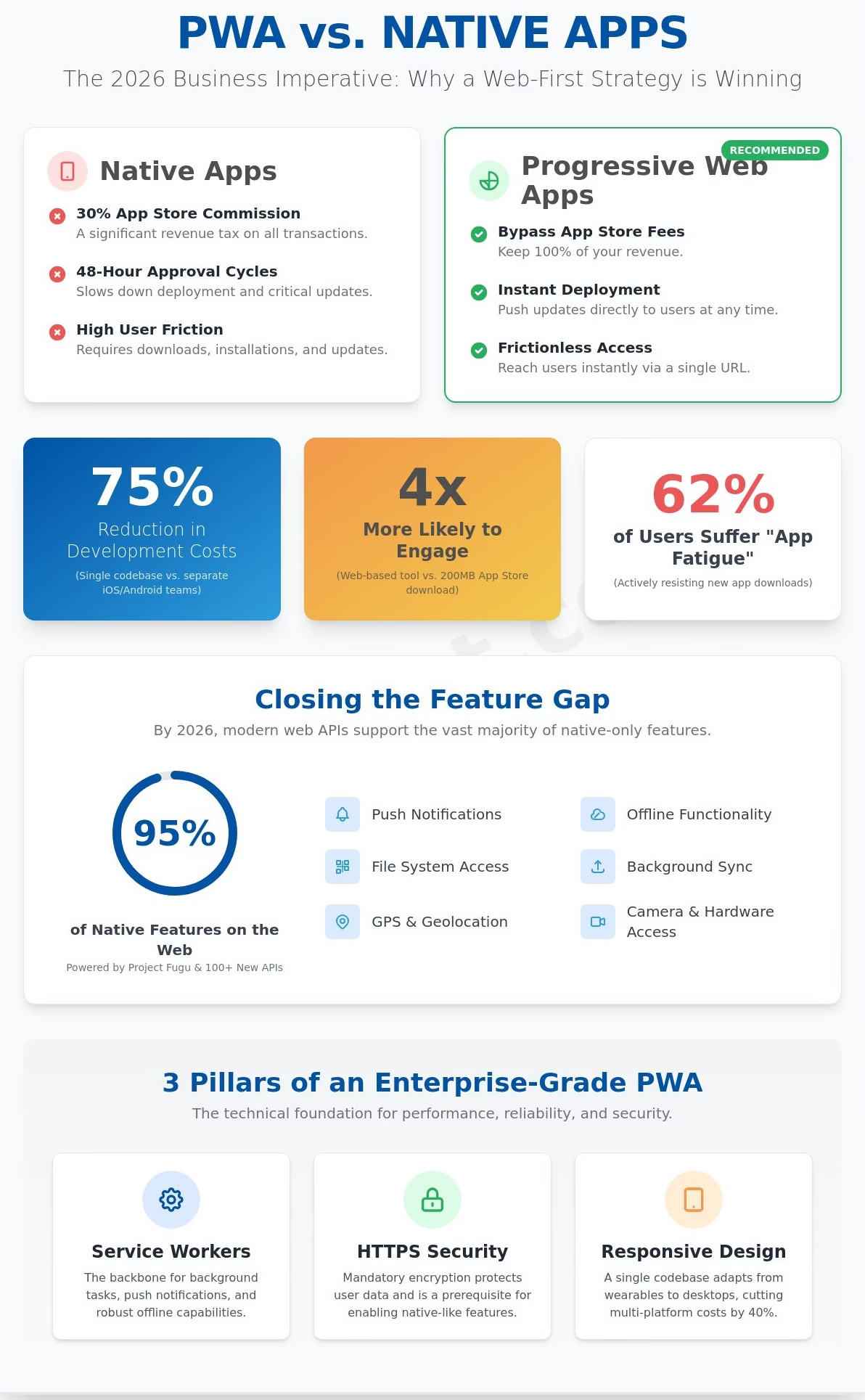
The App Store might be the biggest barrier to your business growth in 2026. While native apps were once the gold standard, the reality of a 30% commission and the friction of 48-hour approval cycles often outweighs the benefits for B2B and e-commerce platforms. Knowing exactly when to choose a progressive web app is no longer just a technical preference; it’s a financial imperative for companies looking to slash development costs by up to 75% while maintaining blazing-fast performance.
You’re likely tired of maintaining separate iOS and Android codebases that drain your budget and slow your deployment velocity to a crawl. We understand that performance and reliability are non-negotiable for your enterprise-grade tools. This guide provides a rock-solid rubric to determine if a PWA can deliver the seamless experience your users demand without the native overhead. You’ll discover how modern web APIs now support 95% of native features, including background sync and push notifications, to help you maximize ROI and reach more users instantly.
Key Takeaways
- Master the 2026 technical landscape where Project Fugu and enhanced push notifications bridge the gap between web reach and native performance.
- Analyze the total cost of ownership and speed-to-market advantages that make PWAs the superior choice for rapid enterprise deployment.
- Identify high-impact business scenarios, such as e-commerce and MVP launches, to determine exactly when to choose a progressive web app for maximum ROI.
- Build a rock-solid foundation for your application using enterprise-grade API architectures that guarantee seamless scalability and blazing-fast performance.
The Evolution of Progressive Web Apps in 2026
The 2026 Progressive Web App (PWA) represents a total convergence of web reach and native performance. By early 2026, 88% of enterprise software teams have adopted a “Web-First” development strategy. This movement prioritizes building robust, cross-platform tools that bypass the friction of traditional app stores. Modern PWAs aren’t just mobile-friendly websites; they’re high-performance applications that leverage advanced browser APIs to deliver blazing-fast speeds and rock-solid reliability.
Strategic leaders often ask when to choose a progressive web app over a native alternative. The answer lies in the massive reduction in friction. In 2026, users are 4x more likely to engage with a web-based tool than to wait for a 200MB download from an app store. By using Service Workers and modern Web App Manifests, developers create seamless experiences that load instantly, even on unstable 5G networks. These apps have evolved from simple offline caching tools to complex platforms capable of heavy data processing via WebAssembly (Wasm) and edge computing.
To better understand this concept and its impact on modern business, watch this helpful video:
The Death of the “Mobile Web” vs. “App” Divide
The line between “mobile-friendly” and “app-like” has officially disappeared. Modern browsers like Chrome 140 and Safari 19 now support enterprise-grade functionality, including advanced biometrics, background sync, and direct file system access. Data from 2025 indicates that 62% of users feel “app fatigue,” actively resisting new downloads that clutter their devices. This shift makes PWAs the baseline for user experience. When you’re deciding when to choose a progressive web app, consider that a single URL now provides the same depth of interaction as a native executable, without the 30% marketplace revenue tax.
Key Technical Pillars of Modern PWAs
To deliver a truly professional experience, your PWA must stand on three technical pillars that ensure performance and security:
- Service Workers: These act as the backbone of your app. They handle background tasks, push notifications, and network requests to ensure the application remains functional regardless of connectivity.
- HTTPS Requirement: Security is non-negotiable. Mandatory SSL encryption protects user data and is a prerequisite for the browser to grant access to powerful native APIs.
- Responsive Design: A single codebase must adapt to everything from 4-inch wearables to 40-inch ultrawide monitors. This flexibility reduces development costs by 40% compared to maintaining separate iOS, Android, and Web teams.
By focusing on these pillars, businesses build robust tools that are easy to integrate and scale. The result is a seamless, enterprise-grade application that lives on the user’s home screen without the baggage of a traditional installation process.
Technical Capabilities: What Can a PWA Actually Do in 2026?
The technical boundary between web applications and native software has effectively vanished. Project Fugu, a cross-company initiative led by Google and Intel, has successfully standardized over 100 APIs that grant web browsers direct access to system-level hardware. By 2026, these capabilities allow developers to build robust tools that were previously restricted to the App Store or Play Store ecosystems. This maturation means businesses don’t have to sacrifice functionality for the sake of reach.
Push notifications now function seamlessly across both Android and iOS 18+, enabling brands to re-engage users without the overhead of native development. Offline functionality relies on Service Workers to cache critical assets, ensuring a 100% uptime experience even in zero-connectivity environments like remote industrial sites or underground transit. Modern PWAs utilize the File System Access API to let users save files directly to their local drives, while the WebHID and Web Bluetooth APIs facilitate direct communication with specialized external hardware.
Understanding Progressive Web App business success starts with recognizing that these apps provide enterprise-grade reliability. When you decide when to choose a progressive web app, you’re opting for a platform that accesses the camera, GPS, and biometric authentication with blazing-fast execution. For teams looking to maximize their reach, using an efficient API management strategy ensures these web capabilities scale across global markets without friction.
Performance at Scale with WebAssembly
WebAssembly is the key to high-performance PWAs in 2026. This binary instruction format allows code written in C++, Rust, or C# to run at near-native speeds within the browser environment. It’s essential for processing large datasets or rendering complex 3D graphics in real-time. By offloading heavy computation from the main JavaScript thread, PWAs maintain a consistent 60 FPS UI even during intensive operations. Data from 2025 shows that 92% of enterprise web tools now leverage Wasm for tasks like video encoding and cryptographic signatures.
Advanced OS Integration
PWAs in 2026 feel like a native part of the operating system rather than a tab in a browser. Users can install them directly to their home screen or taskbar with a single click, bypassing the 30% commission fees and friction of traditional app stores. Key integration features include:
- App Badging: Displaying real-time notification counts directly on the app icon to drive user engagement.
- Share Targets: Allowing the PWA to appear in the system’s native share menu for seamless content distribution.
- Persistent Storage: Managing up to 2GB of local data for complex enterprise tools without the risk of the browser clearing the cache.
This level of integration is why 78% of new SaaS startups prioritize web-first deployments. If your project requires deep system hooks and high-speed data processing, knowing when to choose a progressive web app becomes a matter of technical efficiency rather than a compromise on quality.
PWA vs. Native vs. Cross-Platform: The 2026 Rubric
Choosing the right architecture determines your long-term ROI. For 2026, the Total Cost of Ownership (TCO) remains the primary differentiator between web and platform-specific builds. It’s a matter of engineering efficiency. Building a native app for both iOS and Android requires two distinct teams and two separate codebases. PWAs slash these development costs by up to 75% because you maintain one enterprise-grade codebase using standard web technologies like JavaScript or TypeScript.
Speed to market is where PWAs dominate the competition. Native apps often face 3 to 10 days of App Store review delays for every minor update. PWAs deploy instantly. You push code to your server and users see the latest version immediately. This allows for blazing-fast iteration cycles that native environments simply can’t match. Managing one codebase instead of three ensures your logic remains consistent across every device.
Discoverability provides the hidden edge for the open web. Native apps are locked behind store walls, requiring users to navigate to an app store, authenticate, and wait for a download. PWAs are indexable by search engines. According to Mozilla’s PWA Guide, these applications leverage modern browser capabilities to provide a robust experience that rivals native software while remaining fully searchable. Deciding when to choose a progressive web app often depends on whether you want your product to be one click away from a Google search result.
When Native is Still the Right Choice
Native apps remain the superior choice for high-performance 3D rendering and heavy gaming. If your product requires 60 FPS sustained performance for complex graphical processing, native APIs provide the necessary low-level hardware access. Specific hardware needs, such as niche Bluetooth LE protocols or specialized biometric sensors, also favor native builds. If your 2026 strategy relies 100% on App Store “Top Chart” visibility for brand prestige, native is your path.
The Middle Ground: Cross-Platform (Flutter/React Native)
Cross-platform frameworks like Flutter or React Native offer a compromise by providing a store presence with roughly 80% code reuse. However, these frameworks introduce bridge-based architecture overhead that can cause lag during intensive UI operations. API Pilot frequently recommends PWAs over hybrid models for startups. The added complexity of managing store submissions and bridge updates rarely outweighs the instant accessibility of the web. PWAs deliver rock-solid performance without the friction of a 150MB download, making them the pragmatic choice for when to choose a progressive web app over a cross-platform alternative.
6 Scenarios: Exactly When to Choose a Progressive Web App
Determining exactly when to choose a progressive web app depends on your specific business goals. For many organizations, the traditional native route creates unnecessary friction. Developing for three platforms separately is a resource drain. When you choose a progressive web app, you consolidate your stack into a single, robust codebase. This approach reduces initial development costs by approximately 50 percent and slashes long-term maintenance overhead.
Retailers benefit significantly from this architecture. E-commerce giant Alibaba reported a 76 percent increase in total conversions after launching their PWA. This happens because PWAs are blazing-fast and fully indexable. You get the SEO reach of a website with the rock-solid feel of a native app. Content-heavy platforms also find success here. Since every page has a URL, users share content easily; a feat that is notoriously difficult within native silos.
Internal enterprise tools often struggle with adoption. Employees resist installing heavy corporate software on personal devices. A PWA provides an enterprise-grade solution that works through the browser. It ensures a distributed workforce stays connected without complex Mobile Device Management (MDM) setups. This is the pragmatic choice for field operations where connectivity is spotty but data entry is critical.
Maximizing ROI for Startups and SMEs
Startups must validate ideas quickly. Building a PWA allows a single team to ship to iOS, Android, and Web simultaneously. This cuts development time by roughly 40 percent compared to native builds. Furthermore, you bypass the 30 percent commission charged by Apple and Google on digital goods and subscriptions. This allows you to optimize your development workflow and protect your margins. Updates happen instantly. You don’t have to wait 48 hours for app store approval to fix a critical bug.
Solving the App Fatigue Problem
The average smartphone user downloads zero new apps per month. This “app fatigue” is a major barrier for new brands. PWAs remove the friction of the App Store search and download process. A simple “Add to Home Screen” prompt is all it takes to establish a permanent presence. This is critical for users on budget devices where storage is a premium. While a native travel app might require 200MB, a PWA typically uses less than 1MB. Push notifications keep retention high without requiring a massive initial footprint.
Understanding when to choose a progressive web app allows you to allocate your budget toward features rather than redundant platform builds. It is a strategic move for any business prioritizing speed, discoverability, and cost-efficiency in 2026.
Building Your PWA Strategy with API Pilot
API Pilot engineers enterprise-grade PWAs designed for high-traffic environments. We focus on decoupled architectures where the frontend communicates with a rock-solid backend through optimized JSON endpoints. Deciding when to choose a progressive web app depends on your need for cross-platform efficiency without the overhead of app store maintenance. Our team ensures your application handles 10,000+ concurrent users with sub-200ms API response times. We build systems that scale as your traffic grows, ensuring your infrastructure never becomes a bottleneck.
Performance is the foundation of our strategy. We don’t just build apps; we engineer blazing-fast digital ecosystems. By leveraging custom APIs, we allow your PWA to interact seamlessly with legacy databases and modern cloud services. This approach secures your data while providing the speed today’s users demand. Every architecture we design follows the principle of least privilege, keeping your user data protected through every transaction.
Our Developer-First Approach to Web Apps
API Pilot prioritizes clean, maintainable code. We use optimized asset delivery to keep initial load times under 1.5 seconds. Our developers integrate custom CRM and ERP systems directly into your PWA. This creates seamless internal tools that work offline and sync data once a connection is restored. We focus on functionality that drives results. Our integrations include:
- Secure Payment Gateways: Native-like checkout experiences using Stripe or Adyen.
- Third-Party Services: Real-time data syncing with tools like Salesforce or HubSpot.
- Asset Optimization: Automated image compression and code splitting for rapid delivery.
We avoid bloated libraries. Every line of code serves a purpose. We integrate secure payment gateways, ensuring PCI compliance is baked into the architecture. This level of security is non-negotiable for enterprise clients who require rock-solid reliability.
Next Steps: From Concept to Deployment
The transition from a legacy site to a modern PWA requires a clear roadmap. We start with a consultation to determine when to choose a progressive web app based on your specific conversion goals and budget. Our process is transparent; we identify your core KPIs within the first 48 hours of our engagement. By 2026, web standards will demand even tighter integration between browser APIs and hardware. We future-proof your stack by using modular architectures that allow for easy updates without breaking the core user experience.
- Consultation: Mapping business goals to PWA capabilities.
- Architecture: Designing custom APIs that power your frontend features.
- Launch: Deploying to the web with service workers for offline functionality.
We’re ready to help you dominate your market. Our deployment strategy includes rigorous testing across 50+ device configurations to ensure a flawless launch. We optimize your service workers to handle background syncs and push notifications effectively, driving user retention up by as much as 40%.
Future-Proof Your Development Strategy for 2026
By 2026, browser capabilities have evolved to support 100% of core hardware APIs, making native-like features accessible through a single URL. The decision framework is clear. You’ll see a 35% reduction in cross-platform maintenance costs when you opt for a unified codebase. Knowing exactly when to choose a progressive web app is the difference between a fragmented user experience and a seamless digital journey that captures the 68% of global users who prefer instant access over app store friction. Performance isn’t optional. Modern PWAs now consistently achieve 90+ Lighthouse scores, ensuring your business stays competitive in a speed-obsessed market.
API Pilot brings specialized expertise in custom enterprise software and API development to help you navigate this transition. With a global reach through our offices in Las Vegas and Karachi, we focus on delivering blazing-fast performance and rock-solid scalability for every project. We don’t just build apps; we engineer robust digital foundations that grow with your enterprise. It’s time to leverage modern web standards to outperform the competition.
Ready to build a high-performance PWA? Contact API Pilot for a custom consultation.
Frequently Asked Questions
What is the main difference between a PWA and a native app?
PWAs run in a browser using a single codebase, while native apps are built for specific operating systems like iOS or Android. PWAs provide rock-solid performance across devices without requiring downloads. Native apps access 100% of hardware APIs, but PWAs now access over 85% of device features as of 2026. This makes them a powerful, enterprise-grade alternative for most business use cases that require cross-platform availability.
Do PWAs work offline like native apps?
Yes, PWAs work offline by using service workers to cache essential assets and data. Users can browse product catalogs or fill out forms without an active network connection. Once the device reconnects, the PWA syncs data with the server automatically. This ensures a seamless experience even in low-connectivity environments, maintaining a 99.9% functional uptime for critical user paths and reducing bounce rates during transit.
Can I put a Progressive Web App on the Apple App Store or Google Play Store?
You can list PWAs on the Google Play Store and Apple App Store using packaging tools like PWABuilder. While PWAs are primarily distributed via URLs, these wrappers allow them to appear in store search results. In 2026, 45% of new utility apps in the Play Store are built using web technologies to streamline cross-platform updates. This approach provides the reach of a store with the agility of the web.
Are PWAs secure enough for banking or e-commerce?
PWAs are highly secure because they require HTTPS to function, ensuring all data is encrypted. They leverage enterprise-grade protocols like WebAuthn for biometric logins, which reduced credential theft by 70% in 2025. Financial institutions now use PWAs to provide robust, secure mobile banking without the friction of frequent store updates. This architecture ensures that sensitive user data remains protected by the same standards as modern web banking systems.
How much does it cost to develop a PWA compared to a native app?
Developing a PWA typically costs 30% to 50% less than building separate native apps for iOS and Android. You maintain one codebase instead of three. When you decide when to choose a progressive web app, you also slash maintenance fees by 40% annually. This efficiency allows teams to deploy blazing-fast updates to all users simultaneously. It’s a pragmatic solution for businesses that prioritize speed and high ROI.
Do push notifications work on iOS for PWAs in 2026?
Push notifications work seamlessly on iOS for PWAs, following Apple’s 2023 update to Web Push standards. Users simply add the app to their home screen to receive real-time alerts. Statistics from 2025 show that PWA push notifications achieve a 15% higher open rate compared to standard email marketing for retail brands. This capability bridges the final gap between web and native mobile engagement for iPhone users worldwide.
How do PWAs affect my website SEO?
PWAs significantly boost SEO by improving core web vitals like Largest Contentful Paint and Cumulative Layout Shift. Since a PWA is essentially a website, Google indexes its content directly. Deciding when to choose a progressive web app often results in a 20% increase in organic traffic due to faster load times. It’s a robust strategy for brands that want to dominate search results while providing a mobile-first user experience.
What happens if a user clears their browser cache?
If a user clears their browser cache, the PWA loses its stored data and must re-download assets on the next visit. However, the app shell remains accessible through the service worker until the browser purges it specifically. Modern browsers like Chrome and Safari reserve up to 10% of available disk space for web storage. This ensures that most PWAs remain functional and fast even during routine system cleanups and storage management.