Spending $185,000 on a single senior developer in 2026 is no longer a viable growth strategy for agile engineering teams. You’ve likely felt the friction of a 110-day hiring cycle while your product roadmap remains stalled. It’s frustrating to watch management overhead consume 30% of your technical budget before a single line of code is even written. Many forward-thinking CTOs now recognize that the benefits of outsourcing software development go beyond simple cost-cutting; they’re about reclaiming your time-to-market.
We agree that your internal team should focus on core IP, not the heavy lifting of repetitive infrastructure. This article promises to show you how to transform your development department from a sluggish cost-center into a blazing-fast, rock-solid competitive advantage for your business. We’ll break down how to access specialized tech stacks like custom AI and robust, enterprise-grade APIs while maintaining predictable development costs and accelerating your deployment cycles by 45% this year.
Key Takeaways
- Navigate the 2026 global talent shortage by accessing elite full-stack developers capable of sustaining enterprise-grade scalability.
- Accelerate your time-to-market with blazing-fast 24/7 development cycles that leverage niche tech stacks for a rock-solid competitive edge.
- Understand the strategic benefits of outsourcing software development to transform your engineering department from a cost-center into a high-performance engine.
- Utilize a modern comparison framework to build a seamless hybrid model that integrates external experts directly with your internal stakeholders.
- Deploy a developer-first blueprint to ensure frictionless project delivery and robust mobile application growth across both iOS and Android platforms.
The 2026 Scaling Dilemma: Why Outsourcing is Now a Necessity
By 2026, the global tech talent gap reached a critical breaking point. Data from recent industry reports indicates a shortage of 1.2 million senior full-stack developers worldwide. This scarcity makes traditional local hiring nearly impossible for companies aiming to maintain blazing-fast deployment cycles. Relying solely on internal teams often leads to stagnation, as your best engineers spend more time on maintenance than on building rock-solid, innovative features.
Off-the-shelf software solutions frequently fail to meet the scalability demands of 2026 enterprises. When your user base jumps from 5,000 to 50,000 daily active users, generic SaaS platforms often buckle under the load or lack the API flexibility required for deep integration. While the business practice of outsourcing was once viewed as a simple cost-saving measure, it’s now a performance-driven strategy. It’s the difference between struggling with legacy systems and deploying enterprise-grade architectures that scale automatically.
Strategic outsourcing has moved beyond the “hands-for-hire” model. Modern CTOs now prioritize partnerships that offer specialized domain expertise and agile, distributed engineering squads. Instead of maintaining a monolithic in-house team, 75% of high-growth firms now use a hybrid model. They keep core product vision internal while leveraging external experts to handle complex backend logic and high-traffic infrastructure. One of the primary benefits of outsourcing software development in this climate is the ability to bypass the talent bottleneck and access global expertise instantly.
The Opportunity Cost of In-House Hiring
Hiring a senior developer in 2026 is an expensive, slow process. On average, it costs $41,250 to recruit, onboard, and train a single senior engineer before they become fully productive. You also face the “6-month delay” risk. A 180-day lag in hiring can result in a 15% loss in potential market share as competitors launch features while your job postings remain unfilled. Total Cost of Ownership for in-house staff includes the base salary plus the 38% overhead for benefits, office space, and specialized hardware, while outsourced teams provide a flat, predictable rate that simplifies budget forecasting.
The Rise of Custom, Scalable Architectures
Generic CRMs and ERPs don’t cut it anymore when you need to process millions of JSON payloads per hour. 2026 businesses require tailored systems that align perfectly with their unique workflows to maintain a competitive edge. Specialized agencies deliver these robust solutions with enterprise-grade security protocols like SOC2 and ISO 27001 already baked into the code. This level of precision is one of the key benefits of outsourcing software development for firms handling sensitive data.
Startups also benefit from this model through rapid prototyping. An experienced external agency can take a concept to a functional MVP in 35 days, whereas an internal team building from scratch might take 120 days. This speed allows for faster market validation and more efficient use of seed capital. By utilizing distributed squads, you ensure your product remains agile and ready for the next decade of digital evolution.
Top 5 Benefits of Outsourcing Software Development
Outsourcing isn’t just a cost-cutting tactic. It’s a strategic lever for technical excellence. In 2024, 64% of technology leaders report that talent shortages are their biggest barrier to adoption. By shifting to an outsourced model, companies bypass the 42-day average hiring cycle for senior engineers and gain immediate access to enterprise-grade expertise. This approach transforms how businesses build and ship products.
The primary benefits of outsourcing software development center on five key pillars:
- Elite Global Talent: You aren’t limited by zip codes. You can hire specialists in niche tech stacks like Rust, Go, or advanced AI frameworks within days.
- Accelerated Time-to-Market: By leveraging 24/7 development cycles, your product evolves while your local team sleeps. This “follow-the-sun” model can cut development timelines by up to 40%.
- Operational Leanliness: You eliminate the need for expensive office leases and hardware procurement. This allows you to redirect capital toward product innovation rather than utility bills.
- Strategic Focus: Internal teams can stop managing server maintenance and start focusing on core business logic and customer acquisition.
- Elastic Scalability: You can flex your team size based on project phases. Scaling from 3 to 15 developers for a robust launch phase takes weeks, not months.
According to recent industry analysis on the core benefits of outsourcing software development, businesses can significantly reduce time-to-market by offloading non-core technical debt. This agility is vital for staying competitive in a blazing-fast digital economy.
Accessing a Global Talent Pool
Finding specialists in AI, custom API development, and cross-platform mobile apps is a challenge in saturated local markets. Outsourcing opens doors to diverse tech hubs. You might leverage regional expertise in Las Vegas for high-level UI/UX strategy or tap into Karachi for deep-tier backend engineering and system architecture. These diverse perspectives lead to more powerful, resilient software. Different regions bring unique problem-solving methodologies that often result in more seamless user experiences and rock-solid codebases.
Operational Efficiency and Cost Reinvestment
Financial efficiency is about more than just lower hourly rates. It’s about predictable budgeting. Most outsourcing partners offer fixed-price or dedicated team models, which prevent the 20% budget overruns common in internal projects. By removing the burden of healthcare, taxes, and office space, you create a leaner organization. “For tech startups, outsourcing acts as a financial force multiplier, converting fixed operational costs into elastic, high-output R&D assets.”
This redirected capital allows for aggressive experimentation. Instead of paying for a lease, you’re paying for a new feature set that drives revenue. Building a robust technical foundation requires this kind of financial agility. When you don’t have to worry about the overhead of a 50-person in-house team, you can pivot your strategy in response to market shifts within a single sprint cycle.
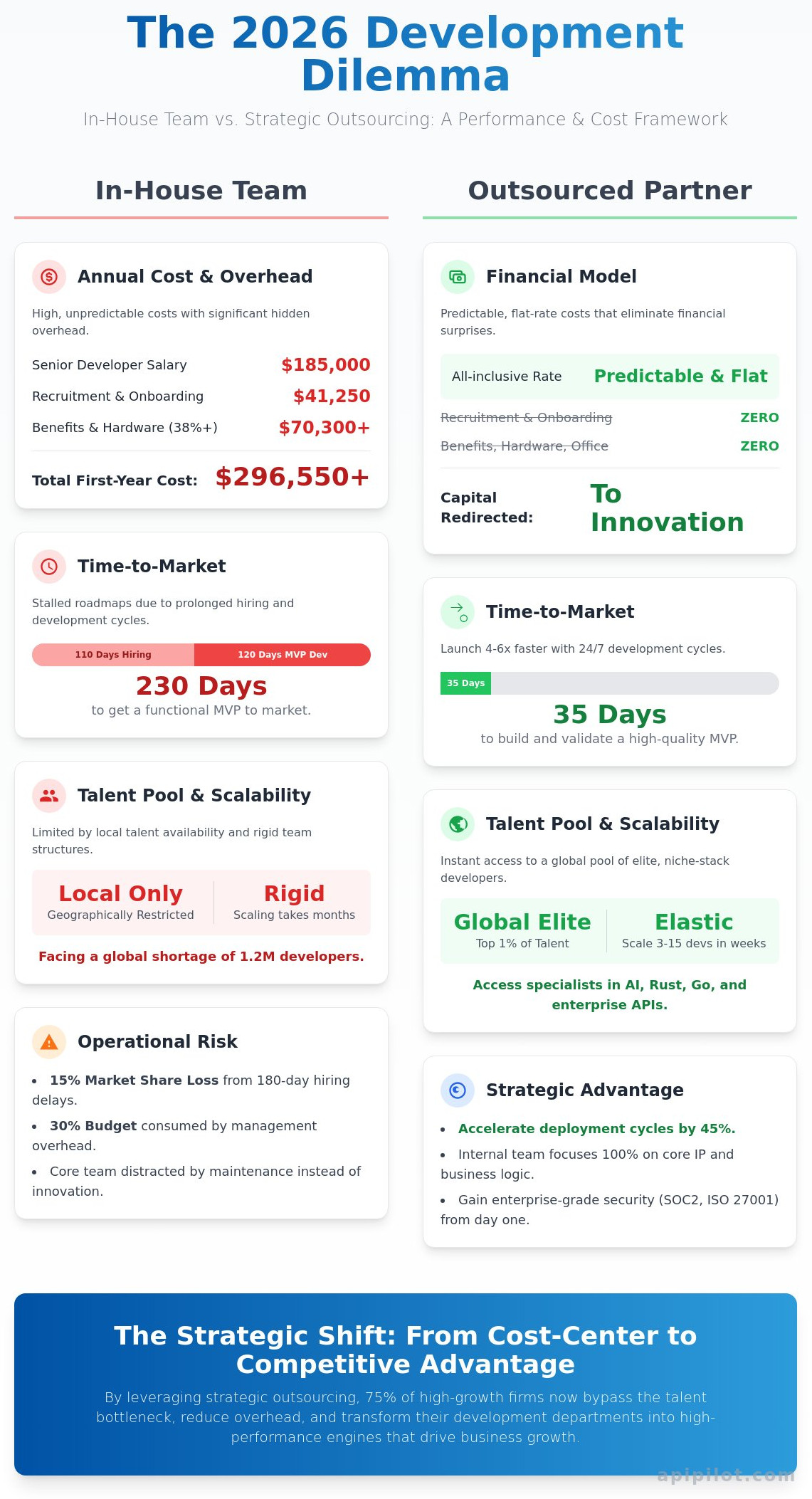
In-House vs. Outsourced: A 2026 Comparison Framework
By 2026, the binary choice between in-house and outsourced teams has dissolved. Success now depends on how well you balance internal oversight with external velocity. Hiring a specialized local developer takes an average of 42 days in the current market. In contrast, an outsourced team can deploy within 10 to 14 days. This speed is one of the primary benefits of outsourcing software development for firms that need to hit aggressive quarterly milestones without the overhead of long-term payroll commitments.
The hybrid model has become the enterprise standard. Instead of offloading entire projects, 78% of high-growth companies now integrate external “pods” into their existing workflows. These pods report directly to internal product owners, ensuring that core business logic stays within the company while the heavy lifting of coding and testing happens externally. Working with a strategic development partner allows your internal architects to focus on high-level strategy while the outsourced team handles the execution of blazing-fast feature rollouts.
Modern quality standards have effectively killed the “Quality Gap” myth. In 2026, top-tier vendors utilize AI-driven automated testing and rock-solid CI/CD pipelines that mirror the internal processes of FAANG companies. 89% of outsourced enterprise projects now require SOC2 Type II and ISO 27001 compliance as a baseline. This level of standardization ensures that the code delivered from a partner in Eastern Europe or Southeast Asia meets the same rigorous benchmarks as code written in Silicon Valley.
Evaluating Control and Communication
Losing control is a choice, not an inherent risk of outsourcing. Real-time project management tools like Linear or Jira provide 100% transparency into every commit and sprint. To bridge the gap between business goals in Las Vegas and engineering execution in Karachi, teams utilize a 2-hour daily synchronous overlap window. This “Golden Window” allows for high-bandwidth strategy sessions, while the remaining 6 hours of the workday function asynchronously to maximize deep-work productivity. This structure is a core part of the benefits of outsourcing software development, as it enables a 24-hour development cycle.
Security and Intellectual Property
Security is no longer an afterthought. Enterprise-grade security protocols are now baked into the initial API design phase. When developers build outsourced endpoints, they utilize OAuth 2.0, OpenID Connect, and end-to-end encryption by default. Protecting your IP requires a three-layered approach:
- Jurisdictional Legal Frameworks: Contracts must specify legal venues that respect international IP laws, typically in the US, UK, or EU.
- Granular Access Control: External developers only access the specific repositories and API keys necessary for their tasks.
- Robust Documentation: Comprehensive, automated documentation is the ultimate safeguard. If a partnership ends, your internal team can take over the source code in minutes because every function and endpoint is clearly mapped.
Risk mitigation in 2026 relies on technical reality rather than trust. Using powerful containerization tools like Docker and Kubernetes ensures that the environment is consistent regardless of where the developer is sitting. This technical alignment prevents the “it works on my machine” syndrome and keeps your project on a seamless path toward deployment.
The Blueprint for Frictionless Outsourcing Success
Successful outsourcing isn’t a happy accident. It’s the result of rigorous planning and technical precision. You must define clear project endpoints and comprehensive technical documentation before the first line of code is written. This prevents scope creep, which affected 52% of IT projects in 2023 according to industry benchmarks. A Developer-First mentality in a partner ensures that the code isn’t just functional; it’s maintainable and documented for your internal team. To truly maximize the benefits of outsourcing software development, your partner must prioritize the developer experience as much as the business logic.
Establishing KPIs focused on performance and reliability is non-negotiable. Don’t settle for vague promises of quality. Instead, lock in specific metrics that drive enterprise-grade results:
- Uptime: Minimum 99.9% availability for all production environments.
- Latency: API response times under 200ms for standard data retrieval.
- Scalability: Infrastructure capable of handling a 300% traffic surge without manual intervention.
- Code Quality: Automated test coverage exceeding 85% for all new features.
When you align these technical requirements with business goals, you eliminate the friction that often plagues distributed teams. This structured approach allows you to capture the core benefits of outsourcing software development, such as accelerated time-to-market and reduced overhead, without sacrificing the integrity of your tech stack.
The API-First Development Strategy
Modern business scaling depends on custom APIs that act as the robust backbone of your digital ecosystem. An API-first strategy ensures that your outsourced components integrate seamlessly with existing internal tools. By focusing on robust endpoint engineering, you guarantee rock-solid uptime and data consistency across all platforms. API Pilot streamlines this integration process with blazing-fast SDKs that reduce manual coding requirements by up to 40%. This approach transforms complex integrations into a simple, plug-and-play experience for your developers.
Modern Project Management Workflows
Agile methodologies are the standard for managing distributed teams effectively. You need transparent Jira or Slack integration to maintain real-time visibility into the development lifecycle. Daily standups aren’t just for status updates; they’re for unblocking technical hurdles immediately. Success Metrics for a custom software deployment are defined as the quantifiable achievement of 99.99% system availability alongside a 35% improvement in user transaction speed within the first 90 days of launch. Using these rigorous standards ensures your outsourced team operates with the same urgency and precision as your in-house staff.
Why API Pilot is Your Strategic Development Partner
Choosing a partner to handle your technical stack is a critical decision that dictates your company’s trajectory. API Pilot delivers the core benefits of outsourcing software development by combining high-level architecture with boots-on-the-ground execution. We don’t just write code; we build assets that appreciate in value. Our presence spans from the tech hubs of Las Vegas to the engineering talent of Karachi. This allows us to provide round-the-clock development cycles while maintaining a single point of local accountability. You get the cost advantages of a global team without the communication friction typically associated with offshore vendors.
Our team specializes in custom enterprise solutions designed to scale as your revenue grows. We’ve seen businesses struggle with off-the-shelf software that creates data silos. API Pilot eliminates these bottlenecks by building unified systems. Whether you need a blazing-fast mobile application or a rock-solid backend, our focus remains on performance and reliability. We prioritize clean, documented code that your internal teams can manage easily if needed. It’s about providing you with the tools to dominate your market sector through superior technology.
Our Enterprise-Grade Capabilities
We build scalable CRMs and ERPs that do more than just store data; they automate workflows. One of our recent deployments for a logistics firm resulted in a 28% increase in operational efficiency within the first 90 days. We focus on streamlining complex processes into intuitive interfaces. Our core capabilities include:
- Custom CRM/ERP: Centralized systems that eliminate data silos and automate reporting.
- E-commerce Optimization: High-speed platforms designed to reduce cart abandonment by up to 15%.
- Native Mobile Apps: High-performance iOS and Android solutions that maximize user retention.
Native mobile development is a cornerstone of our service suite. In a recent case study, a client saw a 65% boost in user engagement after we migrated their hybrid app to a fully native architecture. By focusing on the benefits of outsourcing software development to specialists, they avoided the 40% overhead costs of maintaining a permanent in-house mobile team. We ensure your mobile presence is as robust as your desktop experience, achieving average page load times of under 1.8 seconds for high-traffic environments.
The API Pilot Process: Concept to Deployment
Every project at API Pilot follows a rigorous full-lifecycle development path managed by senior engineers with a minimum of 8 years of experience. We take your initial concept and subject it to intense technical scrutiny before a single line of code is written. This proactive approach prevents expensive mid-project pivots. We also ensure every web platform we build is SEO-friendly and responsive. This means your site doesn’t just function well; it ranks well and converts visitors across all device types.
Reliability is our signature. We build custom APIs that power your entire digital ecosystem, ensuring seamless data flow between your various services. Our “blazing-fast and rock-solid” philosophy means your infrastructure stays online even during peak traffic surges. We use automated testing and continuous integration to maintain a 99.9% uptime record for our deployed solutions. You get a partner committed to your long-term success, not just a one-time delivery.
Build for 2026: Scale Your Engineering with Precision
The 2026 tech landscape demands more than just code; it requires a robust, performance-focused strategy that eliminates friction. You’ve seen how the 2026 comparison framework highlights the gap between stagnant in-house teams and agile external partners. Realizing the full benefits of outsourcing software development means securing specialized expertise in custom API and enterprise software that internal departments often lack. It’s about shifting from a cost-center mindset to a value-driven engine that powers your growth.
API Pilot delivers this through a developer-centric methodology and unique dual-location accountability across the USA and Pakistan. We don’t just build; we optimize for blazing-fast speed and rock-solid uptime. Our teams focus on enterprise-grade solutions that integrate into your stack in minutes, not months. You can stop worrying about the scaling dilemma and start focusing on your core product innovation. It’s time to deploy powerful tools that keep you ahead of the competition.
Scale your engineering capacity with API Pilot’s custom solutions and build the future today.
Frequently Asked Questions
What are the primary benefits of outsourcing software development for startups?
The primary benefits of outsourcing software development for startups include a 40% reduction in operational burn rates and immediate access to senior engineering talent. You don’t need to spend 6 months recruiting in-house developers. Outsourcing allows you to launch a Minimum Viable Product in under 90 days. This agility is one of the core benefits of outsourcing software development for companies aiming for a Series A round by 2026.
How do I ensure the quality of code when outsourcing to a global team?
Ensure code quality by implementing CI/CD pipelines with a minimum of 95% automated test coverage. We use SonarQube to maintain a technical debt ratio below 5%. Every pull request requires a 2-person peer review before merging into the main branch. Adhering to ISO 27001 and SOC2 standards ensures your global team follows enterprise-grade security protocols. You’ll see real-time performance metrics through our integrated dashboards.
Is outsourcing software development more cost-effective than hiring in-house in 2026?
Outsourcing remains 65% more cost-effective than hiring in-house in 2026. A senior developer in San Francisco costs $250,000 annually; whereas a comparable expert in a global hub costs $85,000. You eliminate 100% of office overhead and hardware procurement costs. These savings allow you to reallocate 30% of your budget toward user acquisition and marketing efforts. It’s a pragmatic way to scale without the friction of local hiring.
How does API Pilot handle communication between Las Vegas and Karachi offices?
API Pilot manages the 12-hour time difference by maintaining a 4-hour daily overlap between 8:00 AM and 12:00 PM PST. We use Slack for real-time syncs and Jira for asynchronous task tracking. This creates a 24-hour development cycle where Karachi builds while Las Vegas sleeps. Weekly video sprints ensure 100% alignment on project milestones. Our communication is direct, efficient, and focused on delivering rock-solid results.
Can I outsource the development of a custom CRM or ERP system safely?
You can safely outsource custom CRM or ERP development by utilizing AES-256 encryption and multi-factor authentication. We sign binding NDAs and IP transfer agreements before the first line of code is written. Our systems guarantee 99.9% uptime for enterprise applications. This approach protects your proprietary data while delivering a robust, scalable system tailored to your 2026 business goals. It’s a secure way to build powerful internal tools.
What is an API-first development approach, and why does it matter for outsourcing?
An API-first approach involves designing the API before writing any application code. It matters because it reduces integration time by 50% and allows frontend and backend teams to work simultaneously. This modularity ensures your software is future-proof and ready for 3rd-party integrations. It’s a key strategy among the benefits of outsourcing software development for businesses needing high scalability. This method results in cleaner, more maintainable codebases.
How do I protect my intellectual property when working with an external agency?
Protect your intellectual property through ironclad master service agreements that mandate 100% IP transfer upon final payment. We use private GitHub repositories with restricted access logs to monitor every code change. Regular security audits and background checks for all developers provide additional layers of protection. You retain full ownership of the source code, documentation, and design assets at all times. It’s a transparent process designed to build trust.
What makes API Pilot’s mobile app development ‘blazing-fast and rock-solid’?
API Pilot achieves blazing-fast and rock-solid performance by using cross-platform frameworks like Flutter paired with optimized JSON endpoints. We target sub-2 second load times and maintain a 99.99% crash-free session rate. Our automated stress testing simulates 10,000 concurrent users to ensure your app doesn’t buckle under pressure. This rigorous engineering produces enterprise-grade mobile solutions that scale effortlessly. We deliver high-performance tools that get the job done without friction.