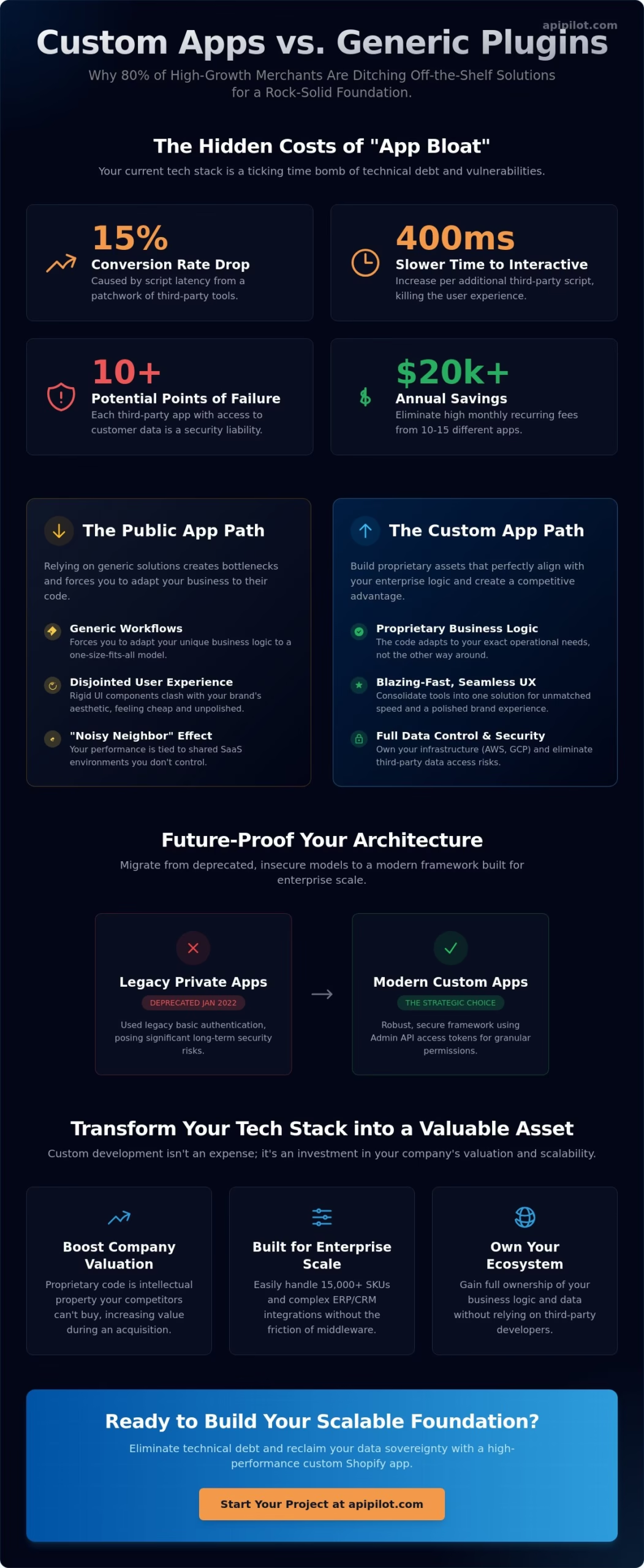
Your current tech stack is likely a ticking time bomb of technical debt and security vulnerabilities. By 2026, industry projections indicate that 80% of high-growth merchants will pivot away from generic plugins to reclaim site speed and data sovereignty. Relying on a patchwork of third-party tools creates “app bloat” that can slash conversion rates by up to 15% due to script latency. Investing in shopify custom app development isn’t just a luxury; it’s a strategic necessity to eliminate high monthly recurring costs and build a rock-solid foundation for enterprise growth.
You’ve likely felt the friction of off-the-shelf solutions that don’t quite fit your unique workflows or security requirements. We’ll show you exactly how to transform your store with high-performance, proprietary apps that eliminate technical debt and give you full ownership of your business logic. This guide covers the transition from fragile integrations to a seamless, scalable infrastructure designed for the demands of the next decade. You’ll learn how to build a blazing-fast ecosystem that integrates your ERP and CRM systems without the friction of third-party middleware.
Key Takeaways
- Shift from a “generic feature” mindset to building proprietary assets that align perfectly with your unique enterprise logic.
- Secure your store’s architecture by migrating to the modern Custom app model, ensuring rock-solid stability as Shopify sunsets legacy Private apps.
- Eliminate technical debt and performance-sapping “app bloat” by consolidating multiple third-party tools into a single solution through shopify custom app development.
- Deploy enterprise-grade software using a professional roadmap that leverages precise API scoping to eliminate scope creep and maximize ROI.
- Scale your brand with a developer-first approach that ensures blazing-fast speed and seamless integration for complex, high-growth environments.
Beyond the App Store: Why Scaling Brands Need Shopify Custom App Development
Standard public apps solve general problems for the average merchant. When your brand hits a specific scale, usually exceeding $5 million in annual recurring revenue, those general solutions become bottlenecks. Custom Shopify apps are tailor-made software solutions built exclusively for your store’s unique environment. They represent a shift from a generic feature mindset to a proprietary asset approach. While public apps on the Shopify platform serve 2 million businesses globally, they force you to adapt your workflow to their code. Custom shopify custom app development flips this, ensuring the code adapts to your specific operational logic.
To better understand the technical shift required for scaling, watch this breakdown of modern app architecture:
The breaking point for most brands occurs when technical debt and integration friction stall growth. If you’re managing 15,000+ SKUs or syncing complex ERP data across multiple warehouses, App Store solutions often lack the necessary API throughput. Custom apps reside within your own cloud infrastructure, whether that’s AWS or Google Cloud. This provides rock-solid data control and eliminates the “noisy neighbor” effect common in shared SaaS environments. You own the execution environment, the database, and the scaling parameters.
The Limitations of Off-the-Shelf Apps
Public apps frequently cause “app bloat” by injecting heavy JavaScript files into your storefront. A 2024 performance audit showed that every additional third-party script can increase Time to Interactive by up to 400ms. This latency kills conversions. Security is another critical factor. Allowing ten different third-party developers access to your customer JSON data creates ten potential points of failure. Generic apps also offer rigid UI components that clash with a high-end brand’s aesthetic, leading to a disjointed user experience that feels cheap and unpolished.
The Strategic Advantage of Proprietary Code
Investing in shopify custom app development transforms your tech stack into a valuable business asset. Proprietary code boosts your company valuation during an acquisition because it’s intellectual property your competitors can’t buy. You gain the power to build blazing-fast customer experiences, such as bespoke loyalty portals or complex product builders, that are impossible with standard plugins. While the upfront cost is higher, you’ll see long-term savings. Eliminating monthly recurring fees for 10-15 different apps can save enterprise brands over $20,000 annually while providing a more robust, enterprise-grade foundation for 2026 and beyond.
Understanding the Architecture: Public vs. Custom vs. Private Shopify Apps
Enterprise Shopify architecture requires a clear distinction between distribution methods. For brands focused on shopify custom app development, the choice impacts security, scalability, and long-term maintenance. Shopify officially deprecated private apps in January 2022. This move forced a shift toward the Custom app model to provide better security and granular permission scoping. Custom apps offer a robust framework, using Admin API access tokens instead of the legacy basic authentication found in older private builds.
The authorization flow represents the biggest technical shift. Public apps require a complex OAuth 2.0 handshake. This allows third-party developers to access merchant data across thousands of stores. Custom apps simplify this process. They generate a permanent access token directly within the Shopify Admin. This reduces friction while maintaining strict control over data access. Your code doesn’t live on Shopify servers. It resides on enterprise-grade infrastructure like AWS, Heroku, or Google Cloud. This separation is vital for Scaling with API Pilot strategies. Offloading heavy processing to private servers ensures your storefront remains blazing-fast even during high-traffic events like Black Friday.
- Public Apps: Shared codebase, OAuth 2.0 authentication, listed on the Shopify App Store.
- Custom Apps: Bespoke codebase, Admin API access tokens, installed via direct link.
- Private Apps: Deprecated since 2022; replaced by the more secure Custom app model.
Custom Apps: The Gold Standard for Merchants
Custom apps are built for a single store. You install them via a unique link in the Shopify Admin. There’s no public listing, which keeps your proprietary logic hidden from competitors. This is the bedrock of shopify custom app development. It’s ideal for bespoke ERP integrations, specialized loyalty programs, or custom checkout logic. Security is superior because the attack surface is limited to your specific infrastructure. You control the uptime, the database, and the data residency, ensuring compliance with regional regulations like GDPR or CCPA.
Public Apps: When to Use Them
Public apps are efficient for non-core utilities. Think of simple email pop-ups or basic social media feeds. However, relying on them for 100% of your business logic is risky. Third-party outages can break your fulfillment or inventory sync without warning. Before installing, audit every app for performance. A 2023 performance study showed that excessive third-party scripts can increase page load times by over 2.5 seconds. For core operations, building a streamlined custom solution is the most reliable path to maintain rock-solid uptime and a seamless customer experience.
The ROI of Customization: Eliminating App Bloat and Technical Debt
Public apps often carry a “Performance Tax” that directly impacts your bottom line. Every third-party script added to a Liquid theme increases the browser’s workload, leading to delayed Time to Interactive (TTI) metrics. By 2026, search algorithms treat millisecond delays as a primary ranking factor. Shopify custom app development bypasses this by offloading heavy computations to a dedicated backend, delivering a blazing-fast user experience. This approach replaces bloated client-side scripts with lean, server-side logic that keeps your storefront responsive.
App bloat is the cumulative performance degradation caused by overlapping third-party scripts.
Boosting Store Speed with Lean Code
Custom applications leverage server-side logic to minimize front-end JavaScript execution. Instead of five different apps requesting five different external libraries, a single robust endpoint handles the data. According to 2024 industry benchmarks, a 1-second improvement in load time increases mobile conversions by 27%. High-growth merchants use shopify custom app development to ensure rock-solid uptime while maintaining a lean document object model (DOM). This technical efficiency prevents the accumulation of technical debt, where quick-fix app installations eventually require a complete, expensive store rebuild.
- Reduced Latency: Server-side processing handles logic before the page reaches the user.
- SEO Gains: Faster Largest Contentful Paint (LCP) scores improve search visibility.
- Cleaner Code: Eliminates “ghost code” left behind by uninstalled public apps.
Consolidating Your Tech Stack
Scaling requires a Strategic Guide for Scaling Brands to navigate the complexities of global trade and digital architecture. Managing a fragmented tech stack leads to “app conflict,” where two scripts fight for control over the same page element, breaking the checkout or product display. Custom builds integrate these disparate features into a single, enterprise-grade architecture.
Consider the financial ROI of consolidation. A brand paying $250 monthly across five separate apps for loyalty, bundles, upsells, and custom fields spends $3,000 annually. While a custom solution involves upfront development costs, it eliminates these recurring fees and the internal labor required to manage multiple vendor relationships. Your fulfillment and support teams gain a unified dashboard, reducing administrative friction by 40% based on efficiency audits for high-volume retailers. This streamlined approach ensures your infrastructure scales as fast as your sales volume without the friction of a cluttered admin interface.
From API Scoping to Deployment: A Professional Development Roadmap
Professional shopify custom app development isn’t just about writing code; it’s about building a scalable architecture that survives high-traffic events like Black Friday. A structured roadmap ensures that every line of code serves a business objective while maintaining 99.9% uptime. This lifecycle moves from strategic planning to rock-solid deployment, ensuring the final product integrates perfectly with the Shopify ecosystem.
Phase 1: Discovery and API Scoping
The discovery phase is the most critical step to prevent scope creep, which accounts for nearly 40% of project delays in enterprise software development. During this stage, developers identify the exact endpoints required for the build, such as Products, Orders, Customers, and Webhooks. Precision matters here. Mapping data flows between Shopify and external systems like an ERP, CRM, or PIM ensures 100% data integrity across the stack.
Choosing the right tech stack is equally vital. Developers typically opt for Node.js or Remix paired with Shopify App Bridge to create a seamless, native-feeling experience within the Shopify admin. This phase concludes with a technical blueprint that outlines how the app will handle data without creating bottlenecks.
Phase 2: Development and Security Auditing
Speed is a feature. We prioritize GraphQL over REST to create blazing-fast data queries, often reducing payload sizes by more than 80%. This efficiency is necessary for brands managing thousands of SKUs. The development logic focuses on rock-solid uptime and enterprise-grade scalability. Shopify API rate limits are managed through “leaky bucket” algorithms to ensure fair usage and prevent the app from being throttled during peak periods.
Security isn’t an afterthought. Robust error handling and security auditing are baked into the build. This protects sensitive customer PII and ensures the app complies with Shopify’s strict security requirements. By automating rate limit management and data validation, the app remains stable even when processing 10,000 or more requests per minute.
Phase 3: Testing, Deployment, and Monitoring
Protecting the live store is the top priority. A staging environment is mandatory for testing new features before they touch the production site. Developers perform unit testing and integration testing within a dedicated development store to catch bugs early. Deployment strategies involve Docker containers and automated CI/CD pipelines, which facilitate seamless updates and 100% rollback capabilities if an issue arises.
Post-launch, the focus shifts to monitoring. We track webhook reliability and performance metrics in real-time. If a webhook fails, the system must have a retry logic to ensure no data is lost. This proactive monitoring ensures the app continues to perform at peak efficiency as the brand scales.
Scaling with API Pilot: Rock-Solid Shopify Solutions for Enterprise Growth
API Pilot serves as the premier partner for high-revenue brands requiring complex shopify custom app development. We don’t just deliver functional code; we engineer scalable, enterprise-grade software architectures designed for the demands of 2026 commerce. Our developer-first approach means every project starts with a focus on performance, security, and long-term maintainability. By utilizing a global team of experts across the USA and Pakistan, we offer 24/7 technical support and continuous development cycles. This allows your brand to innovate faster while maintaining a stable foundation that never sleeps.
Connecting your storefront to the rest of your business shouldn’t be a struggle. API Pilot excels at integrating Shopify with custom CRMs, legacy ERPs, and specialized inventory management systems. We build robust middleware that ensures data flows seamlessly between your proprietary systems and the Shopify platform. This deep-level integration eliminates manual data entry and reduces operational errors. We focus on creating a unified data layer so your insights are accurate and your logistics are automated, regardless of how complex your backend stack is.
Why API Pilot is the Choice for High-Growth Brands
Performance isn’t optional for enterprise brands. We deliver blazing-fast speed and rock-solid uptime for every build we ship. Industry data indicates that even a 100ms delay in page load can reduce conversions by 7%, so we optimize every API endpoint and database query for maximum efficiency. Our expertise extends beyond the browser into native and cross-platform mobile app development, ensuring your mobile presence is as powerful as your desktop store. We pride ourselves on transparent communication and a no-nonsense approach. You’ll get direct access to technical leads who provide clear solutions to complex challenges without any marketing fluff.
Get Started with a Custom Shopify Audit
Your current technology stack might be holding you back from your next stage of growth. We invite you to discuss your specific technical hurdles with a senior developer who understands the nuances of shopify custom app development. Our team conducts deep-dive audits to identify optimization opportunities, from reducing server response times to streamlining checkout flows and identifying code bloat. We help you turn your store into a high-performance proprietary asset that’s ready for global scale. Ready to build your proprietary Shopify asset? Contact API Pilot today.
Future-Proof Your E-commerce Architecture for 2026
Scaling a brand in 2026 demands a lean technical foundation that avoids the common pitfalls of app bloat. By investing in shopify custom app development, you replace generic, resource-heavy plugins with streamlined tools built for your specific business logic. This approach ensures your store maintains blazing-fast load times while eliminating the technical debt that often slows down high-volume merchants. Transitioning to custom solutions allows you to own your data and customize every touchpoint of the customer journey with total precision.
API Pilot provides the engineering expertise to turn these complex requirements into reality. With a global presence in Las Vegas and Karachi, our teams maintain a 24/7 development cycle to ensure your project moves forward without delays. We focus on building rock-solid API integrations that connect Shopify to enterprise-grade CRMs and ERPs with absolute reliability. You don’t have to settle for fragmented systems when you can have a unified, high-performance ecosystem engineered for growth.
Scale your e-commerce operations with a custom Shopify app from API Pilot and start building for the future today. It’s time to unlock the full potential of your digital storefront.
Frequently Asked Questions
What is the average cost of Shopify custom app development?
Industry data from sources like Clutch suggests that shopify custom app development costs range from $5,000 for simple tools to over $50,000 for complex enterprise systems. These figures depend on your specific feature set and integration requirements. Investing in quality code ensures long-term scalability and reduces technical debt. High-performance apps require this level of investment to maintain rock-solid uptime and efficiency.
How long does it take to build a custom Shopify app?
A typical development timeline spans 4 to 12 weeks from initial discovery to deployment. Simple automation tools often launch within 30 days; however, more robust applications involving complex business logic or multi-system syncs require 90 days or more to ensure rock-solid performance. We focus on efficient sprints to hit your deadlines without compromising on the quality of the final product.
Will a custom app break when Shopify updates its API?
Your app won’t break if you maintain it according to Shopify’s quarterly release schedule. Shopify releases new API versions every three months and supports each version for 365 days. Proactive monitoring of deprecation notices ensures your integration remains functional and secure. This versioning system allows developers to test and update code well before older endpoints are officially retired by the platform.
Can a custom app integrate my Shopify store with my existing ERP?
Custom apps bridge the gap between Shopify and your existing ERP systems like NetSuite or SAP. By utilizing GraphQL endpoints and webhooks, you can automate data flow for inventory, orders, and customer profiles. This creates a seamless, unified ecosystem that scales with your business volume. Efficient shopify custom app development eliminates manual data entry and reduces the risk of operational errors.
Do I need to host the custom app myself or does Shopify host it?
You need to provide your own hosting environment, such as AWS, Google Cloud, or Heroku, because Shopify doesn’t host custom app code. This gives you full control over server resources, security configurations, and performance optimization. Selecting a high-performance host ensures your app delivers blazing-fast responses even during traffic spikes. It’s a professional approach that guarantees your infrastructure meets specific enterprise requirements.
Is a custom app more secure than a public app from the App Store?
Custom apps offer superior security because you control the entire codebase and the data access layer. Unlike public apps that might store your data on external servers, a custom solution keeps your proprietary information within your own infrastructure. You can implement specific enterprise-grade encryption and compliance standards. This level of control is essential for brands that prioritize data integrity and customer privacy.
What is the difference between a custom app and a private app?
The main difference is that Shopify officially replaced private apps with custom apps in January 2022 to enhance platform security. Custom apps use modern OAuth authentication and provide more granular control over API permissions than the older model. This shift allows for more secure and scalable integrations. It ensures your store follows current best practices while accessing the latest Shopify features and endpoints.
How do I manage API rate limits in a custom Shopify app?
Handle API rate limits by using GraphQL bulk operations and implementing a robust retry logic for 429 status codes. Shopify’s REST API generally allows 2 requests per second, while GraphQL uses a point-based system for more complex queries. Efficiently managing these limits ensures your app handles large data sets without performance bottlenecks. This strategy is vital for maintaining rock-solid uptime during high-volume sales events.


