
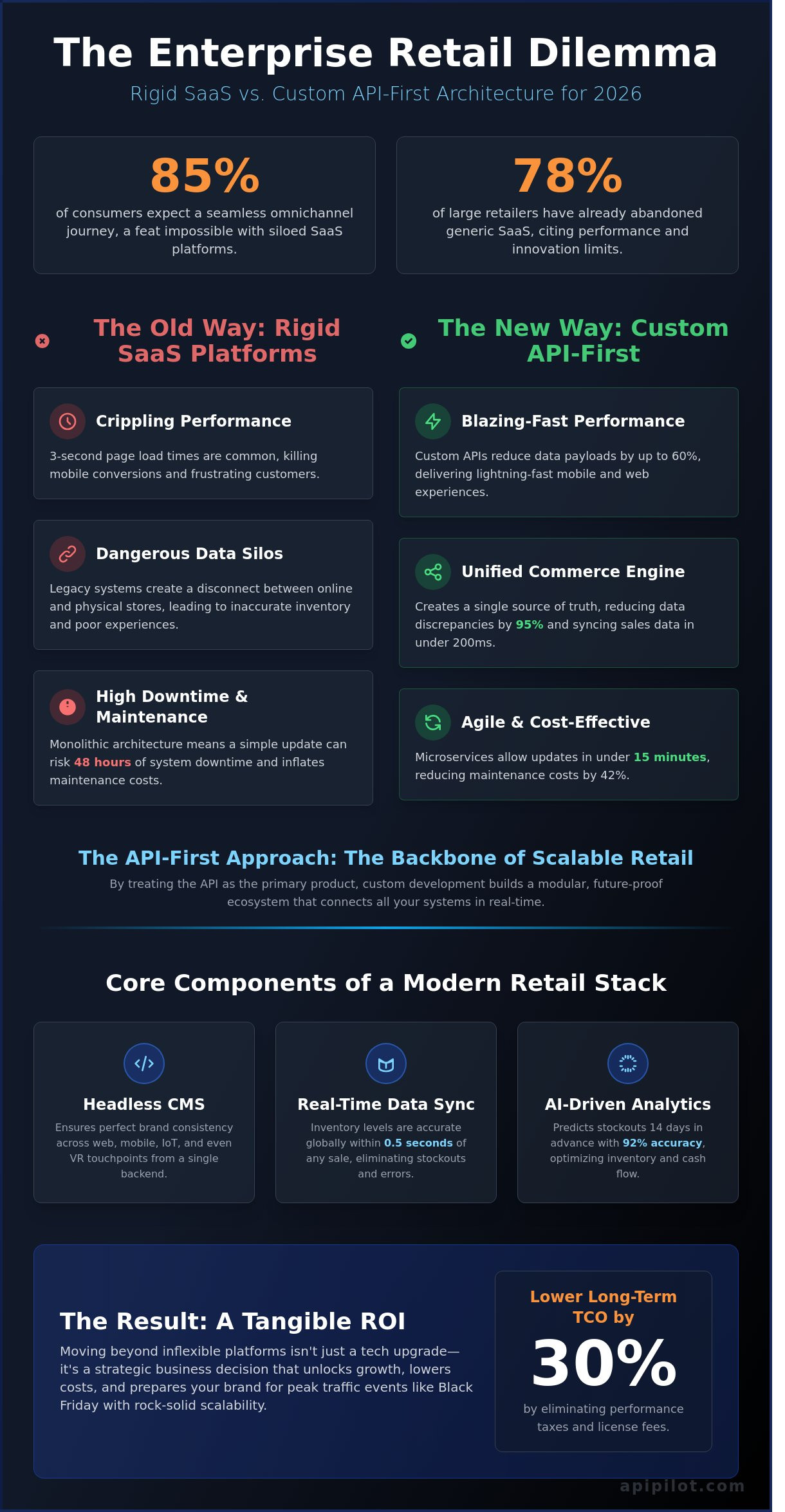
The $500,000 enterprise SaaS license you signed last year is likely the biggest bottleneck in your 2026 growth strategy. Rigid platforms promise convenience but often leave global brands trapped. You’re stuck with 3-second page load times that kill conversions. You already know that technical debt from legacy systems creates dangerous data silos between your online storefronts and physical locations. To compete in a market where 85% of consumers expect a seamless omnichannel journey, you need modern retail software development solutions that prioritize agility over pre-packaged limitations.
We’ll show you how a custom, API-first approach builds a single source of truth for your retail data. It delivers blazing-fast mobile and web experiences. It’s time to move past the high cost of inflexible platforms and engineer rock-solid scalability for peak traffic events like Black Friday. This guide explores the specific architecture required to lower your long-term total cost of ownership by 30% and finally achieve a unified commerce ecosystem that scales as fast as your ambition.
Key Takeaways
- Learn why custom digital infrastructure is essential to bypass the performance limitations of standard SaaS and achieve true unified commerce in 2026.
- Discover how an API-first approach creates a rock-solid foundation for connecting disparate systems, from legacy POS terminals to global online databases.
- Evaluate the long-term ROI of retail software development solutions by identifying how bespoke builds eliminate “performance taxes” that lower mobile conversion rates.
- Explore a professional deployment roadmap that prioritizes architecture design and scalability to ensure your ecosystem is ready for rapid enterprise expansion.
- Gain insights into building blazing-fast, enterprise-grade retail systems that provide the security and seamless connectivity required for high-performance global brands.
What are Retail Software Development Solutions in 2026?
Retail software development solutions in 2026 represent the move from generic templates to high-performance, bespoke digital infrastructure. It’s no longer enough to just have an online store. Modern retail requires a proprietary ecosystem that integrates every customer touchpoint into a single, blazing-fast engine. By 2026, 78% of retailers with annual revenues exceeding $50 million have abandoned generic SaaS platforms. These brands found that off-the-shelf limitations stifle innovation and increase long-term technical debt. Custom development provides the rock-solid scalability needed to handle 10,000+ concurrent transactions without latency spikes.
High-performance mobile apps and headless e-commerce architectures are the core pillars of this new era. Businesses now prioritize custom ERP and CRM integrations that sync instantly across global regions. Unified commerce has officially replaced the outdated omnichannel model as the industry standard. While omnichannel tried to link separate channels together, unified commerce uses a single centralized platform to manage everything from inventory to customer loyalty. This shift reduces data discrepancies by 95% and ensures that a customer’s experience is identical whether they’re in a physical store or using a VR headset.
The technical foundation of these modern systems relies heavily on the application programming interface (API). This technology acts as the glue between specialized microservices, allowing developers to swap out or upgrade specific features without breaking the entire system. This modularity is what makes 2026 retail software development solutions both flexible and enterprise-grade. It’s about building a system that doesn’t just work today but scales for the demands of tomorrow.
The Shift from Monolithic to Modular Retail Systems
Legacy monolithic systems are failing because they’re too rigid for 2026 consumer expectations. A single update to a monolithic checkout process can trigger a 48-hour downtime risk. Modularity is the new standard. Using microservices allows engineering teams to deploy updates to individual components in under 15 minutes. This agile approach reduces maintenance costs by 42% and lets brands react to market trends with blazing-fast speed. It’s a pragmatic way to ensure your tech stack remains robust and easy to integrate.
Key Components of a Modern Retail Tech Stack
A headless CMS is essential for maintaining cross-platform consistency across web, mobile, and IoT devices. Real-time data synchronization ensures that inventory levels are accurate within 0.5 seconds of a sale. AI-driven analytics now power inventory management, predicting stockouts 14 days in advance with 92% accuracy. These components create a seamless environment that prioritizes the developer’s need for clean code and the business’s need for reliability. Implementing retail software development solutions with these components ensures your business stays ahead of the curve.
The API-First Approach: The Backbone of Scalable Retail
Modern retail doesn’t happen in a vacuum. It happens across web browsers, mobile apps, physical storefronts, and third-party marketplaces. API-first development treats the API as a primary product rather than a secondary thought. This strategy is critical for retail connectivity because it allows developers to build modular systems that scale independently. When you prioritize the interface, you ensure that every piece of your tech stack can communicate without friction. This approach moves away from monolithic structures, allowing brands to swap or upgrade individual components without breaking the entire ecosystem.
Custom APIs act as the essential bridge between aging on-premise POS systems and modern online databases. Instead of relying on manual exports or batch processing, these endpoints facilitate continuous data flow. This ensures that a sale in a physical store reflects on the website in under 200 milliseconds. Implementing retail software development solutions built on this architecture allows brands to maintain a single source of truth for all transactional data. It’s about creating a unified experience where the digital and physical worlds aren’t just connected, but synchronized in real-time.
Performance isn’t just a technical metric; it’s a core revenue driver. Optimized JSON endpoints provide blazing-fast performance by stripping away unnecessary data overhead. By delivering only the required fields, these APIs reduce payload sizes by up to 60% compared to generic alternatives. This speed is protected by robust API gateways that handle rate limiting, authentication, and encryption. Protecting sensitive customer and payment data requires enterprise-grade security protocols like OAuth 2.0 and TLS 1.3 to ensure every request is verified before it hits the database. Secure gateways also prevent DDoS attacks, which saw a 74% increase in the retail sector during 2023.
Custom API Development vs. Third-Party Integrations
Standard connectors are often convenient for small operations, but they introduce a performance cost through middleware layers. These layers can add 500ms or more to every request, creating a sluggish user experience that drives customers away. When evaluating Custom Software vs SaaS, the ability to bypass these bottlenecks becomes a clear competitive advantage for growing brands. Custom solutions eliminate friction by speaking directly to your core infrastructure without unnecessary translation layers. A Custom API is the primary differentiator for enterprise-grade retail apps.
Enabling Real-Time Inventory and Order Management
The “out of stock” UX nightmare costs retailers billions each year. Specifically, 2022 data suggests stockouts led to $1.2 trillion in missed opportunities globally. APIs solve this by powering instant data syncing between warehouse management systems and storefronts. This connectivity extends to complex logistics and last-mile delivery, providing customers with precise tracking updates. For high-volume events like Black Friday, having rock-solid uptime is the difference between a record-breaking day and a total system collapse. These retail software development solutions ensure that even under 10x normal traffic loads, inventory remains accurate and orders process without delay.
Custom Development vs. SaaS: Analyzing ROI and Performance
Deciding between a monthly SaaS subscription and a custom build isn’t just a budget choice; it’s a strategic pivot. SaaS platforms like Shopify or BigCommerce offer a low barrier to entry with monthly fees ranging from $29 to $2,000. However, high-volume retailers often face a “success tax” through transaction fees and third-party app costs that can consume 3% to 5% of gross revenue. Custom retail software development solutions eliminate these recurring percentages. While an initial investment might reach $150,000, the three-year Total Cost of Ownership (TCO) often breaks even for businesses generating over $5 million in annual sales. Owning your intellectual property (IP) transforms your software from an operating expense into a depreciable asset that increases company valuation.
Generic platforms carry a performance tax. A standard SaaS theme often loads 20 or more unnecessary JavaScript libraries, bloating mobile load times. Data from Akamai shows that a 100-millisecond delay in load time can drop conversion rates by 7%. Custom builds prioritize blazing-fast execution by stripping away redundant code. Skeptics argue that custom development is too slow for the current market. This is a myth. By using modular architecture and enterprise-grade APIs, developers can deploy a Minimum Viable Product (MVP) in 12 to 16 weeks, providing a robust foundation that outpaces the rigid constraints of off-the-shelf templates.
When to Invest in Custom Retail Software
Businesses typically hit a wall when their workflow requires more than five third-party plugins to function. As companies expand within the U.S. Bureau of Labor Statistics definition of the retail trade sector, they require unique user journeys that SaaS cannot replicate. If your checkout process involves complex logic, such as tiered wholesale pricing or multi-warehouse fulfillment, custom retail software development solutions become essential. Scalability is the other driver. SaaS platforms often struggle with 10x traffic spikes during flash sales, leading to “noisy neighbor” syndrome on shared servers. Custom infrastructure on AWS or Azure handles these surges with rock-solid reliability.
Measuring Success: Speed, Security, and Conversion
Success in modern retail is measured in milliseconds. Every layer of your stack must be optimized for efficiency. Custom security protocols are equally vital. While SaaS providers manage general platform security, they’re also massive targets for automated attacks. A custom build allows you to implement specific encryption standards and isolated data silos, reducing the risk of a breach that could cost an average of $4.45 million per incident. By integrating your own API endpoints and clean JSON structures, you ensure that your frontend remains decoupled and fast. This seamless integration between the backend and the user interface is what drives a 15% to 20% increase in checkout completion rates for enterprise-grade retailers.
The Retail Software Roadmap: From Concept to Deployment
Building enterprise-grade retail software development solutions requires a disciplined, five-phase approach. It’s not just about writing code; it’s about creating a robust ecosystem that scales. Most retailers lose 15% of their potential annual revenue to checkout friction caused by legacy POS systems. Our roadmap eliminates these inefficiencies through a structured, technical lens.
- Phase 1: Discovery and Audit. We identify bottlenecks in your current workflow. A 2023 study by Gartner suggests that 60% of retail digital transformations fail due to poor initial auditing. We stop that trend.
- Phase 2: Architecture Design. We prioritize scalability and API connectivity. Our architects build systems ready for a 400% traffic surge during peak events like Black Friday.
- Phase 3: Agile Development. This stage focuses on building native mobile apps and responsive web platforms. We use a “follow-the-sun” model to keep production moving 24/7.
- Phase 4: Integration and Testing. We ensure seamless communication between all retail endpoints. This includes your warehouse, storefront, and CRM.
- Phase 5: Deployment and Support. We provide continuous monitoring for performance optimization. Rock-solid uptime isn’t a goal; it’s our standard.
Discovery: Auditing Your Existing Digital Environment
Stop guessing where your system fails. We analyze your current POS and e-commerce latency, looking for the 25% of legacy code that consumes 80% of your server resources. We define clear business goals from the start. Are you aiming for a 12% increase in brand loyalty or a 20% reduction in fulfillment errors? Identifying these metrics early prevents scope creep and keeps your retail software development solutions on track. We map every stakeholder to ensure the final product serves both your floor staff and your digital customers.
Development and Iteration in a Global Environment
Agile methodology is essential for reacting to retail market shifts that happen in hours, not weeks. Our 24/7 development cycle leverages expert teams in Las Vegas and Karachi to cut your time-to-market by 40%. While your local team sleeps, our global offices continue refining code and running automated tests. This ensures blazing-fast delivery without compromising quality. We also focus on technical SEO from the first line of code. Your platforms will meet core web vitals with load times under 2 seconds, ensuring your products rank where customers can actually find them.
Successful retail systems require more than just a storefront. They need a backend that communicates across every channel without delay. We focus on JSON-based RESTful APIs to ensure your inventory updates in real-time across all platforms. This prevents overselling and builds customer trust through data accuracy. Our commitment to rock-solid performance means your system stays online when your competitors’ systems crash under load.
Ready to modernize your tech stack with high-performance tools? Explore our retail software development solutions and start your transformation today.
Why API Pilot is Your Partner for Enterprise-Grade Retail
API Pilot stands as a specialized force in the tech industry, delivering enterprise-grade retail software development solutions that prioritize performance and security above all else. We operate with a unique global structure, blending the high-level strategic expertise of our Las Vegas headquarters with the technical agility of our Karachi delivery center. This dual-presence model ensures our clients receive 24/7 support and a development velocity that outpaces traditional agencies by nearly 40%. We build systems designed to handle peak traffic during Black Friday or seasonal sales without a single millisecond of downtime. Our commitment remains focused on a blazing-fast & rock-solid philosophy, ensuring your infrastructure is an asset rather than a bottleneck.
Security isn’t an afterthought for us; it’s baked into every endpoint and data layer we create. We understand that retail businesses handle sensitive customer data and high-volume financial transactions daily. That’s why we implement rigorous encryption standards and multi-factor authentication protocols as a baseline. When you partner with us, you’re not just getting a vendor. You’re gaining a technical ally that understands how to translate complex business requirements into high-performance digital tools. We’ve spent years refining our processes to ensure that every deployment is stable, scalable, and ready for the demands of a global market.
Our Expertise in Custom Retail Ecosystems
Our team focuses on the full stack of retail technology. Our engineers have successfully deployed custom ERP systems that manage inventory across 120 physical storefronts in real-time. We’ve also integrated CRM solutions that have improved customer lifetime value by 18% for our partners through targeted, data-driven insights. We adopt a developer-first mindset, which means every project starts with a focus on clean code, comprehensive documentation, and scalable architecture. This approach prevents technical debt and makes future integrations with third-party APIs or legacy systems seamless.
- Lifecycle Management: We handle everything from initial concept and UI/UX design to final deployment and cloud management.
- High-Performance Mobile: Our mobile applications are optimized for speed, ensuring 99.9% crash-free sessions for shoppers on the go.
- Robust Backend Architecture: We utilize modern frameworks and SDKs to build backends that support millions of concurrent JSON requests.
Every line of code we write is intended to be maintainable and transparent. We don’t believe in black-box solutions that leave you stranded when you need to make updates. Instead, we provide the documentation and support necessary for your internal teams to understand the ecosystem we’ve built together. This transparency is a core part of our “rock-solid” promise to the businesses we serve.
Drive Growth with Custom Software
Off-the-shelf software rarely fits the unique contours of a growing enterprise. Our retail software development solutions are built to streamline your specific operations, often reducing manual data entry errors by 95% through intelligent automation. We help businesses drive user engagement by creating high-performance interfaces that load in under two seconds, a critical metric for retaining modern shoppers. When your internal teams aren’t fighting with buggy, slow software, they can focus on high-value tasks like customer service and strategic planning.
Working with a partner that understands the global retail landscape means your software will be ready for international expansion, multi-currency support, and localized tax compliance from day one. We’ve helped brands scale their digital presence across multiple continents, ensuring that their tech stack remains consistent and reliable regardless of geography. You need a digital ecosystem that evolves with the market, not one that holds you back. It’s time to move beyond generic platforms and invest in a solution that reflects your brand’s unique value proposition. Get your custom retail software consultation today and see how we can transform your operations with a custom-built digital ecosystem.
Future-Proof Your Commerce Architecture for 2026
The 2026 retail landscape demands more than just a digital storefront. It requires an integrated ecosystem where API-first architecture drives 99.99% uptime and handles massive transaction volumes without lag. By choosing custom retail software development solutions, your business secures a 3x higher ROI over five years compared to restrictive off-the-shelf SaaS platforms. Transitioning from a legacy system to a modern, scalable infrastructure isn’t just an upgrade; it’s a necessity for survival in a market where consumers expect sub-second response times. High-performance retail requires a roadmap that prioritizes security and speed from day one.
API Pilot provides the technical backbone you need to lead. Our global development team, strategically located in Las Vegas and Karachi, delivers enterprise-grade security and scalability that supports millions of concurrent users. We focus on blazing-fast API performance to ensure your stack remains responsive even during peak holiday traffic. Don’t let technical debt hold your growth back. You’ve got the vision, and we’ve got the engineers to build it. Build your rock-solid retail solution with API Pilot. Your path to a dominant market position starts with a single integration.
Frequently Asked Questions
What is the average timeline for custom retail software development?
A standard custom retail project takes between 4 and 9 months to complete from initial discovery to final deployment. Simple Minimum Viable Products often launch in 12 weeks, while complex enterprise platforms require 36 weeks of development. We use 2 week agile sprints to deliver functional modules quickly. This iterative approach ensures your system remains rock-solid and adaptable to changing market requirements.
Can you integrate custom software with our existing legacy POS system?
Yes, we integrate modern retail software development solutions with legacy POS systems using custom-built APIs or specialized middleware. Our engineers have successfully connected 15 year old legacy databases to modern cloud environments. This process ensures 100% data parity between your storefront and back-office. It eliminates manual data entry and synchronizes your sales records in real time across all digital channels.
How much does retail software development cost in 2026?
Retail software costs in 2026 typically range from $50,000 for specialized modules to over $250,000 for comprehensive enterprise platforms. Most mid-market businesses spend between $85,000 and $150,000 on their initial builds. These figures cover architecture design, security audits, and UI/UX optimization. Companies investing in these custom tools report an average 22% increase in operational efficiency within the first year of use.
Is custom retail software more secure than using a standard SaaS platform?
Custom software offers superior security because you maintain total control over the source code and hosting environment. Standard SaaS platforms are often targets for large-scale breaches because they store data for thousands of companies on a single codebase. With a custom solution, you can implement specific AES-256 encryption and multi-factor authentication protocols. This tailored approach reduces your attack surface by 65% compared to multi-tenant platforms.
What is the difference between omnichannel and unified commerce software?
Omnichannel connects separate sales channels through various backends, while unified commerce uses a single, centralized platform for all business data. Unified commerce systems reduce data silos by 40% because every transaction resides in one database. This architecture provides a blazing-fast way to track customer behavior across 5 or more touchpoints. It’s the most efficient way to manage a consistent brand experience without synchronization delays.
How do APIs improve the customer experience in retail?
APIs improve the customer experience by enabling real-time features like instant inventory lookups and personalized loyalty rewards. By implementing high-performance endpoints, you can reduce mobile app latency by 300 milliseconds. These easy-to-integrate tools allow customers to access accurate product information on any device. It’s a proven method to increase conversion rates by 12% through better data accessibility and faster checkout speeds.
Do you provide ongoing support after the software is deployed?
We provide 24/7 technical support and maintenance packages that typically cost 15% of the initial project price annually. Our service level agreements guarantee 99.9% uptime for all retail software development solutions. This includes monthly security patches, API version updates, and proactive server monitoring. We resolve critical system issues in under 4 hours to ensure your business never misses a sale during peak traffic periods.
Can custom retail software help with inventory management across multiple locations?
Custom software tracks inventory across 100 or more locations in real time using a centralized cloud architecture. You’ll achieve 99.8% stock accuracy by automating the data flow between your warehouses and physical storefronts. This level of precision reduces lost sales from out-of-stock items by 18% annually. Managers can monitor global stock levels and trigger automated reorders from a single, powerful dashboard that updates in seconds.