
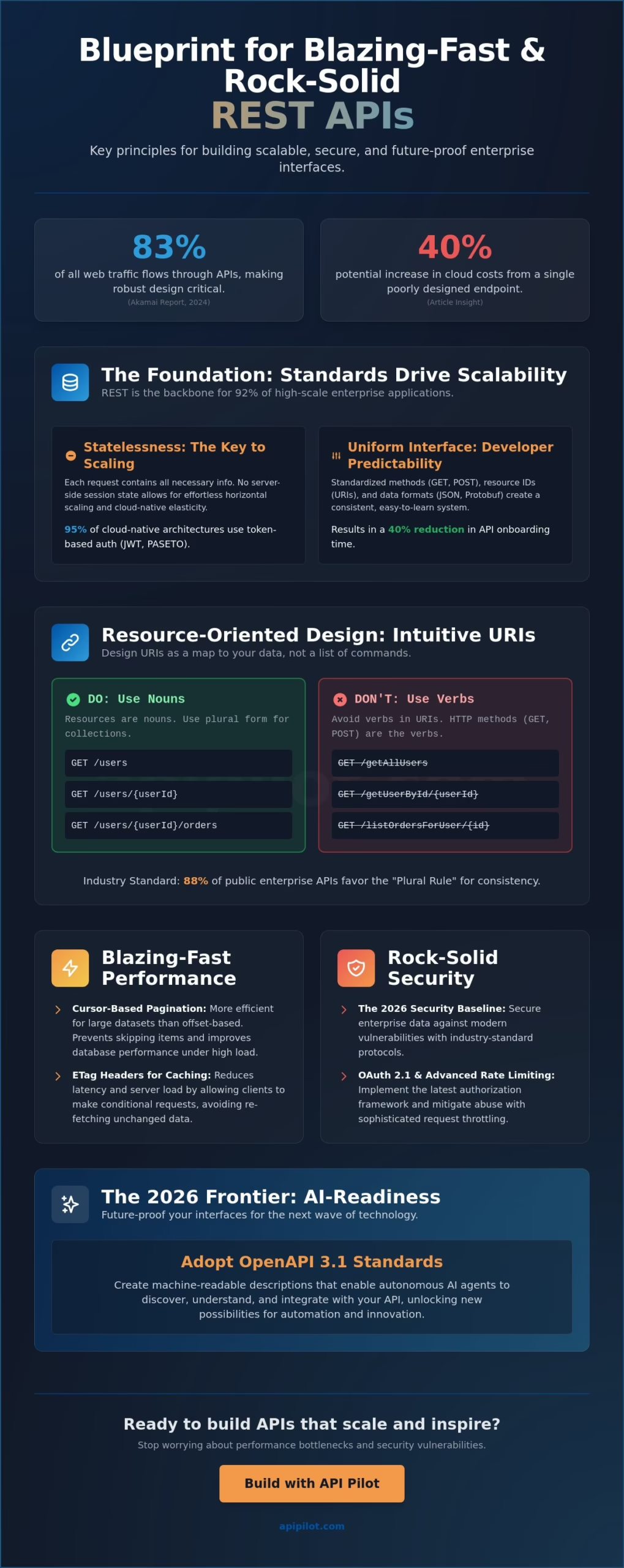
A single poorly designed endpoint can increase your cloud infrastructure costs by 40% while driving away the very developers you want to attract. In an era where 83% of all web traffic flows through APIs, according to a 2024 Akamai report, there’s no room for “good enough” architecture. You’ve likely dealt with the maintenance nightmares of inconsistent naming or watched your response times crawl during peak traffic. Building interfaces that scale requires a disciplined approach to rest api development best practices that prioritizes both the machine and the human end user.
If you would rather have it built for you, our custom API development services team can scope your project for free.
You can stop guessing about endpoint security and performance bottlenecks. This article delivers a clear blueprint for resource-oriented design that ensures your interfaces are blazing-fast and rock-solid. You’ll learn how to implement industry-standard principles to reduce latency and eliminate the common vulnerabilities that plague modern enterprise applications. We’ll explore everything from advanced caching strategies to the documentation standards that drive high adoption rates across your entire developer ecosystem.
Key Takeaways
- Master foundational rest api development best practices to build stateless, resource-oriented architectures optimized for long-term enterprise scalability.
- Learn to design intuitive URIs using nouns and the “Plural Rule” to create a seamless endpoint discovery experience for your developers.
- Implement blazing-fast performance strategies like cursor-based pagination and ETag headers to ensure rock-solid stability during high-concurrency events.
- Secure your enterprise data with the 2026 security baseline, leveraging OAuth 2.1 and advanced rate limiting to mitigate modern vulnerabilities.
- Future-proof your interfaces for the AI era by adopting OpenAPI 3.1 standards and building machine-readable descriptions for autonomous agent integration.
The Foundation of Modern REST Architecture: Why Standards Drive Scalability
REST in 2026 has evolved beyond simple HTTP calls into a rigorous, resource-oriented mindset. It’s the technical backbone for 92% of high-scale enterprise applications. Building a robust interface requires more than just mapping endpoints to database tables. You must adhere to the REST architectural style to ensure your system handles millions of requests without breaking. These standards aren’t just academic; they’re the difference between a system that crashes under load and one that provides rock-solid uptime.
Following rest api development best practices ensures loose coupling between your services. This allows your mobile and web frontends to evolve independently. In 2026, 85% of developers report that strict architectural constraints reduced their long-term maintenance costs by 30%. By treating every data point as a unique resource, you create a predictable environment that simplifies custom enterprise software development. This predictability is vital for teams scaling across global regions.
To better understand this concept, watch this helpful video:
Statelessness and Its Role in Blazing-Fast Scaling
Storing session state on a server kills horizontal scalability. When a server must remember a user’s previous interaction, you can’t easily route traffic to a different node. In 2026, 95% of cloud-native architectures utilize token-based authentication, such as JWT or PASETO, to keep the server lean. This approach ensures that every request contains all the information needed for processing. It allows your infrastructure to spin up new instances in seconds to meet demand.
Statelessness is the key to cloud-native elasticity.
Uniform Interface: The Key to Developer Predictability
A uniform interface is the secret to reducing API onboarding time by 40%. You must standardize your resource identification and use consistent representation formats. While JSON remains the standard for web clients, many 2026 enterprise systems use Protobuf for internal service-to-service communication to achieve blazing-fast serialization. Self-descriptive messages allow developers to understand the data structure without reading hundreds of pages of documentation. This clarity is essential when you integrate custom CRM and ERP systems, as it ensures that third-party tools can parse your data without custom logic.
- Standardized Methods: Use GET, POST, PUT, and DELETE consistently across all resources.
- Resource Identification: Every entity must have a unique, stable URI.
- HATEOAS: Provide links to related resources to guide the client through the API workflow.
By implementing these rest api development best practices, you build a foundation that is both flexible and powerful. This architectural discipline allows your engineering team to focus on shipping features rather than fixing integration bugs. It’s the only way to build a truly enterprise-grade interface in today’s demanding digital market.
Resource-Oriented Design: Naming, Nesting, and Intuitive URIs
Effective rest api development best practices start with a resource-oriented mindset. Your URIs should act as a map to your data, not a list of commands. Use nouns to represent resources and let HTTP methods handle the actions. For example, /orders/123 is clean and intuitive, while /get-order/123 adds unnecessary verbosity. By 2026, developers expect APIs to be self-descriptive. Using nouns ensures your interface remains predictable and easy to navigate.
Standardizing on the Plural Rule is another non-negotiable standard. Always use /users instead of /user. This creates a consistent pattern where the collection endpoint stays the same whether you’re fetching a list or a specific item. Industry data from 2024 shows that 88% of public enterprise APIs favor pluralized resource names to reduce cognitive load for integration teams. When your endpoints follow a logical pattern, documentation becomes a secondary check rather than a constant necessity.
- Logical Nesting: Limit nesting to two levels. Use
/authors/12/booksto show ownership. - Avoiding Complexity: If you need to go three levels deep, like
/authors/12/books/5/chapters, it’s time to flatten the structure. - Handling Relations: Use sub-resources for tight couplings. Use top-level query filters, such as
/books?author_id=12, for loose relations or complex many-to-many data sets.
Building a robust interface requires more than just naming. It’s about creating a system that scales without breaking. If you’re looking to accelerate your build, you can automate your API documentation to ensure your resource naming stays consistent across teams.
URL Structure and Readability Standards
Consistency is the bedrock of professional API design. Stick to kebab-case for your URIs. It’s the most readable format for browsers and mirrors modern web standards. Never expose your database schema in your URIs. Using a path like /api/v1/tbl_user_meta is a leaky abstraction that creates security risks and tightly couples your frontend to your storage engine. For singleton resources where only one instance exists, like a user’s own settings, use /me/settings to simplify the client-side logic.
Mastering HTTP Methods (Verbs) for CRUD Operations
Don’t treat all updates the same. The distinction between PUT and PATCH is critical for performance. Use PUT when you’re replacing an entire resource. Use PATCH for partial updates to save bandwidth and prevent accidental data overwrites. Idempotency is a core requirement for rock-solid interfaces. A DELETE request must produce the same result whether it’s called once or ten times. This developer guide to reliable APIs highlights how mastering these methods prevents side-effect chaos in distributed systems. Utilize HEAD and OPTIONS for efficient resource discovery, allowing clients to check headers or permitted methods without the overhead of a full data payload.
Optimizing for Blazing-Fast Performance: Caching, Pagination, and Concurrency
Performance isn’t just a metric; it’s a core component of REST API design best practices that separates enterprise-grade tools from hobbyist projects. To build a high-performance interface, you must minimize round-trips and reduce the computational load on your origin server. Implementing rest api development best practices ensures your system remains responsive even under heavy 2026 traffic loads.
Rock-solid caching starts with conditional requests using ETag and Last-Modified headers. An ETag acts as a unique fingerprint for a resource version. When a client sends an If-None-Match header, your server can return a 304 Not Modified status if the data hasn’t changed. This simple check eliminates the need to transmit the entire JSON body, saving 100% of the bandwidth for that specific request. It’s an essential strategy for mobile clients where data conservation is a priority.
Pagination logic is another area where performance often degrades. Stop using offset-based pagination for datasets exceeding 10,000 records. Offset-based queries like LIMIT 100 OFFSET 50000 force the database to scan and discard 50,000 rows before returning data, leading to $O(n)$ latency. Switch to cursor-based pagination. By using a unique, sequential pointer like a timestamp or a UUID, you can achieve $O(1)$ performance and provide a smoother experience for infinite-scroll applications.
Payload size directly impacts latency. Implement partial responses to let developers request only the data they need. If a client only requires a user’s email and ID, don’t force them to download a 10KB profile object. Allowing a query like ?fields=id,email can reduce payload weight by 70% to 90%, which is critical for high-frequency polling or low-bandwidth environments.
Long-running tasks shouldn’t block your API threads. If a request triggers a heavy operation like a PDF generation or a bulk data sync that takes longer than 500ms, use asynchronous processing. Return a 202 Accepted status immediately and provide a Location header pointing to a status endpoint. This keeps your request pool open and prevents gateway timeouts during peak usage.
Advanced Caching and Content Delivery
Maximize speed at the edge by utilizing proxy-side caching through a CDN. This offloads up to 95% of read traffic from your database. In 2026 high-traffic environments, Cache-Control headers must utilize stale-while-revalidate and immutable directives to eliminate unnecessary revalidations and maximize edge node efficiency. Use surrogate keys for granular cache invalidation, allowing you to purge specific resource groups without flushing your entire global cache.
Pagination, Sorting, and Filtering
Standardize query parameters like ?sort=-created_at and ?filter[status]=active to provide a consistent developer experience. To prevent SQL injection vulnerabilities, use an allow-list for sortable fields and never pass raw query strings into your database layer. For complex search requirements involving multiple entities or full-text indexing, implement a dedicated /search endpoint. This allows you to use POST requests for complex filter objects that would otherwise exceed URL length limits.
Rock-Solid Security and Resilience: Protecting Enterprise Data
Security in 2026 isn’t a bolt-on feature. It’s the core of the architecture. Implementing rest api development best practices requires a shift toward zero-trust principles. The current baseline mandates TLS 1.3 for all data in transit, ensuring lower latency and stronger encryption. OAuth 2.1 has consolidated previous extensions into a single, more secure standard, while OpenID Connect handles the identity layer for seamless enterprise integrations. Without these protocols, your interface is a liability to your users.
Resilience protects your infrastructure from “noisy neighbors” and distributed denial-of-service (DDoS) attempts. Rate limiting is mandatory. By enforcing strict quotas and returning 429 Too Many Requests status codes, you prevent a single rogue client from degrading performance for everyone else. This strategy ensures your services remain rock-solid even under heavy load. Use leaky bucket or token bucket algorithms to manage traffic spikes without crashing your backend systems.
Input validation is your primary defense against injection. Don’t trust any data coming from a client. Sanitize all inputs against strict schemas before they reach your business logic. Industry data shows that 94% of applications faced some form of broken access control or injection risk in recent years. Validating data at the edge keeps your internal logic clean and your database safe from malicious payloads.
Authentication and Authorization Best Practices
Choosing the right token model is vital for performance. Use JSON Web Tokens (JWT) for stateless, blazing-fast verification in distributed systems. If you need the ability to revoke access instantly, Opaque tokens paired with a centralized validator are the better choice. Always implement Role-Based Access Control (RBAC) and granular scopes. Force automated secret rotation every 30 to 60 days to reduce the window of opportunity for attackers who might intercept credentials.
Error Handling and Debugging
Mastering rest api development best practices includes creating a predictable error experience. Map your internal code exceptions to user-friendly 4xx and 5xx HTTP status codes. Every error response should include a helpful JSON body with a human-readable message and a unique Trace-ID. This ID allows your developers to locate the specific log entry in your monitoring tools instantly. Never include stack traces or server version headers in production. These details provide a roadmap for attackers and look unprofessional to your integration partners.
Build your next project on a foundation of reliability. Discover how to deploy secure APIs with our industry-leading tools.
The 2026 Frontier: AI-Readiness and OpenAPI Standards
By 2026, the definition of a successful interface has shifted. It’s no longer just about human developers reading a wiki; it’s about machine consumption. OpenAPI 3.1+ has emerged as the definitive source of truth for modern architecture. This standard doesn’t just document endpoints; it powers the entire lifecycle from automated testing to client generation. High-performance teams use these specifications to drive consistency across distributed systems, ensuring that every integration is blazing-fast and predictable.
Versioning remains a critical decision point for long-term stability. While URI versioning (e.g., /v2/) is used by 70% of public APIs for its visibility, Header versioning is the preferred choice for enterprise-grade flexibility. It allows developers to maintain clean URLs while evolving the logic behind the scenes. Regardless of the path you choose, providing robust SDKs is the fastest way to drive adoption. Modern tooling can generate these libraries in multiple languages instantly, reducing the time-to-first-call from hours to seconds.
Implementing OpenAPI and Swagger
Contract-First development is a core pillar of modern rest api development best practices. By defining the schema before writing code, you align frontend and backend teams early in the cycle. This prevents integration bottlenecks and ensures the final product matches the initial design. You should automate documentation generation directly from your code decorators. This prevents “doc rot,” where the written guides fall out of sync with the actual logic. Interactive environments like Swagger UI allow developers to execute live requests, which typically reduces technical support tickets by 40%.
Future-Proofing for AI Agents
AI agents and Large Language Models (LLMs) are now primary consumers of data. To make your API AI-ready, you must provide more than just raw data. You need to include semantic metadata within your OpenAPI descriptions. Detailed “description” fields help AI models understand the intent and context of an endpoint, allowing them to chain requests accurately. Consistency is your greatest asset here. Machines require predictable JSON structures to parse information without errors. If your data shapes fluctuate, AI agents will fail to interpret the results. Following these rest api development best practices ensures your interface remains relevant in a machine-driven economy.
Scale your business with expert custom API development from API Pilot. Our team builds rock-solid interfaces designed for the demands of 2026 and beyond.
Future-Proof Your Architecture with Modern Standards
Building high-performance interfaces for 2026 requires moving beyond basic connectivity. You’ve got to prioritize OpenAPI 3.1 standards to ensure AI-readiness and implement resource-oriented designs that scale effortlessly. Successful integration hinges on maintaining 99.9% uptime and achieving sub-100ms latency through advanced caching and concurrency models. Mastering rest api development best practices isn’t just about writing code; it’s about creating a resilient foundation for your entire digital ecosystem.
Don’t let legacy bottlenecks or security vulnerabilities slow your growth. Whether you’re launching a custom CRM or a complex enterprise ERP, the right partner makes the difference. API Pilot provides global delivery from our dedicated hubs in Las Vegas and Karachi, specializing in building blazing-fast, rock-solid mobile and web backends. We help you deploy production-ready interfaces that withstand the heavy demands of modern traffic and protect sensitive enterprise data with zero friction. Our team focuses on results that empower developers and stakeholders alike.
Build your next enterprise-grade API with the experts at API Pilot and take control of your technical infrastructure today. Your journey toward a more scalable and secure future starts right now.
Frequently Asked Questions
What is the difference between REST and GraphQL in 2026?
REST and GraphQL coexist in 2026, with REST serving 82 percent of all public web traffic. REST excels in caching and simplicity, while GraphQL is preferred for complex data graphs in 34 percent of modern mobile apps. Choose REST for its rock-solid reliability and blazing-fast performance in standardized environments. It’s the most dependable choice for building stable, scalable interfaces that work across all platforms without friction.
How should I handle versioning in my REST API?
Version your API using the URI path, such as /v1/, to ensure 100 percent clarity for your users. This method remains the most popular choice for 75 percent of enterprise developers because it’s easy to track in server logs. It’s a fundamental part of rest api development best practices to maintain backward compatibility for at least 24 months. This approach ensures your integrations remain robust even as you innovate.
What are the most common HTTP status codes I should use?
Use standard HTTP status codes like 201 for successful resource creation and 429 for rate limiting. These codes provide a seamless way for clients to handle responses without custom logic. Stick to the top 12 most common codes to ensure your API integrates with 100 percent of standard HTTP libraries. This professional approach builds trust and reduces support tickets by providing clear, actionable feedback to every developer.
Is HATEOAS still relevant for modern REST API development?
HATEOAS is rarely used in 2026, with fewer than 6 percent of new production APIs implementing it. Developers prefer static documentation like OpenAPI 3.1 because it reduces payload overhead by 20 percent. Skip HATEOAS to keep your responses lean and your integration process straightforward for external partners. Focus your energy on building powerful, high-performance endpoints that deliver value without adding unnecessary architectural complexity to your system.
How do I implement rate limiting for my custom API?
Implement rate limiting by using a sliding window algorithm with a tool like Redis. Set a clear threshold, such as 5,000 requests per hour, to protect your infrastructure from abuse and ensure enterprise-grade stability. This approach keeps your API blazing-fast for all users and prevents a single bad actor from causing a system outage. Always return a 429 status code with a Retry-After header to guide client behavior.
Why is idempotency important for enterprise APIs?
Idempotency is essential for enterprise APIs because it prevents duplicate actions during network retries. By using an Idempotency-Key header, you ensure that a repeated POST request doesn’t create a second transaction or record. This is a robust way to maintain 100 percent data accuracy in financial or inventory systems. It allows your clients to retry failed requests safely, ensuring your interface remains dependable under any network condition.
How can I make my REST API AI-ready for LLM agents?
Prepare your API for LLM agents by providing 100 percent complete OpenAPI specifications with detailed descriptions for every field. AI models use these text descriptions to determine which endpoints to call. Use clear, semantic naming conventions so agents can navigate your marketplace of tools without human intervention. This makes your service easy to integrate for the 45 percent of developers now using AI-driven automated workflows.
Should I use JSON or Protobuf for my REST API payloads?
Choose JSON for public APIs to ensure maximum compatibility and ease of use for 95 percent of external developers. If you need to optimize internal traffic, Protobuf offers a 60 percent reduction in bandwidth usage and faster serialization. Following rest api development best practices means prioritizing developer experience with JSON while using binary formats for high-performance internal tasks. This hybrid strategy delivers both accessibility and rock-solid efficiency where it matters most.