
Planning a mobile app for 2026? You’re not just building for the future—you’re budgeting for it today. But navigating development costs can feel like forecasting in a fog, with wildly different quotes and the constant threat of hidden expenses derailing your roadmap. A clear, data-driven understanding of the mobile app development cost 2026 is not just helpful—it’s a critical component for success. This guide is engineered to cut through that noise and provide a reliable, forward-looking pricing framework.
We will deconstruct the core technical components that drive the final price, from platform complexity and API integrations to the impact of emerging technologies. You’ll gain a robust understanding of the key variables, learn how to build a defensible budget, and discover actionable strategies to optimize your investment without sacrificing quality. Get ready to approach your 2026 project with the technical and financial clarity needed for a powerful, on-budget launch.
App Development Cost Projections for 2026: A Quick Overview
Planning your budget for a 2026 launch requires a forward-looking perspective. The mobile app development cost 2026 will be shaped by powerful new trends in technology and economics. While the foundational principles of the Mobile app development lifecycle remain, the tools and talent market are evolving rapidly. These projections are based on current data and anticipated shifts, providing a strategic starting point for your financial planning. This guide will break down these numbers in detail, but this overview provides the high-level data you need now.
For a visual breakdown of these future cost factors, the following video offers a concise overview.
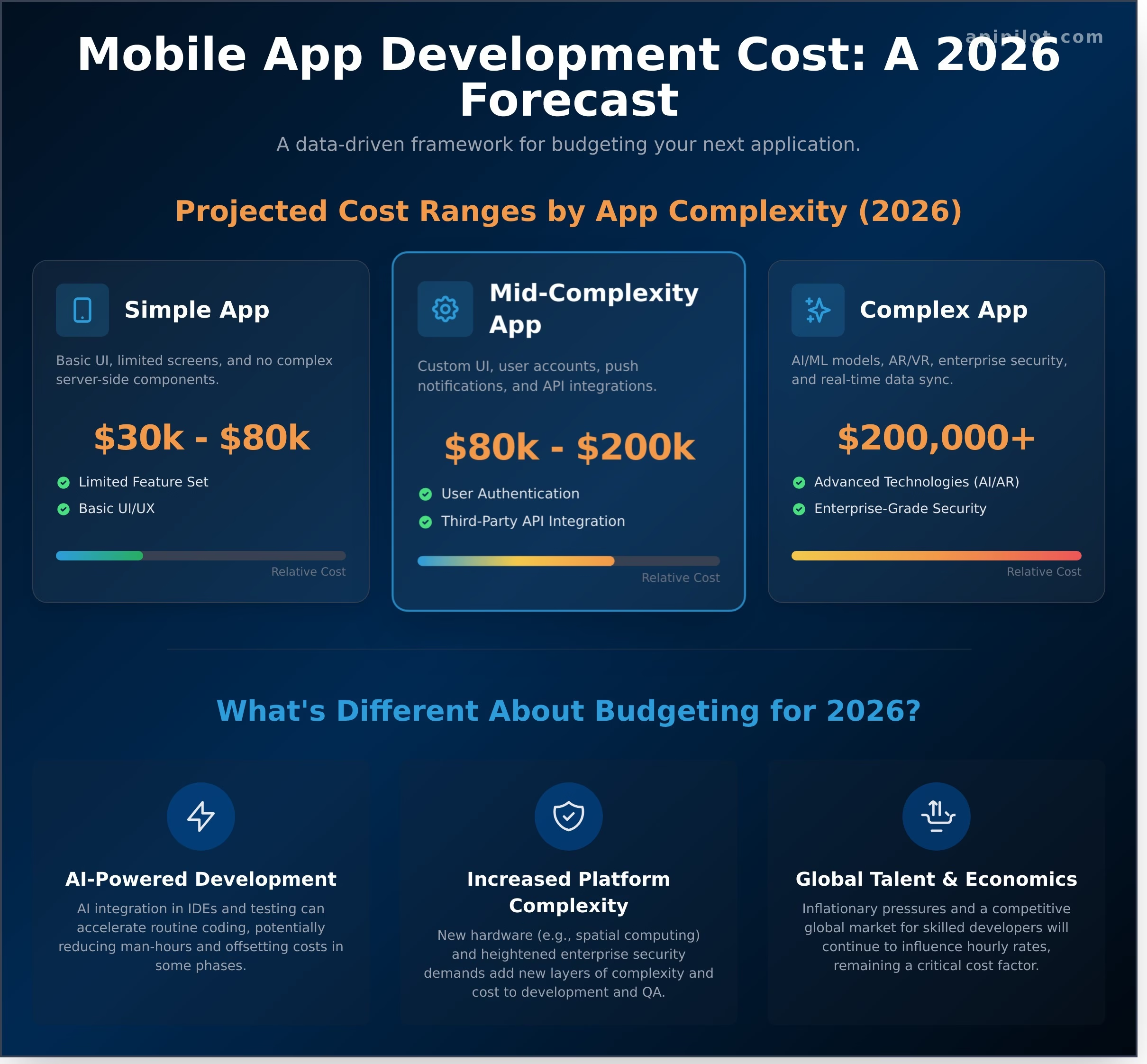
Projected Cost Ranges by App Complexity (2026)
The single most significant factor determining your budget is application complexity. The table below provides a clear, scannable summary of projected costs based on feature sets and technical requirements. These figures represent a baseline for standard development, from UI/UX design to initial QA testing.
| App Complexity | Core Features | Projected Cost (2026) |
|---|---|---|
| Simple App | Basic UI, limited screens, no server-side component. | $30,000 – $80,000 |
| Mid-Complexity App | Custom UI, API integrations, user accounts, push notifications. | $80,000 – $200,000 |
| Complex App | Custom AI/ML models, AR/VR, enterprise-grade security, real-time sync. | $200,000+ |
What’s Different About Budgeting for 2026?
Budgeting for 2026 isn’t just about adjusting for inflation. Several key technological and economic drivers will fundamentally alter cost structures. Businesses must account for these new variables to create a robust and realistic financial plan.
- AI-Powered Development: The integration of AI in IDEs and testing frameworks is set to accelerate routine coding and debugging. This could potentially reduce man-hours for certain development phases, offsetting costs elsewhere.
- Increased Platform Complexity: The emergence of new hardware like spatial computing devices and heightened demands for robust, enterprise-grade security will add new layers of complexity—and cost—to development and QA.
- Global Talent and Economic Shifts: Inflationary pressures and a competitive global talent market will continue to influence hourly rates for skilled developers. The location and expertise of your team remain a critical cost factor.
Core Cost Drivers: A Breakdown of What You’re Paying For
Understanding the mobile app development cost 2026 requires moving beyond a single price tag. Your final investment is a direct function of the features, complexity, and technology powering your application. Every hour of work, from initial strategy to final deployment, contributes to the total cost. As the competitive landscape of the app development industry intensifies, a granular understanding of these drivers is critical for efficient budgeting and building a high-performance, scalable product.
Phase 1: Strategy, Research, and UI/UX Design
This foundational phase is a non-negotiable expense that prevents costly rework later. It translates your business goals into a technical blueprint. Costs here are driven by:
- Discovery & Market Research: Defining user personas, competitive analysis, and feature prioritization.
- Wireframing & Prototyping: Creating low and high-fidelity mockups to map user flows and validate the concept before a single line of code is written.
- UI/UX Complexity: A simple, template-based UI is less expensive than a fully custom design with complex animations and unique brand elements.
Phase 2: Backend and Frontend Development
This is the engineering core where your app is built. The primary cost factors are time and technical complexity. Key decisions impacting the budget include your choice of tech stack—native iOS (Swift) and Android (Kotlin) development is often more expensive upfront than a cross-platform solution like React Native. Building custom APIs and a robust backend infrastructure is a major cost center, whereas leveraging powerful third-party APIs can accelerate development and reduce costs. The sheer number of unique screens and user flows directly correlates to development hours.
Phase 3: Testing and Deployment
Quality Assurance (QA) is not an area to cut corners. A comprehensive testing plan is essential for launching a stable, secure, and reliable application. The budget here depends on the testing approach—a mix of manual testing for user experience and automated testing for regression and performance is standard. This phase also includes the technical requirements and processes for submitting your app to the Apple App Store and Google Play Store, ensuring it meets all platform guidelines. Investing in robust QA prevents post-launch bug fixes, which are significantly more expensive.
The Biggest Variable: Your Development Team’s Location and Model
Beyond features and platform choices, the single greatest factor influencing your mobile app development cost in 2026 is the team you hire. Every project estimate is fundamentally a calculation of time multiplied by an hourly rate. Where your developers are located and how your team is structured will dictate that rate, creating a variance that can span hundreds of thousands of dollars for the same app.
Projected 2026 Developer Hourly Rates by Region
Geographic arbitrage remains a powerful tool for optimizing budgets. As global talent pools mature, the quality gap is narrowing while the cost gap remains significant. Here are our projected average hourly rates for senior developers in 2026:
- North America (USA/Canada): $150 – $250/hour
- Western Europe (UK/Germany): $100 – $180/hour
- Eastern Europe (Poland/Ukraine): $50 – $100/hour
- South Asia (Pakistan/India): $25 – $60/hour
In-House vs. Freelancers vs. Agency: Which is Right for You?
Choosing the right engagement model is critical for balancing cost, control, and risk. Each has distinct advantages and drawbacks for a 2026 project:
- In-House Team: Offers maximum control and deep company knowledge. However, it carries the highest cost due to salaries, benefits, recruitment overhead, and long-term commitment.
- Freelancers: A cost-effective option for small, well-defined tasks. Risky for complex, end-to-end projects due to potential challenges in management, scalability, and long-term reliability.
- Development Agency: Provides a balanced, robust solution. You gain access to a pre-vetted, multi-disciplinary team—including project managers, UI/UX designers, and QA engineers—with proven processes and accountability.
The Hybrid Agency Model: A Cost-Effective Solution
To maximize value without sacrificing quality, the hybrid or blended team model has become the industry standard for efficient development. This model strategically combines US-based project management and architectural leadership with elite global engineering talent. It’s an approach built to navigate the complex Future of App Development, where access to specialized, diverse skills is paramount.
This structure ensures seamless communication, rock-solid project governance, and a final product that meets enterprise-grade standards, all while leveraging global talent rates to optimize your mobile app development cost in 2026. You get the best of both worlds: North American quality control and globally competitive pricing. API Pilot specializes in this exact model. Get a quote from our expert hybrid team.
The Impact of Technology Trends on 2026 App Costs
Technology advancements are the primary drivers of both functionality and expense in mobile applications. As we look toward 2026, emerging technologies are set to redefine development budgets. While some trends promise efficiency, others introduce new layers of complexity and cost. Developing for specialized hardware like AR/VR headsets or wearables, for example, remains a premium endeavor due to unique SDKs, 3D asset creation, and performance optimization demands. Understanding these shifts is critical to accurately forecasting the mobile app development cost 2026.
Generative AI and Machine Learning Integration
Generative AI presents a dual impact on app budgets. On one hand, AI-powered tools can accelerate development by automating code generation, debugging, and testing, potentially reducing man-hours. However, building proprietary AI features—like a custom large language model (LLM) or a predictive analytics engine—is a significant cost driver. This requires specialized AI/ML developers, extensive data training, and powerful cloud infrastructure, adding a substantial premium to your project.
Cross-Platform vs. Native Development in 2026
The choice between native and cross-platform development remains a crucial budgetary decision. Frameworks like React Native and Flutter will be even more mature, offering a cost-effective way to build for both iOS and Android from a single codebase. This is the efficient choice for most content-driven and business apps. However, for applications demanding peak performance, seamless hardware integration (like advanced camera functions), or complex animations, native development provides unparalleled power and a superior user experience, justifying its higher cost.
Cybersecurity and Compliance as a Core Expense
In 2026, robust security is not an optional feature; it is a foundational requirement and a significant line item in your budget. Skimping on security is a direct path to technical debt, data breaches, and severe financial penalties. A forward-looking budget must account for:
- Regulatory Compliance: Adherence to evolving standards like GDPR, CCPA, and new data privacy laws.
- Robust Encryption: Implementing end-to-end encryption for all data in transit and at rest.
- Secure Infrastructure: Proactive measures including regular penetration testing, secure API endpoints, and threat monitoring. Seamlessly integrating secure, third-party data sources via a trusted provider like apipilot.com can also fortify your app’s architecture.
Investing in a rock-solid security framework from day one is essential to protect your users and your business, ultimately saving you far more in the long run.
Beyond Development: Hidden Costs and Long-Term Budgeting
Calculating your initial build estimate is a critical first step, but the launch of your app is the starting line, not the finish. A comprehensive budget for the mobile app development cost 2026 must account for the significant, recurring expenses required to operate, scale, and grow your application post-launch. Neglecting this long-term financial planning is a common pitfall that can jeopardize an otherwise successful project.
To ensure long-term viability, factor these essential post-launch costs into your financial model from day one:
App Maintenance and Updates
Your app requires continuous maintenance to remain functional, secure, and relevant. A reliable industry benchmark is to budget 15-20% of your initial development cost annually for maintenance. This recurring expense covers critical activities like OS compatibility updates for new iOS and Android versions, performance tuning, security patching, and squashing inevitable bugs. A formal maintenance plan with your development partner ensures your app delivers a rock-solid user experience.
Infrastructure and Third-Party Services
Modern apps are powered by a robust backend infrastructure and a suite of third-party APIs, each with its own cost structure. These operational expenses scale directly with your user base and are non-negotiable for functionality.
- Server & Hosting: Costs for cloud services like AWS, Google Cloud, or Azure that host your backend, database, and files.
- Third-Party APIs: Fees for essential services such as payment gateways (Stripe), mapping services (Google Maps API), or push notification platforms.
- Developer Accounts: Annual fees for maintaining your developer accounts on the Apple App Store ($99/year) and Google Play Store ($25 one-time).
Marketing and User Acquisition (UA)
A powerful application is useless without users. Your budget must allocate significant resources for marketing and user acquisition. This is not an afterthought but a core component of your app’s success. Key UA activities include App Store Optimization (ASO) to increase organic visibility, paid advertising campaigns to drive initial downloads, and content marketing to build a community and drive sustained growth. Factoring these into your mobile app development cost 2026 from the outset is crucial.
Your app journey starts with a solid plan. Talk to an API Pilot strategist today.
From Estimate to Execution: Finalizing Your 2026 App Budget
Planning your app’s future requires a clear understanding of the financial landscape. As we’ve explored, your budget will be shaped by core drivers like app complexity and feature set, while emerging technologies and your choice of development team will introduce new variables. A strategic approach is essential to accurately forecast the mobile app development cost 2026 and avoid unexpected expenses post-launch.
An accurate projection is the foundation of a successful project. At APILayer, we demystify the budgeting process. Our global team specializes in both native and cross-platform development, delivering an optimized balance of cost and rock-solid quality. With a proven track record helping startups and enterprises launch robust applications, we provide the clarity you need to move forward with confidence.
Transform your vision into a precise, actionable plan. Ready to build your app? Get a free, detailed cost estimate for your project. Your groundbreaking application is closer than you think.
Frequently Asked Questions
How much will it cost to build an app like Uber or Instagram in 2026?
Forecasting the mobile app development cost 2026 for an enterprise-grade platform like Uber or Instagram points to a range of $500,000 to over $2 million. These are not simple applications; they require complex backend infrastructure, real-time data processing, multiple third-party API integrations, and robust, scalable architectures. Costs are driven by the need for separate iOS and Android development teams, extensive QA testing, and ongoing maintenance to support a massive user base and evolving feature sets.
Can AI tools really lower the cost of app development?
Yes, AI can reduce development costs by accelerating specific tasks. AI-powered tools can automate code generation, streamline debugging, and perform initial quality assurance, which cuts down on developer hours. However, this is not a pure cost reduction. It introduces new expenses for AI tool subscriptions and requires specialized developers to manage and validate the AI’s output. The primary benefit is often accelerated time-to-market rather than a drastic budget decrease, shifting costs from manual labor to advanced tooling.
How can I get an accurate cost estimate for my app idea?
The most effective way to get an accurate estimate is to create a detailed project specification document. This document must clearly define your app’s core features, user flows, target platforms (iOS, Android, web), and technical requirements, including any necessary third-party API integrations. Submitting a comprehensive brief to development agencies allows them to provide a precise, feature-based quote. A vague concept will only yield a broad, unreliable cost range; detailed planning ensures an actionable and accurate budget.
Is it cheaper to build a web app instead of a native mobile app?
Initially, yes. A Progressive Web App (PWA) is typically cheaper as it relies on a single codebase (HTML, CSS, JavaScript) that functions across all devices via a web browser. This eliminates the need to fund and manage separate development projects for iOS and Android. However, native apps provide superior performance, deeper integration with device hardware, and a more seamless user experience. The choice depends on whether the lower upfront cost of a PWA outweighs the performance benefits of a native build.
How long does the average mobile app take to develop?
Development timelines are directly tied to an app’s complexity. A simple application with a limited feature set can often be launched in 3-4 months. A mid-complexity app featuring custom UI/UX, server-side components, and API integrations typically requires 5-9 months. Enterprise-grade applications with extensive features, complex backends, and high-security requirements will take 9-12+ months to develop, test, and deploy successfully. These estimates are for a single platform; building for both iOS and Android will extend the timeline.
What is the single biggest factor that increases app development cost?
Feature creep is the single most significant driver of budget overruns. This occurs when new features and functionalities are continuously added beyond the initial project scope. Each addition requires more development hours, extends the testing phase, and complicates the project management process. To control costs, it is critical to define a clear Minimum Viable Product (MVP) with a core set of features and adhere to a structured development roadmap, saving additional functionality for future updates.


