
Your mobile app’s success hinges on more than a slick user interface. The real power lies in the engine room: the backend. But navigating the complexities of data management, API integrations, and enterprise-grade security can be overwhelming. The fear of building an infrastructure that can’t scale or choosing the wrong technology stack is a critical roadblock for many developers and businesses. This is where expert mobile app backend development services become essential, providing the foundation for a high-performance, secure, and scalable application.
This ultimate guide cuts through the noise. We will deconstruct the critical role of the backend, explore the core components of a robust architecture, and provide a clear roadmap for selecting the right development partner for your project. You will gain the knowledge to build a blazing-fast, rock-solid application that not only meets today’s demands but is engineered to scale seamlessly for future growth. Consider this your blueprint for building a backend that powers success.
The Engine Room: Why Backend Development is Critical for Your App’s Success
Think of your mobile app’s backend as its brain and central nervous system. While the frontend provides the sleek user interface and experience—the car’s polished dashboard and comfortable seats—the backend is the high-performance engine under the hood. It’s the server-side architecture that handles all the complex operations, data processing, and logic that users never see but absolutely depend on for a functional, blazing-fast application.
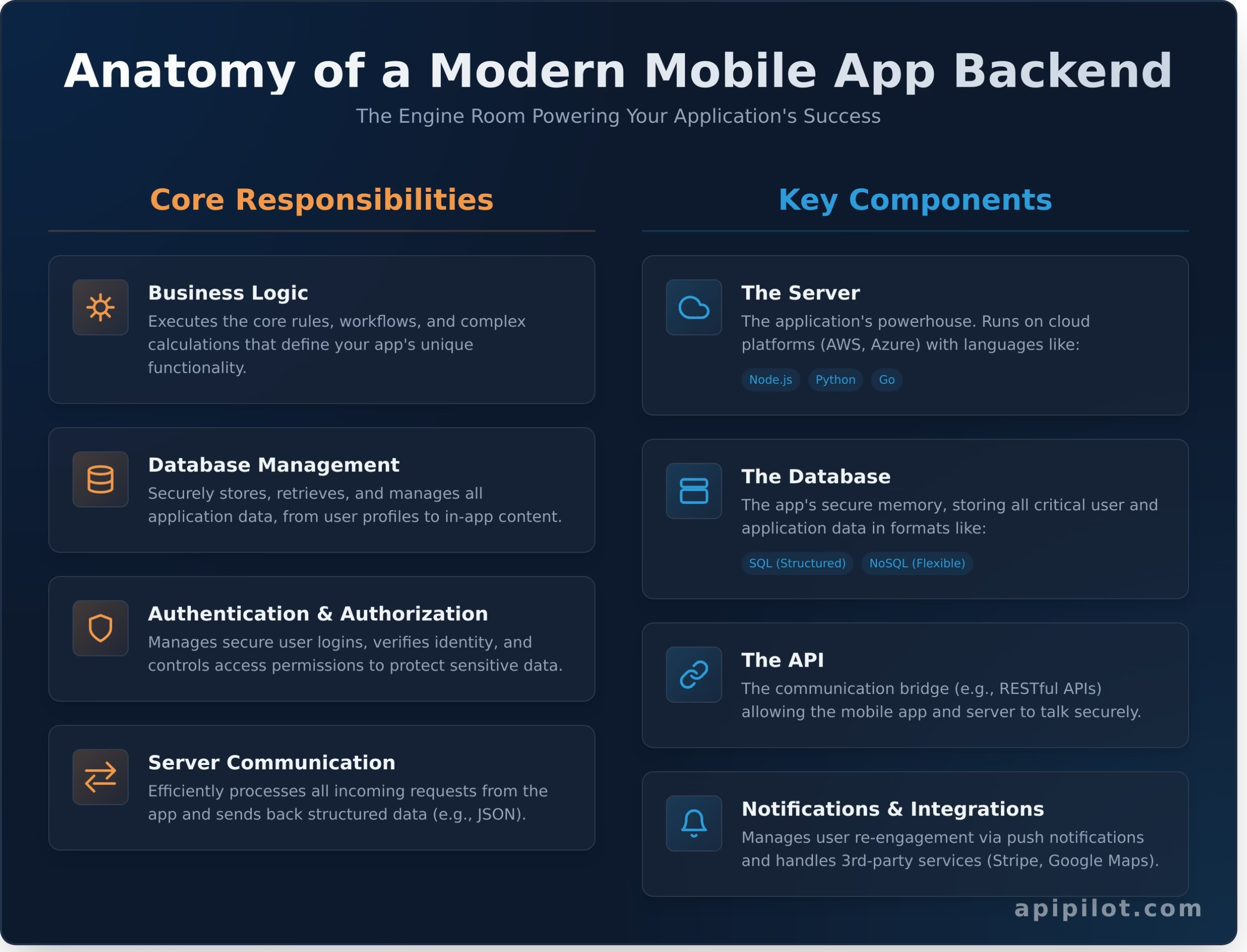
To visualize how these server-side components power the user-facing app, consider this overview:
A poorly architected backend is a direct path to failure. It leads to slow load times, frequent crashes, security vulnerabilities, and a frustrating user experience that culminates in bad reviews and high uninstall rates. Conversely, a robust backend built with professional mobile app backend development services is the rock-solid foundation for success. It ensures seamless performance, enables effortless scalability as your user base grows, and simplifies the process of adding new features in the future.
Frontend vs. Backend: A Clear Distinction
The two sides of an application are distinct yet completely codependent. The frontend, or client-side, is everything the user directly sees and interacts with. The backend, or server-side, is the infrastructure that makes those interactions possible. They communicate through Application Programming Interfaces (APIs), which act as messengers that request and deliver data, forming the critical communication layer in the entire Mobile app development lifecycle.
Core Responsibilities of the Mobile App Backend
A powerful backend is engineered to handle several mission-critical tasks with speed and reliability. Its core functions are the pillars supporting your entire application:
- Business Logic: This is where the core rules and workflows of your app are executed. From processing a payment to calculating user data, the backend enforces the logic that makes your app unique.
- Database Management: Securely storing, retrieving, and managing all application and user data—from user profiles to in-app content—is a fundamental backend responsibility.
- User Authentication & Authorization: The backend manages secure user logins, verifies identities, and controls access permissions to ensure users can only see and do what they are authorized to.
- Server Communication: It efficiently processes all incoming requests from the mobile app, interacts with the database and other services, and sends the correct data back to the user’s device in a structured format like JSON.
Key Components of a Modern Mobile App Backend Architecture
The backend is not a single, monolithic block of code. It’s a robust ecosystem of specialized components working in concert to power your application. Understanding these building blocks is crucial for making informed decisions when procuring mobile app backend development services. A well-architected backend ensures your app is scalable, secure, and blazing-fast.
The Server: The Powerhouse for Your Application Logic
Think of the server as the brain of your operation. It’s where the core business logic lives, processing requests from the mobile app, running complex calculations, and executing tasks. Modern applications leverage powerful cloud-based servers from providers like AWS and Azure for rock-solid uptime and seamless scalability. The logic itself is written in powerful server-side languages, including:
- Node.js: Ideal for real-time applications and high-concurrency needs.
- Python: Excellent for data-intensive tasks and machine learning integrations.
- Go: Known for its raw performance and efficiency in microservices.
The Database: Your App’s Secure Memory
The database is your application’s secure, long-term memory. It stores all critical data, from user profiles and login credentials to in-app purchases and user-generated content. The choice between a structured (SQL) or flexible (NoSQL) database depends entirely on your app’s data model and scalability requirements. Proper database design and optimization are non-negotiable for delivering a responsive, high-performance user experience.
The API: The Bridge Between App and Server
The Application Programming Interface (API) is the messenger that enables communication between the mobile app (frontend) and the server (backend). When a user taps a button, the app sends a request through the API. The API translates this request for the server, fetches the required data from the database, and returns a response. For a more technical overview, IBM’s guide to mobile app backend development offers an excellent deep-dive. We build enterprise-grade RESTful APIs that serve as a reliable and secure data gateway for your application.
Push Notifications & Integrations
Features that seem to originate from the app are often managed by the backend. The server orchestrates and dispatches push notifications to re-engage users at the right moment. It also handles complex third-party integrations—like Stripe for payments, Google Maps for location services, or social media logins—offloading the heavy lifting from the user’s device. This approach keeps the mobile app lightweight, fast, and easier to maintain.
Choosing Your Strategy: Custom Backend vs. BaaS/MBaaS
Selecting the right backend architecture is one of the most critical strategic decisions you’ll make. It directly impacts your app’s scalability, time-to-market, and total cost of ownership. This isn’t just a technical choice; it’s a business decision that defines your product’s future. Both custom development and BaaS are powerful, valid approaches—the optimal choice depends entirely on your project’s specific goals, complexity, and long-term vision.
Custom Backend Development: Ultimate Control and Scalability
A custom backend is built from the ground up, tailored precisely to your application’s unique requirements. This approach offers unparalleled flexibility and control over your entire tech stack, data, and business logic.
- Pros: Complete control over features, infinite scalability, zero vendor lock-in, and full ownership of your intellectual property.
- Cons: Higher initial development costs, longer time-to-market, and the need for an expert in-house or outsourced engineering team.
- Best for: Enterprise-grade applications, apps with complex or proprietary business logic, and long-term projects where scalability and IP ownership are paramount.
Backend-as-a-Service (BaaS): Speed and Simplicity
Often called Mobile Backend as a Service (MBaaS), this strategy involves leveraging a pre-built backend infrastructure. A Backend as a Service (BaaS) provider handles server management, offering ready-to-use components like user authentication, cloud storage, and push notifications through SDKs and APIs.
- Pros: Blazing-fast development speed, significantly lower upfront costs, and simplified backend management.
- Cons: Limited customization, potential for vendor lock-in, and scaling costs that can become unpredictable.
- Best for: Minimum Viable Products (MVPs), simple applications with standard features, and projects with aggressive deadlines and tight budgets.
How to Decide: A Quick Framework
Making the right choice requires a clear-eyed assessment of your immediate and future needs. The decision often boils down to a trade-off between speed and control. For complex projects, robust mobile app backend development services will almost always recommend a custom or hybrid approach.
- Choose Custom if: Your app’s core value lies in its unique business logic, you require seamless integration with legacy systems, or you are building a platform designed for massive, long-term scale.
- Choose BaaS if: Your primary goal is to validate a business idea quickly (MVP), your app relies on common functionalities, and speed-to-market is more critical than long-term flexibility.
A hybrid approach is also a powerful option, combining the speed of BaaS for standard features with a custom microservice for your app’s core proprietary logic. Navigating these options is key, and the right partner can help define the most efficient path forward. At apipilot.com, we specialize in architecting backend solutions that align with your business goals.
Our Process: How We Deliver Rock-Solid Backend Development Services
Understanding the components of a backend is one thing; executing a flawless build is another. At API Pilot, we de-risk your project with a transparent, battle-tested methodology. Our end-to-end process is engineered to deliver high-performance backends that are secure, scalable, and perfectly aligned with your business objectives. This is how we provide enterprise-grade mobile app backend development services.
Phase 1: Discovery and Architecture Design
We begin by focusing on your strategic goals, not just a list of technical features. This foundational phase ensures the backend we build will serve your business now and in the future.
- Strategic Alignment: We dive deep into your business model, target audience, and monetization strategy to inform every technical decision.
- Data and User Flows: We collaboratively map every user interaction and data requirement to create a logical, efficient information structure.
- Future-Proof Architecture: We design a robust, scalable architecture—whether microservices, serverless, or monolithic—tailored to handle your projected growth.
Phase 2: Agile Development and API Creation
With a solid blueprint in place, our team moves into agile development sprints. This iterative approach provides maximum visibility and allows for course correction, ensuring the final product meets your exact needs.
- Iterative Sprints: We build the backend in short, focused cycles, delivering functional components for your review and feedback.
- Secure API Endpoints: We engineer clean, well-documented, and secure RESTful or GraphQL APIs that power your mobile application seamlessly.
- Core Logic Implementation: The essential business logic and database schemas are built to be efficient, maintainable, and powerful.
Phase 3: Rigorous Testing and Quality Assurance
A backend is only as good as its reliability under pressure. Our QA process is relentless, designed to identify and eliminate vulnerabilities and performance bottlenecks before they ever impact your users.
- Comprehensive Testing: We conduct extensive performance, load, security, and integration tests to validate every aspect of the backend.
- Automated Workflows: We implement automated testing pipelines to catch regressions and ensure consistent stability with every code commit.
- Peak Load Simulation: We validate that the backend can handle spikes in traffic and peak user loads without failure, guaranteeing a smooth user experience.
Phase 4: Deployment and Ongoing Support
Launching your backend is just the beginning of our partnership. We manage the entire deployment process and provide the ongoing support needed to ensure your app runs smoothly and scales effortlessly as you grow.
- Seamless Cloud Deployment: We manage deployment to your chosen cloud environment (AWS, Google Cloud, Azure) with zero downtime.
- Proactive Monitoring: We provide 24/7 monitoring and maintenance to ensure rock-solid uptime and performance.
- Scalability Partnership: As your user base grows, we partner with you to evolve the infrastructure, ensuring your success is never limited by technology.
Our structured process eliminates guesswork and guarantees a backend built for performance and growth. Ready to build a scalable backend? Let’s talk.
Partner with the Experts for a Rock-Solid App Backend
Your app’s success is powered by its backend. A well-designed architecture is not just code; it’s the foundation for scalability, performance, and a seamless user experience. Making the right strategic choices, from key components to a custom vs. BaaS approach, dictates your app’s future potential. When you’re ready to build a truly robust digital product, choosing the right partner is the most critical step.
APIpilot provides enterprise-grade mobile app backend development services built on a proven process. Our global team, with offices in the US and Pakistan, has the expertise to build scalable solutions that perform under pressure. We manage the entire lifecycle—from discovery and architecture to deployment and support—ensuring your backend is rock-solid and future-proof.
Ready to build the powerful engine your application deserves? Schedule a Free Consultation to Discuss Your App’s Backend and let’s create the powerful foundation for your success.
Frequently Asked Questions
How much does mobile app backend development cost?
The cost of backend development is directly tied to your application’s complexity. A simple backend for an MVP with basic user authentication and data storage will be on the lower end. However, costs scale with features like real-time data processing, third-party API integrations, and enterprise-grade security protocols. We provide a detailed estimate based on a thorough analysis of your technical requirements, ensuring a transparent and predictable budget for your project.
How long does it take to build a custom backend for a mobile app?
Timelines are determined by project scope. A lean, functional backend for a simple application can be engineered in 4-8 weeks. A more complex system requiring robust APIs, advanced database architecture, and integrations with multiple third-party services can take 3-6 months or more. Our process prioritizes rapid, iterative development to deliver core functionality quickly while building out more complex features in subsequent phases, ensuring a fast time-to-market.
What is the best technology stack for a mobile app backend in 2025?
The optimal stack depends on your specific needs for performance, scalability, and functionality. For high-concurrency and real-time applications, we often recommend Node.js or Go. For data-intensive or AI-powered apps, Python is a powerful choice. This is typically paired with robust databases like PostgreSQL or MongoDB and deployed on scalable cloud infrastructure like AWS or Google Cloud. We architect a stack engineered for your specific business goals.
Do I need a separate backend for iOS and Android apps?
No. A core principle of efficient architecture is to build a single, unified backend that serves both iOS and Android platforms. This backend exposes a set of robust APIs (like REST or GraphQL) that both the iOS and Android client applications communicate with. This approach streamlines development, reduces costs, simplifies updates, and ensures data consistency across all user devices. It’s the industry-standard for building scalable mobile applications.
How do you ensure the security of my application and user data?
Security is architected into our backends from day one. We implement a multi-layered security strategy that includes end-to-end data encryption using SSL/TLS, secure authentication and authorization with OAuth 2.0 and JWTs, and rigorous input validation to prevent common vulnerabilities like SQL injection. We follow OWASP Top 10 best practices and conduct regular security audits to build a rock-solid, enterprise-grade foundation for your application.
What is the difference between a backend developer and a frontend developer?
Frontend developers build the client-side of your application—the user interface (UI) and experience (UX) that users see and interact with. Backend developers build the server-side infrastructure that powers it. They manage the server, application logic, and database, creating the robust APIs that the frontend consumes to handle everything from user authentication to data processing. The frontend is the car’s dashboard; the backend is the engine.
Can you take over an existing backend project?
Yes. Our mobile app backend development services include taking over, maintaining, and scaling existing projects. We begin with a comprehensive code audit and architecture review to identify performance bottlenecks, security vulnerabilities, and scalability issues. Based on this analysis, we can efficiently refactor code, implement new features, or plan a seamless migration to a more modern, high-performance technology stack to support your application’s growth.


