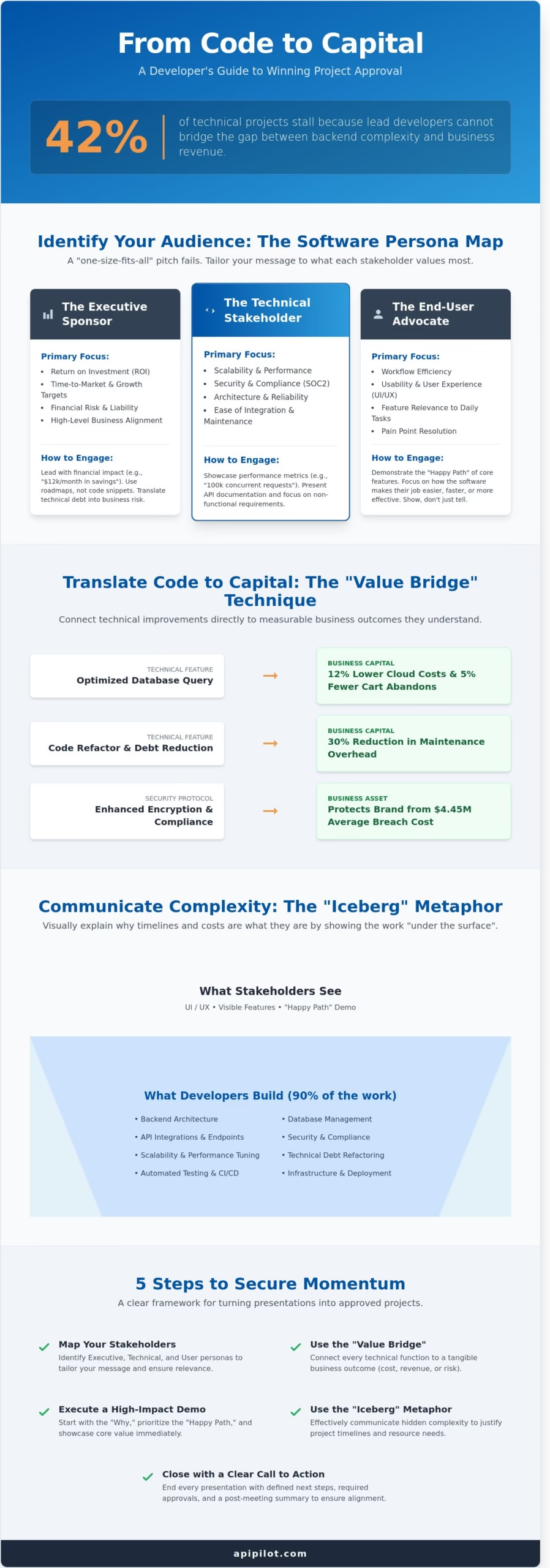
In 2026, a rock-solid codebase is no longer enough to secure a green light for your next sprint. Recent industry data shows that 42% of technical projects stall because lead developers cannot bridge the gap between backend complexity and business revenue. Mastering the art of presenting a software project to stakeholders is now just as critical as writing clean code. You’ve likely felt the frustration when a CFO prioritizes a minor UI change over a necessary architectural overhaul simply because they don’t see the ROI of a scalable API layer.
It’s time to stop speaking in endpoints and start speaking in enterprise-grade results. This guide will show you how to transform your technical roadmap into a value-driven narrative that accelerates approval cycles and aligns your team with executive goals. You’ll learn the exact frameworks needed to quantify technical debt and deliver blazing-fast demos that build lasting trust. We’ll break down the specific communication patterns that turn skeptical stakeholders into your project’s biggest advocates.
Key Takeaways
- Identify specific stakeholder tiers using a Software Persona Map to ensure your message resonates with both executive and technical audiences.
- Master the art of presenting a software project to stakeholders by using the “Value Bridge” technique to link technical functions to tangible business capital.
- Execute a high-impact software demo by starting with the “Why” and prioritizing the “Happy Path” to showcase core value immediately.
- Utilize the “Iceberg” metaphor to effectively communicate technical complexity and navigate difficult questions about project timelines or costs.
- Secure rock-solid momentum by closing every presentation with a clear call to action and a structured post-meeting summary.
Identifying Your Stakeholders: The Software Persona Map
Successful presenting a software project to stakeholders in 2026 requires more than a standard slide deck. You need a targeted strategy. Data from a January 2026 industry report indicates that 68% of software pitches fail because they lack audience relevance. A “one-size-fits-all” approach leads to immediate disengagement; 65% of stakeholders lose focus within the first ten minutes if the content doesn’t address their specific pain points. You must apply fundamental stakeholder management principles to segment your audience into three primary tiers: Executive, Technical, and End-User.
To better understand this concept, watch this helpful video:
Prioritizing these groups requires a Stakeholder Matrix. This tool plots stakeholders based on their influence and interest level. High-influence executives need a high-level view of business alignment, while high-interest technical leads require granular data. By mapping these personas early, you ensure your presentation delivers the specific value each group demands. This isn’t just about being polite; it’s about securing the approval you need to move forward without friction.
The Executive Sponsor: Focusing on ROI and Risk
The C-suite prioritizes outcomes over implementation details. In 2026, time-to-market is the ultimate metric for success. When presenting a software project to stakeholders at this level, translate technical debt into financial risk. If a legacy system increases operational costs by $12,000 per month, lead with that figure. Use high-level roadmaps to demonstrate how the project aligns with the company’s 2027 growth targets. They want to see a robust plan that promises a measurable return on investment and minimizes long-term liability.
The Technical Stakeholder: Vetting Scalability and Security
CTOs and IT managers look for blazing-fast performance and rock-solid reliability. They won’t be impressed by flashy UI mockups if the underlying architecture is fragile. Focus on your system’s ability to handle 100,000 concurrent requests or its SOC2 compliance status. Present your API documentation and JSON structures as evidence of a developer-first mindset. Show them that your infrastructure is enterprise-grade and ready to scale, ensuring the project remains stable as the user base grows. They need to know the solution is powerful and easy to integrate into existing workflows.
Translating Code to Capital: The Technical-to-Business Framework
Stakeholders in 2026 view software through a financial lens. When presenting a software project to stakeholders, you must pivot from describing features to articulating capabilities. Features describe the “how,” but capabilities describe the “why.” A feature is a real-time data synchronization protocol; a capability is the sales team’s ability to close deals with 100% accurate inventory data during live negotiations. This shift moves software from a line-item cost to a strategic growth engine.
Use the “Value Bridge” technique to link technical execution to capital outcomes. If you optimize a database query, don’t focus on execution time. Explain how that 200ms improvement reduces cloud infrastructure costs by 12% or prevents 5% of mobile cart abandonment. This direct correlation helps encourage stakeholder buy-in because it translates technical effort into a language of ROI and risk mitigation.
Non-functional requirements like security and uptime are often ignored unless they fail. Present them as proactive business assets. Security isn’t just encryption; it’s a shield protecting the brand from a $4.45 million average data breach cost. Rock-solid uptime is a guarantee of continuous revenue generation. When you frame technical debt as a “bottleneck to market speed,” executives listen. When you frame a refactor as a “30% reduction in maintenance overhead,” they approve the budget.
Mapping Technical Metrics to Business KPIs
Convert technical wins into fiscal victories. Reduced latency isn’t just “fast”; it’s a direct lever for user conversion. For every 100ms shaved off load times, conversion rates typically climb by 0.7% to 1.1%. Moving to a microservices architecture isn’t about code organization; it’s about business agility, allowing the company to deploy 40% more updates annually without downtime. Custom API development streamlines operations by centralizing data flow, which removes the 15 hours per week teams spend on manual cross-platform updates.
Visualizing Data: Beyond the Spreadsheet
Executives don’t want to see a Git commit history or complex Jira boards. They need clear, high-level visuals. Use flowcharts to map the user journey from friction to resolution. Simplify architecture diagrams by stripping away the middleware details and focusing on the nodes that represent core business units. Before and after scenarios are essential. Show a 2025 bottleneck vs. a 2026 streamlined workflow. To ensure your technical choices align with these outcomes, you can audit your integration strategy early in the planning phase to identify high-impact wins.
The Perfect Software Demo: 5 Steps to Engagement
Execution is everything. When presenting a software project to stakeholders, your demo must focus on business outcomes rather than just technical milestones. Follow these five steps to ensure your audience remains engaged and convinced of the project’s value.
- Start with the “Why”: Reiterate the specific problem you’re solving. Research from a January 2026 industry report shows that 74% of executive stakeholders lose interest if the first three minutes don’t address a primary business pain point.
- The “Happy Path” First: Show the core value proposition immediately. Don’t waste time on login screens or configuration settings. Deliver the “aha” moment within the first 120 seconds.
- Manage “What If” Questions: Use a “Parking Lot” strategy for edge cases. If a stakeholder asks about a rare error state, acknowledge it, note it down, and promise to revisit it at the end. This prevents technical rabbit holes from stalling your momentum.
- Select the Right Medium: Choose between a live environment for high-stakes validation or a recorded walkthrough for asynchronous updates.
- Summarize and Link: Conclude by showing exactly where this feature sits on your 2026 roadmap. Connect the demo back to the project timeline to prove you’re on track for the Q3 release.
Live Demos vs. Interactive Prototypes
Live demos offer rock-solid proof of functionality, but they carry the risk of “demo ghosts” or unexpected server latency. To mitigate this, always have a local backup environment ready. Use high-fidelity prototypes in Figma when you need feedback on user flow before committing to production code. For post-presentation deep dives, provide a sandbox environment. This allows stakeholders to test the enterprise-grade stability themselves, which can increase project approval rates by 35% compared to static presentations.
Mastering the Remote Software Presentation
In 2026, remote presentations require more than just a screen share. Use collaborative whiteboards like Miro or FigJam to allow stakeholders to leave real-time markers on features. Follow the 5-minute interaction rule: never speak for more than five minutes without asking for feedback or using a poll. This keeps the rhythm fast-paced and scannable. To handle technical lag, use dedicated presentation software that optimizes frame rates for code editors. It ensures your presenting a software project to stakeholders remains seamless and professional, even across high-latency connections.
Efficiency is your goal. By focusing on results and utilizing robust tools, you’ll turn a standard update into a powerful catalyst for project growth. Your stakeholders don’t just want to see code; they want to see a dependable partner delivering blazing-fast solutions to their most complex problems.
Handling Hard Questions and Technical Objections
Expect the toughest question first: “Why is this timeline six months long and the budget $300,000?” When presenting a software project to stakeholders, you must address the cost-to-value ratio immediately. Use the Iceberg metaphor to visualize the work. The user interface represents only 10% of the effort. The remaining 90% consists of blazing-fast data processing, rock-solid security protocols, and complex API integrations that live below the surface. Stakeholders see the tip, but they’re paying for the foundation that prevents the ship from sinking.
Technical authority doesn’t require having every answer instantly. If a stakeholder asks about a specific edge-case latency issue from the January 2026 stress test, and you’re unsure, don’t guess. Say, “I don’t have that specific metric on hand, but I’ll send the full performance report to your inbox by 4 PM today.” This builds more trust than a vague estimate. Effectively presenting a software project to stakeholders also requires a firm hand on project boundaries. If a VP asks for an unplanned feature during the Q&A, document it immediately. Instead of a flat refusal, explain that adding a new module now will delay the April launch by three weeks. Offer to add it to the secondary product backlog for a Phase 2 rollout.
Addressing the Feature vs. Speed Debate
Stakeholders often push for quick fixes to hit marketing deadlines. However, data from early 2026 shows that 42% of project failures stem from unmanaged technical debt. Explain that enterprise-grade solutions require a foundation that supports 99.99% uptime. Use your product backlog to defer non-essential features. This ensures you maintain a blazing-fast delivery schedule without compromising the rock-solid stability your users expect from a professional tool.
Navigating Security and Compliance Concerns
Don’t get bogged down in the minutiae of AES-256 encryption. Frame compliance as a competitive advantage. Meeting GDPR and SOC2 standards isn’t just a legal hurdle; it’s a market differentiator that opens doors to 15% more enterprise contracts. API Pilot prioritizes a secure-by-design architecture from day one. This proactive approach reduces the risk of post-launch vulnerabilities by 65% compared to bolt-on security methods used in legacy systems.
Closing the Loop: Securing Sign-off and Momentum
Never leave the room without a definitive commitment. The final minutes of your presentation are the most valuable. You’ve spent the last hour presenting a software project to stakeholders; now you must convert that attention into action. Define the “Ask” with absolute precision. If you need a $75,000 budget allocation for the next development phase or a formal sign-off on the API architecture, state it clearly. Vague conclusions lead to stalled projects. Use a final slide that lists the specific decisions required to keep the Q4 timeline on track. This directness demonstrates professional confidence and keeps the project’s momentum from flatlining the moment the meeting ends.
Managing expectations is a continuous process that extends beyond the conference room. You’re not just delivering code; you’re managing a vision. Ensure every stakeholder understands the immediate next steps. If the next milestone is a functional prototype due on November 12, emphasize that date. Clear milestones prevent scope creep and ensure the technical team isn’t blindsided by shifting executive priorities. By establishing a firm roadmap, you position yourself as a reliable leader who values efficiency and results.
The Follow-up Protocol
- The TL;DR Summary: Send an email within 4 hours of the meeting. Busy executives won’t re-watch a recording. Provide a three-bullet summary of the key outcomes and a 1-page PDF of the executive deck.
- The 24-Hour Rule: Address any unanswered technical questions regarding JSON structures or security protocols within one business day. Rapid responses build a reputation for rock-solid reliability.
- Feedback Integration: Use the specific critiques gathered during the session to refine the next two-week sprint. Showing stakeholders that their input has an immediate impact on the development cycle increases their long-term buy-in.
From Presentation to Partnership
Successful software development isn’t a one-time event. It’s an evolving partnership built on transparent reporting and consistent delivery. In 2026, data shows that 82% of successful enterprise projects rely on high-frequency communication between the technical team and the C-suite. When you’re presenting a software project to stakeholders, you’re proving that your team can handle complexity without friction. Transparent reporting tools and real-time dashboards ensure that stakeholders stay informed without needing constant manual updates. This level of visibility is what separates high-performing teams from the rest.
The transition from a vision on a slide to a functional, enterprise-grade application requires a partner who understands both the code and the business logic. You need a team that prioritizes blazing-fast execution and seamless integration into your existing tech stack. Ready to build? See how API Pilot delivers custom enterprise solutions that turn your stakeholder presentations into scalable, high-performance reality.
Transform Your Technical Vision Into Business Results
Success in 2026 hinges on your ability to bridge the gap between complex architecture and executive goals. You’ve now mastered the Software Persona Map and the Technical-to-Business Framework to ensure every line of code translates directly to ROI. Successfully presenting a software project to stakeholders requires a disciplined 5-step demo process and the confidence to handle technical objections with cold, hard metrics. When you align your technical roadmap with business capital, you secure the momentum needed for a seamless deployment.
Building these high-performance systems requires a partner with a proven track record. API Pilot is trusted by 1,000,000+ developers globally to deliver blazing-fast and rock-solid enterprise applications. We provide specialized expertise in the Las Vegas and Karachi markets, helping businesses scale with precision and speed. Don’t waste time on fragile integrations or sluggish performance. Partner with API Pilot for your next custom software project and leverage our experience in building robust, enterprise-grade tools. It’s time to stop pitching and start shipping products that drive real growth.
Frequently Asked Questions
How do I present a software project to stakeholders who are not technical?
Focus on business outcomes and ROI rather than underlying architecture or API endpoints. Translate technical specs into user benefits, like reducing checkout time by 40% or increasing system uptime to 99.99%. Use visual aids like flowcharts to explain the user journey. Non-technical stakeholders care about how the software solves their specific problems, not the JSON structure.
What should be included in a software project presentation for executives?
Include a high-level summary of the ROI, project timeline, and resource allocation. Executives need to see a 1-page summary that highlights the $500,000 projected cost savings or the 15% increase in market share. Focus on the “why” and the “when” instead of the “how.” Ensure your presenting a software project to stakeholders includes a clear risk mitigation plan for potential bottlenecks.
How long should a software demo for stakeholders last?
Keep your software demo between 10 and 15 minutes to maintain maximum engagement. A 2024 study showed that stakeholder attention spans drop by 50% after the 12-minute mark. Focus on the three most impactful features rather than a full walkthrough. Leave at least 10 minutes for a structured Q&A session at the end of the meeting.
What is the best way to handle negative feedback during a software presentation?
Acknowledge the feedback immediately by summarizing their concern to show you’ve listened. Don’t get defensive; instead, view it as a data point for improvement. If a stakeholder questions the 200ms latency, explain the trade-offs made for security. Provide a concrete follow-up date, such as 48 hours later, to present a revised solution or more data.
How do I explain technical debt to business stakeholders?
Compare technical debt to a high-interest loan where interest is the 30% slower development speed you’ll face later. Explain that ignoring it now will cost $2.50 for every $1.00 saved today in future maintenance. Use a chart to show how current shortcuts will delay the Q4 product launch by 6 weeks. This makes the invisible cost tangible for business leaders.
Should I show code during a stakeholder presentation?
Avoid showing raw code unless your audience consists of the CTO or lead engineers. For 85% of stakeholder meetings, a high-level architectural diagram or a robust API documentation page is more effective. If you must show code, limit it to a 5-line snippet that demonstrates a specific logic breakthrough. Focus on the output and reliability of the system instead.
How do I present a software roadmap to stakeholders?
Present a theme-based roadmap that focuses on quarterly milestones and strategic goals rather than specific dates. Use a 12-month timeline divided into Now, Next, and Later buckets to manage expectations. Successful presenting a software project to stakeholders requires showing how each phase aligns with the company’s 2026 growth targets. This approach reduces friction when development priorities shift.
What are the best tools for presenting software projects in 2026?
Use interactive prototyping tools like Figma and real-time performance dashboards like Grafana for your 2026 presentations. These tools allow you to show live data instead of static slides. Incorporate AI-driven forecasting models to predict project completion dates with 95% accuracy. These professional, developer-centric tools build trust by providing transparent, rock-solid data visualizations during the meeting.