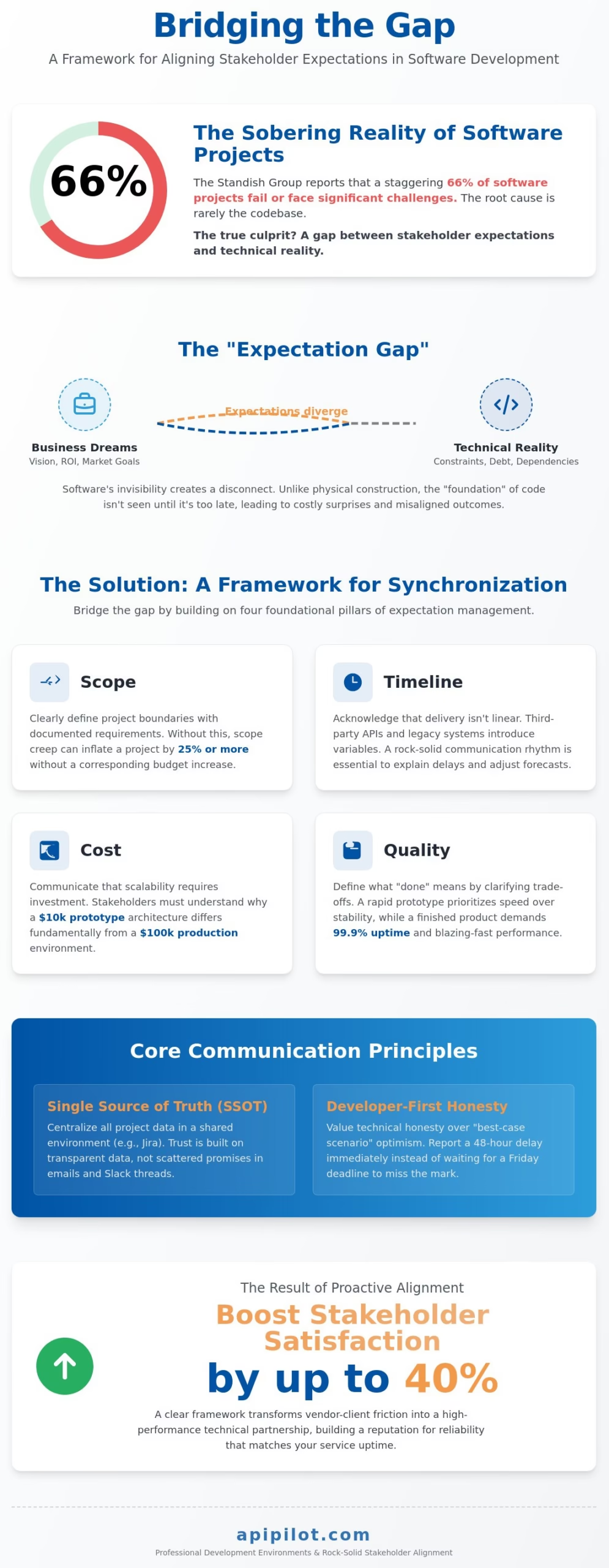
The Standish Group reports that 66% of software projects end in failure or face significant challenges, and the root cause is rarely the codebase. Most engineering teams focus on building rock-solid features while neglecting the critical skill of managing stakeholder expectations in software development. It’s a common trap where technical excellence gets overshadowed by missed deadlines and misaligned goals. You’ve likely felt the stress of a 2 PM Friday meeting when a non-technical stakeholder requests a feature that would require a complete architectural overhaul. It’s frustrating to explain why a simple button requires three days of backend integration and database migration.
This guide provides an enterprise-grade framework to align technical reality with business objectives. You’ll learn how to eliminate scope creep and build a reputation for reliability that matches your service uptime. We’ll break down the specific communication protocols and reporting metrics you need to keep projects on track without the friction of constant pivots. From translating technical constraints to establishing a repeatable feedback loop, this article gives you the tools to create a professional development environment and boost stakeholder satisfaction scores by as much as 40%.
Key Takeaways
- Establish a “Single Source of Truth” to align technical progress with business goals and eliminate costly scope creep.
- Cultivate a developer-first communication culture that prioritizes technical honesty over optimism to build lasting trust with stakeholders.
- Implement a proactive framework for managing stakeholder expectations in software development using interest audits and structured communication cadences.
- Protect your project’s rock-solid uptime by learning when to say no to premature features and “yes-man” agency culture.
- Discover how a global 24/7 feedback loop transforms the vendor-client dynamic into a blazing-fast, high-performance technical partnership.
What is Stakeholder Expectation Management in Software?
Effective managing stakeholder expectations in software development isn’t just about sending weekly status reports. It’s the continuous process of aligning project reality with stakeholder perceptions. Software is uniquely prone to “expectation gaps” because code is invisible until it’s deployed. Unlike physical construction, you can’t see the foundation of an API until you attempt to hit the endpoint. This invisibility often creates a disconnect between what a developer builds and what a business executive imagines. Robust Stakeholder management ensures that every person involved, from the CTO to the end user, shares a unified vision of the final product.
The Project Manager serves as the vital bridge between “code reality” and “business dreams.” They translate complex technical constraints into actionable business logic. Without this translation, projects often descend into “death marches.” These are high-pressure environments where teams work unsustainable hours to meet impossible deadlines. Data from the Standish Group’s CHAOS Report indicates that approximately 66% of software projects fail or face significant challenges due to misaligned goals. This failure results in massive technical debt that can take years to repay and stalls future innovation.
To better understand how these dynamics play out in real-world scenarios, watch this breakdown:
Successful managing stakeholder expectations in software development requires a focus on performance and clarity. When expectations aren’t managed, the “cost of surprise” becomes the most expensive line item on your budget. Clear communication turns technical complexity into a predictable roadmap.
The Four Pillars of Software Expectations
- Scope: This defines the boundary between what’s actually being built and what’s imagined. Without documented requirements, scope creep can expand a project by 25% or more without a corresponding budget increase.
- Timeline: Delivery in a complex ecosystem isn’t linear. Integration with legacy systems or third-party APIs can introduce variables that require a rock-solid communication rhythm to explain.
- Cost: Enterprise-grade scalability requires a specific investment. Stakeholders must understand that a $10,000 prototype doesn’t have the same architecture as a $100,000 production environment.
- Quality: Defining “done” involves trade-offs. Rapid prototyping might prioritize speed, but a finished product requires 99.9% uptime and blazing-fast performance.
Identifying Your Stakeholders Early
Internal stakeholders like operations teams care about efficiency and maintenance. External stakeholders, such as customers, care about seamless UX and reliability. You must speak their specific languages. Technical stakeholders need JSON specs and endpoint documentation; non-technical stakeholders need ROI metrics and high-level milestones.
Use a Power/Interest Grid to prioritize your communication efforts. High-power, high-interest individuals need frequent, rock-solid updates to stay aligned. Low-power groups might only need monthly summaries. Categorizing these groups early prevents communication bottlenecks and ensures that the most influential voices are always in sync with the development team’s progress.
The Framework for Synchronizing Technical and Business Goals
Successful projects rely on a Single Source of Truth (SSOT). When data is scattered across emails, Slack threads, and spreadsheets, miscommunication is inevitable. Professional teams centralize project status and documentation in a shared environment like Jira or Linear. This transparency ensures that every stakeholder sees the same velocity charts and burn-down rates. Trust is built on data, not promises.
A developer-first communication culture values honesty over optimism. It’s a common mistake to provide “best-case scenario” timelines to appease business leaders. This approach backfires when technical debt or integration hurdles appear. Engineering leads often find that effectively managing stakeholders involves shifting from a “yes-man” mentality to a data-driven advisory role. If a feature will take 40 hours to build, don’t quote 20 to sound efficient. High-performing teams report a 48-hour delay immediately rather than waiting for a Friday deadline to miss the mark.
The Discovery Phase: Where Expectations are Born
The discovery phase is the most critical window for managing stakeholder expectations in software development. Before writing a single line of code, use rapid prototyping to visualize the custom software solution. Tools like Figma or low-code mockups allow stakeholders to “feel” the product early. This prevents expensive pivots during the mid-development cycle.
- Define the MVP: Focus on the 20% of features that deliver 80% of the value. According to the Standish Group, 64% of software features are rarely or never used. Cutting these early keeps the project lean.
- Document Constraints: Explicitly state what the software won’t do. If the system isn’t designed to handle 100,000 concurrent users in version 1.0, document that limitation now.
- Set Baseline Metrics: Establish clear KPIs for performance, such as sub-200ms API response times or 99.9% uptime.
Agile Ceremonies as Expectation Tools
Agile ceremonies aren’t just internal rituals; they’re your primary tools for alignment. Sprint reviews turn demos into opportunities to validate assumptions. If a stakeholder sees a feature and realizes it doesn’t meet their business need, you’ve caught the error within a 2-week window rather than a 6-month release cycle. This creates a blazing-fast feedback loop that minimizes wasted effort.
Backlog grooming makes the literal cost of new requests visible. When a stakeholder asks for a “small change,” show them exactly which priority item it displaces on the roadmap. This forces a pragmatic discussion about trade-offs. For teams looking to accelerate these workflows, using a centralized API integration hub can reduce setup time by 35%, allowing more focus on core feature delivery. Finally, use retrospectives to refine the communication flow. If a specific stakeholder felt out of the loop, adjust the reporting cadence for the next sprint to maintain a rock-solid partnership.
Transparency vs. Over-promising: The Developer-Centric Approach
The “Yes-man” culture kills software quality. While it’s tempting for agencies or internal teams to promise immediate results to secure a contract, over-promising leads to technical debt and missed deadlines. According to a 2023 Stack Overflow survey, unrealistic expectations remain a primary driver of developer burnout. Managing stakeholder expectations in software development requires the courage to prioritize rock-solid uptime over premature feature launches. If you launch a feature before the backend is robust, you risk a 100% failure rate during peak traffic, which damages brand reputation more than a delayed release ever could.
Developers must explain the “Iceberg Effect” to non-technical partners. The user interface represents only 10% of the total workload; the remaining 90% consists of security, database optimization, and API logic. To bridge the communication gap, frame technical debt as a financial concept. Just like high-interest credit card debt, unaddressed code issues accumulate interest. If you ignore refactoring, 60% of your future budget might eventually go toward maintenance instead of innovation. This financial analogy helps business stakeholders understand why “invisible” work is a necessary investment.
Managing the “Everything is Urgent” Fallacy
When every request is labeled a priority, nothing is. Use the MoSCoW method to categorize tasks into Must-have, Should-have, Could-have, and Won’t-have. This creates a clear roadmap that prevents scope creep. Don’t forget the Trade-off Triangle: you can choose fast, good, or cheap, but you can only have two. If a stakeholder demands a blazing-fast delivery, they must accept either a higher cost or a reduced feature set. Data from the Standish Group indicates that 45% of software features are never used, so cutting the “Could-haves” often improves the final product’s performance.
Communicating Technical Risks
Transparency builds trust. Instead of making excuses, provide data-driven explanations for API limitations or third-party dependencies. If an external endpoint has a rate limit of 100 requests per second, that’s a hard technical constraint, not a developer failure. Visualizing invisible work like security audits and refactoring is essential. You can utilize strategies for effectively managing stakeholders to ensure technical risks are documented early. Maintain a Risk Register that tracks potential bottlenecks. This document should be updated weekly to ensure managing stakeholder expectations in software development stays proactive rather than reactive. By highlighting risks before they become blockers, you maintain a professional, no-nonsense relationship with your business team.
Step-by-Step: How to Manage Expectations Proactively
Effective managing stakeholder expectations in software development requires a shift from reactive fire-fighting to proactive system design. It’s about building a framework where transparency is the default setting. Follow these five steps to establish a rock-solid foundation for your project.
- Step 1: Conduct a comprehensive stakeholder audit. Use a Power/Interest Grid to categorize every individual involved. Identify who needs high-level summaries and who requires technical deep dives. Mapping these 12 or 15 key players early prevents influential voices from feeling sidelined during critical pivots.
- Step 2: Establish a communication cadence. Define exactly when updates happen. Daily Slack standups keep the internal team aligned. Weekly syncs offer mid-level managers a blazing-fast look at progress. Monthly steering committee meetings should focus exclusively on high-level milestones and ROI.
- Step 3: Create a visual roadmap. Use Gantt charts or Kanban timelines to highlight dependencies. If a third-party API integration is a prerequisite for the login module, show that link clearly. Visualizing the “why” behind timelines reduces friction when delays occur.
- Step 4: Implement a formal change request process. Scope creep is a primary project killer, often adding 25% to total costs if unmanaged. Every new feature request must go through a documented impact analysis. If a stakeholder wants a new dashboard, show them exactly how it pushes the release date by 14 days.
- Step 5: Use data-driven reporting. Move away from “we’re almost done” to “we have completed 78% of the backlog.” Compare current velocity against the original baseline established on Day 1. This quantifiable approach builds trust through objective reality.
Managing Expectations in the Age of AI
AI doesn’t make custom software development instant. While LLMs accelerate boilerplate generation, they don’t replace complex logic or system architecture. In 2024, industry benchmarks suggest that AI-generated code still requires 35% more time for security auditing and refactoring to meet enterprise-grade standards. Use AI-driven estimation tools to analyze historical sprint data. This allows you to provide 95% accurate timeline estimates that account for both human and machine-generated output.
The “No-Surprises” Rule
Success in managing stakeholder expectations in software development relies on the “Bad News Early” principle. If a developer flags a blocker, it should reach the stakeholder within 60 minutes, not at the end of the week. Use self-service dashboards like Jira or Linear to provide 24/7 transparency. Status reports must focus on outcomes, like “Payment Gateway Integrated,” instead of vague activities like “Worked on payments.” This results-oriented communication proves the project is moving at a blazing-fast pace.
Ready to streamline your integration process and keep your projects on track? Optimize your development workflow with our professional tools today.
How API Pilot Ensures Rock-Solid Stakeholder Alignment
API Pilot treats every project as a strategic partnership. We don’t just take orders; we build solutions that solve specific business bottlenecks. Our global presence in Las Vegas and Karachi creates a blazing-fast 24/7 feedback loop. This structure means development never stops. While your local team finishes their day, our global engineers are pushing code and updating documentation. This ensures 100% visibility at every stage of the lifecycle.
We provide enterprise-grade transparency through live documentation and real-time dashboards. This level of clarity is vital for managing stakeholder expectations in software development, as it eliminates the uncertainty that often leads to scope creep. Our clients trust us because we provide a single source of truth for every requirement. Since 2019, we’ve focused on delivering high-performance mobile and web applications that meet strict technical benchmarks and aggressive business timelines.
- Blazing-fast communication: Our dual-location model ensures a response time of under 60 minutes during business hours.
- Rock-solid reliability: We utilize automated testing suites that cover 95% of the codebase before any deployment.
- Direct access: Stakeholders communicate directly with lead engineers, removing the friction of middle-management layers.
From Concept to Deployment: Our Process
Our discovery phase for large-scale CRM and ERP projects involves deep-dive technical audits. We’ve managed complex stakeholder environments for organizations with over 15 key decision-makers. Our team ensures seamless integration with legacy systems, maintaining 99.9% system availability during high-stakes migrations. In 2023, we completed a complex ERP overhaul for a logistics firm, synchronizing data across four international regions and delivering the final build 12 days ahead of schedule. We build for scalability, ensuring your application handles 10x traffic spikes without performance lag.
Ready to Build Your Next Solution?
We focus on driving business growth by building tools that automate manual tasks and streamline operations. Our developer-first mindset ensures that the underlying code is robust, making future updates simple and cost-effective. When the technical foundation is rock-solid, business results follow quickly. Effective managing stakeholder expectations in software development requires a partner who understands that code quality and business ROI are inseparable. You can scale your business with API Pilot’s custom solutions to achieve higher efficiency and a stronger competitive edge in your industry.
Drive Predictable Results Through Technical Transparency
Successful software delivery hinges on more than just clean code. It requires a disciplined framework for managing stakeholder expectations in software development to bridge the gap between business vision and technical reality. By prioritizing transparency over over-promising and implementing proactive communication cycles, teams eliminate the friction that often causes project delays. You need a partner that understands enterprise-grade scalability and the pressure of rapid deployment schedules. It’s about moving from reactive fixes to proactive alignment.
API Pilot leverages the expertise of the APILayer and Idera ecosystem, which is currently trusted by 1,000,000+ developers worldwide. We focus on delivering blazing-fast results backed by rock-solid uptime, ensuring your technical architecture scales alongside your business goals. Our methodology removes the guesswork from the development lifecycle, providing you with a clear roadmap and measurable milestones. Don’t settle for misaligned priorities when you can build with precision. Partner with API Pilot for your next custom software project to experience a seamless integration of business strategy and high-performance engineering. Let’s build something exceptional together.
Frequently Asked Questions
What is the most common cause of stakeholder dissatisfaction in software?
Poor communication is the primary driver of dissatisfaction. A 2023 survey by the Project Management Institute found that 29% of project failures stem directly from inadequate communication. When stakeholders don’t understand technical constraints, they perceive necessary engineering delays as incompetence. Clear documentation and regular touchpoints prevent these misalignments before they escalate into project-ending conflicts.
How do I handle a stakeholder who keeps changing the project scope?
You handle scope creep by implementing a rigid change control process. Every new request must undergo a formal impact analysis to determine its effect on the delivery date and budget. This structured approach is essential for managing stakeholder expectations in software development. It forces stakeholders to prioritize features based on actual business value rather than impulsive ideas that drain resources.
How often should I provide updates to non-technical stakeholders?
Provide high-level updates at least once every week. Research from the Standish Group indicates that projects with frequent stakeholder engagement have a 60% higher success rate than those with monthly contact. Don’t drown them in JSON schemas or pull request details. Use clear dashboards that highlight milestone completion percentages and current blockers to maintain a fast-paced, transparent workflow.
What tools are best for managing software project expectations?
Industry-standard tools like Jira, Confluence, and Slack are the most effective for maintaining alignment. Over 65% of software teams rely on Jira to provide a transparent view of the development backlog. These platforms automate status reporting. This ensures that stakeholders have access to real-time data without requiring manual intervention from your engineering team, keeping the process efficient and no-nonsense.
How do I explain that a feature will take longer than expected without losing trust?
Use evidence-based estimation to explain delays. If an API integration requires 15 additional hours due to undocumented endpoints, present that specific data immediately. Transparency builds trust. Showing a burndown chart that reflects the new reality is better than making vague promises. It demonstrates that your team is focused on delivering a robust, enterprise-grade solution rather than cutting corners.
Can Agile methodology help in managing stakeholder expectations?
Agile methodology is highly effective because it breaks the project into manageable two-week sprints. This iterative process allows for constant course correction, which is a cornerstone of managing stakeholder expectations in software development. By delivering a functional increment every 14 days, you provide tangible proof of progress. This reduces the risk of end-of-project surprises and keeps stakeholders engaged with the product’s evolution.
What should I do if a stakeholder demands a deadline that is technically impossible?
Present a data-driven trade-off analysis using the project management triangle of scope, time, and cost. If a stakeholder demands a 30% reduction in the timeline, show them that this requires a 40% reduction in features to maintain rock-solid stability. Numbers don’t lie. Providing these concrete options shifts the conversation from an impossible demand to a pragmatic business decision about resource allocation and project goals.