
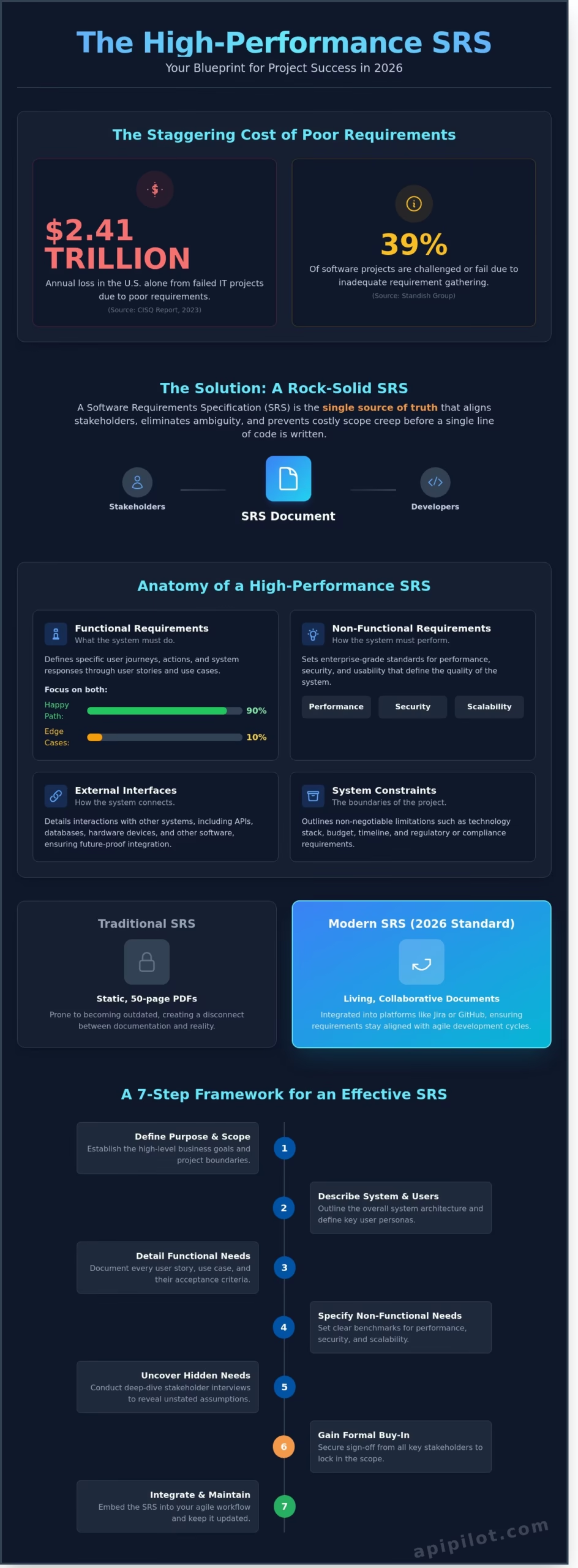
A 2023 report by the Consortium for Information & Software Quality revealed that poor requirements management contributes to a $2.41 trillion annual loss in the U.S. alone. If you’ve ever watched a project’s budget balloon by 40% because of mid-sprint “clarifications,” you know that vague documentation isn’t just a nuisance; it’s a financial liability. You already understand that your engineering team needs more than just a list of features to succeed. They need a precise, technical roadmap that bridges the gap between your business vision and the final deployment.
In this guide, you’ll master how to write a software requirements specification for 2026 that eliminates scope creep and builds a scalable foundation for future API integrations. We’ll show you how to create an enterprise-grade document that delivers accurate cost estimates and rock-solid alignment across your entire organization. We’ll break down the essential components of a high-performance SRS, from functional requirements to performance benchmarks, ensuring your next build is both efficient and future-proof.
Key Takeaways
- Establish a “single source of truth” for your project to eliminate scope creep and prevent costly technical debt before development begins.
- Master how to write a software requirements specification using a streamlined 7-step framework designed for the high-speed demands of 2026.
- Identify the “rock-solid” non-functional requirements necessary to ensure your application meets enterprise-grade performance and security standards.
- Bridge the gap between traditional documentation and Agile flexibility to keep your developers perfectly aligned with the core business vision.
- Learn how to conduct stakeholder interviews that uncover hidden needs, turning your SRS into a scalable, high-performance reality.
What is an SRS and Why It Is the Blueprint for Project Success
A Software Requirements Specification (SRS) serves as the single source of truth for your entire development lifecycle. It defines exactly what the software will do and how it will perform. In 2026, jumping into development without a rock-solid SRS is a high-risk move that leads to enterprise-grade headaches. It’s the foundational contract that aligns business stakeholders with engineering teams, ensuring everyone understands the project’s limits and potential.
The cost of vague requirements is measurable and steep. Research from the Standish Group indicates that 39% of software projects fail or are “challenged” due to poor requirement gathering. Without a precise document, you’re inviting scope creep and technical debt that can stall a launch for months. A well-crafted SRS eliminates ambiguity, acting as both a technical roadmap and a legal agreement that protects all parties involved by setting clear boundaries on deliverable features.
To better understand this concept, watch this helpful video:
The standard for 2026 has shifted from static, 50-page PDFs to collaborative, living documentation. Modern teams integrate their SRS into platforms like Jira or GitHub, ensuring it updates as the project scales. Understanding how to write a software requirements specification today means building a document that is as agile as your code, allowing for real-time adjustments while maintaining a baseline of core functionality.
The Core Elements of a Modern SRS
A powerful SRS balances business goals with technical constraints. You must define user personas clearly, as these dictate the functional flow and UI priorities. Additionally, 2026 standards require a high-level system architecture overview within the document. This ensures the proposed solution is scalable and compatible with existing enterprise-grade stacks. It bridges the gap between what the business wants and what the infrastructure can actually support.
Who Should Own the SRS Process?
The Business Analyst typically leads the process, acting as a translator between non-technical stakeholders and the dev team. However, involving lead developers early is non-negotiable. This prevents the inclusion of “impossible” features that drain resources. Securing formal stakeholder buy-in is the final step. This ensures total alignment on the project scope, making the process of how to write a software requirements specification a collaborative win rather than a bureaucratic hurdle.
The Anatomy of a High-Performance SRS Document
A high-performance SRS acts as the single source of truth for your engineering team. It transforms vague business goals into a technical blueprint that developers can execute with precision. Mastering how to write a software requirements specification requires a deep dive into four critical pillars: functional needs, non-functional standards, external interfaces, and system constraints. This structure ensures that every stakeholder understands the “what,” “how,” and “within what limits” of the build.
To ensure your document meets industry standards, refer to the IEEE Computer Society guide for standardizing requirement definitions. This framework helps eliminate ambiguity and provides a rock-solid foundation for the development lifecycle. In 2026, clarity is the only way to avoid costly mid-sprint pivots.
Functional Requirements: User Stories and Use Cases
Functional requirements define the specific actions the system must perform. You should map every user journey to a concrete system response. Start with the “Happy Path,” the ideal sequence where everything goes right for the user. However, high-performance teams spend equal time on “Edge Cases.” These are the 5% of scenarios, such as expired session tokens or database timeouts, that cause 90% of system crashes if ignored. Each requirement needs clear acceptance criteria. A feature is only “done” when it passes every predefined test case, leaving no room for interpretation.
Non-Functional Requirements: Scalability and Speed
While functional requirements cover what the software does, non-functional requirements define how it performs. In a developer-centric environment, performance must be blazing-fast. Set specific benchmarks, such as sub-150ms latency for API responses and 99.99% rock-solid uptime. Security is equally critical. Specify data encryption standards, OAuth2 protocols, and GDPR compliance requirements directly in the SRS. These aren’t just features; they are the pillars that ensure your application can scale to handle 1,000,000+ concurrent users without friction. If you want to streamline your technical documentation, focus on these quantifiable metrics early.
API and Integration Specifications
Modern software rarely exists in a vacuum. Your SRS must document exactly how the system talks to the world. Detail every custom API endpoint, including expected JSON data structures and error codes. If the project involves third-party integrations like Stripe for payments or Salesforce for CRM, define the authentication and data mapping requirements upfront. Use webhooks for asynchronous event handling to keep the system responsive. Clear integration specs prevent the “integration hell” that often occurs during the final 20% of a project.
Finally, address system constraints. This includes hardware limitations, such as 2GB RAM limits for mobile environments, or regulatory requirements like SOC2. When you understand how to write a software requirements specification with these constraints in mind, you protect the project from technical debt and legal hurdles before the first line of code is written.
SRS in the Agile Era: Finding the Middle Ground
Agile development doesn’t mean abandoning documentation. That’s a persistent myth that leads to fragmented architectures and 40% higher technical debt in long-term projects. In 2026, high-performing teams don’t choose between speed and clarity. They use a Lean SRS. Traditional Waterfall specifications were static, 100-page binders that became obsolete the moment they were printed. Modern Agile requirements focus on a “just-enough” approach, providing a rock-solid foundation for every sprint.
The 2026 comparison is clear. Waterfall SRS documents prioritized exhaustive detail upfront. Agile User Stories prioritize immediate action. The middle ground is a living document that defines the “What” and “Why” while leaving the “How” to the developers. This strategy ensures that your API architecture and core business logic remain consistent even as features pivot. Mastering how to write a software requirements specification in this environment requires a focus on scalability and modularity.
- Waterfall: Static, fixed scope, manual updates, siloed.
- Agile User Stories: Granular, conversational, fast-paced, often lacks context.
- Lean SRS 2026: Dynamic, Git-based, integrated with CI/CD, provides a single source of truth.
The Living Documentation Approach
Stop treating your SRS as a finished product. Treat it like code. By 2026, leading engineering teams use “Documentation as Code” workflows. This means your SRS lives in a Markdown format within your repository. When you update a feature, you submit a Pull Request for the documentation alongside the code. This ensures your requirements are always blazing-fast to access and never out of sync.
Integrate your tools to maintain a seamless flow. Link your Jira epics or GitHub issues directly to specific sections of your SRS. When a developer clicks a task, they should see the high-level requirement it serves. This bidirectional linking reduces ambiguity and ensures that every line of code contributes to the enterprise-grade standards defined in your initial plan. If you’re learning how to write a software requirements specification for modern stacks, start by automating the versioning process.
Visualizing Requirements: Wireframes and Flowcharts
Text is often the least efficient way to communicate complex logic. A single sequence diagram can replace 1,500 words of technical description. In 2026, interactive and visual elements are mandatory for a robust SRS. Use Mermaid.js to embed live, editable diagrams directly into your documentation. This allows you to map out JSON payloads and API endpoints with precision.
Focus on these visual assets to accelerate development:
- Interactive Wireframes: Use Figma or Adobe XD links to show UI flow.
- UML Sequence Diagrams: Define how services interact across your ecosystem.
- State Machine Diagrams: Map out complex logic for user permissions or payment processing.
Rapid prototyping tools now allow you to generate functional UI shells from your SRS requirements. This provides immediate feedback from stakeholders before you commit to a full build. By visualizing the requirements early, you eliminate the friction of late-stage design changes and keep your development cycle efficient and focused.
7 Steps to Writing Your Software Requirements Specification
Creating a high-performance SRS requires a structured approach to bridge the gap between business vision and technical execution. Follow these seven steps to ensure your documentation is rock-solid and ready for the 2026 development cycle. Mastering how to write a software requirements specification ensures your team doesn’t waste time on features that don’t drive value.
- Step 1: Define Purpose and Scope. Identify the business goal before the technical details. Clearly state the primary problem you’re solving to prevent scope creep.
- Step 2: Conduct Stakeholder Interviews. Engage with users and executives to uncover hidden needs. A 2023 study by the Standish Group found that 45% of software features are never used; interviews help you focus on the 55% that matter.
- Step 3: Outline Functional Requirements. Document the core feature set. This is the heart of how to write a software requirements specification that developers can actually build without constant clarification.
- Step 4: Detail the Technical Stack and Constraints. Specify the languages, databases, and infrastructure. If you’re building for scalability, define your performance benchmarks and hardware limitations here.
- Step 5: Define External Interfaces and APIs. Map out your connectivity layer. Detail JSON structures, authentication methods, and endpoint behaviors for seamless integration with third-party tools.
- Step 6: Review for Clarity and Testability. Every requirement must be verifiable. If a QA engineer can’t write a test case for a requirement, it isn’t ready for the dev team.
- Step 7: Finalize and Baseline. Lock the document for the first sprint. This creates a stable foundation, allowing your team to start coding with a clear roadmap.
Gathering Requirements Without the Friction
Working with non-technical founders requires translating abstract ideas into technical specs. Use MoSCoW prioritization to categorize features into Must have, Should have, Could have, and Won’t have. This prevents gold-plating, which is the tendency to add unnecessary features that bloat the MVP. Focus on the 20% of features that deliver 80% of the user value to keep your launch on track.
Testing Your Requirements for Quality
High-quality requirements follow the INVEST criteria: Independent, Negotiable, Valuable, Estimable, Small, and Testable. You’ve got to eliminate contradictory requirements early in the process. For instance, you can’t promise blazing-fast performance while requiring heavy, synchronous data processing on every request. Resolving these conflicts in the SRS saves hundreds of hours in rework later in the lifecycle.
Custom Development: Turning Your SRS into a Scalable Reality
You’ve mastered how to write a software requirements specification that covers every functional detail. Now comes the critical transition from documentation to deployment. A static document cannot handle 10,000 concurrent users or secure sensitive JSON endpoints without expert implementation. A professional development partner acts as your final editor. They stress-test your logic before the first line of code is written, ensuring your vision survives the pressure of a production environment.
Bridging the gap between a PDF and an enterprise-grade application requires a deep understanding of modern architecture. Off-the-shelf software often hits a wall when you need to scale or integrate unique workflows. Custom API development ensures your ecosystem remains flexible and robust. In 2024, API-first design became the industry standard for high-growth tech companies. By 2026, it’s the only way to maintain a competitive edge. We focus on building systems that don’t just work; they perform with blazing-fast speed and rock-solid reliability.
From Concept to Deployment with API Pilot
API Pilot refines client visions into rock-solid specifications. We leverage our dual-hub expertise in Las Vegas and Karachi to build systems that scale across borders. Our process eliminates technical debt by identifying potential bottlenecks during the initial SRS review phase. Custom software provides a 30% higher ROI over five years compared to rigid SaaS platforms that charge escalating per-user fees. We build for performance, ensuring your application remains responsive as your user base grows. Our developers prioritize clean code and seamless integrations, turning your requirements into a functional powerhouse.
Next Steps: Starting Your Project Right
Preparation is the difference between a successful launch and a stalled project. Before your first consultation with a development agency, organize your SRS into clear, modular sections. A precise document allows us to provide an accurate, blazing-fast quote. It removes the ambiguity that leads to scope creep and budget overruns. Your SRS is the blueprint; we are the builders who turn those plans into a scalable reality. When you know how to write a software requirements specification with clarity, you’ve already finished half the battle.
Build Your Scalable Future Today
A rock-solid SRS is the technical engine that drives your project from a concept to a scalable reality. By mastering the 7-step writing process and balancing Agile flexibility with structured documentation, you eliminate friction before the first line of code is written. Mastering how to write a software requirements specification ensures your development team stays aligned, which can reduce project delays by 25% or more in complex enterprise environments. It’s about creating a single source of truth that survives the fast-paced shifts of the 2026 tech landscape.
Now it’s time to turn those requirements into high-performance tools. Whether you’re building blazing-fast ERP systems or robust CRM solutions, you need a partner with a proven track record. Our API ecosystem is already trusted by 1,000,000+ developers globally. With seamless delivery centers in Las Vegas and Karachi, we provide the technical expertise to scale your vision into an enterprise-grade product. Build your custom software with a partner who understands your requirements. Explore API Pilot.
Your roadmap is ready. Let’s build something powerful together.
Frequently Asked Questions
What is the difference between an SRS and a Product Requirements Document (PRD)?
An SRS focuses on technical implementation and system behavior, while a PRD outlines the business goals and user needs. The PRD is typically the precursor to the SRS. In 2025 industry standards, the SRS provides the granular technical details developers need to build the software. It bridges the gap between a product manager’s vision and an engineer’s technical execution to ensure a rock-solid build.
How long should a typical SRS document be for a mobile app?
A typical SRS for a standard mobile application ranges from 20 to 50 pages. This length ensures every endpoint, user flow, and API integration is documented. For instance, a fintech app with 15 core features will require more documentation than a simple utility app. Focus on clarity over page count to ensure the development team has a professional foundation for the project.
Can I use an SRS template for Agile projects?
You can use an SRS template for Agile projects by keeping the document modular and iterative. Instead of a 100-page static file, Agile teams use living documents that update every two-week sprint. Research from the Standish Group shows that clear requirements reduce project failure rates by 20 percent. Learning how to write a software requirements specification in an Agile context involves documenting core architecture while allowing for flexible updates.
What are the most common mistakes when writing an SRS?
The most common mistakes include using ambiguous language like “user-friendly” and omitting non-functional requirements. Over 40 percent of software defects stem from poor requirements according to 2023 industry benchmarks. Developers need precise metrics, such as “the page must load in under 200 milliseconds,” rather than vague descriptions. Avoid technical debt by ensuring every requirement is measurable and testable from the start of the project.
How do I define non-functional requirements like security?
Define non-functional requirements by using quantifiable benchmarks and industry standards like ISO 27001 or OWASP Top 10 guidelines. For security, specify that the system must use AES-256 encryption for data at rest and TLS 1.3 for data in transit. This provides a robust framework for your engineering team. Precise definitions ensure your application meets enterprise-grade performance and security expectations without friction or unexpected vulnerabilities.
Should I include UI/UX designs in my SRS document?
You should include UI/UX wireframes or high-fidelity mockups as visual references within your SRS. Linking to a Figma file with 30 screens provides context that text alone cannot convey. This integration helps developers understand the relationship between functional requirements and the user interface. It creates a seamless workflow between design and development teams, reducing the risk of UI inconsistencies during the blazing-fast build phase.
How often should the SRS be updated during the development lifecycle?
Update the SRS at the end of every development sprint or whenever a change request is approved. In 2026, automated documentation tools often sync with Jira to keep requirements current. Keeping the document updated prevents requirement drift, which affects 30 percent of long-term projects. Regular maintenance ensures the SRS remains a reliable source of truth for the entire lifecycle of the software and keeps stakeholders aligned.
Is an SRS necessary for a small MVP (Minimum Viable Product)?
An SRS is necessary for a small MVP to prevent scope creep and ensure the core value proposition is built correctly. Even a 5-page SRS Lite defines the essential APIs and user paths needed for launch. Understanding how to write a software requirements specification for an MVP helps you focus on the most critical 20 percent of features that drive 80 percent of user value for your customers.