
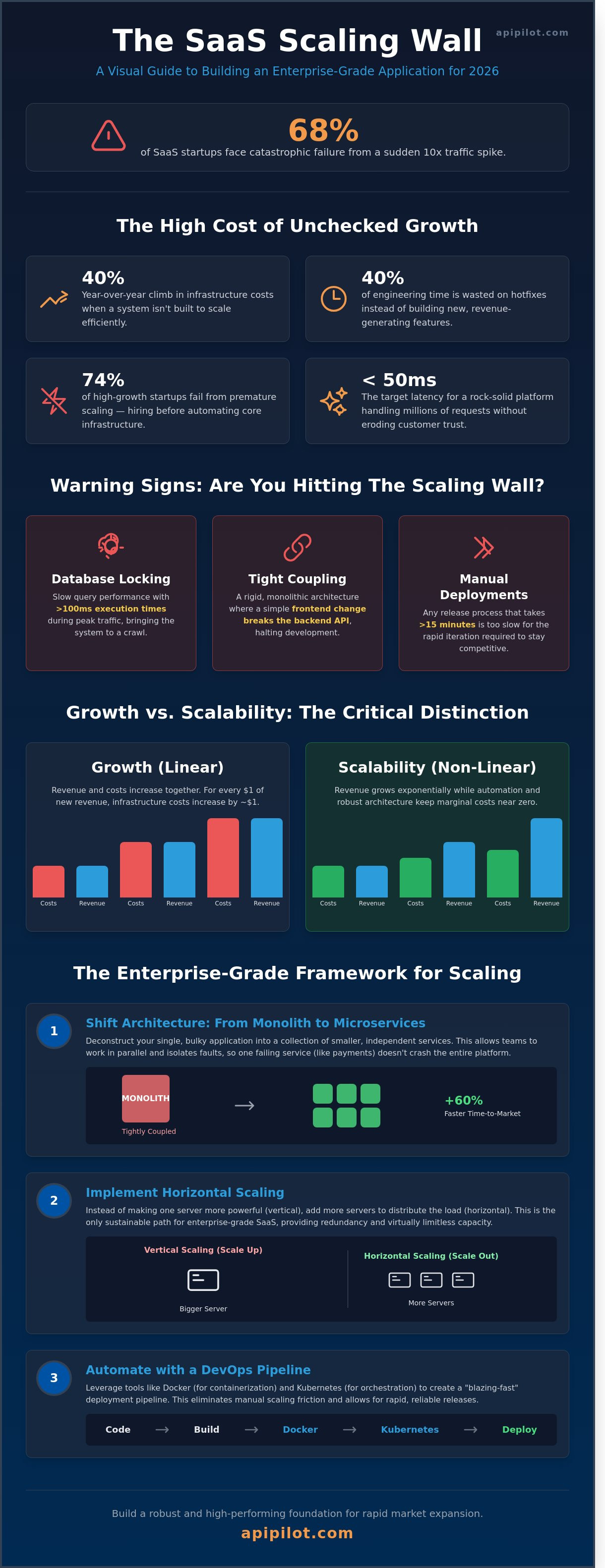
Success shouldn’t break your system, but for 68% of SaaS startups, a sudden 10x traffic spike leads to catastrophic failure rather than a celebration. If you’re struggling with technical debt or watching your infrastructure costs climb by 40% year over year, your current stack isn’t just inefficient. It’s a liability. You need to learn how to scale a saas application before your next growth milestone turns into an expensive outage that erodes customer trust.
We agree that you shouldn’t have to choose between shipping features and maintaining stability. You’ve likely felt the frustration of releases crawling to a halt because your monolithic legacy code can’t keep up with demand. This guide provides the enterprise-grade framework you need to master the technical shifts required for 2026. You’ll learn to transform a fragile startup setup into a blazing-fast, rock-solid platform that handles millions of requests with sub-50ms latency.
We’ll explore a clear roadmap for horizontal scaling, global distribution through edge computing, and a self-funding growth model that keeps your margins healthy as you expand. Let’s build a foundation that stays up when it matters most.
Key Takeaways
- Identify the critical symptoms of the “Scaling Wall” and learn to distinguish between simple user growth and efficient, enterprise-grade capacity expansion.
- Discover how to scale a saas application by transitioning to an API-first microservices architecture that allows for independent service scaling and seamless integration.
- Evaluate horizontal versus vertical scaling strategies and implement advanced database sharding to manage massive datasets with rock-solid reliability.
- Build a blazing-fast deployment pipeline using Docker and Kubernetes to automate your infrastructure and eliminate manual scaling friction.
- Leverage custom-built, enterprise-grade CRM and ERP solutions to ensure your platform remains robust and high-performing during rapid market expansion.
The Hard Truth About Scaling a SaaS Application in 2026
Scaling isn’t just a buzzword; it’s a survival metric. In 2026, the SaaS market is more crowded than ever, with over 30,000 active platforms competing for enterprise budgets. Most founders confuse growth with scaling. Growth means your revenue increases, but your costs keep pace. This creates a “leaky bucket” where profit margins never actually expand. Learning how to scale a saas application requires a shift from brute-force hiring to architectural efficiency.
A foundational step involves understanding scalability as the ability of a system to handle increased load by adding resources, rather than just adding manual labor. When your infrastructure isn’t built for this, you hit the “Scaling Wall.” This is where a monolithic application begins to crumble under the weight of its own success. Performance lags, and your engineering team spends 40% of their time on hotfixes instead of new features.
This video breaks down the specific steps needed to reach the $10M milestone efficiently:
Premature scaling remains the top killer of startups. Startup Genome reports that 74% of high-growth internet startups fail because they scale too fast. They hire 50 people before they’ve automated their core infrastructure. This results in technical debt that acts as an anchor. By the time you reach 10,000 concurrent users, that debt becomes a bottleneck that stops enterprise-grade expansion. You need a rock-solid foundation before you turn on the marketing firehose.
Growth vs. Scalability: Why the Distinction Matters
Growth is a linear increase in revenue and resources. Scalability is about achieving non-linear results. If your infrastructure costs increase by $1 for every $1 of new revenue, you aren’t scaling; you’re just growing. A truly scalable SaaS uses automation and robust API integrations to keep marginal costs near zero. This ensures your service remains blazing-fast even as your user base grows by 500%.
Identifying Your Scaling Bottlenecks
You’ll know you’ve hit the wall when performance dips despite increasing server spend. To master how to scale a saas application, watch for these three specific technical indicators:
- Database Locking: Slow query performance often stems from 100ms+ execution times during peak traffic.
- Tight Coupling: If changing your frontend logic breaks your backend API, your architecture is too rigid for 2026 standards.
- Manual Deployments: Any release process taking longer than 15 minutes prevents the rapid iteration required to stay competitive in an AI-driven market.
Architecting for Scale: From Monolith to API-First
Scaling isn’t just about adding more servers; it’s about a fundamental shift in your system design. If you’re wondering how to scale a saas application effectively, the answer usually begins with breaking down the monolith. A monolithic architecture limits your ability to scale specific components independently. By 2022, industry research into IT scalability highlighted that horizontal scaling is the only sustainable path for enterprise-grade growth. Moving to a distributed system allows you to allocate resources where they’re needed most without over-provisioning the entire stack.
The Benefits of Microservices in 2026
Microservices are an architectural style that structures an application as a collection of services. In 2026, agility is the benchmark for success. Microservices enable engineering teams to work in parallel, meaning your billing team can push updates without affecting the analytics squad. This structure ensures fault isolation. If your payment gateway service fails, your core search functionality remains active. Data from 2024 indicates that companies using microservices report a 60% faster time-to-market compared to those stuck on legacy monoliths.
Implementing an API-First Strategy
An API-first strategy means building your core logic as a set of robust, reusable endpoints before the UI even exists. This approach powers web, mobile, and third-party integrations from a single source of truth. Standardizing JSON responses ensures blazing-fast data exchange and reduces latency. Providing well-documented SDKs can reduce developer onboarding time by up to 45%, making it easier for partners to build on your platform. You can explore curated API tools to streamline this transition and ensure your endpoints are ready for heavy traffic.
Modern SaaS growth requires decoupling the frontend using headless architectures. Frameworks like Next.js or Nuxt allow for a seamless user experience while the backend remains hidden and secure. Security remains paramount in this distributed environment. You must secure every endpoint with enterprise-grade authentication. Use OAuth 2.0 or JWT to ensure rock-solid protection across all distributed services. This prevents unauthorized access and keeps your data integrity intact as you learn how to scale a saas application for a global user base.
- Decoupling: Use modern frameworks to separate the presentation layer from business logic.
- Standardization: Use JSON for all data exchange to maintain consistency.
- Security: Implement rate limiting and authentication at the gateway level to protect your infrastructure.
Database and Infrastructure Scaling Strategies
Scaling isn’t just about adding more users. It’s about maintaining blazing-fast performance while your data volume explodes. If you want to know how to scale a saas application effectively, you must move beyond a single server setup. Most startups begin with a monolithic architecture. Growth requires a shift toward distributed systems that ensure rock-solid reliability and performance under pressure.
Vertical vs. Horizontal Scaling Comparison
Vertical scaling involves adding more power, such as CPU or RAM, to an existing machine. It’s a simple approach but hits a hard ceiling quickly. For instance, a single AWS EC2 instance currently caps at 448 vCPUs. Beyond these limits, costs often skyrocket by 40% for marginal gains. Horizontal scaling adds more nodes to your pool instead. While it introduces complexity through load balancers and distributed state management, it offers nearly infinite headroom. Enterprise-grade SaaS platforms favor horizontal distribution. It eliminates single points of failure and allows for seamless updates without service interruptions.
Optimizing the Data Layer
Your database is often the first bottleneck. Read-heavy workloads benefit from read replicas. These offload up to 85% of query traffic from the primary node, allowing your application to handle massive traffic spikes. For write-heavy applications, NoSQL databases like MongoDB or Cassandra handle unstructured data at scale by distributing writes across a cluster. Sharding partitions your data into smaller, manageable chunks across different servers. This requires careful shard key selection to maintain data integrity and prevent “hot spots.” Understanding the challenges and strategies for scaling a SaaS business helps teams decide when to move from a single RDS instance to a complex sharded cluster.
Advanced Caching and Edge Computing
Don’t hit your database for every request. Implement Redis or Memcached to store session data and frequent query results. This practice reduces response times from 250ms to under 5ms in many production environments. Moving logic to the edge with Cloudflare Workers or AWS Lambda@Edge brings compute power closer to the end user. This reduces global latency by as much as 60% for international customers. Learning how to scale a saas application involves minimizing the physical distance between your data and your users. Serverless architectures allow you to pay only for the compute you use. This typically cuts infrastructure waste by 30% compared to over-provisioned traditional servers. These tools provide the robust foundation needed for seamless enterprise expansion.
Automating the Scaling Process with DevOps
Manual scaling is a liability. To master how to scale a saas application, you must build a rock-solid DevOps engine that removes human error from the equation. Containerization via Docker provides the foundation by ensuring your code runs identically across every environment. Kubernetes then takes over as the orchestrator, managing these containers to maintain 99.99% uptime even during massive traffic spikes. For modern SaaS platforms handling LLM-heavy workloads, this infrastructure must also manage GPU resources. Provisioning clusters of NVIDIA H100s dynamically allows your app to process 1,000+ concurrent inference requests without degrading performance.
The 5-Step CI/CD Scaling Roadmap
A blazing-fast deployment pipeline is essential for sustainable growth. Follow these steps to automate your path to scale:
- Automate Testing: Execute 2,000+ unit and integration tests in parallel to ensure code quality before every merge.
- Containerize: Package your application and its dependencies into Docker images for 100% environment parity.
- Blue-Green Deployments: Route traffic between two identical production environments to eliminate downtime during releases.
- Auto-scale Infrastructure: Set real-time triggers to spin up new cloud nodes automatically when CPU usage exceeds 75%.
- Automated Rollbacks: Use health check triggers to revert to the previous stable build in under 45 seconds if errors spike post-launch.
Observability and Performance Tuning
Simple monitoring tells you if a server is up; observability explains why your system is slow. Implementing distributed tracing is critical for microservices, allowing developers to track a single request across 40+ independent services. Real-user monitoring (RUM) provides the data needed to identify localized latency. For example, if users in Singapore see a 300ms delay compared to those in New York, RUM highlights the specific CDN bottleneck. By 2026, 65% of high-growth SaaS companies will use AI-driven analytics to predict traffic surges 20 minutes before they occur. This allows for proactive scaling that preserves the user experience and optimizes cloud spend. Effective how to scale a saas application strategies rely on these deep insights to tune performance at the granular level.
Scaling Your SaaS with API Pilot’s Custom Solutions
Scaling isn’t just about adding more server capacity. It’s about building an architecture that doesn’t buckle under its own weight. Most off-the-shelf solutions hit a hard ceiling when you reach 50,000 monthly active users or high-concurrency thresholds. API Pilot builds enterprise-grade software designed to scale from the first line of code. We create custom CRM and ERP solutions that eliminate the performance bottlenecks found in generic, one-size-fits-all platforms. This custom approach ensures your operations stay lean even as your data volume grows by 400% or more.
Mobile engagement is another area where generic builds fail. When your user base explodes, latency typically follows. Our mobile application development focuses on maintaining sub-150ms response times during massive traffic spikes. If you’re researching how to scale a saas application without sacrificing user experience, custom software is the only viable path. It beats off-the-shelf limits by removing bloated, unnecessary features and optimizing core functions for maximum throughput. We’ve seen businesses reduce their infrastructure costs by 30% simply by switching from rigid pre-built tools to a tailored architecture.
Our Developer-First Approach to Custom Software
We leverage our distributed teams in Las Vegas and Karachi to maintain a continuous 24/7 development cycle. This global presence allows us to push updates and resolve issues in half the time of traditional agencies. We focus on blazing-fast speed and rock-solid uptime for every build, targeting 99.99% availability for enterprise clients. We help startups navigate the difficult transition to enterprise-grade platforms by implementing robust API structures that handle millions of requests daily. Our goal is to make your backend invisible to the user; it just works, no matter the load.
Start Your Scaling Journey Today
A successful expansion requires a clear technical roadmap. We start every project with a deep-dive technical audit to identify 100% of your existing infrastructure weaknesses. This prevents costly outages during your growth phase. Our custom API development streamlines your business operations by automating complex data flows between your internal systems. If you need to know how to scale a saas application while maintaining a high standard of security and performance, it’s time to act. Consult with our software architects today to build a foundation that supports 10x growth. We’ll turn your technical debt into a competitive advantage.
Future-Proof Your Infrastructure for 2026
Building a resilient platform for the next era of tech requires moving beyond basic load balancing. You’ve seen that transitioning from a monolith to an API-first architecture is non-negotiable for maintaining blazing-fast speed. Automating your scaling process with DevOps ensures rock-solid uptime even during massive traffic spikes. Mastering how to scale a saas application in this landscape means prioritizing database sharding and infrastructure that supports global demand.
Don’t leave your growth to chance. API Pilot provides the specialized expertise needed to build custom CRMs, ERPs, and high-performance mobile apps that handle enterprise workloads. We’re already trusted by 1,000,000+ developers worldwide. With our strategic presence in Las Vegas and Karachi, you get round-the-clock support to keep your systems running at peak efficiency. It’s time to transform your technical debt into a competitive advantage.
Scale your application with API Pilot’s enterprise-grade development services. Your journey toward a limitless, high-performance future starts today.
Frequently Asked Questions
How do I know when it’s time to scale my SaaS application?
Scaling is necessary when CPU usage consistently exceeds 70% or API latency increases by more than 200ms during peak hours. You should also watch for a 15% month-over-month growth in active users. If your support tickets regarding performance have doubled in a 30-day window, it’s time to act. Don’t wait for a system failure before learning how to scale a saas application effectively.
What is the difference between horizontal and vertical scaling?
Vertical scaling involves adding more power to an existing server, like upgrading from 16GB to 64GB of RAM. Horizontal scaling means adding more machines to your pool, such as running five smaller EC2 instances behind a load balancer instead of one large one. Horizontal scaling is generally preferred for SaaS because it offers better redundancy. If one server fails, others keep the application running with rock-solid uptime.
How much does it cost to scale a SaaS application to 1 million users?
Infrastructure costs for 1 million monthly active users typically range from $5,000 to $20,000 per month depending on data intensity. For example, a basic CRUD app might stay at the lower end, while a video processing tool will hit the upper limit. You’ll also need to budget for enterprise-grade monitoring tools like Datadog, which can add $500 to $1,500 to your monthly bill. Efficiency in code can reduce these costs by 30%.
Can I scale my SaaS without moving to microservices?
Yes, you can scale a monolithic architecture by using load balancers and database sharding. Stack Overflow famously serves over 1.3 billion monthly page views using a primarily monolithic C# codebase and optimized SQL servers. You don’t need the complexity of microservices until your engineering team exceeds 50 developers. A well-structured monolith provides a seamless path to growth without the networking overhead of distributed systems.
What are the most common technical bottlenecks when scaling?
Database locking and unoptimized queries cause 60% of all scaling performance issues. When thousands of users attempt to write to the same table simultaneously, your IOPS will spike and slow the entire system. Other bottlenecks include synchronous API calls and lack of caching. Implementing Redis can reduce database load by 80%, ensuring your application remains blazing-fast even as traffic doubles.
How does an API-first approach help with scaling?
An API-first approach decouples the backend from the frontend, allowing you to scale each layer independently. By using standardized JSON endpoints, you can swap out backend services or add new mobile clients without rewriting core logic. This modularity reduces integration time by 40% when adding new features. It’s a robust strategy for anyone focused on how to scale a saas application while maintaining a clean developer experience.
What role does DevOps play in the scaling process?
DevOps automates the infrastructure through CI/CD pipelines and Infrastructure as Code, reducing deployment errors by 50%. Tools like Terraform or Kubernetes allow your team to spin up new environments in under 10 minutes. Without a strong DevOps culture, scaling becomes a manual, error-prone process that leads to frequent downtime. Automation ensures your scaling is repeatable and consistent across all regions.
Is it better to use serverless architecture for a scaling SaaS?
Serverless is ideal for unpredictable workloads since it scales from zero to 10,000 concurrent executions automatically. It eliminates the need to manage underlying servers, which saves your team roughly 20 hours of maintenance per week. However, for steady, high-volume traffic, serverless can become 2x more expensive than reserved instances. Use serverless for event-driven tasks like image processing or webhooks to keep your architecture efficient.


