Is your off-the-shelf software straining against your unique workflows? Are legacy systems creating bottlenecks instead of driving growth, trapping critical data in departmental silos? You recognize that a custom, enterprise-grade solution is the path forward. The challenge, however, isn’t just building the software—it’s selecting the right partner. Choosing the wrong enterprise software development company is a significant financial risk that can compromise your most critical business objectives.
This guide eliminates that ambiguity. We provide a comprehensive, no-nonsense framework for vetting and selecting a technology partner equipped to build the robust, scalable solutions your business needs to thrive. You will learn how to assess technical expertise, cultural fit, and project management methodologies to forge a long-term partnership that delivers a clear, quantifiable return on your investment and powers your future growth.
What is Enterprise Software Development (And Why It’s Not Just for Giants)
Enterprise software is designed to solve complex, organization-wide challenges. While the term often brings to mind massive corporations, the reality is more nuanced. As detailed in resources like Wikipedia’s entry on What is Enterprise Software, it refers to robust systems built to manage and automate core business functions—from supply chain management and customer relations to data analytics and operations. The focus is on solving large-scale problems, not on company size.
To see how this applies when selecting a partner, this video offers a practical overview:
The primary drivers for investing in enterprise-grade software are clear: improving operational efficiency, gaining a significant competitive edge, and building a foundation for seamless scaling. As businesses grow, off-the-shelf tools often create more friction than they solve. This is the point where even mid-sized companies realize they need enterprise-level solutions to break through growth plateaus, and partnering with a skilled enterprise software development company becomes a strategic necessity.
Custom Development vs. Off-the-Shelf Software
The choice between building a custom solution and buying a SaaS product is a critical one. Off-the-shelf software offers rapid deployment but often forces your team into rigid, generic workflows. A custom solution is tailored to your exact processes for maximum efficiency. While the initial investment may be higher, you avoid perpetual licensing fees and gain full control over your data, security protocols, and future feature development.
Signs Your Business Needs a Custom Enterprise Solution
How do you know when it’s time to invest in a custom build? Look for these clear indicators that your current tools are holding you back:
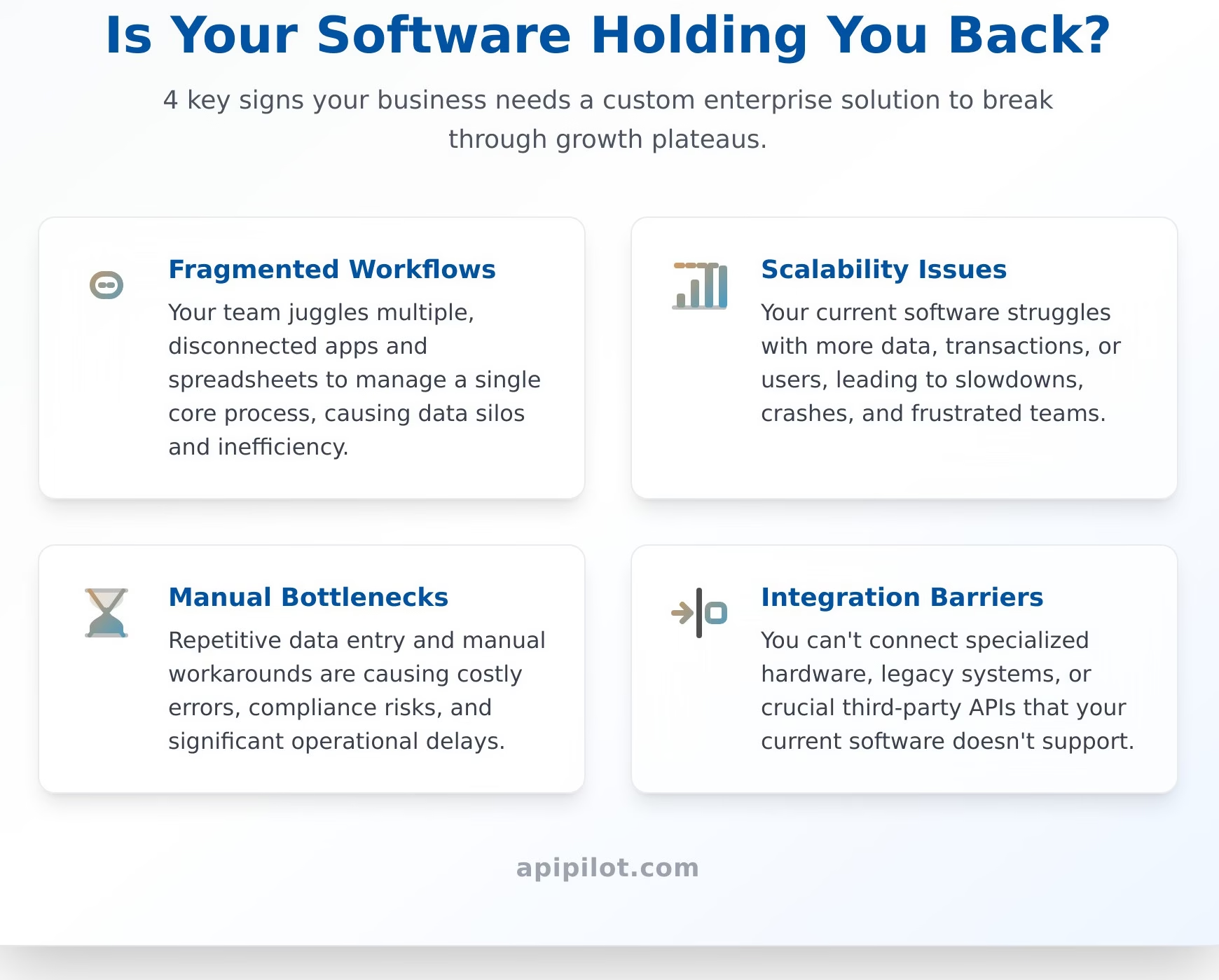
- Fragmented Workflows: Your team relies on multiple, disconnected applications and spreadsheets to manage a single core process.
- Scalability Issues: Your current software struggles to handle a growing volume of data, transactions, or concurrent users, leading to slowdowns and crashes.
- Manual Bottlenecks: Repetitive, manual data entry and workarounds are causing costly errors, compliance risks, and significant delays.
- Integration Barriers: You need to connect with specialized hardware, legacy systems, or third-party APIs that your current software does not support.
Core Solutions Built by Enterprise Software Development Companies
Enterprise software isn’t a monolithic product; it’s a broad category of powerful, custom-built systems designed to solve complex operational challenges. A capable enterprise software development company moves beyond off-the-shelf limitations to architect solutions that generate significant business value. Understanding the types of systems a partner can build is a critical first step in learning how to select a software vendor, as it showcases their technical depth and strategic thinking. Below are core solutions that drive efficiency, growth, and innovation.
Enterprise Resource Planning (ERP) Systems
Custom ERPs are the central nervous system of a modern enterprise. They unify disparate functions into a single, cohesive platform, providing a rock-solid foundation for scalability. The goal is to create a single source of truth that powers smarter, faster operations across the organization.
- Centralize Core Processes: Seamlessly integrate finance, HR, manufacturing, and supply chain data.
- Automate Workflows: Eliminate repetitive manual tasks to improve resource management and reduce operational overhead.
- Business Outcome: Achieve enterprise-wide efficiency and data consistency.
Customer Relationship Management (CRM) Software
A bespoke CRM is engineered to match your unique sales and service model. It goes far beyond standard contact management to build a comprehensive, 360-degree view of every customer interaction, enabling highly personalized engagement and maximizing lifetime value.
- Build Custom Pipelines: Design sales funnels and workflows that mirror your exact go-to-market strategy.
- Integrate Key Data: Unify marketing automation, sales activity, and customer service data in one platform.
- Business Outcome: Increase sales velocity and improve customer retention.
Supply Chain Management (SCM) & Logistics Platforms
Robust SCM platforms provide end-to-end visibility and control over your entire supply chain. From procurement to final delivery, these systems are built to optimize every step, reduce costs, and mitigate risks in a complex global market.
- Manage Inventory & Fulfillment: Automate procurement, track stock levels, and streamline order processing.
- Optimize Logistics: Leverage real-time data to track shipments and optimize delivery routes.
- Business Outcome: Create a more resilient, efficient, and predictable supply chain.
Business Intelligence (BI) & Data Analytics Tools
Custom BI tools transform raw data into actionable intelligence. By consolidating information from multiple sources—ERPs, CRMs, and third-party APIs—these platforms empower your teams to make data-driven decisions with confidence.
- Create Custom Dashboards: Visualize critical KPIs and track performance against strategic goals in real-time.
- Unlock Deeper Insights: Aggregate and analyze cross-functional data to identify trends and opportunities.
- Business Outcome: Foster a culture of informed decision-making across the entire organization.
The 7 Key Criteria for Choosing the Right Development Partner
Selecting the right partner is the single most critical decision in your project’s lifecycle. Technical proficiency is the baseline, not the benchmark. The goal is to find a long-term strategic advisor, not a short-term vendor who just executes on a spec. Evaluating an Enterprise software partner requires a methodical approach that looks beyond code.
Use the following criteria as a scorecard when interviewing any potential enterprise software development company. This framework ensures you assess the full spectrum of capabilities required for building robust, scalable, and mission-critical applications.
1. Technical Expertise and Relevant Tech Stack
Verify their proficiency in modern, scalable technologies (e.g., cloud-native architectures, microservices, relevant programming languages). Review their portfolio for projects of similar scope and technical complexity. A partner’s architectural approach must align with your long-term vision for performance, scalability, and maintainability to avoid costly re-platforming down the road.
2. Proven Industry Experience and Case Studies
Domain knowledge is a massive accelerator. A partner who understands your industry’s unique regulatory, operational, and competitive challenges can deliver value faster and mitigate risks. Demand specific case studies with measurable results and KPIs. This expertise reduces ramp-up time and ensures the final product solves real-world business problems, not just technical ones.
In highly regulated fields like aviation, for example, partnering with a firm that understands the technical and management landscape is non-negotiable. To see how this specialized support works in practice, visit Air Tech Consulting.
3. Transparent Process and Agile Methodology
Confirm they operate with an iterative, agile framework like Scrum or Kanban. This ensures flexibility to adapt to changing requirements and provides regular feedback loops. Ask about the project management and communication tools they use (e.g., Jira, Slack, Confluence). A transparent process builds trust and keeps stakeholders aligned from sprint to sprint.
4. Robust Security and Compliance Practices
Security cannot be an afterthought. Inquire about their secure coding practices, such as adherence to OWASP Top 10, and their process for vulnerability scanning and penetration testing. For any enterprise software development company handling sensitive data, verifying their experience with regulations like GDPR, HIPAA, or CCPA is non-negotiable.
5. Strategic Communication and Cultural Fit
A true partner does more than send weekly status reports. They should act as a strategic advisor, challenging assumptions and offering innovative solutions. Assess their communication style and determine if their team can integrate seamlessly with yours. A strong cultural fit fosters collaboration and turns a client-vendor relationship into a genuine partnership.
6. Scalability and Future-Proof Architecture
The solution built today must support your growth tomorrow. Discuss the partner’s approach to designing for scale. This includes their strategy for cloud infrastructure, database design, and API scalability. A forward-thinking architectural plan is essential for ensuring your software can handle increased user loads and feature expansion without performance degradation.
7. Long-Term Support and Maintenance Model
The project doesn’t end at launch. Clarify their post-launch support and maintenance options. What are their Service Level Agreements (SLAs) for uptime and issue resolution? A reliable partner offers clear, structured support plans to ensure your application remains stable, secure, and optimized for the long haul.
Understanding the Enterprise Software Development Lifecycle
Transforming a complex business requirement into a fully functional, enterprise-grade application is not magic—it’s a structured engineering process. A reputable enterprise software development company follows a rigorous, transparent lifecycle to mitigate risk, ensure rock-solid quality, and deliver predictable outcomes. This roadmap ensures your vision is translated into a powerful, scalable, and maintainable software solution.
Understanding these phases helps you set realistic expectations for timelines, deliverables, and your own involvement in the project. It’s a collaborative journey from initial concept to long-term support.
Phase 1: Discovery and Strategy
This foundational phase aligns business objectives with technical feasibility. The goal is to create a comprehensive blueprint that eliminates ambiguity before a single line of code is written. Your primary involvement is providing domain expertise and defining success metrics.
- Business Goal Alignment: Clearly defining the problem the software will solve and the expected ROI.
- Stakeholder & User Research: Conducting interviews to gather requirements and understand user workflows.
- Technical Specification: Creating a detailed project roadmap, feature list, and technology stack proposal.
Phase 2: UI/UX Design and Prototyping
Here, we focus on the end-user. For enterprise software, intuitive design is critical for adoption and efficiency. We create interactive models of the application to validate workflows and gather feedback early, preventing costly revisions during development.
- Wireframing & Prototyping: Building visual blueprints and clickable prototypes to test user flows.
- User-Centric Design: Designing clean, efficient interfaces that simplify complex tasks for your team.
Phase 3: Development, QA, and Testing
This is the core engineering phase where your software is built. Our process emphasizes writing clean, scalable code and integrating quality assurance from day one. We implement a multi-layered testing strategy to build a robust and secure application.
- Agile Development: Building the software in iterative sprints for continuous progress and feedback.
- Rigorous QA: Combining automated and manual testing to identify and resolve bugs efficiently.
- Comprehensive Testing: Conducting performance, security, and User Acceptance Testing (UAT) to ensure the software meets all requirements.
Phase 4: Deployment, Maintenance, and Support
A successful launch is a carefully planned event, not a finish line. We ensure a seamless transition to the live environment with minimal disruption. Post-launch, our commitment continues with ongoing support to ensure your application runs at peak performance.
- Strategic Rollout: Planning and executing a smooth deployment to your production environment.
- Ongoing Maintenance: Providing proactive monitoring, updates, and critical bug fixes.
- Long-Term Support: Offering dedicated support and a roadmap for future enhancements and scalability.
Why Partner with API Pilot for Your Enterprise Needs
Selecting the right partner is the final and most critical step in your software journey. The principles of technical expertise, transparent communication, and a focus on business outcomes are not just theoretical benchmarks—they are the core of our delivery model. As an enterprise software development company dedicated to building powerful, mission-critical applications, API Pilot directly aligns with the rigorous criteria your business demands.
We understand that enterprise software isn’t just about code; it’s about creating a strategic asset that drives efficiency, growth, and a distinct competitive edge. Here’s how we deliver on that promise.
Custom-Built for Your Unique Goals
Off-the-shelf solutions and rigid templates can’t solve complex, unique business challenges. We build bespoke software from the ground up, meticulously designed to integrate with your existing workflows and achieve your specific objectives. Our solutions are precision-engineered to give you a true competitive advantage, not just another tool.
- Deep Expertise: Our teams are proficient in building complex systems, from custom CRM and ERP platforms to high-performance mobile applications and sophisticated API integrations.
- Process-Centric Design: We invest time to understand your operations, ensuring the final product enhances your processes rather than forcing you to adapt to the software.
Enterprise-Grade Security and Scalability
For an enterprise, performance is non-negotiable. Our development process is rooted in building robust, scalable architectures designed for long-term growth and reliability. Security isn’t an add-on; it’s a foundational component of every project, ensuring your data and operations are protected from day one. Our solutions are engineered to handle high user loads and massive data volumes without compromising speed or stability.
A Global Team for Efficient Delivery
To deliver exceptional value, we leverage a strategic blend of expert teams in the United States and Pakistan. This hybrid model provides the best of both worlds: onshore project management for seamless communication and strategic oversight, combined with a world-class offshore development team for efficient, cost-effective execution. This structure makes us a uniquely agile and effective enterprise software development company, capable of accelerating timelines and maximizing your ROI. Let’s discuss your project’s specific needs.
Build Your Future with the Right Development Partner
Selecting the right partner is more than a technical choice; it’s a strategic decision that defines your company’s future agility and growth. A truly effective enterprise software development company doesn’t just write code—they understand your business objectives, navigate the full development lifecycle with precision, and deliver robust, scalable solutions. By focusing on the key criteria we’ve outlined, you can confidently select a team that will act as a true extension of your own.
At API Pilot, we embody these principles. Our global development team specializes in building the custom, scalable software—from complex CRMs to integrated ERPs—that powers business efficiency. With a proven track record in delivering high-performance mobile, web, and e-commerce solutions, we provide the enterprise-grade expertise and reliability you need to succeed.
Ready to transform your operations and build a solution that scales with your ambition? Schedule a Free Consultation to Build Your Custom Enterprise Solution. Let’s engineer the powerful tools your business needs to thrive.
Frequently Asked Questions
How much does custom enterprise software development cost?
The cost is directly tied to project complexity, the number of integrations, and the required team size. A straightforward application may begin in the $100,000 range, while complex platforms with extensive third-party integrations can exceed $1 million. A professional enterprise software development company will conduct a detailed discovery phase to define scope and provide a transparent, fixed-price quote or a flexible time-and-materials estimate, ensuring a predictable and efficient build process.
What is the typical timeline for building an enterprise application?
Project timelines are determined by feature velocity and overall complexity. A Minimum Viable Product (MVP) focused on core functionality can typically be delivered in 4-6 months, enabling rapid user feedback and validation. A full-scale, enterprise-grade application with robust security, multiple system integrations, and advanced features often requires 9 to 18+ months for comprehensive development, rigorous testing, and a seamless deployment across your organization.
How do you ensure the security of my data and intellectual property?
We implement enterprise-grade security at every stage of the development lifecycle. Our process includes secure coding practices aligned with OWASP standards, end-to-end data encryption for information both in-transit and at-rest, and regular vulnerability assessments. All intellectual property is protected through strict NDAs and contractual clauses. We build robust, compliant systems engineered to meet rigorous security standards like SOC 2 and ISO 27001.
What is the difference between enterprise software and standard business software?
Standard software is an off-the-shelf product designed for general tasks (e.g., a CRM or accounting tool). Enterprise software is custom-built to solve unique, mission-critical business challenges at scale. It is defined by its high degree of customization, capacity for massive data processing, seamless integration with legacy systems, and multi-layered security protocols. Enterprise solutions are engineered for superior performance, scalability, and long-term reliability.
Will we own the source code after the project is complete?
Yes. Upon final payment and project completion, your organization receives 100% ownership of the source code and all related intellectual property. Our partnership agreements are structured for a complete and transparent handover. This gives you full autonomy to modify, scale, and manage your application with any team in the future, guaranteeing your investment is protected from vendor lock-in and proprietary licensing restrictions.
What kind of post-launch support and maintenance do you offer?
We provide structured post-launch support plans to ensure your application operates at peak performance and reliability. These plans are governed by clear Service Level Agreements (SLAs) and include proactive system monitoring, security patching, performance optimization, and dedicated help desk access. A true partnership with an enterprise software development company extends beyond deployment to provide ongoing value and ensure your system evolves with your business needs.


