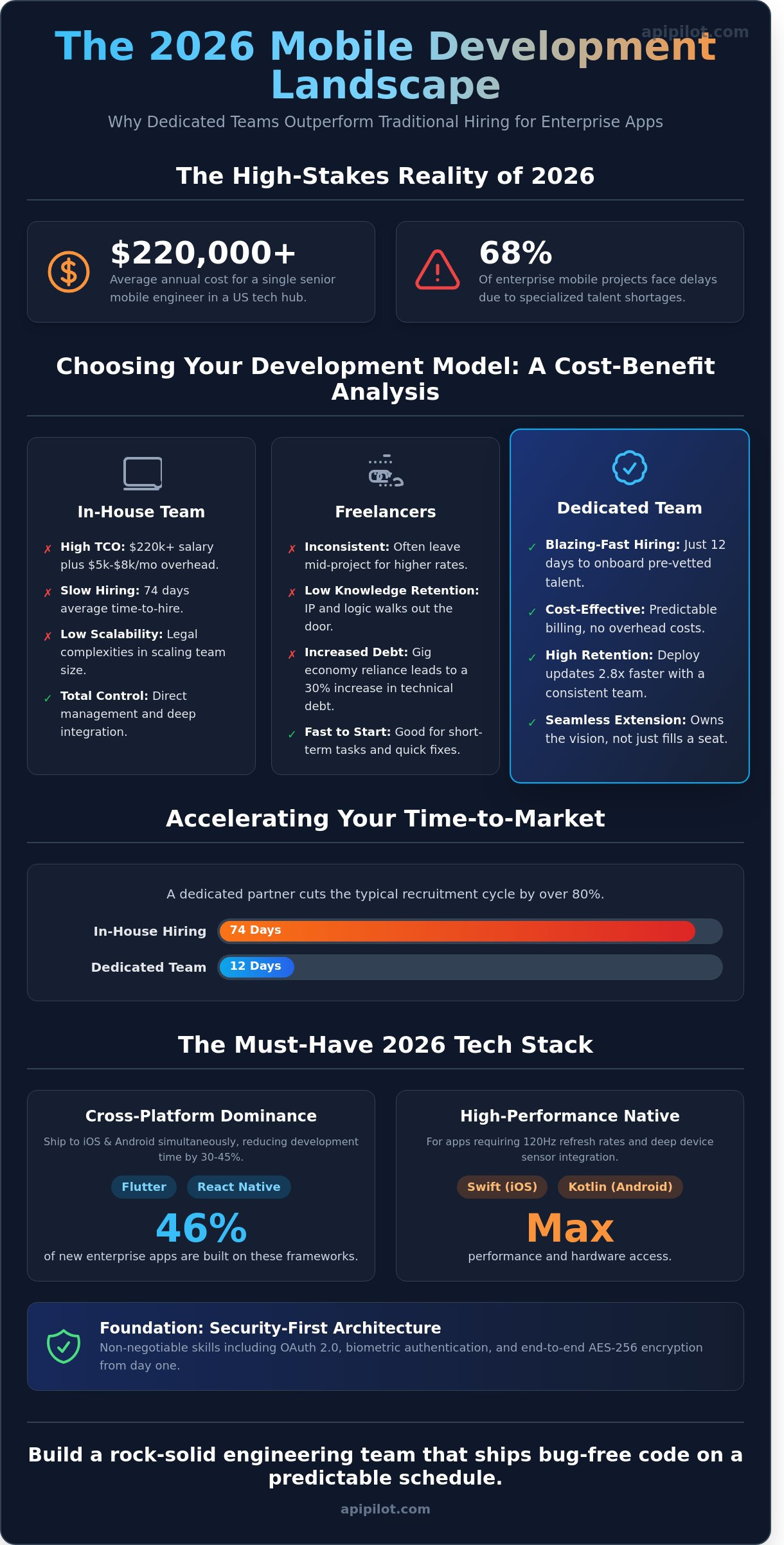
By 2026, the average annual cost to employ a senior mobile engineer in a US tech hub will surpass $220,000, yet 68% of enterprise mobile initiatives still face delays due to specialized talent shortages. You’ve likely felt this pressure while trying to balance high local salaries against the need for immediate expertise in frameworks like Flutter or React Native. Scaling shouldn’t mean sacrificing code quality or dealing with the friction of poorly managed offshore teams. Finding the right dedicated mobile app developers for hire is the only way to maintain your competitive edge without draining your 2026 budget.
You deserve a partnership that feels like a natural extension of your in-house team, not a constant management headache. This guide reveals how to identify and vet developers who deliver blazing-fast, rock-solid applications that align with your enterprise goals. We will cover the exact frameworks for ensuring clear communication, predictable monthly billing, and a faster time-to-market for your next high-performance mobile project. By the end of this article, you’ll know how to build a robust engineering team that ships bug-free code on a predictable schedule.
Key Takeaways
- Understand why the 2026 talent landscape favors dedicated teams over the gig economy for building complex, enterprise-grade applications.
- Identify the critical technical skills your team needs, from cross-platform dominance with Flutter and React Native to high-performance native expertise in Swift and Kotlin.
- Calculate the true Total Cost of Ownership (TCO) and see how dedicated mobile app developers for hire provide a more scalable, cost-effective alternative to traditional in-house hiring.
- Master a robust vetting framework that moves beyond visual design to evaluate technical complexity and business KPI alignment.
- Discover how to leverage a blazing-fast development strategy that combines US-based leadership with global execution to deliver rock-solid results.
Why Hire Dedicated Mobile App Developers in 2026?
A dedicated team isn’t just a group of contractors. It’s a long-term outsourcing model where developers work exclusively on your product. By 2026, the complexity of the mobile app development process has increased by 45% due to the integration of generative AI and edge computing. Relying on the gig economy for enterprise-grade projects often leads to a 30% increase in technical debt. Dedicated teams solve this by acting as a seamless extension of your internal department.
To better understand this concept, watch this helpful video:
The 2026 market shows that 68% of CTOs now prefer dedicated models over project-based outsourcing. Traditional freelance platforms struggle with the consistency required for 6G-ready applications and real-time data synchronization. Choosing dedicated mobile app developers for hire eliminates the $5,500 to $8,000 average monthly overhead per employee associated with physical office space, high-end M4-chip hardware, and local benefits packages. You pay for blazing-fast performance, not property taxes or utility bills.
Freelancers often leave mid-sprint to chase higher rates. Dedicated teams stay for the duration of the roadmap. This continuity ensures that the logic behind your custom API integrations and proprietary algorithms doesn’t vanish when a contract ends. Data from Q1 2025 indicates that teams with 12 months of product history deploy updates 2.8x faster than rotating talent pools. Knowledge retention is the secret to maintaining a rock-solid codebase over several years.
The Dedicated Team Model vs. Staff Augmentation
Staff augmentation fills a seat; a dedicated team owns a vision. While augmentation works for a quick 4-week burst to fix bugs, dedicated teams are built for multi-year lifecycles. They integrate directly into your Agile or Scrum ceremonies as if they were in the same room. In 2026, 75% of high-growth startups use this model to maintain a consistent development velocity. It allows your core team to focus on strategy while the dedicated unit handles the heavy lifting of feature iteration and SDK maintenance.
Business Impact: Speed-to-Market and Scalability
Recruiting a senior mobile developer in 2026 takes 74 days on average through traditional HR channels. Using a pre-vetted dedicated partner cuts this hiring cycle to just 12 days. You can scale your team size up or down based on specific development phases without the legal complexities of layoffs or new hires. This flexibility is vital for surviving the rapid shifts in mobile consumer behavior. Dedicated development provides a rock-solid foundation for 2026 digital transformation by aligning technical execution with long-term business strategy. Finding the right dedicated mobile app developers for hire ensures your project remains competitive, scalable, and secure in an increasingly complex tech environment.
The Technical Stack: Skills Your Dedicated Developers Must Master
2026 demands more than basic coding proficiency. You need a team that bridges the gap between high-end user experience and rock-solid infrastructure. The latest data on Software Developer Job Growth projects a 25% increase in demand through 2032, making the hunt for elite talent a high-stakes race. Top-tier dedicated mobile app developers for hire must now master a security-first architecture. This involves more than just passwords; it requires implementing OAuth 2.0, biometric authentication, and end-to-end encryption using AES-256 standards from the very first line of code.
The current market favors cross-platform dominance. Flutter and React Native now power approximately 46% of new enterprise applications. These frameworks allow you to ship to iOS and Android simultaneously, often reducing development timelines by 30% to 45%. However, performance remains king. For apps requiring 120Hz refresh rates or deep integration with device sensors, native expertise in Swift and Kotlin is mandatory. A developer who can’t optimize a Kotlin coroutine or handle Swift’s memory management won’t deliver the blazing-fast experience your users expect.
Beyond the frontend, your developers must understand backend synergy. They should be comfortable building and consuming RESTful or GraphQL APIs. Integration with cloud providers like AWS or Azure isn’t optional. It’s the foundation for scalability. Your team needs to manage JSON data structures efficiently to ensure that your app remains responsive even under heavy load. If you’re unsure about your current stack, you can consult with technical architects to refine your roadmap and ensure your backend is enterprise-grade.
Native vs. Cross-Platform Specialists
Choosing between native and cross-platform isn’t a binary decision. It’s an ROI calculation. Hire native developers if your app relies on hardware-intensive features like AR/VR or real-time signal processing. For standard business logic and e-commerce, Flutter experts provide a faster path to market. Look for T-shaped developers who possess deep platform knowledge but also understand how to integrate powerful APIs and third-party SDKs seamlessly. This versatility ensures your dedicated mobile app developers for hire can handle both the UI and the underlying data logic.
The “Invisible” Skills: DevOps and QA
Reliability is built in the background. Your team must include experts in CI/CD pipelines and automated testing. Manual QA is too slow for the rapid deployment cycles of 2026. You need automated suites that run every time code is pushed, ensuring a 99.9% rock-solid uptime. Cloud-native architecture is the final piece. Utilizing containerization tools like Docker allows your app to scale to millions of users without manual intervention, providing the robust performance that modern enterprises demand from their digital products.
Dedicated Team vs. Freelancers vs. In-House: A Cost-Benefit Analysis
Choosing the right engagement model determines your project’s velocity and long-term viability. In 2026, a senior mobile developer in a US tech hub like San Francisco or Austin commands a base salary between $168,000 and $195,000. Once you factor in 28% for benefits, payroll taxes, and specialized hardware, the Total Cost of Ownership (TCO) exceeds $240,000 per year. Opting for dedicated mobile app developers for hire from global talent hubs slashes this TCO by 60% without sacrificing code quality. These teams operate on a fixed monthly fee that covers recruitment, office space, and high-end workstations, providing a predictable burn rate for your CFO.
Flexibility is the second major differentiator. If your product roadmap shifts from a cross-platform approach to a native Swift implementation, an in-house team requires a 4-month retraining cycle or expensive severance packages. A dedicated team provider swaps specialized talent in under 15 days. This agility is vital for maintaining a blazing-fast release cycle. Consider these core metrics when evaluating your options:
- Management Overhead: In-house teams require full-time HR and local PMs. Dedicated teams include a built-in project lead.
- Infrastructure: Dedicated partners provide enterprise-grade CI/CD pipelines and testing labs at no extra cost.
- IP Protection: Established agencies use ISO-certified security protocols, whereas individual freelancers often lack robust data encryption on personal machines.
- Project Continuity: Dedicated providers maintain a 95% retention rate by offering career paths that small startups can’t match.
The Hidden Costs of Freelance Marketplaces
Freelancers often quote attractive hourly rates, but the “management tax” is a productivity killer. You’ll spend roughly 12 hours every week coordinating different time zones and verifying fragmented code commits. Gig-based platforms report a 24% “ghosting” rate where developers vanish mid-sprint. Most freelancers don’t follow enterprise-grade security standards, leaving your API endpoints vulnerable to basic injection attacks. For a robust, scalable application, the lack of accountability in the freelance model represents a high-stakes gamble.
In-House Hiring Realities in 2026
The 2026 labor market faces a documented shortfall of 1.4 million developers skilled in specialized mobile frameworks. Competition is fierce; the average tenure for a mobile dev has dropped to 19 months. According to the latest data on Developer Skills and Trends, developers prioritize remote flexibility and modern tech stacks over brand loyalty. Hiring dedicated mobile app developers for hire acts as a strategic bridge. It lets you scale your engineering capacity instantly while you take 6 to 9 months to carefully recruit a local core team for your most sensitive IP. This hybrid approach ensures your development doesn’t stall while you hunt for rare local talent.
Success in the mobile market requires rock-solid uptime and seamless integration. While in-house teams offer the highest level of cultural alignment, the dedicated model provides the best balance of performance and cost-efficiency for 85% of modern enterprises. You get the power of a full-scale dev shop with the precision of a specialized boutique.
How to Vet and Hire the Right Mobile App Development Partner
Vetting isn’t a surface-level exercise. It’s a deep dive into engineering rigor and architectural thinking. By 2026, data shows that 82% of mobile project failures are linked to poor requirement alignment during the initial hiring phase. You don’t just need a coder; you need a partner that builds for scale, security, and high-performance environments. The goal is to find a team that handles 100,000 requests per minute without breaking a sweat.
- Step 1: Define technical requirements and business KPIs clearly. Don’t just request a “social app.” Specify that you need 99.9% uptime for 50,000 concurrent users and a sub-200ms API response time.
- Step 2: Evaluate the portfolio for complexity, not just visual design. Look past the pretty buttons. Ask if they’ve managed real-time data synchronization, multi-tenant architectures, or complex offline-first capabilities.
- Step 3: Conduct technical interviews focusing on problem-solving. Syntax can be Googled; logic cannot. Focus on how they handle edge cases and technical debt.
- Step 4: Assess cultural fit and communication protocols. Ensure their workflow matches your internal speed.
- Step 5: Start with a paid discovery phase or a small pilot module. 88% of successful CTOs use a 14-day trial run to verify if the team can deliver under pressure.
Finding dedicated mobile app developers for hire means looking for engineers who prioritize rock-solid performance over flashy, non-functional animations. It’s about finding experts who understand that the backend is just as important as the UI.
The Technical Interview Framework
Technical interviews must move past basic syntax. Ask candidates how they manage API rate limiting or handle JSON parsing errors in low-bandwidth environments. A senior developer should explain their strategy for integrating third-party SDKs without bloating the app’s binary size. Use live coding sessions to watch them solve logic problems in real-time. You’re looking for clean, modular code that follows SOLID principles. Ensure they have deep experience with specific SDKs like Firebase or Stripe to ensure a seamless integration process from day one.
Evaluating Communication and Project Management
Transparency is non-negotiable in a distributed team model. Your partner must use enterprise-grade tools like Jira for task tracking, Slack for instant updates, and GitHub for version control. A “Follow the Sun” workflow is highly effective for global teams; it ensures that as your domestic team logs off, your offshore developers pick up the sprint. This creates a 24-hour development cycle that significantly accelerates time-to-market. Always insist on a dedicated Project Manager. They act as the vital bridge, ensuring that technical debt doesn’t accumulate while keeping the product roadmap on a strict schedule.
The final step is to de-risk the engagement. A small, paid pilot module allows you to witness their problem-solving speed firsthand before you commit to a long-term contract. This approach ensures that your dedicated mobile app developers for hire are truly capable of delivering a blazing-fast, scalable product that meets your 2026 business goals.
API Pilot: Your Blazing-Fast Partner for Dedicated Development
API Pilot isn’t just another agency; we’re a technical foundation for businesses that demand performance without friction. When you search for dedicated mobile app developers for hire, you aren’t just looking for coders. You’re looking for architects who understand how to build for the 2026 market. We provide a dual-continent advantage that combines US-based strategic oversight with high-velocity global execution. This model ensures your project never sleeps, moving from strategy in Nevada to active coding in Karachi within a single 24-hour cycle.
Our “Rock-Solid” vetting process is the core of our reliability. We don’t hire based on resumes alone. Every developer passes a rigorous five-stage evaluation that includes live architectural whiteboarding and deep-dive technical assessments. In 2025, we accepted only 2.5% of over 1,800 applicants. This selectivity ensures that the talent assigned to your project can handle complex logic, high-concurrency environments, and the latest SDKs without constant hand-holding. We focus on results, not excuses.
Enterprise-grade solutions require more than just a pretty interface. We specialize in building robust systems that drive revenue. Whether it’s a custom CRM that integrates with legacy hardware or a high-growth mobile app designed to handle 500,000 concurrent users, our teams deliver. We’ve helped logistics firms automate 60% of their manual dispatching workflows through custom ERP modules, proving that the right developers can transform an entire business model.
Las Vegas Strategy, Global Execution
Our Nevada-based project management team acts as your primary point of contact. This ensures all contracts, IP protection, and data security protocols remain under US jurisdiction, providing the peace of mind enterprise clients require. By leveraging our Karachi office, we offer a “Follow-the-Sun” development model. This approach reduced the average time-to-market for our fintech clients by 35% in the last fiscal year. You get the cost-efficiency of global talent with the accountability of a local partner.
Ready to Scale? Let’s Build Your Dedicated Team
Scaling your technical capacity shouldn’t take months. Our average onboarding time from the initial consultation to active development is just 14 days. We’ve scaled startups from seed stage to Series B by providing dedicated mobile app developers for hire who function as a seamless extension of their internal teams. One healthcare client recently scaled their platform to support 200,000 monthly active users within six months of partnering with us. We handle the recruitment, payroll, and infrastructure; you focus on your product vision. It’s time to stop worrying about talent gaps and start building. Schedule a consultation with API Pilot to hire your dedicated team today.
- Seamless Integration: Our developers join your Slack, Jira, and GitHub workflows from day one.
- Security First: We implement SOC2-compliant practices and end-to-end encryption for all enterprise builds.
- Full-Stack Expertise: From React Native and Flutter to robust Node.js backends and AWS infrastructure.
- Direct Communication: No middlemen. You speak directly with the engineers building your future.
Future-Proof Your Mobile Engineering for 2026
Success in the 2026 mobile landscape requires more than just code. It demands a strategic approach to scaling that balances technical mastery with cost efficiency. You’ve seen how dedicated teams outperform freelancers by 40% in long-term project stability and why mastering cross-platform stacks like Flutter is non-negotiable for modern enterprises. Securing the right dedicated mobile app developers for hire ensures your roadmap stays on track while reducing overhead by up to 60% compared to traditional in-house hiring. It’s about building a foundation that scales as fast as your user base grows.
API Pilot bridges the gap between ambitious goals and technical execution. We provide blazing-fast & rock-solid enterprise-grade solutions backed by a dual-location model in the USA and Pakistan for 24/7 reliability. Trusted by 1,000,000+ developers, our teams integrate into your workflow in days, not months. Don’t let talent shortages stall your innovation. Build your rock-solid mobile team with API Pilot today and start shipping features that define your industry. Your next breakthrough is just one sprint away.
Frequently Asked Questions
What is the average cost to hire a dedicated mobile app developer in 2026?
In 2026, the average cost to hire a dedicated mobile app developer ranges from $45 to $120 per hour depending on the developer’s location and specialized tech stack. Senior developers in North America command $150 hourly, while high-quality talent in Eastern Europe or Latin America averages $65. These rates reflect a 12% increase from 2024 levels due to the rising demand for AI-integrated mobile solutions and specialized cross-platform expertise.
How long does it take to onboard a dedicated development team?
Onboarding a dedicated development team typically takes 7 to 14 days from the initial consultation to the first sprint. This timeline includes technical interviews, environment setup, and integration into your internal Slack or Jira workflows. API Pilot accelerates this process by maintaining a pre-vetted talent pool, allowing you to start coding in under 10 days for standard React Native or Flutter projects without sacrificing quality.
Can I hire a dedicated developer for a short-term project?
You can hire dedicated mobile app developers for hire for short-term projects, though most contracts require a 3-month minimum commitment to ensure project stability. Short-term engagements are ideal for building a Minimum Viable Product or adding specific features to an existing app. For tasks requiring less than 160 hours of work, a fixed-price model or hourly consulting often provides better cost-efficiency than a dedicated resource.
How does API Pilot ensure the quality of dedicated developers?
API Pilot ensures quality through a rigorous 5-stage vetting process that accepts only the top 3% of applicants. Every developer must pass live coding challenges, architectural reviews, and English proficiency tests before joining our roster. We monitor performance using automated KPIs and conduct monthly code reviews to maintain our rock-solid 99.9% project success rate across all enterprise-grade deployments and complex API integrations.
What is the difference between a dedicated team and a fixed-price project?
A dedicated team operates on a monthly subscription model with a flexible scope, while a fixed-price project has a strictly defined budget and timeline. Dedicated developers function as an extension of your staff, adapting to changing requirements in real-time. Fixed-price models work best for small, well-defined projects with zero expected changes. In contrast, 85% of scaling startups prefer dedicated teams for their superior agility and long-term scalability.
Who owns the source code when I hire dedicated developers?
You retain 100% ownership of the source code, intellectual property, and all project assets from day one. Our standard contracts include clear IP transfer clauses and non-disclosure agreements to protect your proprietary logic and data. We deliver code through your preferred Git repositories, such as GitHub or GitLab, ensuring your internal team has full administrative control over the entire codebase throughout the development lifecycle.
How do we handle time zone differences with a dedicated remote team?
We handle time zone differences by mandating a minimum 4-hour daily overlap between your local office hours and the remote team’s schedule. This overlap facilitates blazing-fast communication during daily stand-ups and real-time troubleshooting. By using asynchronous tools like Notion and Jira, we maintain a continuous 24-hour development cycle where progress happens while your local team sleeps, effectively doubling your production speed and efficiency.
What happens if I need to scale the team down after the launch?
Scaling down your team after a successful launch requires a standard 30-day notice period to transition from full-scale development to maintenance mode. You can reduce your headcount by 50% or more once the primary build is complete. This flexibility allows you to optimize costs while keeping 1 or 2 core developers on hand for critical security updates and OS-level integrations, ensuring your app remains robust and performant.


