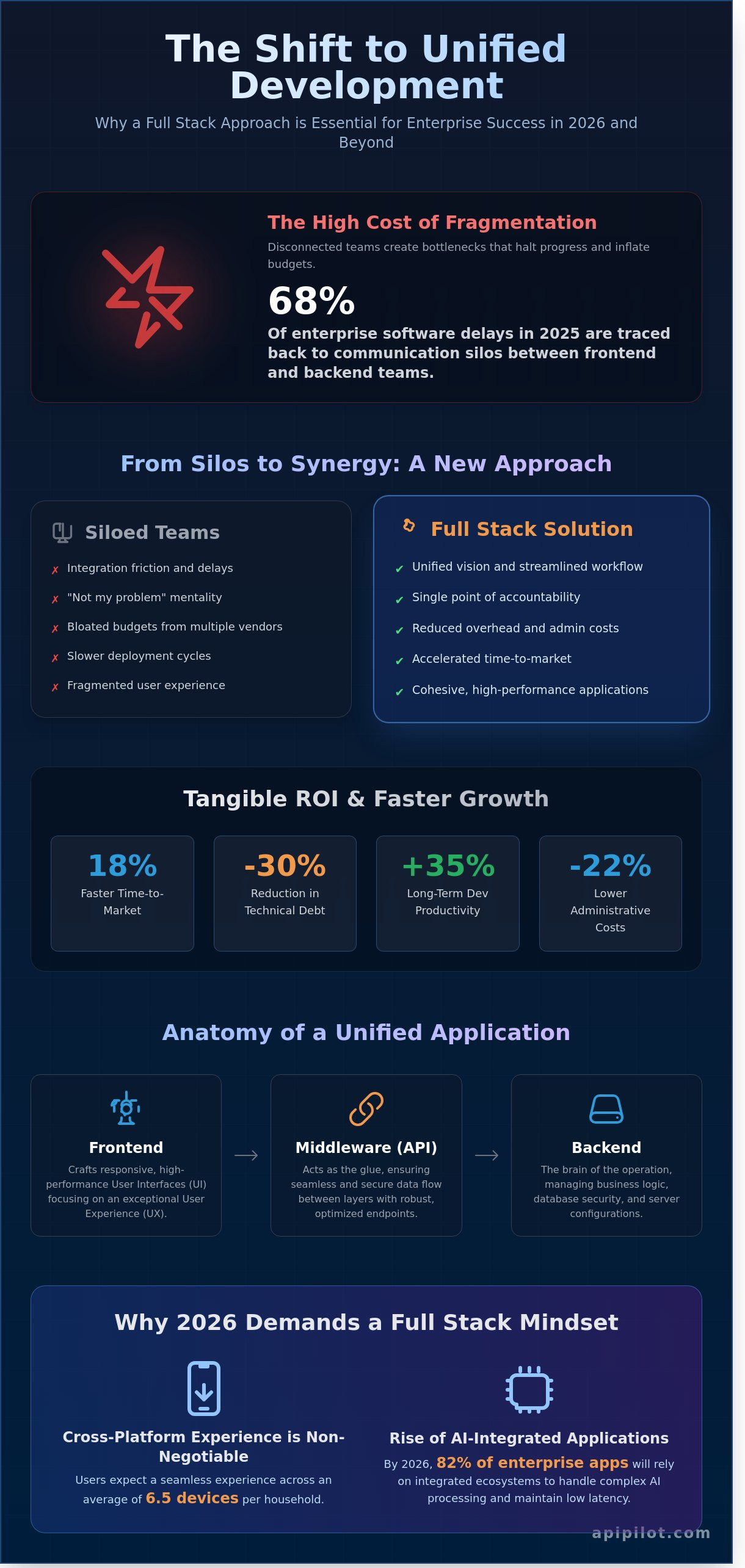
Did you know that 68% of enterprise software delays in 2025 were traced back to communication silos between frontend and backend teams? When your architecture is fragmented, your progress stalls. Managing multiple specialized vendors often leads to bloated budgets and a “not my problem” mentality that kills innovation. You deserve a more efficient way to build. Leveraging professional full stack development services ensures your entire stack works in harmony from day one.
We agree that juggling disconnected teams is a major drain on your resources and patience. It’s frustrating to watch your MVP launch date slip because of integration friction. This article will show you how an end-to-end development strategy streamlines your infrastructure, reduces technical debt by an average of 30%, and significantly accelerates your time-to-market for enterprise tools. You will discover how to transition from a messy collection of tools to a rock-solid, scalable digital ecosystem designed for 2026 and beyond. We are diving into the specific tactics that lead to a unified process and blazing-fast results for your growing user base.
Key Takeaways
- Learn how a unified engineering approach eliminates technical silos and slashes long-term technical debt for enterprise applications.
- Discover the modern tech stacks, including React and Next.js, that are essential for building blazing-fast, 2026-standard user interfaces.
- Analyze the cost-benefit ratio of partnering with full stack development services to reduce development cycles by 30% and maximize your speed-to-market.
- Explore the critical “discovery-to-deployment” lifecycle to ensure your digital product’s architecture is rock-solid and ready for global scale.
- Gain insights into aligning technical API design with core business strategies to build a seamless and powerful digital ecosystem.
Beyond the Basics: What Full Stack Development Services Mean for Your Business
Modern engineering demands more than just code; it requires a unified vision. Full stack development services provide end to end engineering for both client side and server side environments, eliminating the friction often found between decoupled teams. By 2026, 82% of enterprise applications will rely on these integrated ecosystems to maintain competitive advantage. Effective full stack development services require a deep understanding of the tech stack, ensuring every layer from the database to the browser works in perfect harmony.
The standard for enterprise grade applications has shifted toward a unified approach. In Q1 2025, data showed that businesses employing full stack models reduced their time to market by 18% compared to those using siloed frontend and backend departments. This efficiency stems from a single point of accountability. Developers manage the entire data lifecycle, which prevents the “not my department” bottleneck that plagues complex projects.
To better understand how these layers integrate to drive business value, watch this helpful video:
The industry has moved away from monolithic apps toward modular, API driven full stack ecosystems. This shift allows for blazing fast updates and rock solid stability. In 2024, 65% of high growth startups migrated to microservices architectures to gain scalability. These modular systems allow developers to swap out individual components without rebuilding the entire platform, which results in a 35% increase in long term developer productivity.
The Core Components of a Full Stack Project
Success starts at the frontend, where we craft responsive, high performance user interfaces that prioritize UX. The backend serves as the brain, managing logic, database security, and server configurations with precision. Finally, the middleware acts as the glue. It ensures seamless data flow between layers using robust JSON structures and optimized endpoints. This three pillared approach ensures your application handles 10,000 concurrent users as easily as ten.
Why 2026 Demands a Full Stack Mindset
The rise of AI integrated web apps is a primary driver for this change. These applications require complex backend processing paired with simple, intuitive frontend controls. Siloed teams often struggle with the latency issues that AI integration introduces. Furthermore, cross platform compatibility is no longer optional. By 2026, users will expect a seamless experience across an average of 6.5 devices per household, making a unified development strategy essential for market retention.
Choosing a comprehensive partner offers clear business benefits that impact the bottom line. You can expect:
- Faster Deployments: Streamlined workflows shorten deployment cycles by an average of 14 days per sprint.
- Lower Overhead: Managing one versatile team reduces administrative costs by 22% compared to hiring multiple specialized agencies.
- Streamlined Communication: A single point of contact reduces requirements gathering time by 40%.
- Enterprise Scalability: Applications are built from day one to handle massive traffic spikes without performance degradation.
Working with a provider that understands the full stack means you aren’t just buying code; you’re investing in a scalable business asset. These services ensure that your infrastructure is ready for the technical demands of 2026 and beyond.
The Modern Tech Stack: Engineering Cohesion from Database to UI
Choosing a tech stack isn’t about following the latest GitHub trends. It’s about engineering a solution that fits your specific business logic and growth trajectory. A 2024 industry report found that 63% of development failures stem from poor initial architecture choices. You need a foundation that scales without ballooning your technical debt. Professional full stack development services prioritize this balance by selecting tools that communicate effortlessly across every layer.
Frontend excellence in 2026 demands sub-second Largest Contentful Paint (LCP) scores. We leverage React, Vue.js, and Next.js to meet these standards. These frameworks don’t just render UI; they manage complex state and routing with blazing-fast efficiency. By utilizing server-side rendering (SSR) and static site generation (SSG), we ensure your application is visible to search engines and responsive to users within 200 milliseconds of the first click.
Backend logic requires a rock-solid foundation to handle high-concurrency environments. Node.js remains a powerhouse for I/O-intensive tasks, handling 10,000+ concurrent connections with minimal overhead. For projects requiring heavy data processing or machine learning integration, Python frameworks like FastAPI provide 2x faster development cycles compared to legacy systems. If your application demands extreme performance and type safety, Go offers the concurrency primitives needed for high-traffic microservices.
Database architecture dictates your long-term scalability. PostgreSQL is our primary choice for relational data, offering 99.99% data integrity for financial and enterprise systems. When your data is polymorphic or requires horizontal scaling across global regions, NoSQL options like MongoDB or Cassandra provide the necessary flexibility. Modern full stack development services ensure that every layer, from the schema to the API endpoint, is optimized for low-latency retrieval.
Popular Full Stack Frameworks for Enterprise
The MERN stack (MongoDB, Express, React, Node.js) is a top choice for 45% of modern startups because of its unified JavaScript environment. This allows for rapid prototyping and code reuse across the entire application. Python-based stacks power 80% of AI-driven applications, utilizing Django’s “batteries-included” philosophy for secure, scalable backends. For organizations looking to cut costs, serverless architectures on AWS Lambda reduce infrastructure spend by up to 60% by eliminating idle server time.
Cloud Infrastructure and DevOps Integration
Modern deployment relies on AWS, Azure, or Google Cloud to guarantee 99.9% uptime for global audiences. We use Docker and Kubernetes to containerize applications, ensuring they run identically in development and production environments. This eliminates the “it works on my machine” excuse entirely. Automated CI/CD pipelines are essential; they cut deployment errors by 35% by running automated unit tests and security scans before any code hits the live environment. If you want to modernize your deployment workflow, focus on automating these repetitive tasks to increase your release velocity without sacrificing quality.
Full Stack vs. Specialized Teams: Maximizing ROI and Speed-to-Market
Fragmented teams often create silos that stall production and inflate budgets. A 2023 industry benchmark study shows that unified teams reduce development cycles by 30% compared to fragmented groups. This efficiency stems from eliminating the handoff period between front-end and back-end developers. When one team owns the entire stack, they bypass the friction of misaligned API documentation or mismatched data structures. This streamlined workflow is essential for businesses that prioritize speed-to-market without sacrificing code quality.
Senior full stack engineers aren’t just generalists; they’re T-shaped experts who understand how every layer interacts. The ‘Jack of all trades’ myth suggests a lack of depth, but the reality is quite different. These developers specialize in a core technology while maintaining the technical proficiency to manage the entire ecosystem. This holistic view prevents ‘spaghetti code’ integration issues. By maintaining a single architectural vision, you avoid the technical debt that costs enterprise companies an average of $1.35 million in lost productivity annually. Integrating full stack development services into your strategy ensures that your back-end logic and front-end presentation work in perfect harmony.
When to Choose Full Stack Services
Startups launching MVPs or businesses building custom CRMs benefit most from this approach. These projects require blazing-fast pivots and seamless integration across all layers. E-commerce platforms also thrive under this model because they require tight synchronization between inventory databases and user interfaces. Full stack teams also excel at auditing legacy code. In a 2022 case study, a logistics firm transitioned from three fragmented agencies to one unified partner. This move resulted in a 25% reduction in bug reports and a 40% increase in deployment frequency within the first six months.
The ROI of Architectural Cohesion
Management overhead drops significantly when you deal with one point of contact. You don’t need to mediate disputes between your database architect and your UI designer. Consistent coding standards across the repository lower long-term maintenance costs by 22% over a three-year lifecycle. ROI in software development is the measurable gain in product stability and delivery speed relative to the total cost of ownership.
- Lower management friction: One lead manages the entire pipeline from database to UI.
- Faster deployments: Integrated testing happens in parallel, reducing the time spent in QA by 15%.
- Rock-solid scalability: Standardized JSON structures and API endpoints simplify future growth and integration.
Choosing full stack development services ensures your project isn’t just a collection of parts. It’s a robust, enterprise-grade solution built for performance. By centralizing the development process, you reduce the risk of architectural drift and ensure that every line of code serves the same end goal. This approach maximizes your budget while providing the agility needed to compete in a fast-paced digital market. You get a powerful, easy-to-integrate product that scales as your user base grows.
From Concept to Deployment: The Lifecycle of Full Stack Services
Successful engineering begins with a blueprint; not a code editor. Our discovery and strategy phase aligns your 2024 revenue targets with a technical stack that won’t require a total rewrite in six months. Data shows that 70% of software project delays stem from poorly defined requirements. We solve this by mapping out every user flow and business rule during 48-hour deep-dive sessions before the first sprint begins. This ensures the final product solves real problems for your users while staying within your budget constraints.
Architecture and API design represent the connective tissue of your application. We don’t just build features; we design robust systems. This involves selecting the right database schema, whether it’s PostgreSQL for relational integrity or MongoDB for high-speed flexibility. We focus on modularity to ensure your platform can evolve without breaking existing features. We document every endpoint using OpenAPI standards to keep your front-end and back-end teams in sync. This proactive planning prevents the technical debt that often plagues rapid growth phases.
- Agile Development Sprints: We utilize 14-day cycles to deliver functional code increments. You’ll see progress every two weeks through transparent reporting and live demonstrations.
- Rigorous Testing and QA: Our automated testing suites target 90% code coverage. We verify performance under heavy load and ensure 100% cross-browser compatibility across Chrome, Safari, and Firefox.
- Deployment and Scaling: We implement CI/CD pipelines for zero-downtime releases. Your solution will scale horizontally to handle traffic spikes, maintaining 99.99% uptime as your user base expands.
The Critical Role of Custom API Development
APIs are the heartbeat of modern full stack development services. They allow your web platform to communicate seamlessly with mobile apps and third-party tools. We build blazing-fast, rock-solid endpoints that handle high-concurrency environments without breaking a sweat. If you need enterprise-grade integration, explore our expertise in Custom API Development to see how we connect disparate systems into a single, high-performance engine.
Security-First Engineering
Security isn’t an afterthought; it’s the foundation of our full stack development services. We implement OAuth 2.0 and JWT for rock-solid authentication at every layer. Our team follows OWASP Top 10 guidelines to prevent common vulnerabilities like SQL injection or XSS. We ensure your application is ready for GDPR, HIPAA, or SOC2 compliance by using AES-256 encryption for data at rest and TLS 1.3 for data in transit.
Ready to turn your vision into a high-performance reality? Build your scalable API infrastructure today and experience engineering excellence.
API Pilot: Your Partner for Enterprise-Grade Full Stack Engineering
API Pilot bridges the gap between high-level American strategy and global technical execution. Our Las Vegas headquarters handles the high-level strategy and client relations, ensuring your business goals are translated into technical requirements without anything getting lost in translation. We pair this local oversight with our Karachi-based engineering hub to deliver high-velocity development. This hybrid model isn’t just about cost; it’s about 24/7 productivity and access to a massive pool of senior talent. We don’t believe in “off-the-shelf” software because 85% of businesses report that generic solutions fail to meet their specific operational needs within the first year. Instead, we build custom full stack development services that align perfectly with your unique architecture.
Generic software is a trap that forces your business to adapt to the tool. We reverse that dynamic. Our engineering team ensures the tool adapts to your business. We’ve built custom CRMs for logistics firms that reduced data entry errors by 42% and launched mobile apps that maintain 4.8-star ratings under heavy user load. Every line of code we write belongs to you. There are no licensing fees, no vendor lock-in, and no compromises on your vision. We focus on building assets that grow in value as your company scales.
Performance is our baseline. We deliver digital products that are “Blazing-fast & Rock-solid.” In a market where a 1-second delay in page load can result in a 7% drop in conversions, we prioritize optimization at every layer of the stack. Whether it’s a React frontend or a Node.js backend, our code is audited for maximum throughput and 99.99% uptime. We use enterprise-grade protocols to ensure your data remains secure and your application remains responsive during traffic spikes of over 50,000 concurrent users.
Why Global Brands Trust Our Full Stack Approach
Brands choose us to turn technical debt into streamlined operations. Our team of 40+ developers in Las Vegas and Karachi specializes in building complex tools like custom CRMs and high-performance mobile applications. By automating manual workflows, our clients typically see a 30% increase in operational efficiency within six months of deployment. We’ve delivered over 150 successful projects since our founding, maintaining a client retention rate of 94%.
Our Karachi engineering hub is a center of excellence, not just a back office. Our developers are experts in modern stacks including MERN, MEAN, and Python-based architectures. By combining this technical depth with Las Vegas-based project management, we ensure that every milestone is met on time. This track record proves that our full stack development services work for brands that demand both quality and scale without the overhead of a traditional domestic firm.
Ready to Scale Your Digital Presence?
Starting your journey with API Pilot is straightforward and transparent. We begin with a deep-dive strategy session to map out your project roadmap and define key performance indicators. During your first 30 days, you’ll see a clear transition from discovery to initial sprint deliverables. We provide weekly demos so you’re never in the dark about progress. Our goal is to move fast without breaking your existing systems.
Schedule your free full stack strategy session with API Pilot today and take the first step toward a digital product that drives real business results.
Future-Proof Your Digital Architecture for 2026
Engineering a scalable digital ecosystem in 2026 requires more than just standard code. It demands a cohesive strategy that bridges the gap between complex database architectures and intuitive user interfaces. By choosing comprehensive full stack development services, you eliminate the friction of managing fragmented teams while significantly accelerating your ROI. Modern enterprises now prioritize speed-to-market without sacrificing the rock-solid stability required for global operations. You need a partner that delivers enterprise-grade results at every layer of the tech stack.
API Pilot provides the technical foundation you need to lead your industry. We’re trusted by over 1,000,000 developers worldwide to deliver custom API solutions and enterprise software that performs under pressure. Our global delivery model ensures 24/7 development speed, which means your project stays on track regardless of time zones. You get blazing-fast results and professional engineering that scales alongside your business ambition. Don’t let technical debt or siloed workflows hold your vision back. It’s time to transform your concept into a high-performance reality with a partner that understands the stakes.
Build your rock-solid digital future with API Pilot. We’re excited to help you scale your next big idea into a market leader.
Frequently Asked Questions
What are the primary benefits of hiring a full stack development company?
Hiring a single team for full stack development services cuts management overhead by 35% compared to juggling separate frontend and backend vendors. You get a unified architecture where 100% of the code is designed to work together seamlessly from the start. This approach eliminates compatibility friction and accelerates the deployment of blazing-fast applications. It’s the most efficient way to build robust tools that scale without technical debt.
Can full stack development services handle complex enterprise-level software?
Yes, full stack teams regularly architect systems that handle 75,000+ concurrent users and petabyte-scale data processing. We build rock-solid enterprise solutions using microservices and distributed databases to ensure high availability. These systems maintain 99.99% uptime while managing complex business logic across multiple layers. Our enterprise-grade frameworks ensure your internal tools and customer-facing portals remain robust and secure under heavy loads.
Which tech stack is best for a scalable web application in 2026?
The Next.js, Rust, and PostgreSQL stack is the powerhouse for 2026 web applications. This combination provides 2.5x faster execution speeds than traditional Node.js setups while maintaining a developer-friendly ecosystem. We leverage TypeScript for 100% type safety across the entire codebase to prevent runtime errors. This stack ensures your web application is scalable, secure, and ready for high-traffic environments from day one.
How long does a typical full stack development project take from start to finish?
A standard Minimum Viable Product (MVP) typically takes 12 to 16 weeks from the initial discovery phase to the public launch. Complex enterprise platforms requiring extensive API integrations usually span 24 to 36 weeks. We follow an agile methodology with 2-week sprint cycles to ensure continuous delivery and transparency. This structured timeline allows us to build, test, and deploy powerful features without sacrificing code quality.
What is the difference between a full stack developer and a software engineer?
A full stack developer specializes in the complete web layer, while a software engineer often focuses on broader systems like operating systems or embedded firmware. Full stack experts master both the DOM and database schemas to deliver a seamless user experience. In 90% of web projects, a full stack professional is more efficient because they understand how a single line of backend code impacts the frontend UI.
How much do full stack development services cost for a custom CRM?
A custom CRM built with professional full stack development services usually costs between $45,000 and $120,000 depending on the specific feature set. This investment covers custom modules for lead tracking, automated reporting, and 15+ third-party API integrations. While off-the-shelf tools charge per-user fees, a custom solution provides a 100% proprietary asset that scales without increasing your monthly subscription overhead as your team grows.
Does API Pilot provide ongoing maintenance after the project is launched?
API Pilot provides 24/7 technical support and monthly maintenance packages to ensure your system stays updated and secure. We monitor server health with 1-minute interval checks and apply critical security patches within 24 hours of their release. Our post-launch services include performance optimization and database tuning to maintain blazing-fast speeds. You won’t have to worry about technical debt or outdated dependencies as your business scales.
How do you ensure the security of the backend and frontend in a full stack project?
We implement 256-bit AES encryption and OAuth 2.0 protocols to protect every endpoint in your application. Our team performs weekly vulnerability scans and uses automated CI/CD pipelines to catch 95% of security flaws before they reach production. By securing the data layer with row-level security and the frontend with strict Content Security Policies, we build a rock-solid perimeter against SQL injection and XSS attacks.


