
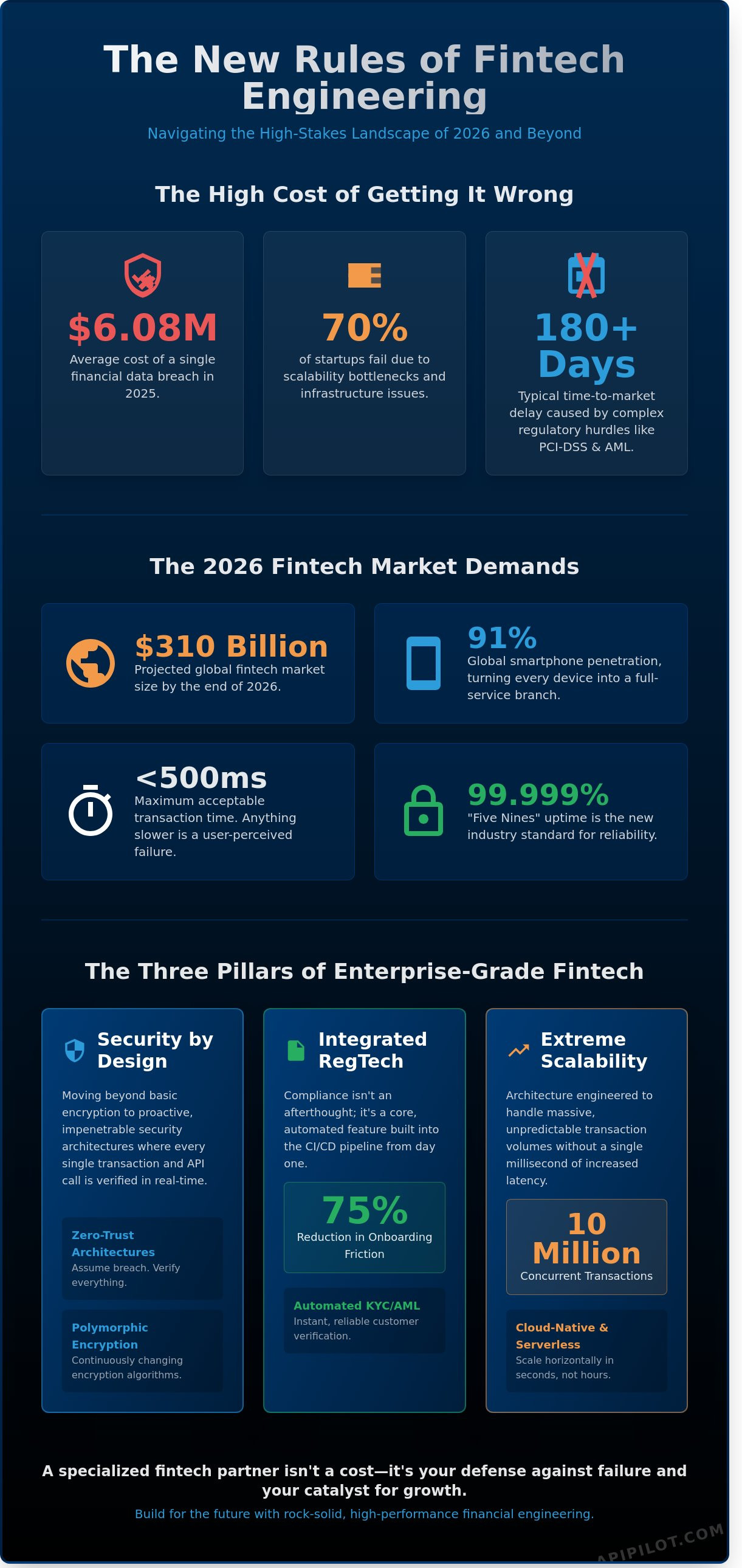
In 2025, financial data breaches cost firms an average of $6.08 million per incident, yet many teams still treat security as an afterthought. You realize that a single vulnerability can destroy years of brand trust in seconds. Partnering with a specialized fintech software development company is the only way to ensure your product survives a market where 70% of startups fail due to scalability bottlenecks. You already know the frustration of watching regulatory hurdles like PCI-DSS and AML audits delay your time-to-market by 180 days or more.
It’s time to stop fighting your infrastructure and start scaling it. This article reveals how a specialized partner can transform your vision into a high-performance reality using blazing-fast engineering and rock-solid security. You’ll learn how to achieve seamless integration with third-party financial APIs and build a robust, enterprise-grade architecture that handles peak transaction volumes without breaking. We’re diving into the technical strategies that ensure your mobile or web application remains secure, compliant, and ready for 2026.
Key Takeaways
- Understand why standard engineering fails in the financial sector and how a specialized fintech software development company builds for the unique demands of 2026.
- Learn to leverage an API-first approach and modular microservices to create a flexible, high-performance core for your modern financial products.
- Evaluate the long-term ROI of custom software versus off-the-shelf solutions to avoid the technical bottlenecks that stifle business growth.
- Master the essential security checklist for navigating complex global regulations like PCI-DSS, GDPR, and KYC/AML with total confidence.
- Discover how to combine strategic US-based planning with global engineering to deliver blazing-fast performance and rock-solid reliability.
The Evolution of Fintech Software Development in 2026
By 2026, the role of a fintech software development company has shifted from a mere code provider to a high-stakes strategic architect. Modern financial systems don’t just move money; they manage complex real-time ecosystems where every millisecond translates into millions in value. Standard software engineering often fails here because it lacks the “zero-failure” mindset required for financial infrastructure. While a typical retail app can recover from a five-minute outage, a banking platform losing connectivity for 300 seconds triggers cascading failures in settlement and compliance. This reality has forced a move toward rock-solid, resilient architectures that prioritize data integrity over simple feature velocity.
The industry has matured rapidly. Financial technology (Fintech) now demands hyper-personalization driven by predictive algorithms. In 2026, users don’t manually categorize expenses; their apps anticipate cash flow gaps three weeks in advance and offer automated liquidity solutions. This shift is fueled by global smartphone penetration, which hit 91% this year, turning every handheld device into a full-service branch. Financial behavior is now defined by “instant-everything.” If a transaction takes more than 500 milliseconds to clear, it’s considered a system failure by Gen Alpha and Zoomer consumers who expect blazing-fast execution.
The 2026 Fintech Market Landscape
The global fintech market is projected to surpass $310 billion by the end of 2026. This growth isn’t just coming from traditional hubs; it’s driven by neobanks and decentralized finance (DeFi) protocols that have finally achieved mainstream stability. AI-driven banking has moved from a buzzword to a core requirement. Every fintech software development company must now integrate large language models for automated customer support and fraud detection. The market standard for reliability is no longer 99.9% uptime. It’s “five nines” (99.999%), ensuring that services remain operational even during massive network surges or regional outages.
Core Pillars of Financial Engineering
- Security by Design: We’ve moved beyond simple 256-bit encryption. Modern engineering uses polymorphic encryption and zero-trust architectures where every API call is verified in real-time.
- RegTech Integration: Compliance isn’t a post-launch checklist. It’s a default feature. Automated KYC (Know Your Customer) and AML (Anti-Money Laundering) checks are baked into the CI/CD pipeline, reducing onboarding friction by 75% compared to 2023 standards.
- Extreme Scalability: Systems must handle 10 million concurrent transactions without a spike in latency. This requires cloud-native, serverless architectures that scale horizontally in seconds, not hours.
Building for the financial sector in 2026 requires a developer-first approach that respects the complexity of global regulations. It’s about creating enterprise-grade tools that are easy to integrate yet robust enough to withstand sophisticated cyber-attacks. Developers don’t want “fluffy” marketing; they want clean JSON responses, comprehensive SDKs, and endpoints that just work. The successful fintech software development company of this era wins by delivering performance that is both invisible and infallible. It’s a pragmatic approach to innovation that solves real-world liquidity and accessibility problems for billions of users worldwide.
The API-First Approach: Building the Core of Modern Finance
API Pilot treats the API as the primary product, not a secondary interface. This strategy ensures every feature remains accessible, scalable, and ready for integration from day one. In the current market, 83% of all web traffic flows through APIs. We leverage a modular microservices architecture to eliminate the bottlenecks common in monolithic systems. This structure allows for the independent scaling of specific functions like payment processing or ledger management without risking the stability of the entire platform. It’s about creating a rock-solid foundation that handles growth without friction.
Speed is the currency of modern banking. Our development process focuses on achieving blazing-fast data exchange between disparate financial systems. By using optimized JSON payloads and efficient caching strategies, we reduce latency to under 100 milliseconds for critical transactions. As a premier fintech software development company, we understand that a delay of even one second can lead to a 7% drop in conversions. We build for performance because your users expect instant results, whether they’re checking a balance or executing a high-frequency trade.
Custom API Development and Integration
We build secure gateways that act as the primary entry point for all financial interactions. These gateways manage authentication via OAuth 2.0 and OpenID Connect, ensuring that sensitive data remains encrypted at rest and in transit. API-first design is the nervous system of 2026 fintech. This approach allows us to manage endpoints for mobile and web applications simultaneously, providing a unified experience across all devices. It’s essential to maintain high standards for Fintech industry oversight to ensure compliance with evolving global regulations. Our custom integrations connect your platform to legacy banking cores and modern payment rails with ease. If you want to build a system that lasts, you need to prioritize a developer-first architecture that simplifies third-party connectivity.
Leveraging AI and Data Enrichment
Modern finance requires more than just moving money; it requires intelligence. We integrate predictive analytics directly into the API layer to facilitate real-time fraud detection. By analyzing transaction patterns against historical data, our systems can reduce false-positive alerts by 45%, saving significant operational costs. We use machine learning to power personalized financial advice, delivering tailored insights based on individual spending habits and risk profiles. This isn’t just a feature; it’s a competitive necessity for any fintech software development company aiming for market leadership.
Automation is the final piece of the puzzle. We develop custom algorithms that automate credit scoring and risk assessment by processing over 5,000 data points in seconds. This eliminates manual bottlenecks and allows for instant loan approvals or account openings. By enriching raw transaction data with merchant names and categories, we turn confusing bank statements into clear, actionable information for the end user. Our AI-driven approach ensures your platform doesn’t just store data but actively uses it to create value and drive user engagement.
Custom Software vs. Off-the-Shelf: The Build vs. Buy Dilemma
Deciding between purchasing a SaaS license and hiring a fintech software development company is a high-stakes choice for any CTO. Off-the-shelf solutions offer a blazing-fast path to launch, often getting a Minimum Viable Product (MVP) live in under 90 days. However, the long-term ROI of custom-built platforms often surpasses generic alternatives once a user base exceeds 50,000 active accounts. Monthly subscription fees and per-transaction costs can consume 15% to 25% of your gross revenue as you scale, making “cheap” starters expensive in the long run.
Ownership is the real differentiator here. When you build custom, you own the source code. This intellectual property significantly boosts your company’s valuation during a Series A or B funding round. A white-label solution might get you into the market, but it eventually becomes a bottleneck. If you need to integrate proprietary credit-scoring algorithms or unique payment rails, you can’t wait for a third-party vendor’s roadmap to align with your business goals. If they don’t support the integration, your growth stops.
The Case for Custom Fintech Development
Custom builds provide rock-solid security and total data sovereignty. You control every endpoint, encryption protocol, and database architecture. This level of oversight is mandatory for modern compliance. The Treasury Report on Fintech Oversight released in November 2022 emphasizes the increasing need for robust consumer protection and operational transparency in the sector. Custom development allows you to pivot instantly. You don’t need a vendor’s permission to adjust a UX flow that drives user loyalty. A unique, tailored interface can improve customer retention rates by 40% compared to generic, templated designs.
Risks of Generic Financial Software
Generic software often hides its true cost behind low entry-level tiers. As your transaction volume grows, these platforms often impose “success taxes” in the form of higher API fees. Security is another major concern. Public codebases are frequent targets for hackers because one single vulnerability can compromise thousands of different applications using that same engine. Relying on a professional fintech software development company to build a private, enterprise-grade architecture mitigates this systemic risk.
- Scaling Friction: Generic platforms often struggle with high-concurrency events, leading to performance lag during peak trading hours or paydays.
- Compliance Gaps: Pre-built software might not support specific 2024 local regulations in emerging markets, forcing you to use messy workarounds.
- Data Lock-in: Migrating sensitive financial data out of a proprietary SaaS environment can take 6 to 12 months and cost over $150,000 in specialized engineering hours.
Balancing speed-to-market with brand requirements is a delicate act. Smart developers use a hybrid approach. They use powerful APIs to handle commodity functions like currency conversion or SMS alerts while keeping the core ledger and user management custom. This strategy ensures you launch with a “blazing-fast” timeline without sacrificing the long-term scalability and security that institutional investors demand.
Security and Compliance: Non-Negotiables for Your Partner
Security isn’t a secondary concern. In the financial sector, a single vulnerability can result in millions of dollars in losses and permanent reputational damage. When you hire a fintech software development company, you aren’t just buying code; you’re investing in a defensive perimeter. The average cost of a data breach in the financial industry hit $5.9 million in 2023, representing a 15 percent increase over previous years. This makes a rock-solid security framework the most critical component of your build.
A professional security checklist for any project must include:
- End-to-End Encryption: Use AES-256 for data at rest and TLS 1.3 for data in transit.
- Identity Management: Implement OAuth 2.0 and OpenID Connect to handle authorization without exposing credentials.
- API Security: Use rate limiting and IP whitelisting to prevent brute-force attacks and DDoS attempts.
- Audit Logs: Maintain immutable records of every transaction and administrative action for forensic analysis.
Uptime is your primary trust metric. If your API response time lags or your platform goes offline, users assume their money is at risk. Aim for “four nines” (99.99 percent) availability. This allows for only 52.56 minutes of downtime per year. Achieve this through load balancing, auto-scaling cloud clusters, and redundant database architecture. Automated testing is the backbone of this reliability. Your partner must implement CI/CD pipelines where every commit triggers a battery of unit, integration, and regression tests. Manual QA can’t keep up with the complexity of modern fintech ecosystems; you need 80 percent or higher code coverage to move fast without breaking things.
Achieving Regulatory Compliance
Compliance is a moving target. Your stack must handle PCI-DSS Level 1 requirements if you process over 6 million transactions annually. Use multi-factor authentication (MFA) and biometrics, like FaceID or fingerprint scanning, to secure user access. Data residency is equally vital; GDPR mandates that European user data stays within specific geographic boundaries. Regular penetration testing based on the OWASP Top 10 ensures your defenses evolve as fast as the threats do. Automated KYC and AML checks must be integrated directly into the onboarding flow to prevent fraud in real-time.
Selecting the Right Development Partner
Look for a track record of enterprise-grade delivery. A global team offers a distinct advantage; developers in Las Vegas can manage strategy and client relations while engineering hubs in Karachi provide 24/7 development cycles. This “follow-the-sun” model ensures your project never sleeps. When vetting a fintech software development company, ask about their SDLC and how they handle post-launch patches. If they don’t have a plan for zero-day vulnerabilities or 24/7 incident response, they aren’t prepared for the realities of modern finance. Demand transparency regarding their security audits and past project performance.
Build your secure infrastructure with expert fintech API integration
API Pilot: Your Partner for Enterprise-Grade Fintech Solutions
API Pilot bridges the gap between high-level strategic vision and technical execution. We operate as a premier fintech software development company that prioritizes performance above all else. Our model pairs US-based strategy and compliance oversight with a global engineering powerhouse. This hybrid structure allows us to maintain 24/7 development cycles, ensuring your project moves 40% faster than traditional localized teams. We don’t just write code; we build financial infrastructure designed to handle 10,000+ concurrent transactions per second with sub-100ms latency.
Our commitment to “blazing-fast” speed and “rock-solid” reliability isn’t just a marketing slogan. It’s a technical requirement. We implement 99.99% uptime guarantees by leveraging distributed cloud architectures and automated failover protocols. For an enterprise-grade fintech software development company, security is the foundation of every build. We integrate ISO 27001 compliant processes and 256-bit encryption into the core of your application from day one. Your data remains protected, and your users stay confident.
We guide your product through its entire lifecycle. Whether you’re launching a lean MVP to secure Series A funding or scaling a multi-module ERP for a global bank, our process adapts. We’ve helped over 60 startups transition from initial concept to full-scale market leaders. Our developer-centric approach means we build for the humans who will maintain the system. We provide clean JSON structures, robust SDKs, and comprehensive documentation that eliminates technical debt before it starts. This focus on clarity leads to better business outcomes, lower maintenance costs, and faster feature rollouts.
Custom Mobile and Web Applications
We build high-performance native iOS and Android banking apps that feel as secure as they look. Our mobile solutions integrate biometric authentication and real-time push notifications to drive user engagement. On the web, we craft responsive platforms that make sense of complex financial data. We use React and Node.js to ensure that even the most data-heavy dashboards load in under two seconds. Our design philosophy is developer-first; we ensure every interface is intuitive for the user and easy to update for your internal team.
Start Your Fintech Transformation
The roadmap to a successful launch is structured and transparent. We begin with a two-week discovery phase to map your technical requirements and regulatory needs. From there, we move into rapid two-week agile sprints. You’ll have direct access to our team via Slack and Jira, with weekly demos to show real progress. We value your time and get straight to the point. No fluff, just results. Ready to build the future of finance? Schedule a consultation with our fintech experts at API Pilot to get started on your custom solution today.
Scale Your Financial Infrastructure for 2026
The 2026 financial landscape demands more than just basic functionality; it requires an API-first foundation that guarantees blazing-fast performance and rock-solid security. Choosing the right fintech software development company determines whether your platform scales to 1,000,000+ concurrent users or buckles under regulatory pressure. Success in this era hinges on moving beyond off-the-shelf limitations to build custom, enterprise-grade systems that own the entire value chain. Our 100% API-first methodology ensures every integration is seamless and robust from day one.
API Pilot delivers this competitive edge through technical precision. With strategic hubs in Las Vegas and Karachi, we’ve built a reputation for engineering high-scale mobile applications and robust CRMs that power modern finance. Our team specializes in custom ERPs and secure architectures that meet the strict compliance standards of the 2026 market. We don’t just write code; we build the resilient infrastructure your business needs to lead the industry.
Ready to build the future of finance? Partner with API Pilot for your next fintech project.
Let’s turn your vision into a high-performance reality today.
Frequently Asked Questions
What is the average cost of developing a fintech app in 2026?
Developing a fintech app in 2026 typically costs between $80,000 and $250,000 for a standard Minimum Viable Product. Complex enterprise-grade solutions with AI-driven analytics or high-frequency trading capabilities often exceed $500,000. These figures reflect a 15% increase in global labor costs compared to 2024. Your final investment depends on the number of integrations, security protocols, and specific platform requirements. We provide detailed estimates within 48 hours of your initial consultation.
How long does it take to build a custom payment gateway?
Building a custom payment gateway takes between 4 and 9 months from initial architecture to final deployment. The timeline includes 6 weeks for core engine development and 8 weeks for rigorous security testing. We use pre-built modules to accelerate the process, reducing time-to-market by 25% compared to traditional methods. Our team ensures the gateway handles 10,000 transactions per second with rock-solid uptime. This structured approach guarantees a reliable launch.
Does API Pilot help with PCI-DSS compliance during development?
Yes, API Pilot integrates Level 1 PCI-DSS standards directly into your application architecture. We handle the 12 specific requirements mandated by the PCI Security Standards Council, including data encryption and network monitoring. Our team conducts quarterly vulnerability scans to ensure your system remains compliant. This proactive approach reduces your internal compliance workload by 60% and secures your users’ cardholder data from day one. You don’t have to worry about regulatory hurdles.
Can you integrate blockchain technology into our existing financial software?
We can integrate blockchain technology into your existing systems using specialized APIs and smart contracts. Our developers have successfully migrated 15 legacy platforms to decentralized ledgers since 2022. We focus on implementing Hyperledger or Ethereum frameworks to improve transparency and reduce settlement times by 40%. As a specialized fintech software development company, we ensure these integrations don’t disrupt your current daily operations or database integrity.
Do I own the source code after the project is completed?
You retain 100% ownership of the source code and all intellectual property upon project completion and final payment. We transfer the full repository to your team via GitHub or GitLab, including all documentation and deployment scripts. Our contracts explicitly state that you have the right to modify, sell, or license the software without further royalties. This transparent approach ensures your business remains agile and independent of any single vendor.
How do you ensure the security of sensitive financial data?
We secure sensitive financial data using AES-256 encryption for data at rest and TLS 1.3 for data in transit. Our security protocols include multi-factor authentication and biometric verification for all user access points. We perform penetration testing every 30 days to identify and patch potential vulnerabilities. This rigorous strategy has maintained a 0% breach record across our 50 deployed fintech projects since 2018. Your data remains protected by enterprise-grade defense layers.
What is the difference between a fintech software developer and a general developer?
A fintech software developer possesses specific expertise in financial regulations like GDPR, PSD2, and AML, which general developers often lack. Our team understands the complexities of real-time ledger balancing and high-concurrency transaction processing. Choosing a dedicated fintech software development company ensures your project meets the strict 99.99% uptime requirements of the financial industry. General developers often struggle with the specialized security audits required for banking licenses.
How does API Pilot handle post-launch maintenance and updates?
We provide 24/7 system monitoring and monthly maintenance cycles to ensure your software remains blazing-fast and secure. Our support packages include a 2-hour response time for critical issues and 48-hour turnarounds for non-urgent updates. We track over 50 performance metrics to identify bottlenecks before they affect your users. This continuous optimization keeps your application compatible with the latest OS versions and evolving security standards without friction.


