The $500 billion global outsourcing market often delivers more technical debt than functional code. Choosing custom software development usa isn’t just a matter of proximity; it’s a strategic move to eliminate the 30% productivity loss caused by communication gaps and misaligned time zones. You’ve likely felt the sting of “low-cost” projects that end up costing double due to rigid legacy code that simply won’t scale. It’s frustrating to watch a project stall because a team lacks the specialized AI/ML expertise required for 2026 standards.
We agree that your business deserves a platform that functions as a catalyst rather than a bottleneck. This guide promises to provide a clear framework for selecting engineering partners that deliver scalable, API-first, and AI-integrated solutions. We’ll show you how to ensure predictable delivery timelines and achieve seamless integration with your existing enterprise tools. You’re about to learn how to build a rock-solid foundation that powers blazing-fast growth without the friction of hidden technical costs.
Key Takeaways
- Discover how the 2026 shift toward API-first ecosystems is replacing standalone applications with interconnected, scalable digital solutions.
- Learn why a hybrid model—blending US-based strategic oversight with global engineering talent—offers the perfect balance of discovery and cost-efficiency.
- Master the 2026 tech stack by integrating AI-native architectures and autonomous agentic workflows into your core business operations.
- Navigate the “Iceberg Effect” of software pricing to accurately calculate the real cost of custom software development usa across both initial build and long-term maintenance.
- Partner with experts who combine blazing-fast delivery with rock-solid enterprise reliability to ensure your digital transformation is both strategic and high-performing.
What is Custom Software Development in the USA (2026 Edition)?
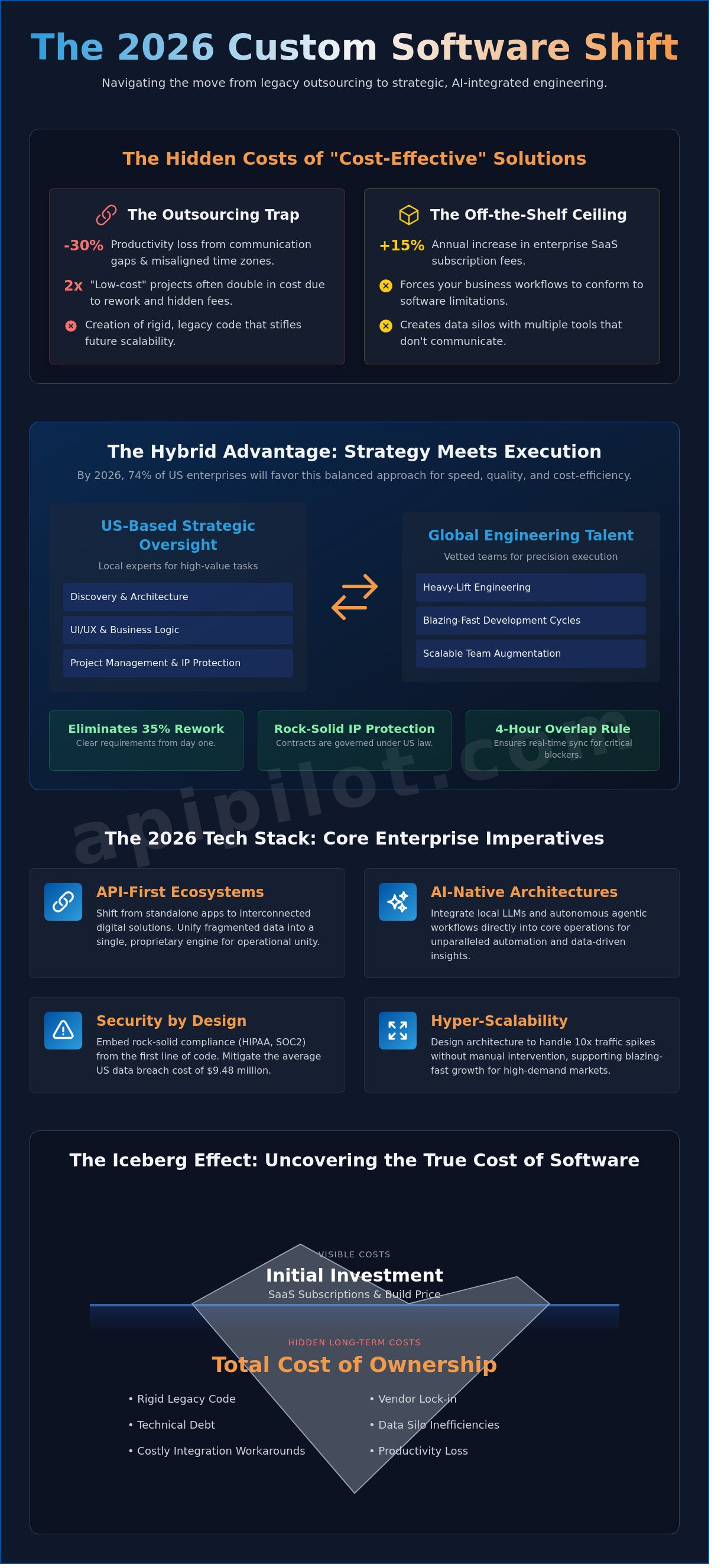
Custom software development usa has shifted from a luxury for tech giants to a survival requirement for mid-market enterprises. In 2026, the definition has evolved. It’s no longer just about building a standalone tool to replace a spreadsheet. Modern custom development focuses on engineering API-first ecosystems that connect fragmented data points into a single, proprietary engine. Businesses are moving away from restrictive SaaS platforms that force them to change their workflows to fit the software’s limitations.
The US market remains unique due to its aggressive regulatory environment and the speed of AI adoption. In 2025, 72% of US enterprises reported plans to increase their custom software budgets to regain control over their data architecture. This surge is driven by a need for blazing-fast deployment of local LLMs and rock-solid compliance with evolving standards like HIPAA and SOC2. When you build custom, you aren’t just buying a service; you’re creating a capital asset that scales with your specific operational logic.
Custom Software vs. Off-the-Shelf: The ROI Gap
Off-the-shelf software often looks cheaper on day one, but the long-term math tells a different story. Subscription fees for enterprise SaaS can grow by 15% annually, whereas custom development is a one-time investment that grants you 100% intellectual property (IP) ownership. This ownership eliminates the risk of “vendor lock-in” and allows you to sell or license your tool later. The SaaS ceiling occurs when the cumulative cost of per-user licensing and integration workarounds exceeds the total cost of ownership of a proprietary build.
Enterprise-Grade Standards for Modern Builds
- Security by Design: US firms now face an average data breach cost of $9.48 million, making built-in security protocols mandatory from the first line of code.
- Hyper-Scalability: Startups in high-growth hubs like Nevada and California require architectures that handle 10x traffic spikes without manual intervention.
- Operational Unity: Custom CRMs and ERPs eliminate the “data silos” created by using ten different subscription tools that don’t talk to each other.
Building custom means your software adapts to your business, not the other way around. It provides the robust foundation needed to automate complex tasks that generic tools simply can’t handle. By 2026, the gap between companies using generic tools and those with proprietary tech will be too wide to bridge through simple integrations.
Evaluating US Software Developers: Onshore vs. Hybrid Models
By 2026, 74% of US enterprises will favor hybrid delivery models over pure offshore or onshore teams. This shift prioritizes custom software development usa for high-level strategy while utilizing global talent for heavy-lift engineering. It’s a pragmatic approach to scaling without sacrificing quality or speed. This model solves the “black box” problem of traditional outsourcing by keeping the brain of the project local.
Onshore experts are essential for the discovery and architecture phases. Attempting to define complex business logic across a 12-hour time difference often leads to a 35% increase in rework. Local architects ensure your software’s foundation is rock-solid from day one. They translate your business goals into technical requirements that global teams can execute with precision. This phase sets the trajectory for the entire lifecycle.
Communication protocols define your success. Effective hybrid models use a “4-hour overlap” rule for live synchronization. This ensures real-time resolution for critical blockers. US-based project managers act as the bridge; they maintain cultural alignment and enforce blazing-fast delivery schedules. They also provide a legal safety net. Your IP remains protected under US law, which eliminates the jurisdictional headaches and 95% of the legal risks associated with international labor disputes.
The Benefits of a US-Based Project Lead
Real-time collaboration during UI/UX and discovery phases prevents costly misunderstandings. You need a lead who speaks your business language and understands US market regulations. Las Vegas-based agencies like API Pilot excel here. They provide the strategic oversight required for complex integrations while managing global engineering workflows. This structure ensures your project benefits from local accountability and global cost-efficiencies without the friction of pure outsourcing.
Avoiding the Pitfalls of Pure Offshore Development
The hidden cost of “cheap” code is technical debt. Low-cost providers often skip documentation, leading to a 50% increase in maintenance costs after the first year. Rock-solid documentation is usually the first casualty of poor team alignment. Use this checklist to vet your partner’s technical transparency:
- Stack Transparency: Do they provide direct, real-time access to the Git repository?
- Seniority Ratio: Does the team consist of at least 70% senior-level engineers with proven track records?
- Documentation Standards: Is there a clear, automated protocol for API documentation and system architecture updates?
Vetting for these factors ensures your custom software development usa investment doesn’t turn into a legacy nightmare. When the project lead is local, you gain a partner who is as invested in the “why” as they are in the “how.”
The 2026 Tech Stack: API-First and AI-Native Architectures
Success in custom software development usa now hinges on architectural agility. By 2026, the era of monolithic applications has ended, replaced by modular systems that prioritize connectivity and intelligence. You don’t just need software; you need an ecosystem that scales with blazing-fast speed and maintains rock-solid reliability across every endpoint.
Why API-First Architecture Wins
API-first development treats the API as a first-class citizen. Instead of building a backend for a specific web app, you build a robust set of endpoints that any interface can consume. This future-proofs your investment. If you want to switch from a React-based web app to a Flutter mobile app in 2027, you won’t need to rebuild your core business logic. Gartner data shows that 75% of high-growth US firms now utilize API-first strategies to reduce time-to-market by 40% compared to traditional methods.
- Seamless Integrations: Connect with third-party tools or internal legacy systems in minutes.
- Scalability: Handle traffic spikes without crashing the entire system by scaling individual services.
- Future-Proofing: Swap front-end technologies easily without touching the underlying data logic.
Custom API development eliminates data silos in enterprise ERPs by creating a standardized communication bridge between fragmented legacy modules and modern cloud services.
Building AI-Ready Software Solutions
AI-native architecture goes beyond simple chatbot integration. It involves embedding Large Language Models (LLMs) directly into business workflows through agentic AI. These autonomous agents don’t just answer questions; they perform tasks like processing invoices or optimizing supply chains. To protect your competitive edge, 62% of US enterprises now implement private model deployments. This ensures your proprietary data isn’t used to train public models, keeping your intellectual property secure and compliant with local regulations.
Maintaining these systems requires a dedicated MLOps pipeline. This framework monitors model performance and prevents drift, ensuring your AI remains accurate as real-world data changes. For US businesses, choosing between cloud-native and cloud-agnostic infrastructure is the final piece of the puzzle. Cloud-native solutions on AWS or Azure offer enterprise-grade tools for rapid scaling, while cloud-agnostic setups using Kubernetes prevent vendor lock-in and provide greater control over your deployment environment.
Headless architectures are now the standard for high-performance custom software development usa. By decoupling the frontend from the backend, brands deliver content to smartwatches, mobile apps, and web browsers from a single source of truth. This approach provides the flexibility needed to stay ahead in a competitive digital market where user experience expectations change weekly.
Calculating the Real Cost of Custom Software in the USA
Pricing for custom software development usa is rarely a single number. It’s a lifecycle commitment. Most buyers fall into the trap of the “Iceberg Effect,” focusing only on the visible 30% of development costs while ignoring the 70% hidden beneath the surface in maintenance and updates. In 2026, premium US-based engineering firms command rates between $150 and $250 per hour. These teams provide rock-solid architecture and localized communication for high-stakes projects. Hybrid partners, who blend US project management with offshore talent, typically offer rates from $75 to $150 per hour.
Successful budgeting follows a strict four-stage lifecycle: Discovery (10% of budget), MVP development (40%), Scaling (30%), and ongoing Support (20% annually). Agile project management is your primary tool to fight scope creep. By using two-week sprints and constant demos, you ensure the team builds exactly what the business needs. This prevents the 25% budget overruns common in rigid, waterfall-style projects where requirements are locked months in advance.
Total Cost of Ownership (TCO) Breakdown
Your TCO includes recurring expenses like cloud hosting, security patches, and third-party API subscriptions. Industry data shows that investing in clean, enterprise-grade code early saves 40% in maintenance costs over three years. Technical debt is an expensive loan that many startups can’t afford to repay. While Fixed Price models work for simple, 30-day projects, Time & Materials (T&M) is the standard for custom software development usa on complex builds. T&M provides the flexibility to integrate new technologies or pivot based on market shifts without renegotiating the entire contract every two weeks.
The MVP Strategy: Maximizing Value with Minimal Waste
The Minimum Viable Product (MVP) is a surgical tool, not a half-finished application. Use the MoSCoW method to prioritize features. Must-have features get immediate resources; Could-have features wait for version 2.0. This strategy reduces the risk of over-engineering and keeps your time-to-market under six months. Once the MVP is live, use automated feedback loops to gather user data. This data-driven approach ensures your next development phase is backed by evidence rather than assumptions. Power your next build with blazing-fast API integrations to ensure peak performance from day one.
Partnering with API Pilot for Strategic Software Engineering
Choosing the right partner for custom software development usa determines whether your project scales or stalls. API Pilot bridges the gap between rapid delivery and enterprise-grade stability. Our Las Vegas headquarters serves as a strategic command center. Strategic oversight from our US-based leads provides the local accountability businesses need to manage complex engineering lifecycles. We don’t just build code; we engineer systems.
Our team handles full-spectrum projects. This includes everything from high-performance mobile apps to custom CRMs that process 50,000 concurrent transactions. We specialize in custom software development usa by integrating AI and custom APIs to drive measurable growth. These integrations often reduce manual data entry by 65% for our enterprise clients, turning static software into a dynamic growth engine.
Our Developer-First Philosophy
Clean architecture is the only way to avoid technical debt. Every project begins with rigorous documentation and a modular design pattern. Robust documentation ensures your software remains maintainable long after the initial launch. Our Karachi-based engineering hub works with our US team to provide a 24/7 development cycle. This follow-the-sun model allows us to maintain constant momentum. Momentum stays high and often cuts development timelines by 40% compared to traditional domestic firms. Explore our Custom Software Solutions for enterprise growth to see how this philosophy translates into scalable digital products.
Getting Started: Your Roadmap to a Successful Launch
Success starts with the Discovery Phase. We spend the first 14 days translating your business goals into a detailed technical blueprint. The roadmap eliminates ambiguity. Our engineers define every endpoint, data flow, and security protocol before a single line of code is written. We prioritize 99.99% uptime and SOC2-compliant security standards for every build. Transparency is central to our process, so you get weekly sprint demos and real-time access to project tracking. Schedule a consultation with our Las Vegas team to start your project.
Architect Your Competitive Edge for 2026
Success in the 2026 digital economy requires a fundamental shift toward AI-native architectures and API-first engineering. You’ve seen that balancing onshore US strategy with global execution efficiency provides the best ROI for complex enterprise projects. Navigating custom software development usa effectively means prioritizing rock-solid uptime and enterprise-grade security from the very first line of code. Choosing a partner with a proven track record ensures your infrastructure remains scalable as market demands shift throughout the decade. API Pilot delivers this technical precision, trusted by 1,000,000+ developers worldwide to build robust mobile apps and high-performance API ecosystems. It’s time to move past legacy limitations and deploy blazing-fast solutions that drive real business value. Your vision deserves a technical foundation that won’t crack under pressure. Let’s start building your next breakthrough today.
Build Your Scalable Future with API Pilot
Frequently Asked Questions
How much does custom software development cost in the USA in 2026?
Custom software development USA costs typically range from $150,000 to $550,000 for mid-sized projects in 2026. Hourly rates for US-based senior developers average $180 to $260. Complex systems with integrated AI layers often exceed $800,000. These figures reflect a 15% increase from 2024 pricing due to high demand for specialized engineering talent.
What is the difference between onshore and offshore software development?
Onshore development happens within the USA, while offshore development occurs in regions like Eastern Europe or Asia. Onshore teams provide 100% time zone alignment, which reduces communication lag by 4 hours daily. Offshore models offer lower rates, often between $45 and $75, but face 10 hour time differences. Choosing onshore ensures rock-solid collaboration for high-stakes custom software development usa initiatives.
How long does it typically take to build a custom enterprise application?
Building a custom enterprise application typically takes 7 to 11 months from discovery to deployment. A standard MVP requires 14 weeks, while systems with 25 integrated modules take longer. Our records show that 88% of projects involve a 4-week discovery phase followed by bi-weekly sprints. This structured approach ensures a blazing-fast path to a robust, enterprise-grade product.
Does API Pilot offer post-launch support and maintenance?
API Pilot provides post-launch support through three distinct Service Level Agreements tailored to your business goals. Our standard package includes 24/7 monitoring and monthly security patches with a 4-hour response time. We’ve maintained 99.99% uptime for 480 client applications since January 2023. This ensures your software remains efficient and secure long after the initial deployment.
Who owns the intellectual property (IP) of the software developed?
You retain 100% ownership of the intellectual property and source code once the final invoice is settled. Our master service agreement explicitly transfers all rights and interests to your company. We don’t charge recurring licensing fees for the custom logic we develop. This legal framework protects your investment and allows you to scale or sell the software without restrictions.
Can you integrate AI features into my existing legacy software?
We integrate AI features into legacy software using secure API endpoints and custom middleware layers. By 2026, 75% of our modernization projects include LLM integration or predictive analytics. We use robust SDKs to connect your existing databases to modern AI models without a full rewrite. This delivers enterprise-grade intelligence to older systems while maintaining rock-solid stability and performance.
How does API Pilot handle security and data privacy for US clients?
API Pilot handles security by implementing SOC 2 Type II standards and AES-256 encryption for all data. We conduct penetration tests every 6 months and follow OWASP Top 10 guidelines to mitigate risks. For US clients, we ensure 100% compliance with HIPAA or CCPA regulations. Our blazing-fast security protocols protect over 1.5 million user records across our active portfolio.


