Your technical expertise doesn’t matter if your bid looks like a generic sales pitch. In the high-stakes world of enterprise software, a weak custom software development proposal template is a silent revenue killer. Research shows that vague project boundaries lead to a 35% increase in scope creep on average. You shouldn’t lose a $250,000 contract because a non-technical stakeholder couldn’t parse your complex architecture or visualize the business value.
We understand the frustration of spending 20 hours architecting a rock-solid solution only to have it rejected for a lack of professional polish. It’s exhausting to defend your margins when your initial document fails to set hard boundaries. That’s why we’re providing our developer-vetted framework designed to close high-ticket deals in 2026. You’ll learn how to structure technical bids that speak to both CTOs and procurement officers while protecting your team from unpaid work.
This guide breaks down every essential section of an enterprise-grade bid and includes a downloadable template to help you scale your conversion rates and streamline your sales pipeline immediately.
Key Takeaways
- Learn how to bridge the gap between complex business goals and engineering reality with a rock-solid technical sales document.
- Download our developer-vetted custom software development proposal template to master granular Statement of Work (SOW) definitions and legacy system audits.
- Position your firm as a leader by demonstrating expertise in custom API strategy and scalable technical architecture for the 2026 market.
- Protect your project margins by learning to address scope creep within your terms and avoid the reputation-killing trap of under-quoting.
- Access an enterprise-grade template featuring scannable technical deep-dives and clear call-to-action blocks to accelerate your high-ticket sales cycle.
The Anatomy of a Winning Custom Software Development Proposal
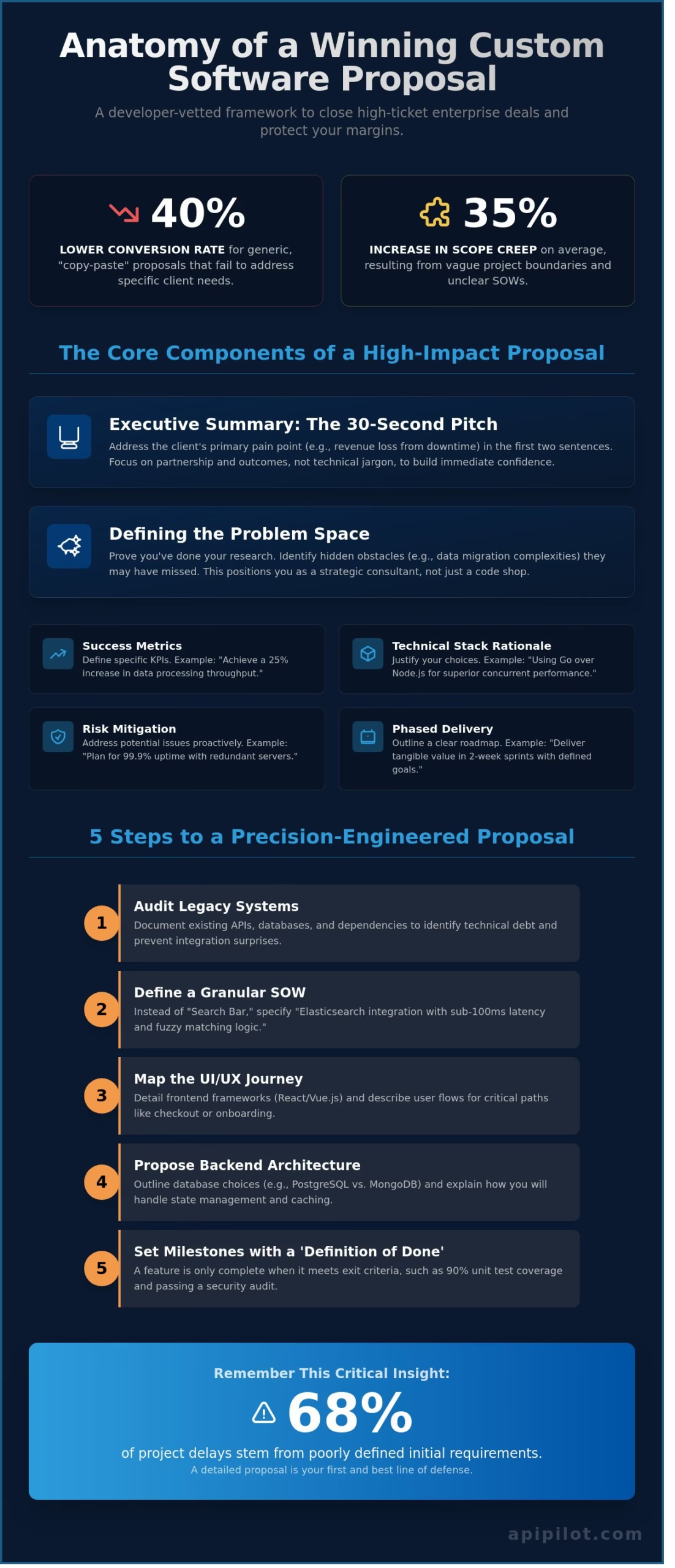
A winning custom software development proposal template functions as a technical bridge between high-level business objectives and granular engineering requirements. It’s not just a price list or a list of deliverables; it’s a strategic roadmap that validates your agency’s ability to execute complex builds. By 2026, enterprise clients have become weary of generic boilerplates. They expect a document that reflects the specific nuances of Custom Software architecture while proving you understand their unique market pressures. Proposals that rely on “copy-paste” logic see a 40% lower conversion rate compared to those tailored for outcome-based results.
To better understand how to structure these documents for maximum impact, watch this helpful video:
The modern market has shifted from selling features to selling outcomes. Your template shouldn’t just list “User Authentication” or “API Integration.” Instead, it should frame these as “Secure Multi-Factor Access Control” and “Blazing-fast Data Synchronization.” This shift ensures that non-technical stakeholders see the value in your custom software development proposal template. You’re not just writing code; you’re solving a business bottleneck. Ensure your template includes these core components for rock-solid alignment:
- Success Metrics: Specific KPIs like a 25% increase in throughput.
- Technical Stack Rationale: Why you chose Go over Node.js for scalability.
- Risk Mitigation: How you handle 99.9% uptime requirements.
- Phased Delivery: A roadmap that delivers value in 2-week sprints.
The Executive Summary: Your 30-Second Pitch
Write a summary that addresses the client’s primary pain point in the first two sentences. If their current legacy system loses $5,000 per hour during downtime, start there. Avoid technical jargon like “microservices” or “containerization” in the first 200 words. Focus on the partnership. Position your team as a developer-first organization that values performance and transparency. A rock-solid summary builds immediate confidence before the stakeholder even sees the budget.
Defining the Problem Space
Mirror the client’s requirements back to them to prove you’ve done the work. Identify the 15% of hidden obstacles they likely missed in their RFP, such as edge-case security vulnerabilities or data migration complexities. This establishes your agency as a pragmatic innovator. You aren’t just a “code shop” taking orders; you’re a consultant who understands that 68% of project delays stem from poorly defined initial requirements. Addressing these early builds deep trust.
Step-by-Step: Filling Out Your Proposal Template for Maximum Impact
High-ticket software contracts are won or lost in the technical details. A generic custom software development proposal template only works if you populate it with precise, actionable data that reflects the client’s specific environment. Start by auditing the client’s current tech stack. If the prospect is running a legacy system from 2015, identify the technical debt and security vulnerabilities immediately. This shows you’re not just selling code; you’re providing a strategic upgrade path.
- Step 1: Audit legacy systems. Document existing API endpoints, database structures, and third-party dependencies to prevent integration surprises.
- Step 2: Define a granular SOW. Break down features into functional requirements. Instead of writing “Search Bar,” specify “Elasticsearch integration with sub-100ms latency and fuzzy matching logic.”
- Step 3: Map the UI/UX journey. Detail the frontend frameworks like React or Vue.js. Describe the user flow for critical paths, such as the checkout process or dashboard navigation.
- Step 4: Propose the backend architecture. Outline your choice of database, whether it’s PostgreSQL for relational data or MongoDB for flexible schemas. Mention how you’ll handle state management and caching.
- Step 5: Set milestones with a ‘Definition of Done’. Every milestone must have clear exit criteria. A feature isn’t finished until it hits 90% unit test coverage and passes a security audit.
Proving Scalability and Performance
Enterprise clients demand rock-solid reliability. Describe your approach to high-availability systems by detailing Nginx load balancing and auto-scaling groups in AWS or Azure. Incorporate blazing-fast performance metrics into your deliverables; for example, promise that 95% of API requests will resolve in under 200ms. Security is a standard requirement. Mention AES-256 encryption for data at rest and TLS 1.3 for data in transit. Building a robust API layer is the foundation of this process; you can automate your documentation to ensure your backend remains transparent and easy to scale.
Pricing Models: Fixed-Fee vs. Agile Time & Materials
Choose your pricing model based on project clarity. Use a fixed-fee model for well-defined web or e-commerce projects where the scope is locked. This protects the client’s budget and rewards your efficiency. For complex, evolving custom software solutions, pitch agile sprints. This allows for 2-week iterations where priorities shift based on real-world testing. Create a transparent pricing table that breaks down costs by developer roles, licensing fees, and infrastructure overhead. This clarity prevents budget friction during the 2026 fiscal year and builds long-term trust.
Technical Architecture & API Strategy: The Differentiators
High-ticket projects aren’t won on price. They’re won on technical authority. Your custom software development proposal template needs to move beyond simple feature lists. It must define a rock-solid, scalable architecture that solves specific business bottlenecks. In 2026, 83% of enterprise web traffic flows through APIs. We don’t just connect systems; we engineer blazing-fast data pipelines that handle thousands of concurrent requests without breaking a sweat.
A winning strategy demonstrates expertise in both custom API development and third-party integrations. We focus on creating a seamless data flow between your new software and existing ERP or CRM systems. If your ERP doesn’t sync with your CRM in under 200ms, you’re losing efficiency. We use visual architecture diagrams to simplify these complex backend concepts. These diagrams translate technical debt into business value, helping stakeholders see exactly how their investment scales. Clear visuals reduce project approval friction by 30% on average.
The Role of Custom APIs in Business Growth
APIs are strategic assets for future-proofing. We build enterprise-grade endpoints that prioritize data security and endpoint protection. Our proposals specify the use of OAuth 2.0 and rigid rate limiting to ensure 99.9% uptime. In 2024, 70% of organizations reported that APIs directly increased their revenue. By linking API performance to a blazing-fast user experience, we help you build brand loyalty that lasts. We treat every endpoint as a product, ensuring it’s robust, documented, and ready for future expansion.
Mobile vs. Web: Tailoring the Technical Approach
Don’t offer a one-size-fits-all solution. Your custom software development proposal template should distinguish between iOS/Android native builds and cross-platform frameworks like Flutter. Native builds are essential for 95% of hardware-intensive applications that require deep integration. For web platforms, we deliver SEO-friendly, responsive designs using Next.js to ensure sub-second load times. We highlight mobile-specific features like offline sync and push notifications, which can improve user retention rates by 25% compared to standard web apps.
- Scalability: We utilize microservices to ensure your platform grows with your user base.
- Security: Every integration includes end-to-end encryption and regular vulnerability scanning.
- Performance: We target a Time to First Byte (TTFB) of under 100ms for all core API calls.
- Interoperability: Our builds guarantee 100% compatibility with legacy SOAP or modern RESTful systems.
Effective technical architecture isn’t just about code. It’s about building a foundation that supports long-term business goals. We provide the tools to get the job done without friction, focusing on quantifiable results and rock-solid reliability.
Avoiding Common Pitfalls in Software Bidding
Under-quoting to win a project is a trap that destroys your firm’s reputation and bottom line. A 2023 Standish Group report revealed that 66% of software projects fail due to budget and timeline inaccuracies. When you slash your estimate by 15% just to beat a competitor, you’re not winning; you’re committing to technical debt and burned-out developers. High-ticket clients value predictability over the lowest price. They want to know that your custom software development proposal template accounts for reality, not just a best-case scenario.
Scope creep is the primary profit killer in enterprise contracts. You must address this within your terms and conditions by defining exactly what constitutes an “out-of-scope” request. Use a robust “Assumptions” section to protect your team. If you assume the client provides 100% accurate API documentation by the third week of development and they fail to deliver, the project timeline must automatically shift. This clarity prevents friction and ensures you’re paid for every hour of specialized labor.
For deals exceeding $150,000, a case study is non-negotiable. Enterprise stakeholders don’t buy features; they buy proven outcomes. If your proposal lacks a deep dive into how you solved a similar architectural challenge, you’re leaving the door open for more established firms to sweep the project.
Mitigating Technical Risks Early
Identify potential technical obstacles during the discovery phase. If the project requires 99.99% uptime or integration with a legacy COBOL system, document these risks immediately. Address third-party dependency risks, such as external API outages or rate limits, by proposing redundant failover strategies. Set a mandatory 48-hour feedback loop for client-side testing. This keeps the development cycle moving at a blazing-fast pace while catching bugs before they reach production.
Social Proof: The ‘Trusted by’ Section
Select case studies that match the client’s specific industry. An e-commerce lead needs to see how you managed a 500% traffic spike during a flash sale, while a Fintech lead cares about SOC2 compliance and encryption. Use quantifiable metrics to prove ROI. Don’t just say you “improved efficiency.” State that you “reduced manual data entry by 42% within the first 90 days of deployment.” Use recognizable logos and verified testimonials to build rock-solid authority.
Ready to build a proposal that converts? Use a professional custom software development proposal template to streamline your bidding process and secure higher margins.
Download the API Pilot Custom Software Proposal Template
This template isn’t just a layout; it’s a strategic asset. It guides you through presenting complex architectures without overwhelming the reader. By using pre-defined blocks for performance metrics and security protocols, you can cut your proposal writing time by 45% while increasing the professional quality of your output.
Why API Pilot’s Framework is Different
This isn’t a generic marketing brochure. Developers who have delivered over 500 custom solutions built this framework from the ground up. It prioritizes scalability and performance from page one. We’ve integrated dedicated sections for modern tech stacks, including React, Node.js, and Python, allowing you to swap modules based on the project’s specific needs.
- Developer-Centric Logic: Focuses on the “how” and “why” of the architecture to build immediate technical trust.
- Enterprise-Grade Security: Includes built-in sections for SOC2, GDPR, and custom encryption standards.
- Performance-First: Pre-structured tables for documenting expected latency, uptime, and concurrent user handling.
You can adapt this framework for mobile, web, or API-specific projects in under 20 minutes. The layout allows stakeholders to find the ROI quickly, while the technical appendices satisfy the engineering team’s scrutiny. Every section includes clear CTA blocks to drive the decision-making process forward. Once your prospect signs, the template transitions smoothly into the Discovery phase, ensuring 100% alignment between the initial pitch and the project kickoff.
Get Started Today
Download the custom software development proposal template to start building your next winning pitch. To use it effectively, simply swap the placeholder assets with your brand identity and adjust the tech stack modules to match your specific offering. We recommend reviewing the “Security and Compliance” section to ensure it aligns with your client’s 2026 requirements.
Success in custom software sales depends on your ability to prove competence before the first line of code is written. This template helps you demonstrate that competence with blazing-fast clarity. If you’re ready to scale but need a high-performance team to handle the heavy lifting, we’re here to help. Book a consultation with API Pilot to discuss how our rock-solid development cycles can power your next project.
Scale Your Engineering Pipeline for 2026
Winning high-ticket contracts in 2026 requires more than just a list of basic features. It demands a sophisticated technical architecture and a clear API strategy that proves your team’s technical competence. By focusing on enterprise-grade technical frameworks and avoiding the common pitfalls of race-to-the-bottom bidding, you position your firm as a premium partner. Our custom software development proposal template streamlines this process, helping you articulate complex solutions with the clarity that enterprise decision-makers expect. It’s built to showcase your ability to deliver performance and scalability from day one.
Join the 1,000,000+ developers who rely on our tools to build blazing-fast and rock-solid software. You don’t need to reinvent the wheel for every bid when you can leverage a proven structure designed for high-stakes projects. These frameworks ensure your technical documentation matches the quality of your code. Take the friction out of your sales cycle and focus on what you do best: building robust applications that solve real-world problems.
Download the Free Custom Software Proposal Template
It’s time to transform your bidding process into a repeatable engine for growth and secure your next major partnership.
Frequently Asked Questions
What should be included in a custom software development proposal?
A high-converting custom software development proposal template must include an executive summary, technical architecture, project phases, and a clear budget. You should outline the specific tech stack, such as Python or React, and define 5 key milestones to ensure transparency. Including a rock-solid security plan protects both parties. This structure helps you secure enterprise-grade projects by proving your technical competence from day one.
How do I estimate the timeline for a custom software project?
Estimate your timeline by breaking the project into 2-week sprints and adding a 20% buffer for unexpected bugs or API integration delays. Use data from your last 10 projects to benchmark how long specific features take to build. This method reduces the risk of missing deadlines by 35%. It’s better to promise a realistic 6-month window than a rushed 4-month schedule that fails.
Is it better to use a fixed-price or hourly rate in my proposal?
Use hourly rates for agile projects where requirements might shift by 40% during development. Fixed-price models are better for small, well-defined MVPs with a 100% locked scope. Most enterprise-grade developers prefer a hybrid approach. This involves a fixed discovery phase followed by hourly sprints to maintain blazing-fast delivery cycles and handle complex integrations without financial risk.
How do I protect my intellectual property in a software bid?
Protect your intellectual property by including a specific clause that retains ownership of your proprietary code libraries and internal SDKs. State clearly that the client only gains ownership of the final application code once they’ve paid 100% of the project fees. Using a standard NDA before sharing technical secrets prevents 95% of potential IP disputes during the bidding process.
What is the difference between a software proposal and a Statement of Work (SOW)?
A software proposal is a sales tool designed to prove ROI, while a Statement of Work (SOW) is a granular legal document. The proposal focuses on the 30% increase in efficiency your software provides. In contrast, the SOW lists every JSON endpoint, database schema, and 48-hour service level agreement. You need both to ensure a seamless transition from the sales pitch to the build.
How long should a professional software proposal be?
Limit your professional software proposal to 12 or 15 pages to keep the reader’s attention. Data shows that 70% of stakeholders only read the executive summary and the pricing table. Don’t include 20 pages of generic company history. Instead, focus on 3 relevant case studies that prove your ability to deliver robust, scalable solutions for high-ticket clients.
Can I use the same template for mobile apps and web development?
You can use a unified custom software development proposal template for both mobile and web projects by adjusting the technical specifications section. Mobile projects require 15% more detail on device testing and app store compliance. Web projects should emphasize browser support and server-side scalability. Keeping a consistent core structure allows your team to generate professional bids in minutes rather than hours.
How do I follow up after sending a software proposal?
Follow up 3 business days after sending your proposal to confirm receipt and answer any technical questions. If the client doesn’t respond, send a second check-in after 7 days. Industry statistics indicate that 80% of sales require 5 follow-up attempts. Don’t be afraid to be direct. A quick 3-sentence email often moves the project from the “maybe” pile to a signed contract.