For a CTO, few decisions carry as much weight as the one at the center of this build vs buy software decision guide. Choosing between a custom-built solution and an off-the-shelf product is a high-stakes crossroads where the wrong turn leads to budget overruns, resource drains, and strategic misalignment. The pressure often results in analysis paralysis, fueled by the fear of hidden costs and complex, long-term consequences.
The path forward requires more than a gut feeling; it demands a robust, data-driven framework. This guide provides exactly that. We move beyond a simple list of pros and cons to deliver a pragmatic, step-by-step process designed to help you evaluate your unique business needs, technical requirements, and strategic roadmap.
Follow this framework to eliminate the uncertainty. You will gain the clarity needed to make a strategically sound choice, build a rock-solid business case for stakeholders, and confidently navigate the complexities of either path while avoiding common, expensive pitfalls.
The Build vs. Buy Decision: Why It’s More Critical Than Ever
For modern tech leaders, the build vs. buy software decision is a fundamental crossroads. This choice dictates far more than just implementation; it shapes your budget, dictates your product timeline, and can ultimately define your competitive advantage. Every new project or system requirement forces a re-evaluation of this critical dilemma.
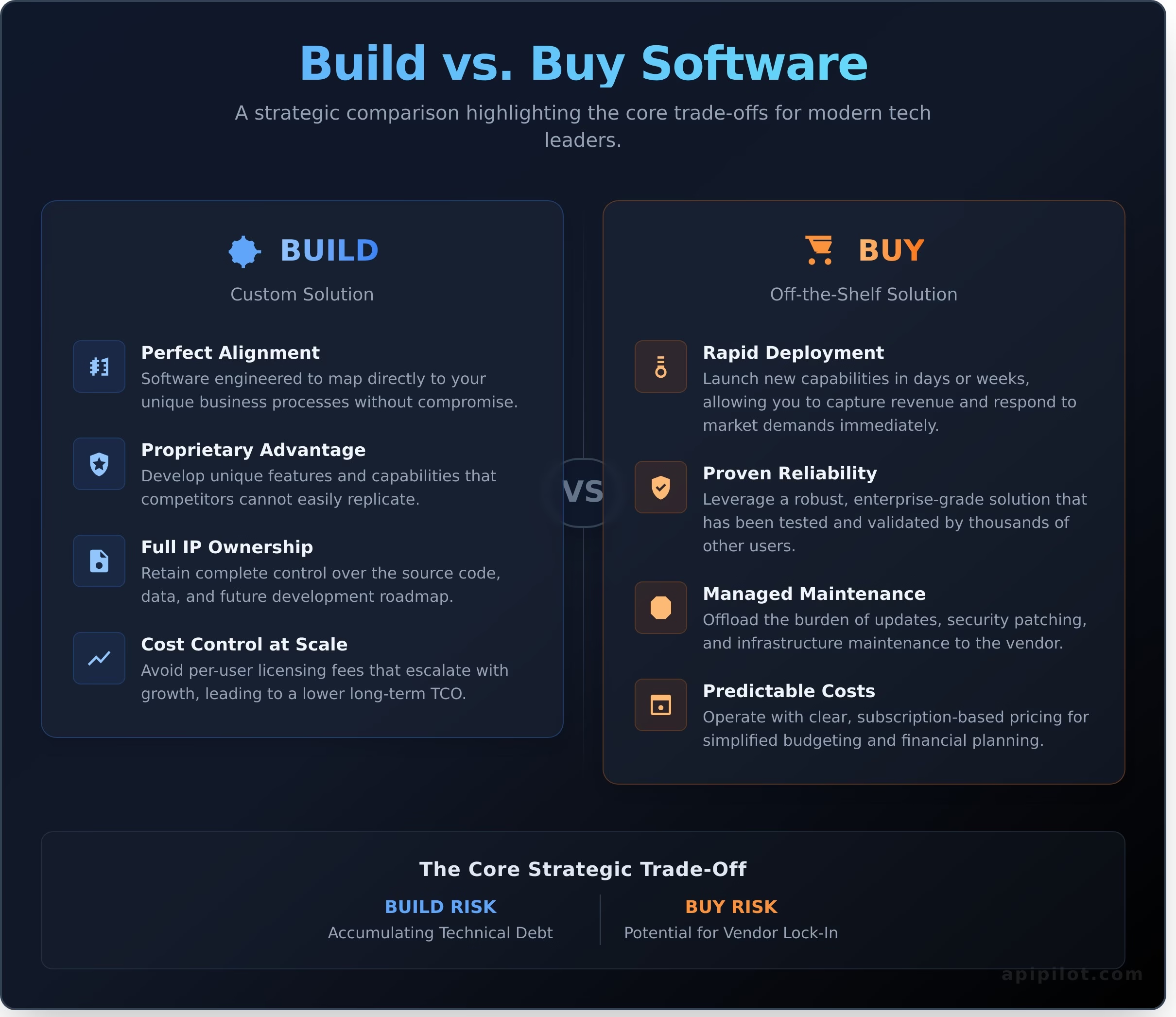
To frame this strategic choice, the following overview provides a high-level perspective:
Navigating this choice in an era of rapidly growing SaaS options and increasing software complexity requires a robust framework. The decision boils down to a strategic trade-off: the risk of accumulating technical debt with a custom solution versus the potential for vendor lock-in with an off-the-shelf product. This build vs buy software decision guide is designed to provide the clarity needed to make a pragmatic, efficient choice for your organization.
The Case for Building: Ultimate Control and Competitive Edge
Opting to build is a commitment to creating a perfectly tailored asset. While it requires a significant investment in development resources and a deep commitment to understanding the software build process, the strategic payoffs can be immense.
- Perfect Alignment: Engineer software that maps directly to your unique business processes and workflows without compromise.
- Proprietary Advantage: Develop features and capabilities that competitors cannot replicate, creating a durable market differentiator.
- Full IP Ownership: Retain complete control over the intellectual property, source code, and future development roadmap.
- Cost Control at Scale: Avoid per-user licensing fees that escalate with growth, leading to a lower total cost of ownership over time.
The Case for Buying: Speed, Reliability, and Lower Upfront Cost
Purchasing a ready-made solution, typically a SaaS product, prioritizes speed-to-market and operational efficiency. It allows you to leverage external expertise and focus internal resources on your core business.
- Rapid Deployment: Launch new capabilities in days or weeks, not the months or years required for ground-up development.
- Proven Reliability: Leverage a robust, enterprise-grade solution that has been tested and validated by thousands of other users.
- Managed Maintenance: Offload the burden of updates, security patching, and infrastructure maintenance to the vendor.
- Predictable Costs: Operate with clear, subscription-based pricing for simplified budgeting and financial planning.
A 5-Factor Framework for Your Build vs. Buy Analysis
Making the right software choice requires a structured, data-driven approach, not a gut feeling. Emotional bias toward building a “perfect” custom solution or the allure of a ready-made tool can lead to costly mistakes. This framework provides a defensible rationale for your choice by evaluating the five critical factors that determine success. Use this as a practical build vs buy software decision guide to ensure your decision aligns with your strategic, financial, and operational goals.
Factor 1: Strategic Importance & Competitive Advantage
Start by evaluating how the software fits into your core business. If a function is a commodity—like payroll or CRM—buying is almost always the efficient choice. However, if the software is a core part of your value proposition and directly impacts customer experience, building a custom solution can create a powerful, defensible market differentiator that competitors cannot replicate.
Factor 2: Total Cost of Ownership (TCO)
Look beyond the initial price tag and project the TCO over a 3-5 year period. A comprehensive analysis includes often-overlooked expenses. A true financial comparison requires mapping out all potential costs for both paths.
- Build Costs: Include developer salaries, project management, infrastructure (servers, hosting), security compliance, and, crucially, ongoing maintenance, bug fixes, and future updates.
- Buy Costs: Factor in subscription or licensing fees (per-seat or usage-based), initial setup and integration costs, data migration, employee training, and any fees for essential customizations or premium support.
Factor 3: Speed to Market & Opportunity Cost
Time is a critical, non-renewable resource. How quickly does your business need this capability? An off-the-shelf solution can often be implemented in days or weeks, allowing you to capture revenue and respond to market demands immediately. Building can take months or even years, creating an opportunity cost where competitors can gain ground while you are still in development.
Factor 4: In-House Resources & Expertise
An honest assessment of your team’s capabilities is essential. Do you have developers with the required expertise and, just as importantly, the bandwidth to take on a major new project without derailing other critical initiatives? Building may require hiring new talent or diverting your best engineers from revenue-generating work. If your internal team is stretched thin, partnering with a development agency or choosing a robust off-the-shelf solution is the pragmatic path. Assess your project with our expert team.
Uncovering the Hidden Costs: What Standard Analyses Miss
A surface-level analysis of building vs. buying software often stops at the initial development estimate versus the subscription fee. This is a critical mistake. An accurate build vs buy software decision guide must go deeper to calculate the true Total Cost of Ownership (TCO), accounting for persistent operational drains that don’t appear on an invoice. These hidden costs are frequently the deciding factor that tips the scales in a close decision.
The Hidden Costs of Building Software
Opting to build custom software means committing to a full product lifecycle, not just a one-time project. The initial build is often just the opening act of your financial commitment. The real, recurring costs emerge over time as you become responsible for every aspect of the software’s existence, from uptime to security.
- Ongoing Maintenance: This extends far beyond simple bug fixes. It’s a continuous, resource-intensive cycle of security patching, dependency updates to prevent vulnerabilities, and refactoring code to adapt to new OS versions or industry compliance standards.
- Talent Recruitment & Retention: Sourcing, hiring, and retaining specialized engineers in a competitive market is a significant, ongoing expense. This cost includes high salaries and benefits, plus the invaluable time your existing team spends on interviewing and onboarding.
- Infrastructure & DevOps Overhead: You own the entire stack and its associated costs. This includes cloud server fees, CI/CD pipeline maintenance, robust monitoring and alerting systems, and the dedicated DevOps personnel required to keep it all running 24/7.
- Opportunity Cost: This is the most critical, yet most overlooked, cost. Every engineering hour spent maintaining an internal tool is an hour not spent innovating on your core, revenue-generating products.
The Hidden Costs of Buying Software
Similarly, choosing a commercial off-the-shelf (COTS) solution is not a simple transaction; it’s an integration project with its own set of long-term financial implications. The sticker price is rarely the final price you’ll pay to make the software truly functional within your unique ecosystem.
- Integration Costs: The new tool must communicate seamlessly with your existing tech stack. This requires significant developer hours to build, test, and maintain API connections, data syncs, and authentication workflows.
- Customization Gaps & Workarounds: No SaaS product is a perfect fit. When you inevitably hit the limits of its customization, your teams are forced into inefficient manual processes and clunky workarounds, creating a hidden productivity tax across the organization.
- Data Migration & Vendor Lock-in: Moving your business-critical data into a new system takes time and technical expertise. Moving it out years later can be exponentially more difficult and costly, creating a powerful vendor lock-in effect that reduces future flexibility.
- Unpredictable Scaling Costs: Many SaaS platforms use per-user or usage-based pricing. As your company grows, this seemingly low monthly fee can quickly spiral into a major, unpredictable operational expense that erodes your initial ROI.
When to Build: Scenarios Where Custom Software Wins
While off-the-shelf solutions offer speed, the decision to build is a strategic investment in long-term competitive advantage. It’s about owning your core technology and future-proofing your operations. Certain scenarios provide clear signals that a custom-built solution is not just an option, but a necessity. Understanding these signals is a critical part of any effective build vs buy software decision guide. This is where building moves from a cost center to a powerful revenue driver, and where a dedicated development partner like API Pilot delivers exceptional value.
Your Core Business Logic is Unique
When your software is your business—your ‘secret sauce’—an off-the-shelf tool will always fall short. If your operations rely on a proprietary workflow, a custom logistics optimization algorithm, or a unique fintech platform, you cannot replicate that value with a generic SaaS product. Building ensures your technology perfectly mirrors and enhances the unique processes that differentiate you from the competition.
You Need Deep, Complex Integrations
Enterprise ecosystems are rarely simple. If your new solution must communicate flawlessly with multiple legacy systems, custom databases, or a web of internal APIs, standard integrations won’t suffice. They are often too shallow, failing to provide the robust, real-time data flow required. A custom build allows you to architect powerful, seamless integrations that unify your entire tech stack, eliminating data silos and automating critical workflows.
Long-Term Scalability and Control are Paramount
If you anticipate massive growth, you cannot afford to be limited by a third-party vendor’s roadmap or architectural constraints. Building your own software gives you absolute control over:
- The Tech Stack: Choose technologies optimized for performance and your team’s expertise.
- Architecture: Design a rock-solid foundation built for enterprise-grade scalability and data volume.
- The Roadmap: Pivot and add features on your own timeline, not a vendor’s.
This autonomy is crucial for scaling efficiently without hitting a technical ceiling. Ready to build your competitive advantage? Talk to us.
When to Buy: Leveraging Off-the-Shelf Solutions Smartly
Making the right call in the build vs. buy software decision guide isn’t about technical capability; it’s about strategic resource allocation. A “buy” decision is often the most efficient path, freeing up your most valuable assets—your engineering talent and capital—to focus on what truly differentiates your business. Don’t fall into the trap of building what you can buy. Instead, leverage robust, market-tested solutions to accelerate your roadmap and concentrate your firepower on your core mission.
The Function is a Solved Problem or Commodity
If the software you need handles a common business function, the problem has already been solved—likely thousands of times over. Think about core operational needs:
- Customer Relationship Management (CRM)
- Human Resources and Payroll Systems
- Accounting and Financial Software
Mature, enterprise-grade solutions for these areas are abundant. Building your own offers no competitive advantage and needlessly consumes development cycles that could be spent on your unique value proposition.
This principle extends to highly specialized and complex domains like the Internet of Things (IoT). Rather than building a data and device management platform from the ground up, a company can leverage an end-to-end solution; for a powerful example, check out Pallax.
Your Budget and Timeline are Severely Constrained
Custom software development is a capital-intensive and time-consuming process. When you need a functional solution immediately and lack the upfront budget for a full development team, buying is the only pragmatic choice. Off-the-shelf software provides immediate access to functionality, predictable subscription costs, and eliminates the risk of project delays. It’s the fastest way to get a tool into the hands of your team and start generating value.
The Solution is for a Non-Core, Internal Process
Not every piece of software needs to be a groundbreaking innovation. For internal support tools—like project management boards, team communication platforms, or documentation wikis—the standard is “good enough.” The goal is to enhance productivity, not to build a new product. Opting for a proven SaaS tool in this scenario is a smart, efficient decision that keeps your engineering team focused on revenue-generating, customer-facing features.
Ultimately, this build vs buy software decision guide highlights that choosing to buy is a powerful strategic move. It allows you to stand on the shoulders of giants, integrating powerful, pre-built functionalities so you can scale faster. When connecting these disparate systems, a robust API integration platform like apipilot.com can provide the seamless connectivity required to make your software stack truly powerful.
Your Strategic Decision: Build or Buy?
The choice between building and buying software is a pivotal moment for any CTO. As we’ve explored, the optimal path isn’t found in initial price tags but in a deep analysis of total cost of ownership, strategic alignment, and long-term scalability. The most effective leaders recognize that custom solutions are essential for core differentiators, while off-the-shelf products can efficiently handle standard operational needs. This framework is your definitive build vs buy software decision guide to making a confident, data-driven choice that propels your business forward.
When your analysis points to building a custom solution, you need a partner with proven, enterprise-grade expertise. API Pilot’s global team specializes in creating robust, scalable, and secure solutions. From complex custom enterprise software to high-performance mobile apps and e-commerce platforms, we deliver the technical excellence required to turn your strategic vision into a competitive advantage.
Ready to build the right way? Start building your custom software solution. Contact API Pilot today. Transform your unique requirements into a powerful, market-leading application.
Frequently Asked Questions
How do you accurately calculate the Total Cost of Ownership (TCO) for both building and buying?
To calculate Total Cost of Ownership (TCO), you must look beyond the initial price tag. For building, factor in developer salaries, infrastructure, ongoing maintenance, security updates, and the opportunity cost of your team’s time. For buying, include subscription fees, initial integration costs, employee training, data migration, and any expenses for premium support or future customizations. A comprehensive TCO analysis provides the true financial picture needed for a smart decision.
What is the ‘Not Invented Here’ syndrome and how can I manage it on my engineering team?
‘Not Invented Here’ (NIH) syndrome is a cultural bias where a development team favors building solutions internally over adopting existing third-party products. To manage it, focus the discussion on strategic goals, not just technical preferences. Establish objective evaluation criteria for external tools and demonstrate how buying a solution for a solved problem frees up valuable engineering resources to build unique, core features that deliver a true competitive advantage for the business.
How do I present my build vs. buy business case to non-technical stakeholders like the CFO?
When presenting to a CFO, translate technical decisions into financial impact. Frame your case around key business metrics: Total Cost of Ownership (TCO), Return on Investment (ROI), and time-to-market. Use charts to compare the projected costs and revenue timelines for each path. Avoid deep technical jargon; instead of discussing “API latency,” talk about “customer experience,” and replace “maintenance overhead” with “predictable operational expenditure” to make the business value clear.
What is the ‘hybrid’ approach, and when does it make sense to combine build and buy?
The hybrid approach involves building a core, proprietary application while integrating pre-built components or APIs for non-differentiating functions. This model is ideal when your competitive advantage comes from a unique process but you need standard features like payment processing, user authentication, or currency conversion. It allows you to focus engineering on your unique value proposition while leveraging robust third-party services to accelerate development and reduce project risk.
How does choosing an open-source solution fit into the build vs. buy framework?
An open-source solution fits primarily on the ‘build’ side of the framework. While the software license is free, the TCO is not zero. Your team is responsible for the full cost of implementation, customization, hosting, security hardening, and ongoing maintenance, which requires significant in-house expertise. A robust build vs buy software decision guide treats open-source as a path offering maximum control but demanding a substantial and continuous investment of internal engineering resources.
If we decide to build, what are the pros and cons of using an in-house team vs. a development agency?
An in-house team offers deep domain knowledge and long-term alignment with company goals, but recruitment can be slow and expensive. A development agency provides immediate access to specialized skills and can scale quickly, accelerating your time-to-market. However, this often comes at a higher hourly cost and risks less knowledge retention post-project. The optimal choice depends on your project’s urgency, budget, and the long-term strategic importance of the software being built.