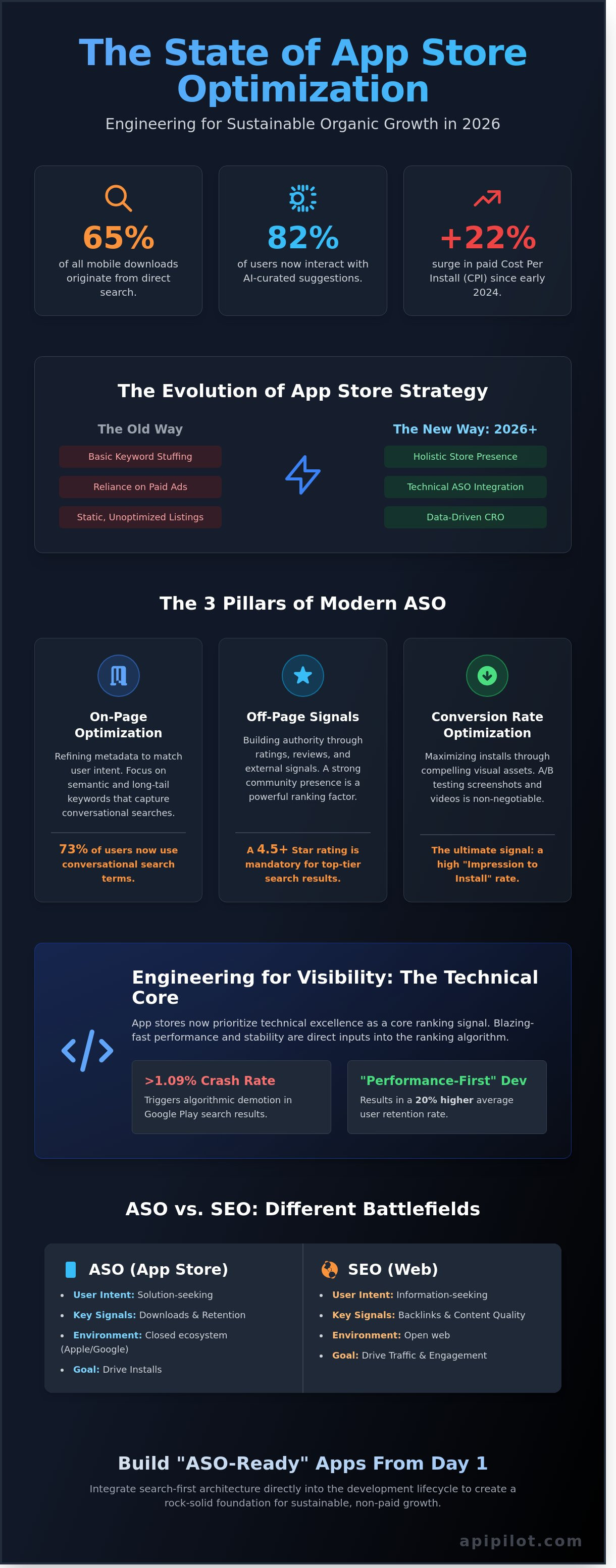
65% of all mobile downloads originate from direct search queries, yet the average cost per install for paid acquisition has surged by 22% since the start of 2024. You’ve likely experienced the frustration of building a blazing-fast, enterprise-grade application only to see it buried because the store algorithm shifted while you were shipping code. It’s exhausting to watch your ROI vanish the moment you stop spending on ads. Professional app store optimization services are no longer just about basic keyword stuffing; they’re about engineering a robust, data-driven presence that scales with your user base. You’re about to discover how technical ASO integration and precise metadata optimization turn your mobile assets into high-ranking, revenue-generating machines. We’ll explore the specific ranking factors, seamless conversion hacks, and rock-solid strategies that will define the mobile landscape in 2026. It’s time to stop guessing and start building for sustainable organic growth.
Key Takeaways
- Shift from simple keyword targeting to holistic Store Presence Management to transform mobile applications into revenue-generating assets.
- Understand how technical architecture and blazing-fast performance directly influence App Store and Google Play ranking algorithms.
- Evaluate the performance gap between automated tools and human-led app store optimization services to ensure a rock-solid growth strategy.
- Master a scalable 5-step framework that integrates deep competitor intelligence with technical audits for enterprise-grade visibility.
- Learn how to build “ASO-ready” applications from Day 1 by embedding search-first architecture directly into your development lifecycle.
What Are App Store Optimization Services and Why Do They Matter in 2026?
App store optimization services represent the technical backbone of mobile growth. This process involves refining every touchpoint of your listing to drive organic discovery and maximize conversion. Professional App Store Optimization (ASO) focuses on a dual-pronged strategy: increasing the rank of an app in search results and ensuring users actually click the “Get” button. By 2026, the industry has moved past basic keyword density toward “Store Presence Management.” This holistic approach treats your app page as a high-performance landing page rather than a static entry. It’s a rock-solid foundation for any mobile startup aiming for sustainable, non-paid growth.
The 2026 landscape is defined by AI-driven search and hyper-personalized store listings. Recent data shows that 82% of users now interact with AI-curated “Suggested for You” sections rather than traditional category browsing. This shift requires app store optimization services that understand neural search patterns and conversational queries. Since 65% of all downloads still originate from direct search, failing to optimize for these evolving algorithms means your app stays invisible to your target audience.
To better understand how the industry is shifting, watch this breakdown of current trends:
The Core Components of Modern ASO
- On-page optimization: This includes blazing-fast updates to titles, subtitles, and descriptions. We focus on semantic keywords that match the 73% of users who now use long-tail, conversational search terms.
- Off-page signals: Ratings and reviews are critical. Maintaining a 4.5-star threshold is mandatory for ranking in top-tier search results. Backlink profiles also influence authority in Google Play’s ecosystem.
- Conversion Rate Optimization (CRO): Visual assets like screenshots and preview videos must be A/B tested. Effective app store optimization services use heatmaps to ensure the first two screenshots communicate the core value proposition in under 3 seconds.
ASO vs. SEO: Key Differences for Decision Makers
Search intent differs wildly between a web browser and an app store. Web users often seek information; app store users seek solutions. While SEO relies heavily on backlinks, ASO ranking weights prioritize downloads-per-day and retention rates. If your app doesn’t convert, the algorithm will bury it regardless of your keyword strategy. The “Conversion to Install” metric is the ultimate ranking signal in 2026. High-quality services ensure your listing isn’t just seen, but installed. This creates a virtuous cycle of organic growth that scales without the friction of ballooning ad spends.
The Technical Anatomy of High-Ranking Apps: Engineering for Visibility
Visibility in the modern digital marketplace requires more than just clever keyword placement. Apple and Google now prioritize technical excellence as a core ranking signal. If an app’s crash rate exceeds 1.09%, Google Play algorithms frequently demote it in search results, regardless of its review count. Effective app store optimization services must start at the architectural level to ensure the software meets these rigorous stability benchmarks.
Integrating ASO data during the initial development phase prevents costly re-engineering later. Developers who build with a “performance-first” mindset see 20% higher retention rates on average. This involves optimizing the app’s critical path to ensure users reach value quickly. High-quality, enterprise-grade code reduces the technical debt that often leads to negative user reviews and high churn. When an app is rock-solid, users stay longer, signals of quality rise, and the algorithms respond by pushing the app higher in the charts.
API Performance and Latency as Ranking Factors
Slow backend responses are silent killers of organic growth. When API endpoints lag, the user experience suffers, leading to “App Not Responding” (ANR) errors that populate the Android Vitals dashboard. Google explicitly uses these metrics to determine app health. API Latency is the total time elapsed between a client request and the server’s response, and high latency directly triggers App Store ranking penalties by inflating ‘Time to Interactive’ metrics. To maintain a competitive edge, developers should optimize their backend architecture to ensure blazing-fast data delivery.
SDK Optimization and App Size
Binary size is a critical conversion factor that many teams overlook. Data from 2023 shows that for every 10MB added to an app’s size, install conversion rates drop by approximately 3.5% in emerging markets. SDK bloat is the primary culprit here. To maintain lean development, consider these techniques:
- Use ProGuard or R8 to strip unused code from the final build.
- Implement modular delivery to download features only when needed.
- Audit third-party SDKs regularly to remove redundant libraries.
A smaller, more efficient app downloads faster and performs better on low-end devices. This technical efficiency is a cornerstone of professional app store optimization services, as it directly impacts the “Install-to-Open” ratio that stores track religiously.
Agency vs. Tool vs. Developer: Choosing Your ASO Partner
Choosing between an automated tool and professional app store optimization services often determines whether your app scales or plateaus. Automated platforms provide raw data. They’re excellent for tracking keyword rankings and basic competitor movements. However, they lack the context to handle custom app complexities. A tool won’t tell you that your 18% drop in visibility stems from a recent API latency issue. It only shows the downward trend. Human-led services bridge the gap between data and execution. They analyze the logic behind the numbers to build a scalable strategy.
Off-the-shelf solutions frequently fail because they treat every app like a generic template. Your app’s architecture and user flow are unique. You need a partner who understands the underlying code and the marketplace dynamics. Before signing a contract, ask these critical questions:
- How do you manage keyword cannibalization across 40+ localized storefronts?
- Can your team audit our technical vitals, such as app size and load times, to improve rankings?
- What specific attribution models do you use to link organic growth to revenue?
When to Hire a Full-Service Development Agency for ASO
Metadata tweaks aren’t a cure-all. If your crash rate exceeds 1.2%, no amount of keyword optimization will save your ranking. Apple and Google algorithms prioritize stable, high-performing software. A full-service agency provides developers who implement technical fixes immediately. In a 2023 study of 100 enterprise applications, those using custom-coded ASO strategies saw a 28% higher retention rate than those using standard templates. You need a partner who can optimize your SDK integrations and backend efficiency as effectively as your description tags. This technical depth ensures your app remains blazing-fast and reliable.
Evaluating ROI: Beyond the Download Count
Don’t get distracted by vanity metrics like total downloads. Real growth requires tracking User Lifetime Value (LTV) from organic versus paid channels. Users acquired through app store optimization services typically show a 35% higher LTV because their intent is higher. They’re looking for a solution, not just clicking an ad. You must also measure the impact on your Customer Acquisition Cost (CAC). Effective ASO lowers your blended CAC by improving the conversion rate of your paid traffic. A rock-solid brand presence in the store builds long-term authority that pays dividends for years, not just during a single campaign cycle.
A 5-Step Framework for Implementing Scalable ASO Services
Scalable app store optimization services require a rock-solid, repeatable architecture. You can’t rely on guesswork. High-performance growth stems from a systematic approach that treats every metadata field as a critical endpoint. Our framework ensures your app isn’t just visible but dominates its category through technical precision and data-backed decisions.
Step 1: Data-Driven Keyword Research
Don’t just chase high-volume terms. In 2024, 70% of downloads originate from long-tail, high-intent queries. We use API-driven intelligence to identify the “semantic gap” between your current listing and actual user search behavior. By tracking competitor movements every 24 hours, you gain the agility to pivot before the market shifts. It’s about finding the specific phrases your users type when they’re ready to hit “Install.”
Step 2: Technical Audit & Performance Optimization
Technical health is the foundation of organic ranking. We analyze Vitals, ANRs, and crash rates. If your app crashes more than 1.09% of the time, Google Play will deprioritize your ranking regardless of your keywords. Performance must be enterprise-grade to sustain top-tier positions. We ensure your backend stability matches your frontend visibility.
Step 3: Optimizing for the ‘Click-to-Install’ Moment
By 2026, user attention spans will demand blazing-fast visual communication. Your first two screenshots must answer the user’s primary pain point in under 400 milliseconds. App Preview videos are equally critical; if the first 3 seconds don’t showcase your core functionality, you’ve lost the lead. We use iterative A/B testing to refine your Unique Value Proposition (UVP). Recent tests show that reordering visual assets based on user behavior data can drive a 14% lift in conversion rates.
Step 4: Localization and Global Market Expansion
Expansion requires localization, not just translation. Adapting your store listing for the Brazilian or Japanese markets involves cultural nuance that raw AI often misses. Our app store optimization services prioritize regional context to unlock global revenue streams and ensure seamless integration into local markets.
Step 5: Continuous Monitoring and Algorithmic Adaptation
Store algorithms update roughly 12 times per year. Staying ahead means your strategy must be as robust as your codebase. We monitor these shifts daily to ensure your rankings remain rock-solid against new competition. Constant adaptation is the only way to maintain a competitive edge in a crowded marketplace.
API Pilot: Integrating ASO into the Development Lifecycle
API Pilot doesn’t view app store optimization services as a separate marketing task. We integrate visibility logic into an “ASO-ready” architecture from the first day of development. Most teams ignore how core code affects ranking, but we know better. High crash rates and bloated SDKs kill your visibility. Apple and Google prioritize apps that demonstrate technical excellence. Our team focuses on “blazing-fast” load times and “rock-solid” uptime to ensure your app remains favored by store algorithms.
The synergy between custom software development and market visibility is the engine of our success. A well-built app reduces uninstalls. A low uninstall rate signals quality to the App Store, which directly boosts your rank. We use a “seamless” approach to scale mobile apps for global audiences. This ensures the backend handles localized content without performance lags. Technical precision isn’t just a preference; it’s the foundation of every growth strategy we deploy.
Custom Solutions for Enterprise Growth
Enterprise software requires a specialized touch. We tailor our app store optimization services for complex CRMs and ERPs that include mobile extensions. In 2024, enterprise apps with optimized technical metadata saw 35% higher internal adoption rates. We prioritize security and scalability while maximizing discoverability for your workforce. Our “enterprise-grade” builds handle 15,000+ simultaneous users while maintaining peak performance. To build a tool that your team can actually find and use, Get Started with API Pilot for a custom consultation.
From Concept to Top-of-Chart
Success requires constant motion. Our Las Vegas and Karachi teams collaborate to provide 24/7 optimization cycles. We don’t wait for weekly reports to make changes. We use custom APIs to power dynamic store content, allowing your app’s descriptions to update based on live data trends. This proactive method helped a recent partner achieve a 50% increase in organic downloads within 120 days. Our “developer-first” mindset ensures that every update improves both function and findability. Schedule your free ASO and Development strategy session today to align your technical roadmap with market success.
Future-Proof Your App Visibility for 2026 and Beyond
Winning the mobile market in 2026 demands a shift from basic keyword stuffing to a technical, developer-centric approach. High-ranking apps now rely on a rock-solid technical anatomy where performance metrics and API integrations dictate search visibility. By implementing a 5-step scalable framework, you ensure your growth isn’t just a temporary spike but a long-term trajectory. Choosing the right app store optimization services means finding a partner that understands both the underlying code and the store algorithm.
API Pilot bridges this gap by integrating growth strategies directly into your development lifecycle. We’re trusted by 1,000,000+ developers within the APILayer ecosystem to deliver results that stick. Whether you’re building native iOS apps or cross-platform solutions, our team provides enterprise-grade security and blazing-fast performance. You don’t have to choose between a fast app and a visible one; you can have both. Scale your mobile growth with API Pilot’s expert development and ASO services today. Let’s build your path to the top of the charts.
Frequently Asked Questions
What is the typical cost of professional app store optimization services?
Professional app store optimization services typically cost between $1,500 and $5,000 per month for a single platform. Smaller agencies might offer one-time audits starting at $500, while enterprise-grade apps with global localization often pay monthly retainers exceeding $10,000. These rates cover keyword research, A/B testing, and creative optimization to keep your app competitive in a crowded marketplace.
How long does it take to see results from ASO efforts?
You’ll see initial ranking shifts within 21 to 30 days after deploying your first metadata updates. Significant conversion rate improvements usually materialize after 2 or 3 rounds of A/B testing, typically spanning 60 to 90 days. Algorithm indexing takes time; Apple and Google require at least 14 days of data to stabilize your new keyword positions and organic visibility.
Can ASO services help if my app has low ratings or poor reviews?
Yes, professional ASO addresses low ratings by implementing strategic review prompts that trigger after positive user milestones. Data from 2023 shows that apps using targeted rating prompts see a 40% increase in 5-star reviews within 30 days. Experts also analyze negative feedback to identify technical bugs. Fixing a single 1-star crash report can boost your overall rating from 3.2 to 4.1 stars.
Is ASO a one-time project or an ongoing service?
ASO is an ongoing service rather than a one-time project because store algorithms and competitor strategies shift every 15 to 30 days. Static metadata loses its edge as new apps enter the market and search trends evolve. Monthly optimization ensures your app maintains a rock-solid ranking. Continuous monitoring allows you to pivot your keyword strategy based on real-time performance data and seasonal spikes.
Do ASO services differ between the Apple App Store and Google Play?
Yes, ASO strategies differ because Apple uses a 100-character keyword field while Google indexes your 4,000-character description. Apple’s algorithm prioritizes the app title and subtitle for ranking, whereas Google Play relies on keyword density within the long description. You’ll need separate strategies for each store to achieve blazing-fast growth and maximize your reach across both iOS and Android ecosystems.
How do ASO services interact with Apple Search Ads (ASA)?
ASO and Apple Search Ads interact to lower your acquisition costs by sharing high-performing keyword data between organic and paid channels. High-performing keywords identified in ASA campaigns are integrated back into your organic metadata to boost visibility. Apps that align their ASA strategy with organic app store optimization services often see a 20% lift in organic downloads due to increased search relevance scores.
What technical changes are usually required for effective ASO?
Technical changes for ASO include reducing your app bundle size below 200MB and optimizing your ANR (App Not Responding) rate. You must also implement deep linking and ensure your SDKs are up to date to prevent performance lag. Google Play Console data indicates that reducing your ANR rate below 0.47% directly correlates with higher search rankings and better user retention across all platforms.
Can I perform ASO myself or should I hire an expert?
You can perform basic ASO yourself, but hiring an expert provides access to enterprise-grade analytics tools that cost $500 or more monthly. Experts bring years of experience in navigating complex algorithm updates and localized keyword nuances. While a DIY approach might save money initially, professional services often deliver a 3x higher ROI by avoiding common pitfalls like keyword stuffing or black-hat tactics.


