
The most expensive software project isn’t the one with the highest hourly rate. It’s the one where the billing model incentivizes the wrong behavior. You likely worry that a fixed-price contract leads to corner-cutting on your custom software or that hourly billing will spiral out of control due to hidden costs. It’s a common tension. You need high-performance, scalable code, yet defining a rigid scope for complex APIs or mobile applications often feels like guesswork.
The choice between fixed price vs hourly software development is about more than just a line item on an invoice. It’s about aligning financial incentives with project uncertainty to protect your ROI. You’re right to demand a transparent relationship and predictable delivery timelines. This strategic guide provides the framework you need to master these financial mechanics. We’ll break down how to choose the billing model that fits your technical requirements, ensuring you get professional-grade results without the budget bloat.
Key Takeaways
- Recognize that software development is a discovery process. You’ll learn to align billing models with technical uncertainty to prevent budget overruns.
- Use fixed-price models for budget certainty on well-defined projects like MVPs or custom API integrations. It’s the most efficient choice for rigid scopes.
- Adopt hourly billing to support the iterative nature of modern engineering. It’s ideal for projects that require high-velocity performance and ongoing scalability.
- Analyze the trade-offs of fixed price vs hourly software development to protect your ROI. Choosing correctly ensures a professional-grade result without hidden costs.
- Follow a discovery-first framework to remove financial friction. This methodology guarantees a transparent relationship and high-performance delivery of custom software solutions.
The Software Cost Paradox: Why Billing Models Define Project Success
Software development isn’t a commodity you buy off a shelf. It’s a discovery process. In 2026, the “Iron Triangle” of software, scope, time, and cost, remains the governing law of every build. When you choose between fixed price vs hourly software development, you aren’t just selecting a payment method. You’re deciding how risk is distributed between your business and your development partner. A model that looks cheap on paper often results in a massive Total Cost of Ownership (TCO) if it fails to account for technical evolution.
To better understand how these financial models impact your project’s bottom line, watch this helpful video:
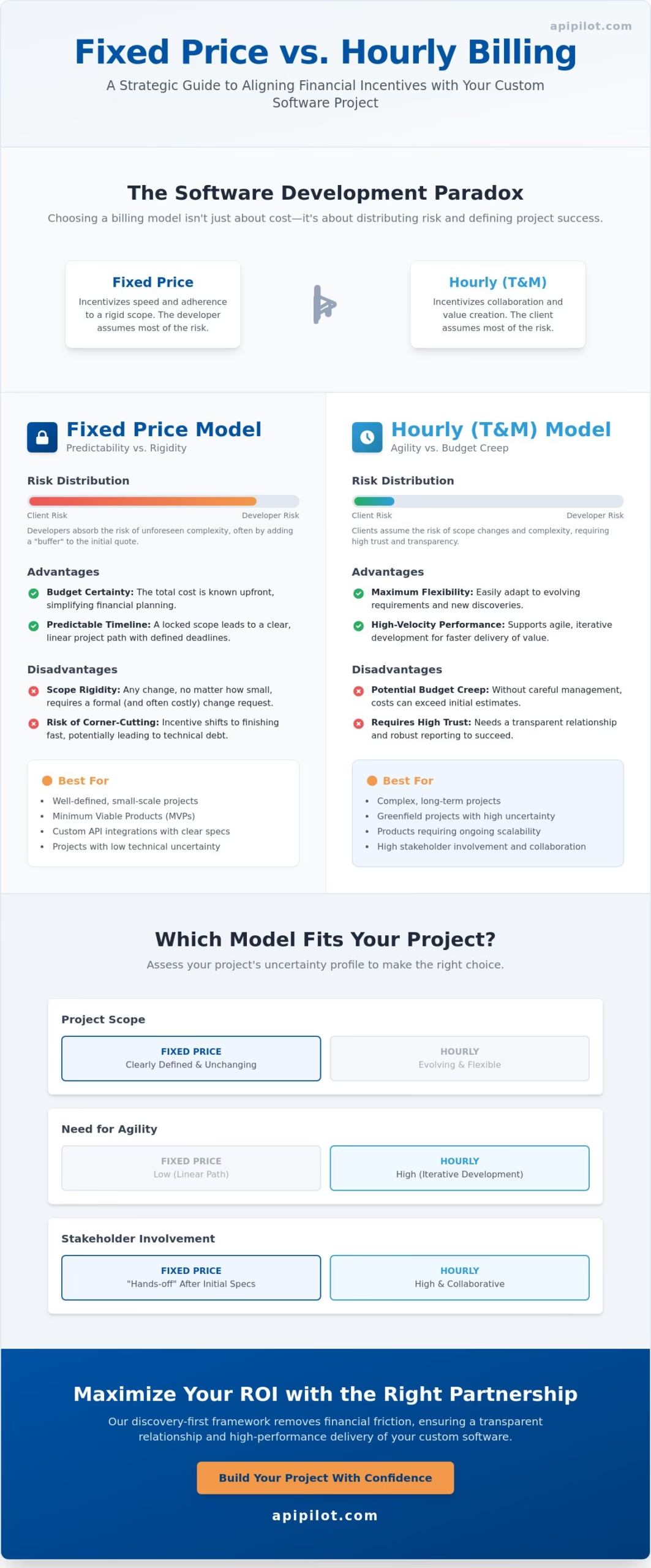
The paradox lies in the incentives. A Fixed-Price Contract offers budget certainty by locking in a specific fee for defined deliverables. This sounds ideal for financial planning, but it places the risk entirely on the developer. If the project hits a technical snag, the incentive shifts from building the best solution to finishing the project as quickly as possible. Hourly billing shifts that risk back to you, requiring a high-trust relationship and transparent reporting to ensure every engineering hour translates into quantifiable value.
The High Cost of Misaligned Incentives
When billing models don’t fit the project, friction is inevitable. If developers feel squeezed by a rigid budget, they might prioritize speed over structural integrity. This results in technical debt, code that functions today but lacks the scalability to handle future growth. Communication breaks down when every minor adjustment to a custom API or mobile interface triggers a formal change request. This administrative overhead slows down high-velocity performance and inflates the final cost through delays rather than development.
Defining Your Project Uncertainty Profile
Choosing the right structure requires an honest assessment of your project’s uncertainty. Greenfield projects, where you’re building something entirely new, are inherently fluid. Requirements evolve as stakeholders see the first builds. Conversely, a straightforward e-commerce website with a known feature set has a “Fixed” profile. You must decide if your requirements are set in stone or if you need the agility to iterate. High stakeholder involvement usually favors hourly models, while a “hands-off” approach for simple builds might benefit from a fixed-price structure.
Understanding the nuance of fixed price vs hourly software development ensures you aren’t just buying code. You’re investing in a financial framework that supports high-performance, professional-grade results.
The Fixed Price Model: Predictability vs. Rigidity
A fixed-price model is a contractual agreement where a set fee is paid for a strictly defined set of deliverables. It functions as a closed system. You provide a detailed specification, and the developer provides a quote that covers the entire execution. This model is often the first choice for businesses seeking budget certainty for small-scale web builds, basic MVPs, or clearly documented custom API integrations. However, this predictability comes at a cost that isn’t always visible on the initial invoice.
The “Safety Illusion” is a common trap in the fixed price vs hourly software development debate. For a fixed-price contract to succeed, you need 100 percent upfront clarity. Any ambiguity in the initial scope creates friction later. Professional agencies understand that software is unpredictable. To protect their margins, they build a “buffer” or contingency fee into the quote. This means you’re often paying a premium for the developer to assume the financial risk of technical unknowns. If you’re planning a custom software solution, you must decide if that premium is worth the perceived safety.
Advantages of the Fixed Price Approach
Budget certainty is the primary driver for this model. It’s an effective tool for securing board-level approvals or hitting specific targets in startup funding rounds. Because the scope is locked, the project follows a linear path with clear deadlines tied to measurable milestones. Management overhead remains low for the client because the developer is responsible for resource allocation and internal timelines. You simply wait for the delivery of the agreed-upon features.
The Hidden Risks of Fixed Scope
Rigidity is the enemy of innovation. According to one industry perspective, the fixed-price model can struggle with the iterative nature of modern engineering. When you encounter a “Change Request” bottleneck, progress stalls. Every pivot or adjustment based on user feedback requires a new negotiation, which inflates costs and slows down delivery.
From a developer-first perspective, fixed budgets can inadvertently lead to “feature cutting” or technical debt. If a project runs over the estimated hours, the incentive shifts toward finishing the task rather than perfecting the code. This lack of flexibility prevents you from integrating real-time feedback during the build phase. You might end up with exactly what you asked for, even if market conditions or user needs have changed during the development cycle.
Hourly Billing (Time & Materials): Agility vs. Budget Creep
Hourly billing, frequently referred to as Time & Materials, involves paying for the specific engineering effort and resources used during a development cycle. It is the polar opposite of the rigid, closed systems discussed in previous sections. Modern software thrives on iteration. A mobile application or custom SaaS platform is rarely a static product; it’s a living system that must adapt to user needs. This billing model is the agile gold standard. It allows for high-velocity development and rapid scaling. You avoid the administrative delays and friction inherent in the fixed price vs hourly software development debate.
The “blank check” fear is the biggest hurdle for most clients. You don’t want costs to spiral without a clear end in sight. You can solve this through rigorous project management. Real-time tracking tools and weekly reporting provide the transparency needed to monitor the burn rate. You aren’t signing away your budget. Instead, you’re investing in a flexible pipeline that produces quantifiable value. This model ensures that every dollar spent is directed toward the most impactful features at that specific moment in time.
Why Developers and Tech-Savvy Clients Prefer Hourly
Technical teams value the ability to pivot. User testing often reveals that a specific feature needs a total redesign to be effective. In an hourly model, you change course immediately without a new contract negotiation. This focus on code quality over hard deadlines prevents the accumulation of technical debt. This ensures your fixed price vs hourly software development strategy supports the reality of building complex systems. It’s the most effective way to handle the integration of evolving technologies. Whether you’re building sophisticated AI modules or custom API development, the path to success often shifts. An hourly structure accommodates these shifts smoothly.
Managing the Risks of Time & Materials
Protecting your ROI requires active oversight. Setting “Not-to-Exceed” (NTE) clauses is a common strategy to provide a financial safety net. This gives you the flexibility of an hourly model with the budget safety of a cap. Choosing a senior-heavy team is another way to manage costs effectively. Expert engineers at API Pilot work faster and write cleaner code. While the hourly rate for a senior architect is higher, their ability to solve complex problems in fewer hours reduces the total project cost. You get a high-performance product that is scalable from day one.
High-quality code is more cost-effective over a long lifecycle than “cheap” code that requires constant patching. Transparent reporting ensures you are never surprised by an invoice. You see the direct correlation between engineering hours and feature completion. Understanding the nuances of Fixed-Price vs. Hourly Contracts helps you select the model that guarantees long-term viability and technical excellence.
Comparative Analysis: Which Model Fits Your Project?
Selecting the right framework for fixed price vs hourly software development requires an honest evaluation of your project’s technical risk. Small projects with static requirements, such as a standard e-commerce website or a basic landing page, are well-suited for fixed pricing. However, as complexity increases, the rigid boundaries of a set fee often break down. Enterprise systems like custom ERPs or CRMs demand a more nuanced approach because they involve deep architectural discovery that cannot be fully quantified on day one.
Deep technical integrations make fixed pricing particularly dangerous for custom API development. You cannot always predict third-party endpoint behavior or data format mismatches before you start coding. When you force these complex tasks into a rigid contract, you often end up in “change request” cycles that stall progress. For high-performance, scalable systems, the billing model must account for the reality of technical discovery without inflating the total cost of ownership through administrative delays.
The Hybrid Model: The Best of Both Worlds
A significant trend in 2026 is the shift toward hybrid billing structures for complex builds. This model typically begins with a Fixed-Price Discovery phase. During this period, the team maps the architecture, defines the technical stack, and creates detailed documentation. Once the blueprint is established, the project transitions into an Hourly Development phase for the actual construction. This minimizes financial risk for you while allowing the developers to focus on code quality and structural integrity. Milestone-based billing also offers a middle ground, where you pay fixed prices for specific, measurable sprints or modules.
Decision Matrix: A 30-Second Selection Guide
Use these three criteria to determine which model aligns with your business goals:
- Clarity of Requirements: On a scale of 1 to 10, if your requirements are an 8 or higher, fixed price is a viable option. If you’re below a 5, choose hourly to avoid constant renegotiations.
- Market Volatility: If you need the flexibility to pivot based on real-time user testing for mobile applications, hourly billing supports the necessary agility.
- Internal Management Capacity: Hourly models require active client oversight and a dedicated product owner. If your internal team has limited bandwidth, a hybrid or milestone-based approach reduces your management overhead.
Ready to build high-performance software that scales with your business? Get a custom software solution designed for technical excellence and transparent ROI.
Maximizing ROI with API Pilot: A Developer-First Partnership
Project success depends on more than just choosing between fixed price vs hourly software development. It requires a partner who understands that financial structures must serve the technical requirements, not the other way around. API Pilot structures every engagement for maximum transparency. We prioritize high-velocity performance and infrastructure stability. Our methodology ensures that your capital is invested in high-performance code rather than administrative friction or scope-creep negotiations.
Our “Discovery-First” approach is the cornerstone of this transparency. We eliminate the guesswork in project quoting by conducting a deep technical audit before the first line of code is written. This phase allows us to define the architecture, identify potential API bottlenecks, and establish a realistic roadmap. By mapping out the technical stack early, we provide a foundation for predictable delivery timelines. This process protects your ROI by ensuring the billing model you choose aligns perfectly with your specific project uncertainty profile.
Our Approach to Custom Software and APIs
We build professional-grade infrastructure designed for long-term stability. Whether we are developing scalable ERPs, custom CRMs, or complex Mobile Applications for both iOS and Android, our focus remains on structural reliability. We don’t believe in “black box” development. You receive real-time access to progress and code repositories. This level of transparent communication is vital, especially when navigating the nuances of fixed price vs hourly software development. You always know exactly where your project stands, which engineering tasks are being prioritized, and how they contribute to your business growth.
- Custom API Development: We design interfaces that handle high-volume data with minimal latency.
- E-commerce Websites: Our builds focus on conversion-optimized performance and secure transaction layers.
- Custom Software Solutions: We engineer tools that solve specific operational challenges through automation.
Ready to Build? Let’s Define Your Model
Choosing the right billing model is a strategic decision that shouldn’t be made in a vacuum. A consultation is the first step toward an accurate price estimate and a successful launch. We help you evaluate your requirements, market volatility, and internal capacity to determine the most efficient path forward. Our goal is to provide a dependable foundation for your external applications, ensuring your software is high-performance and scalable from day one. Consult with an API Pilot expert on your project pricing to master the financial mechanics of your next build.
Strategic Alignment for Long-Term Engineering Success
Choosing the right billing model is about aligning financial incentives with the technical reality of your project. Fixed pricing provides budget safety for strictly defined deliverables, while hourly billing offers the agility required for complex, high-performance systems. Mastering the balance between fixed price vs hourly software development ensures you don’t compromise code quality for a predictable invoice.
API Pilot bridges this gap with a developer-first approach. With a global presence in Las Vegas and Karachi, our teams specialize in building professional-grade custom ERP, CRM, and API solutions. We prioritize high-velocity performance and infrastructure stability, using a discovery-first methodology to eliminate financial guesswork. Whether you’re launching a mobile application or scaling an enterprise platform, we provide the technical expertise and transparent communication needed to guarantee project success.
Get a custom software development quote from API Pilot and secure a dependable foundation for your next build. Your innovation deserves a partnership built on technical excellence and reliable ROI.
Frequently Asked Questions
Is fixed price always cheaper than hourly software development?
Fixed-price contracts are not inherently cheaper. They often carry a premium or risk buffer added by the developer to cover technical unknowns. If your requirements are simple and well-documented, a fixed fee provides certainty. For complex systems, the lack of flexibility in fixed models often leads to expensive change requests. Choosing between fixed price vs hourly software development requires evaluating whether you’re paying for actual effort or a perceived safety net.
Can I switch from a fixed price to an hourly model mid-project?
You can transition models, though it requires a formal contract update. Many businesses start with a fixed-price discovery phase and move to an hourly model for the build. This shift is common when the initial technical audit reveals hidden complexities in custom API development or legacy migrations. Switching ensures the engineering team focuses on structural reliability and high-velocity performance rather than being constrained by an inflexible, outdated scope.
What is a “Discovery Phase” and why is it billed separately?
A Discovery Phase is a technical audit where architects map out your software’s infrastructure, data protocols, and feature requirements. We bill it separately to provide a concrete blueprint before the main development begins. This process eliminates guesswork and provides the documentation needed for accurate quoting. It’s a critical step for high-performance custom software solutions, ensuring the billing model fits the project’s actual technical complexity and business goals.
How do you prevent “scope creep” in an hourly billing model?
Scope creep is managed through transparent reporting and Not-to-Exceed (NTE) clauses. By using real-time project tracking, you can monitor exactly how engineering hours are spent each week. Regular sprint reviews allow you to reprioritize tasks based on quantifiable value. This structured approach ensures that the flexibility of hourly billing doesn’t lead to budget bloat. It keeps the focus on delivering high-performance, scalable code within your financial limits.
Which model is better for building a Minimum Viable Product (MVP)?
Fixed price is often ideal for a standard MVP with a low-complexity feature set. It allows for predictable budgeting during early funding rounds. If your MVP requires complex custom API development or deep technical integrations, an hourly model is superior. It provides the agility to iterate based on real-time user feedback. This ensures your initial product is a high-performance foundation that can scale as your user base grows.
What happens if a fixed-price project takes longer than expected?
If the project exceeds the timeline due to technical challenges within the original scope, the developer usually covers the additional costs. This is the primary advantage of fixed pricing for clients. However, if the delay results from a change in requirements, it leads to a formal change request. This administrative process can be slow and expensive. It highlights the inherent rigidity that often makes the fixed model less efficient for innovative builds.
Do hourly rates include project management and QA testing?
Professional hourly rates include the entire engineering lifecycle, including project management and rigorous QA testing. These roles are essential for maintaining infrastructure stability and professional-grade quality. Skipping these steps to save on hourly costs leads to technical debt and higher maintenance expenses later. A developer-centric approach ensures that QA is integrated into every sprint. This delivers a scalable, high-performance product that minimizes long-term financial friction for your business.
How does API Pilot ensure billing transparency?
We provide real-time access to progress and code repositories to ensure absolute clarity. Our discovery-first methodology removes ambiguity by defining the technical roadmap upfront. Whether we are building mobile applications or e-commerce websites, we provide detailed resource allocation reports. This transparency is central to the fixed price vs hourly software development choice. It builds a reliable, trustworthy partnership where you see the direct correlation between your investment and engineering output.


