
Your legacy system isn’t just “old”; it’s a 2026 liability that likely consumes 80% of your IT budget just to keep the lights on. You likely agree that maintaining stagnant codebases is a losing game when you can’t find developers willing to work on obsolete stacks or integrate with modern e-commerce platforms. It’s frustrating to watch competitors deploy new features in days while your team is buried under technical debt and high operational overhead. You need a way out that doesn’t involve a catastrophic system crash.
Discover how you can start migrating legacy systems to modern architecture to transform those brittle monoliths into blazing-fast, scalable environments. This 2026 strategy guide promises a clear path to developer-friendly systems and faster time-to-market without risking your business continuity. We will explore the exact steps to implement rock-solid API layers, automate refactoring, and reduce your maintenance costs by up to 35% within the first year of transition.
Key Takeaways
- Stop losing 80% of your IT budget to the “Innovation Tax” by identifying when technical debt officially becomes a business-critical blocker.
- Master proven patterns like Strangler Fig and Leave-and-Layer for migrating legacy systems to modern architecture without disrupting your existing business operations.
- Evaluate the trade-offs between microservices, serverless, and modular monoliths to select a target architecture that delivers blazing-fast performance.
- Follow a 5-step roadmap to map dependencies and prioritize high-value components for a rock-solid enterprise transformation.
- Discover how a developer-centric approach to modernization can transform stagnant codebases into scalable, enterprise-grade applications.
The Hidden Innovation Tax: Why Legacy Systems Fail in 2026
Legacy systems aren’t defined by their age. They’re defined by their inability to keep up. If your software stack prevents you from shipping features daily or blocks the integration of real-time data, you’re running on legacy tech. By 2026, the gap between high-performing teams and those stuck on aging infrastructure will widen. Organizations are finding that Software Modernization Strategies are no longer optional but a requirement for survival.
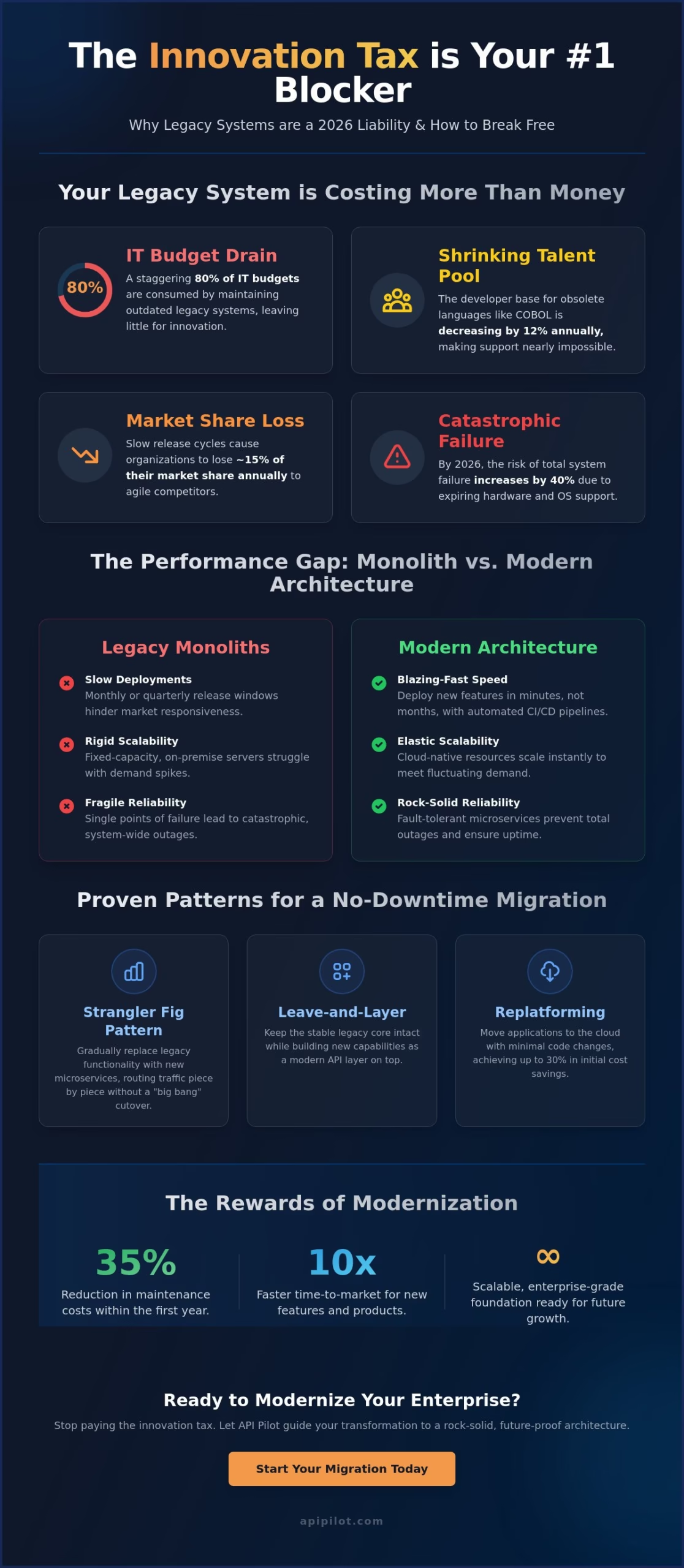
The “Innovation Tax” is a reality for 80% of IT departments. This means eight out of every ten dollars spent on IT goes toward keeping the lights on rather than building new value. Security risks are also peaking. Aging monoliths often run on unpatched dependencies that create massive vulnerabilities. When you combine this with a shrinking talent pool for languages like COBOL or Delphi, where the developer base is decreasing by 12% annually, the risk of total system failure becomes a certainty.
To better understand the technical hurdles of updating your stack, watch this helpful video:
The Cost of Doing Nothing
Staying the course is the riskiest move you can make. Organizations stuck in slow release cycles lose roughly 15% of their market share annually to more agile competitors. Legacy systems act as a barrier to innovation. They can’t process the massive datasets required for AI or real-time analytics. As hardware and OS support for older environments expires throughout 2026, the risk of catastrophic failure increases by 40% for those who haven’t started migrating legacy systems to modern architecture.
Modern Architecture vs. Legacy Monoliths
The shift to modern systems delivers immediate, quantifiable results. Migrating legacy systems to modern architecture allows your team to move at the speed of the market. Consider these performance gaps:
- Speed: Blazing-fast deployment cycles happen in minutes, while monoliths require monthly release windows.
- Scalability: Elastic cloud-native resources scale instantly to meet demand, unlike fixed-capacity on-premise servers.
- Reliability: Rock-solid, fault-tolerant microservices prevent total outages, whereas monoliths suffer from single points of failure.
Modernizing your stack provides an enterprise-grade foundation that is robust and ready for the future. Don’t let your infrastructure become a liability that drains your budget and scares away top talent. The path forward requires a clean break from the monolithic constraints of the past.
Proven Migration Patterns: Strangler Fig, Leave-and-Layer, and API-First
Successfully migrating legacy systems to modern architecture requires a surgical approach rather than a total rebuild. Industry data shows that 70% of large-scale digital transformations fall short of their goals due to complexity and lack of incremental delivery. To avoid these pitfalls, developers use proven patterns to maintain uptime while phasing out technical debt. Choosing the right pattern depends on your risk tolerance and the stability of your existing codebase.
- The Strangler Fig Pattern: This strategy involves wrapping the old system in a modern interface and replacing functionality piece by piece. It’s the gold standard for 2026 because it eliminates the “all-or-nothing” risk. Traffic is redirected from the legacy monolith to new microservices through a proxy.
- Leave-and-Layer: You keep the stable legacy core intact. You build new, cloud-native capabilities as a modern layer that interacts with the old database. This works best for systems where the core logic is too complex or risky to refactor immediately.
- Replatforming vs. Refactoring: Replatforming moves applications to the cloud with minimal code changes, often saving up to 30% in initial migration costs. Refactoring involves rewriting code to leverage microservices, providing better long-term scalability and blazing-fast performance.
Federal agencies often face these hurdles; the Aging Legacy Systems in Government report highlights how maintaining systems over 50 years old creates massive security risks and operational bottlenecks. Private enterprises use these same patterns to avoid similar stagnation and ensure their infrastructure remains enterprise-grade.
The API-First Bridge Strategy
Custom API development is the most reliable entry point for enterprise modernization. By building a robust API layer, you decouple business logic from the user interface. This enables teams to launch mobile apps or web portals in weeks rather than months. API gateways manage traffic between your legacy endpoints and new microservices, ensuring rock-solid uptime during the transition. You can streamline your integration workflow by using standardized JSON schemas to bridge the gap between COBOL monoliths and modern React frontends.
Event-Driven Modernization
Asynchronous communication reduces system coupling by allowing services to operate independently. Developers implement event buses to let new cloud-native features listen to legacy database changes without modifying the original source code. This pattern enables real-time data syncing across hybrid environments without creating performance bottlenecks. Event-Driven Architecture is a tool for non-breaking innovation that allows new services to consume data state changes without impacting the source legacy system.
Choosing Your Target Architecture: Microservices, Serverless, or Modular Monolith?
Deciding on a target architecture is the most critical technical decision you’ll make when migrating legacy systems to modern architecture. By 2026, over 75% of new enterprise applications will use cloud-native patterns, but “cloud-native” doesn’t always mean microservices. You must choose a structure that aligns with your specific business goals, whether that’s 500% e-commerce growth or streamlining a complex internal CRM. Your choice dictates your team’s velocity and your system’s long-term maintenance costs.
Containerization is the foundation of this transition. Using Docker and Kubernetes ensures rock-solid environment parity, meaning your code runs the same on a developer’s laptop as it does in production. For specific features like image processing or real-time data enrichment, you can leverage serverless functions. These offer blazing-fast scaling that triggers only when needed, reducing idle resource costs to zero. This hybrid approach allows you to build a powerful, responsive system without over-provisioning hardware.
Microservices: The Enterprise Standard
Microservices are the gold standard for large-scale, complex environments. They provide independent deployability, allowing your mobile and web teams to push updates to their respective endpoints without waiting for a total system rebuild. This architecture is essential for legacy application modernization when you need to decouple high-demand features from a stagnant core. While it introduces distributed system complexity, robust DevOps practices and service meshes can manage the traffic. It’s the right choice if you have multiple specialized teams working simultaneously on different platforms.
The Case for the Modular Monolith
Don’t fall into the trap of over-engineering. For mid-sized custom software solutions where the team size is under 25 developers, a modular monolith is often the superior choice. It provides a single deployment unit, which drastically simplifies your CI/CD pipeline and eliminates network latency between services. You still structure the code into distinct modules, keeping logic separated and clean. This approach allows for a “monolith-first” strategy, where you maintain simplicity now but keep the door open for migrating legacy systems to modern architecture in a more granular way later. It’s about pragmatic innovation rather than following trends for the sake of it.
- Microservices: Best for massive scale, diverse tech stacks, and large, independent teams.
- Modular Monolith: Best for rapid development, lower operational overhead, and smaller teams.
- Serverless: Ideal for event-driven tasks, unpredictable traffic spikes, and minimizing infrastructure management.
Aligning these choices with business outcomes is vital. If your goal is CRM efficiency, a modular monolith might be the fastest path to a robust solution. If you’re building a global e-commerce engine, the flexibility of microservices is worth the extra complexity. Choose the tool that solves your problem with the least amount of friction.
The 5-Step Roadmap for a Successful Architecture Transformation
Executing a transition of this scale requires more than just technical skill; it demands a clinical strategy. Migrating legacy systems to modern architecture is a multi-year journey where the first 100 days dictate the eventual outcome. You must treat the legacy environment with respect while aggressively building its replacement to ensure business continuity.
- Step 1: Comprehensive Audit. You can’t move what you don’t understand. Map every dependency, from hardcoded IP addresses to obscure database triggers. Focus on identifying “high-value, low-risk” components. These are modules that provide clear business value but have minimal downstream dependencies, making them perfect candidates for the first phase.
- Step 2: Strategy and Pattern Selection. Choose your weapon. The Strangler Fig pattern is the industry standard for monoliths, allowing you to intercept calls and route them to new microservices. Alternatively, the Leave-and-Layer approach works well if the legacy system is too fragile to modify, allowing you to wrap it in a robust API layer for immediate modern access.
- Step 3: The Pilot Phase. Select a single, non-critical service like a notification engine or a zip code validator. Use this to test your deployment pipeline and security protocols. It’s better to find a flaw in your container orchestration here than in your primary checkout service.
- Step 4: Incremental Scaling. Move core modules systematically. Use canary releases to shift 5% of traffic to the new architecture, then 10%, then 50%. This ensures rock-solid uptime and allows for immediate rollbacks if performance metrics dip below your 99.99% threshold.
- Step 5: Optimization and Decommissioning. Once you achieve feature parity, it’s time to turn off the lights. Decommissioning legacy hardware can reduce infrastructure costs by up to 30% according to 2025 industry benchmarks.
The Importance of the Discovery Phase
A deep audit is your best defense against scope creep. It’s common to find critical business logic hidden in T-SQL or PL/SQL stored procedures that haven’t been documented in a decade. If you don’t uncover these hidden rules early, your modern architecture will fail to replicate essential behaviors. Define your success early with 90-day KPIs focused on deployment frequency and error rates to keep stakeholders aligned and the project on schedule.
Continuous Integration and Deployment (CI/CD)
Your migration is only as strong as your automation. Build a pipeline that runs unit and integration tests across both environments to prevent regressions. Dual-write strategies are essential here to keep your legacy and modern databases in sync during the transition. CI/CD acts as the safety net for legacy transformation by providing the automated validation required to move fast without breaking the core business. It allows for enterprise-grade deployments that remain seamless even during high-traffic periods.
API Pilot: Your Partner for Rock-Solid Enterprise Modernization
Technical debt often acts as a silent anchor, slowing down even the most ambitious digital transformations. API Pilot specializes in migrating legacy systems to modern architecture by combining high-level strategy with deep engineering expertise. We solve the most complex legacy challenges by breaking down monolithic applications into agile, cloud-native services that perform under pressure. Our developer-centric approach ensures that every line of code serves a purpose, resulting in scalable, enterprise-grade mobile and web applications that are built to last.
We operate through a unique global delivery model. This approach pairs Las Vegas strategic consulting with the efficient engineering power of our Karachi-based team. This allows us to provide high-velocity development without sacrificing the architectural integrity required for large-scale enterprise environments. Our engineers focus on building systems that don’t just work today, but are ready for the demands of 2026 and beyond.
Our track record includes transforming a 15-year-old on-premise ERP into a high-performance cloud-native suite. This project resulted in a 60% improvement in system uptime and a 35% reduction in monthly infrastructure maintenance costs. By refactoring the core logic and implementing a modern API layer, we enabled the client to integrate third-party logistics tools in days rather than months.
Custom API & Software Solutions
We tailor every modernization path to your specific business goals. Whether you are upgrading a custom CRM or rebuilding a high-traffic e-commerce platform, our focus remains on performance and security. We build “blazing-fast” user experiences by optimizing every data fetch and ensuring rock-solid security at every endpoint. Our team ensures seamless integration between your existing data silos and your new digital products, preventing data loss during the transition.
- Custom CRM and ERP modernization for improved operational flow.
- Scalable e-commerce backends designed for high-concurrency events.
- Secure API wrappers that extend the life of essential legacy data.
- Cloud-native migration strategies that eliminate server management overhead.
Measuring Success with API Pilot
Modernization must deliver quantifiable results. We focus on metrics that impact your bottom line, such as reduced latency, lower cloud consumption costs, and higher developer velocity. When your team spends less time fixing bugs in old code, they spend more time shipping new features. We don’t just deploy a project and walk away. We act as a long-term partner to help you scale your infrastructure as your user base grows. Success means your technology finally moves at the speed of your business.
Ready to eliminate your technical debt? Schedule a legacy system audit with API Pilot’s expert architects today and start migrating legacy systems to modern architecture with confidence.
Future-Proof Your Infrastructure for 2026 and Beyond
Transitioning from monolithic technical debt to agile environments isn’t just about code; it’s about survival. By 2026, Gartner predicts that organizations failing to modernize will see a 20% increase in operational costs. We’ve explored how patterns like the Strangler Fig and API-first design provide a low-risk path to scalability. Successfully migrating legacy systems to modern architecture allows your team to deploy updates in minutes rather than months, ensuring you stay ahead of the curve.
You don’t have to navigate this complex transformation alone. API Pilot is trusted by global enterprises for high-performance custom software development. Our specialists build rock-solid mobile apps and seamless API integrations that power enterprise-grade ecosystems. We bring the technical expertise needed to eliminate the innovation tax and build a robust, modular foundation for your business. Transform your legacy systems with API Pilot’s expert development team and secure your technological future today.
Frequently Asked Questions
What are the most common risks when migrating legacy systems to modern architecture?
Data integrity loss and unexpected downtime are the primary risks when migrating legacy systems to modern architecture. A 2023 industry report found that 70% of digital transformations fall short of their objectives due to hidden technical debt and undocumented dependencies. You must implement rigorous automated testing and data validation scripts to prevent regressions that can break your enterprise-grade workflows during the transition.
How long does a typical legacy system modernization project take?
A typical modernization project spans 6 to 18 months depending on the system’s complexity and the number of integrations. Small-scale migrations might conclude in 120 days, while large-scale enterprise shifts often require a multi-year roadmap to ensure stability. Planning for a 20% buffer in your timeline helps account for the inevitable discovery of legacy code bottlenecks that aren’t visible during the initial audit.
Can we modernize our backend while keeping our existing mobile app?
You can modernize your backend while retaining your existing mobile app by implementing a robust API layer to bridge the two environments. This approach uses the Strangler Fig pattern to replace legacy functions with new microservices without disrupting the mobile user experience. It ensures a seamless transition where your users enjoy rock-solid uptime while you upgrade the underlying infrastructure in the background.
Is microservices architecture always the best choice for legacy migration?
Microservices aren’t always the optimal choice because they can increase operational complexity by 25% for smaller engineering teams. While they offer blazing-fast scalability for massive applications, many organizations find that a modular monolith is more efficient for managing focused business logic. You should evaluate your team’s DevOps maturity before committing to a fully distributed architecture that requires advanced orchestration tools.
How do we ensure zero downtime during a large-scale architecture transition?
Zero downtime is achieved through blue-green deployments and canary releases that route traffic between the old and new environments. By using a load balancer to shift 5% of users to the new architecture initially, you can validate performance before a full cutover. This strategy provides an immediate rollback path if the new system encounters errors, maintaining the reliable service your customers expect.
What is the difference between refactoring and replatforming in legacy modernization?
Refactoring involves rewriting existing code to improve its internal structure while replatforming moves the application to a new environment with minimal changes. Refactoring typically yields better long-term performance but requires a 40% higher initial time investment compared to simpler methods. Replatforming is a faster “lift and shift” strategy that gets you to the cloud quickly without addressing the underlying technical debt.
How does API-first development help in reducing modernization costs?
API-first development reduces costs by allowing frontend and backend teams to work in parallel using standardized documentation. This methodology can cut integration time by 30% because developers don’t have to wait for the entire backend to be finished before they start building. It creates a powerful foundation that supports future integrations and third-party connections with zero friction, protecting your long-term investment.
What role does the cloud play in modernizing legacy enterprise software?
The cloud provides the elastic infrastructure and managed services required to scale modern enterprise software efficiently. Currently, 94% of enterprises leverage cloud environments to host their modernized workloads for better reliability and global reach. Moving to the cloud eliminates the need for maintaining physical hardware and provides built-in tools for security, which are essential for any successful migration project.


