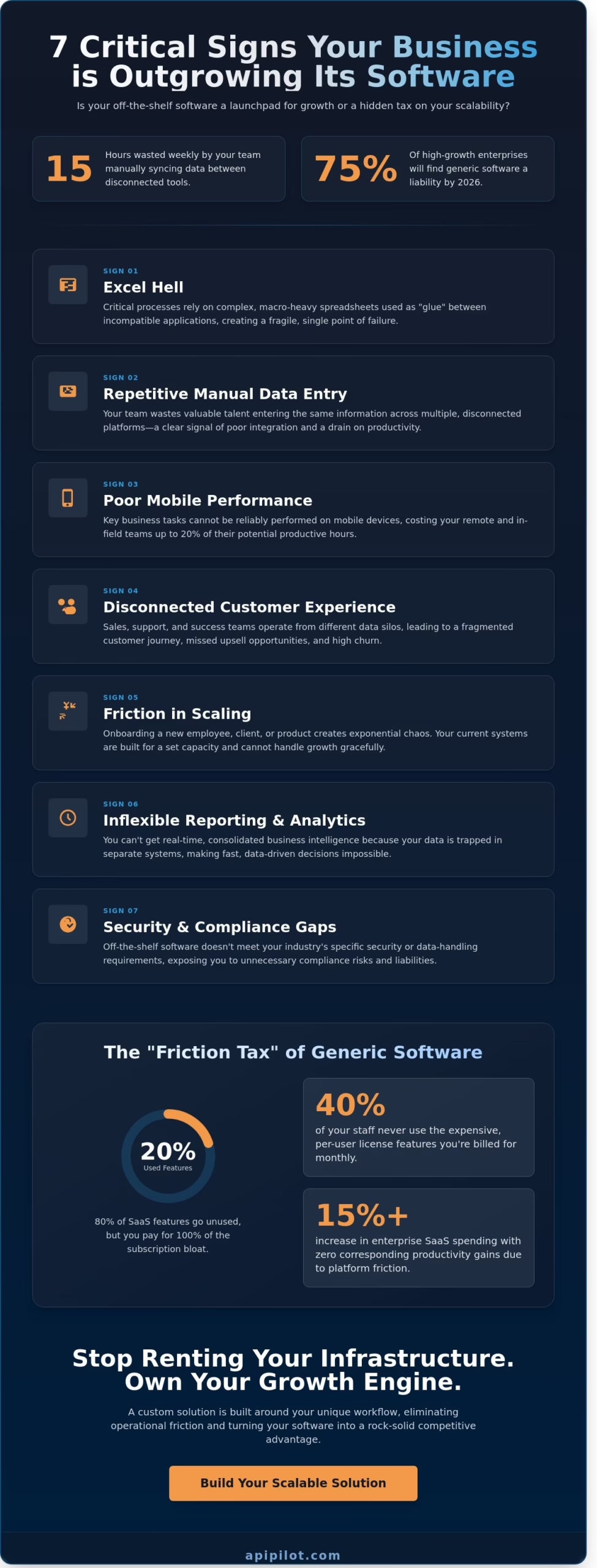
If your team spends 15 hours every week manually syncing data between disconnected SaaS tools, you aren’t running a business; you’re managing a digital bottleneck. Industry reports suggest that by 2026, 75% of high-growth enterprises will realize that generic software suites are actually a tax on their scalability. These are the unmistakable signs your business needs custom software to maintain a competitive edge.
You likely agree that paying for expensive per-user licenses for features 40% of your staff never touches is a drain on your resources. It’s difficult to make fast decisions when you lack real-time visibility into your performance because your data is trapped in silos. We promise to help you identify the critical bottlenecks holding your growth back and show you exactly when to pivot to a rock-solid custom solution. We’ll preview seven blazing-fast indicators that it’s time to build your own enterprise-grade tools, eliminate operational friction, and finally own your intellectual property.
Key Takeaways
- Identify the exact moment generic tools become a liability and learn why off-the-shelf software fails to handle 2026’s modern data complexity.
- Spot the seven critical signs your business needs custom software, from spreadsheet dependency to the “Friction Tax” of manual data entry.
- Calculate the hidden financial impact of operational inefficiencies and learn how to eliminate the cost of every redundant, manual click.
- Master a robust “Build vs. Buy” decision framework to determine if your integration woes require a custom API or a full-scale platform pivot.
- Explore how to build a rock-solid foundation for growth using a blazing-fast, API-first development approach tailored for enterprise scalability.
The Tipping Point: When Off-the-Shelf Software Becomes a Liability
Every software tool follows a predictable lifecycle. It starts as a “good enough” solution that solves immediate pain points. As your company scales toward 2026, those same tools often transform into rigid bottlenecks. Generic platforms struggle to handle the 463 exabytes of data global users will generate daily by next year. When your team spends more time fighting the interface than using the data, you’ve hit the tipping point. Understanding What is custom software? helps clarify why proprietary systems outperform packaged goods. Custom builds focus on your specific operational DNA rather than a broad market average.
If your staff relies on “Excel bridges” or manual data entry to link two incompatible apps, your system is failing. These workarounds are primary signs your business needs custom software to maintain a blazing-fast workflow. Relying on third-party stability is a gamble. By 2026, the strategic shift toward proprietary IP will define market leaders. You don’t want to rent your core infrastructure when you can own the engine that powers your growth. Ownership ensures that your data pipelines remain secure and your endpoints stay under your total control.
To better understand this concept, watch this helpful video:
The Myth of the “One-Size-Fits-All” Solution
Data from industry leaders shows that 80% of businesses use only 20% of their SaaS features. You’re paying for 100% of the bloat while your unique value proposition suffers. When you adapt your business processes to fit a software’s limitations, you lose your competitive edge. Generic software isn’t built for your specific edge cases; it’s built for the lowest common denominator. This constraint is one of the clearest signs your business needs custom software to remain agile. Custom software allows you to build features that don’t exist elsewhere in the market, giving you a rock-solid technical advantage.
The Hidden Cost of Subscription Bloat
SaaS costs aren’t just monthly fees. They include the risk of “forced updates” that break your internal integrations overnight. In 2024, enterprise SaaS spending rose 15%, yet many firms saw zero productivity gains due to platform friction. Proprietary IP offers a rock-solid foundation where you own the code and control the security roadmap. Building a custom solution eliminates the per-user tax that punishes your growth. It’s about building a robust, enterprise-grade environment that scales on your terms, not a vendor’s billing cycle. This transition ensures your tech stack remains a powerful asset rather than a growing liability.
7 Critical Signs Your Operations Are Outgrowing Standard Tools
Off-the-shelf software often hits a functional ceiling. When your workflow outpaces your tools, efficiency drops and technical debt accumulates. Recognizing the signs your business needs custom software early prevents operational collapse. In a 2026 market that demands blazing-fast responses, relying on generic solutions puts you at a disadvantage. If your team spends more time managing tools than serving clients, you’ve reached a breaking point.
- Sign 1: Excel Hell. Your team uses spreadsheets as “glue” to connect different SaaS platforms. If a critical process relies on a macro-heavy workbook that only one person understands, your architecture is failing.
- Sign 2: Manual Data Entry. Repeating the same task across three different platforms is a waste of talent. This redundancy signals a lack of integration that only a custom-built API layer can fix.
- Sign 3: Lack of Mobile Performance. Work happens everywhere. If your team can’t execute complex tasks on a mobile device with rock-solid reliability, you’re losing 20% of your productive hours.
- Sign 4: Disconnected Customer Experience. Sales and support shouldn’t operate in silos. When they see different data, the customer suffers. Fragmented views lead to missed upsells and high churn.
- Sign 5: Scaling Friction. Adding a new employee or client shouldn’t create exponential chaos. If onboarding requires manual setup across five systems, you have a bottleneck that prevents growth.
Operational Inefficiency and Manual Bridges
Manual processes act as a drag on your growth. Many businesses rely on “human middleware” to function. Human middleware is an operational failure point where employees spend their time manually moving data between disconnected systems instead of performing high-value tasks. According to a 2023 study by the University of Hawaii, manual data entry has an average error rate of 1% to 4%. These mistakes compound, leading to significant losses in your bottom line. Custom solutions eliminate these bridges by creating a seamless, automated flow.
The Data Visibility Gap
Relying on lagging indicators kills 2026 decision-making. You need real-time insights to pivot. Custom dashboards that pull from proprietary APIs provide a unified view of your operations. Fragmented data causes companies to miss 15% of market opportunities because they can’t see trends as they happen. If you want to automate these workflows, custom software is the only way to build a robust foundation. These signs your business needs custom software indicate that your current tech stack is no longer an asset, but a liability.
The Friction Tax: Calculating the Hidden Cost of Inefficiency
Every extra click and manual data sync acts as a silent drain on your revenue. This is the Friction Tax. It’s the cumulative cost of using fragmented tools that don’t talk to each other. In 2026, businesses often pay more in lost time than they do in software licenses. Direct costs like subscription fees are easy to track. Indirect costs, such as the 20% of time employees spend searching for information across disjointed systems, are harder to see but far more damaging.
The Innovation Gap is another heavy burden. When your team spends 70% of their day managing legacy workarounds, they aren’t building new features or reaching new markets. This gap widens every month you delay a transition to tailored solutions. Clunky, non-intuitive software is also a leading cause of workplace frustration. High-performing talent won’t tolerate tools that slow them down. If your staff spends more time fighting the interface than doing their actual jobs, it’s one of the primary signs your business needs custom software to retain its best people.
Quantifying Lost Productivity
You can calculate the exact cost of manual workarounds using a simple formula: (Daily minutes wasted) x (Hourly rate) x (Total employees) x 260 days. A 2024 study of enterprise workflows showed that a custom CRM implementation saved 15 hours per week per employee by automating data entry across five different endpoints. This isn’t just about efficiency. It’s about opportunity cost. A three-week delay in project delivery caused by manual data bottlenecks can result in thousands of dollars in lost revenue and missed market windows.
The Competitive Disadvantage
Ignoring the signs your business needs custom software gives your competitors a massive head start. They use blazing-fast internal automation to reduce overhead while you’re stuck paying for technical debt. Robust, custom-built tools allow for faster customer response times, which directly impacts retention rates. By 2026, the gap between businesses using enterprise-grade custom stacks and those relying on generic, “good enough” tools will become a chasm. Technical debt isn’t just a developer problem; it’s a market-share problem. Consider these risks of staying with outdated systems:
- Underpriced by competitors: Automated workflows allow rivals to operate with 30% lower overhead.
- Customer churn: Slow internal processes lead to sluggish customer support and missed SLAs.
- Integration failure: Old systems can’t scale with the rock-solid API ecosystems of 2026.
Building a seamless, custom infrastructure isn’t a luxury anymore. It’s a requirement for survival in a market that moves at the speed of light. If your current stack feels like an anchor, it’s time to build a engine that actually powers growth.
Strategic Roadmap: Evaluating Custom vs. Packaged Solutions
Choosing between off-the-shelf SaaS and bespoke development isn’t just a budget decision; it’s a performance strategy. One of the clearest signs your business needs custom software is when you’re paying for 100 features but only using 15, while the 5 functions you actually need don’t exist. According to a 2023 IDC report, 75% of digital leaders prioritize custom applications to differentiate their brand from competitors who use the same generic tools.
Use the 80/20 rule as your decision framework. If a packaged solution solves 80% of your workflow without modification, buy it. If your “secret sauce” lies in the remaining 20%, you need custom code. Standard software often fails at deep integration. A custom API can bridge these silos, ensuring rock-solid data flow between legacy systems and modern stacks. This prevents the “data islands” that slow down enterprise-grade operations.
Security and compliance are the final deal-breakers. When “standard” encryption doesn’t meet your specific regulatory requirements, custom builds allow for granular control. You own the code, the security protocols, and the data residency. This level of control is vital for businesses scaling toward 2028, where data sovereignty will be a primary market differentiator.
The Hybrid Approach: Customizing the Core
You don’t need to reinvent the wheel for generic tasks like payroll or basic CRM functions. Use enterprise-grade SaaS for those. Focus your custom development on the specific processes that drive unique value. This hybrid model relies on a robust API strategy to keep data synced. It’s about building a blazing-fast layer of proprietary logic on top of stable, standard foundations. Identifying the signs your business needs custom software early prevents technical debt from mounting as you grow.
Future-Proofing Your Investment
Think about 2028. Will your current SaaS provider still exist? The average SaaS lifecycle is roughly 7 years before acquisition or a major pivot. Custom software gives you total ownership and longevity. It ensures your stack is ready for AI and machine learning tools through clean, structured data endpoints. Design for cross-platform mobile engagement from day one. This avoids costly refactoring when user behavior shifts. It’s about building a foundation that scales as fast as your ambition.
Build your competitive edge with a rock-solid technical strategy. Explore custom software solutions
Building for 2026: The API Pilot Approach to Scalable Systems
Every successful digital product starts with a rock-solid foundation. If you’ve identified the signs your business needs custom software, you aren’t just looking for a quick fix; you’re looking for a scalable future. At API Pilot, we treat architecture as the most critical phase of development. We don’t just write code. We engineer systems that handle growth without the technical debt that cripples 65% of scaling startups.
Our developer-centric process moves from concept to blazing-fast deployment by prioritizing performance at every layer. We focus on building custom APIs that act as the high-speed nervous system for your business. Instead of relying on rigid, third-party middleware, we build precision-engineered endpoints that streamline global operations. This approach bridges your existing legacy tools into a unified platform, ensuring that data flows seamlessly between departments without manual intervention. We’ve seen this transformation reduce operational bottlenecks by up to 40% for our enterprise partners.
- Rock-Solid Architecture: Built to withstand high-traffic loads and complex data processing.
- Blazing-Fast Deployment: Optimized workflows that get your product to market in record time.
- Custom API Power: Unique integrations that connect disparate software into one powerful ecosystem.
- Seamless Integration: We unify your tech stack so you don’t have to jump between five different dashboards.
Enterprise-Grade Mobile and Web Development
We build high-performance native apps designed to drive brand loyalty through speed and reliability. In a market where a one-second delay can drop conversions by 7%, our native applications prioritize sub-200ms latency. Our web platforms are built with an SEO-friendly structure from day one, ensuring your digital presence delivers measurable business results. Security isn’t an afterthought here. The API Pilot commitment includes robust encryption protocols and a 99.9% uptime guarantee, keeping your services available to your customers 24/7/365.
Your Partner in Digital Transformation
Digital transformation is a journey, and we handle the entire process from our home base in Las Vegas to global markets. We believe in true partnership, which means you gain full ownership of your source code and data. You won’t be locked into a proprietary vendor system. Whether you’re a local firm or a multinational corporation, we provide the technical expertise to turn the signs your business needs custom software into a competitive advantage. It’s time to stop fighting with your tools and start letting them work for you. Contact API Pilot today for a custom software consultation and let’s build something powerful together.
Future-Proof Your Operations for 2026 and Beyond
Staying competitive in 2026 requires more than just standard tools; it demands a digital infrastructure that adapts to your unique workflows. We’ve explored how the friction tax from off-the-shelf liabilities can stall your growth and inflate your operational costs. By identifying the specific signs your business needs custom software, you’re choosing to trade technical debt for scalable, enterprise-grade systems. Implementing an API-first roadmap ensures your mobile, e-commerce, and ERP solutions remain agile in an increasingly complex market.
API Pilot provides the foundation you need to scale without limits. We’re trusted by 1,000,000+ developers who rely on our rock-solid uptime and blazing-fast performance to power their most critical applications. Don’t let rigid software dictate your company’s ceiling. It’s time to build a robust system that works for you, not against you. Whether you’re streamlining complex enterprise processes or launching a high-traffic e-commerce platform, the right architecture makes all the difference.
Ready to eliminate your business friction? Get a custom software quote from API Pilot.
Your journey toward a more efficient, automated future starts today. We’re excited to help you build something powerful.
Frequently Asked Questions
Is custom software always more expensive than off-the-shelf?
Custom software isn’t always more expensive when you calculate the Total Cost of Ownership over a 5 year period. While SaaS subscriptions for 100 users often cost $20,000 annually, custom builds eliminate these recurring per-seat licensing fees. You own the IP. This removes the 20% annual price hikes common in the software industry. It’s a strategic investment that scales without increasing your monthly overhead.
How long does it typically take to develop a custom business application?
A standard MVP typically takes 4 to 6 months to deploy, while complex enterprise systems require 9 to 12 months. Recognizing the signs your business needs custom software early allows you to plan this timeline without disrupting current operations. Using pre-built API endpoints can reduce development time by 30%. These timelines ensure your build is rock-solid and ready for blazing-fast performance on day one.
What happens to my data if I move from SaaS to custom software?
You retain full ownership and control of your data during the migration through JSON or CSV exports. Most modern SaaS platforms provide REST APIs that allow for 100% data extraction. Your new custom database will map these fields to ensure a seamless transition. This process eliminates data silos and ensures 99.9% data integrity as you move to a more robust, proprietary system.
Can custom software integrate with my existing Shopify or WooCommerce store?
Yes, custom software integrates seamlessly with Shopify and WooCommerce using their robust REST and GraphQL APIs. Integration is often one of the clearest signs your business needs custom software to scale beyond the constraints of basic plugins. You can automate inventory syncs or order processing in minutes by connecting your custom backend to their existing endpoints. This bypasses the limitations of standard apps.
Do I need a technical background to manage a custom software project?
You don’t need a technical background to lead a successful project if you focus on clear business logic and functional requirements. Professional developers handle the JSON, SDKs, and server architecture while you manage the product roadmap. Regular 2 week sprint reviews keep the project on track. This ensures the final build delivers the blazing-fast results your operations require without you writing a single line of code.
How does custom software improve my business valuation?
Custom software increases business valuation by transforming a recurring expense into a proprietary asset. According to industry exit data, companies with unique IP often command 2x to 3x higher multiples than those relying solely on third-party tools. You’re building a moat around your operations that competitors can’t easily replicate. This rock-solid foundation makes your company significantly more attractive to private equity buyers and investors.
What is the role of APIs in custom business software?
APIs act as the essential bridge between your custom application and the external digital world. They allow your software to fetch real-time data or process payments through simple endpoints. By leveraging a marketplace of powerful APIs, you can add complex features like currency conversion in minutes. This modular approach ensures your system remains scalable and easy-to-integrate as your business grows. It’s about building a powerful, connected ecosystem.
Is custom software secure enough for enterprise-grade operations?
Custom software provides enterprise-grade security because it allows you to implement specific protocols tailored to your risk profile. Unlike mass-market SaaS, your code isn’t a public target for hackers looking for widespread vulnerabilities. You can enforce strict encryption standards at every layer. This creates a rock-solid environment that meets 100% of your compliance requirements, including GDPR or SOC2 standards. Security becomes a built-in feature, not an afterthought.


