
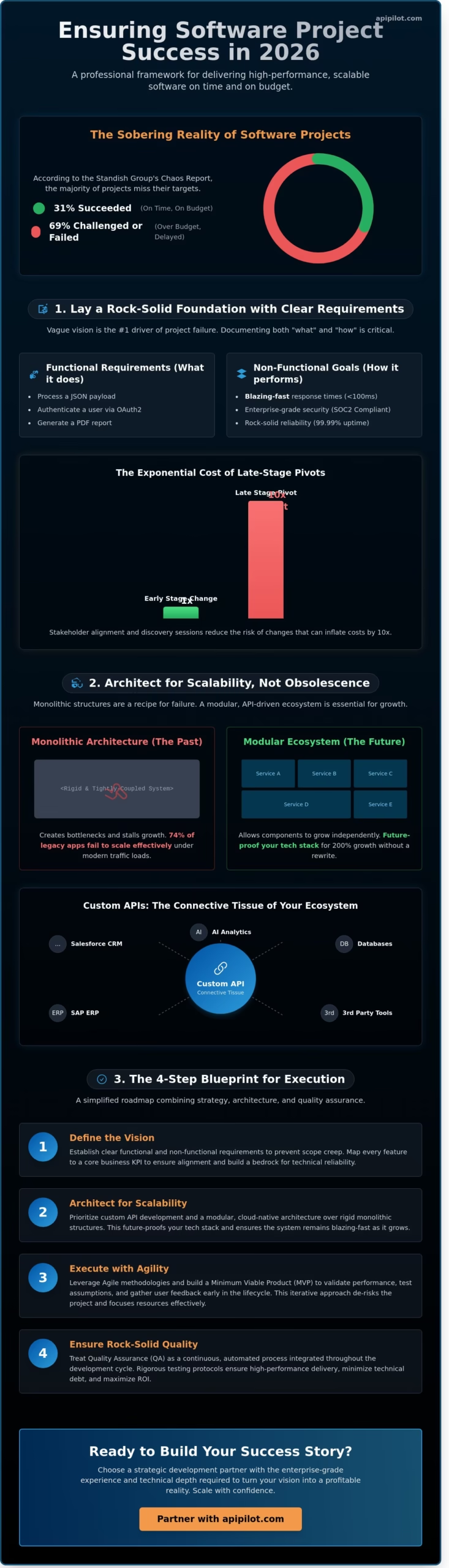
The Standish Group Chaos Report reveals that only 31 percent of software projects are completed on time and within budget. If you’ve experienced a 40 percent budget overrun or watched technical debt stall your production, you understand that traditional management often fails. Learning how to ensure software project success in 2026 requires moving beyond basic coding to a rock-solid integration of business goals and technical execution. It’s frustrating when developers focus on features while ignoring the ROI, but this misalignment is a solvable architectural problem.
This article provides the professional frameworks you need to deliver high-performance, scalable software without the typical friction. You’ll master the essential technical strategies to build enterprise-grade systems that remain blazing-fast as they grow. We’re providing a clear roadmap that covers modular architecture, automated testing protocols, and the strategic alignment required to turn your technical vision into a profitable reality.
Key Takeaways
- Learn how to define clear requirements to prevent costly scope creep and establish a bedrock for technical reliability and business alignment.
- Architect blazing-fast, scalable ecosystems by prioritizing custom API development over rigid monolithic structures to future-proof your tech stack.
- Discover how to ensure software project success by leveraging Agile methodologies and MVPs to validate performance and goals early in the lifecycle.
- Establish a rock-solid standard by treating quality assurance as a continuous, automated process that ensures high-performance delivery and maximum ROI.
- Identify the critical technical depth and enterprise-grade experience required to choose a strategic development partner that scales with confidence.
Defining the Vision: Why Clear Requirements are the Bedrock of Success
Software project success isn’t just about writing code; it’s about delivering a robust solution that hits specific business KPIs within strict resource limits. In 2026, the margin for error is razor-thin. You must balance technical reliability with commercial goals to stay competitive. A “vague vision” is the primary driver of project failure. Research from the Standish Group indicates that 66% of software projects either fail or face significant challenges, often because the initial roadmap lacked precision. When documentation is thin, scope creep takes over, bloated budgets follow, and timelines shatter.
To better understand this concept, watch this helpful video:
You must distinguish between functional requirements and non-functional performance goals. Functional requirements describe what the software does, such as processing a JSON payload or authenticating a user. Non-functional goals define how the system performs, focusing on blazing-fast response times, enterprise-grade security, and 99.99% uptime. Learning how to ensure software project success requires documenting both with equal rigor. If your API is functional but takes five seconds to respond, it’s a technical failure that impacts the bottom line.
Mapping Business Goals to Technical Features
Start by identifying your “North Star” metric. This is the single most important data point that tracks your software’s value, such as reducing data processing time by 40%. Every feature you build must support this metric. Use a Feature Priority Matrix to categorize tasks into “Must-have,” “Should-have,” and “Nice-to-have” buckets. This prevents resource exhaustion during the initial build. Define your project in one sentence: “This platform automates real-time currency conversion to eliminate manual entry errors for 500 enterprise clients.”
The Role of Stakeholder Alignment
Architecting for Scalability: Why Custom APIs and Flexibility Matter
Monolithic structures are a recipe for failure in 2026. These rigid systems create bottlenecks that prevent 74% of legacy applications from scaling effectively under modern traffic loads. To understand how to ensure software project success, developers must prioritize modularity. Building a modular ecosystem allows individual components to grow independently, ensuring that a surge in user activity doesn’t crash the entire platform.
Future-proofing your investment requires a tech stack that accommodates 200% growth without requiring a total rewrite. This means moving toward cloud-native architectures that support microservices. Data security and compliance aren’t just afterthoughts; they’re foundational requirements. With global data breach costs averaging $4.88 million in 2024, your architecture must include SOC2 or GDPR compliance protocols from the first line of code.
The Strategic Advantage of Custom APIs
Custom APIs act as the connective tissue for your digital ecosystem. They allow for seamless integration with enterprise CRMs like Salesforce or ERPs like SAP, ensuring data flows without manual intervention. By using a decoupled architecture, you significantly reduce technical debt. This approach ensures your software talks to future technologies, such as AI-driven analytics or edge computing nodes, using blazing-fast JSON endpoints that deliver results in milliseconds.
Choosing Scalable Infrastructure
Cloud-native infrastructure is non-negotiable for 2026 goals. You must choose between horizontal scaling, adding more machines, or vertical scaling, adding more power to existing ones. Most high-growth projects favor horizontal scaling for its rock-solid reliability. Prioritize redundant system designs to maintain 99.99% uptime. This ensures your service remains available even during localized server outages or maintenance windows.
- Decoupled Logic: Separate the frontend from the backend to allow for independent updates.
- Enterprise-Grade Security: Implement OAuth2 and TLS 1.3 for all API communication.
- Performance Monitoring: Use real-time telemetry to identify latency before it affects the user.
Selecting the right tools early on defines the trajectory of your build. If you want to accelerate your development timeline while maintaining high standards, you should explore custom API solutions that simplify complex integrations. This strategic choice is a primary factor in how to ensure software project success when dealing with aggressive market deadlines. High-performance teams don’t build everything from scratch; they leverage robust, reusable components to maintain speed and agility.
Executing with Agility: Managing Timelines without Sacrificing Performance
Traditional “Big Bang” releases are a relic of the past. In 2026, 70% of high-performing engineering teams prioritize iterative development to mitigate risk and handle complexity. Waiting six months to see a final product often leads to total misalignment with user needs. Agile methodology allows for continuous integration and delivery, keeping the project flexible and responsive. It’s the most reliable way to understand how to ensure software project success when market demands change overnight. By breaking work into two-week cycles, you maintain a blazing-fast development cadence that keeps stakeholders engaged and informed. This rhythm ensures that the team addresses bugs early before they become systemic failures.
Automation is the engine behind this speed. Use robust CI/CD pipelines to ensure every line of code is tested, scanned, and deployed without manual friction. This creates a rock-solid foundation for scaling. When you automate the repetitive tasks, your developers focus on high-level logic and innovation. This efficiency isn’t just about speed; it’s about building an enterprise-grade product that remains stable under heavy traffic. High-performing teams that automate 80% of their testing report a 40% reduction in post-release bugs. Automation eliminates human error in the deployment process, ensuring that your 2026 roadmap stays on schedule and within budget.
The MVP Framework for Enterprises
Enterprise projects often suffer from scope creep that kills budgets. Identify the 20% of features that deliver 80% of the core value. This is your Minimum Viable Product (MVP). 2024 benchmarks show teams that launch an MVP 30% faster gather critical data that saves months of development. Use this data to inform phase two. Avoid the feature trap where 65% of functions are rarely used. Focus on utility to guarantee ROI.
Effective Communication Protocols
Transparency is non-negotiable. Establish a single source of truth using tools like Jira or Trello. Every task needs a clear owner and a hard deadline. Weekly sprints provide a predictable rhythm for feedback. This structure is essential for how to ensure software project success during pivots. When shifts occur, don’t derail the project; re-prioritize the backlog. Clear loops ensure 100% stakeholder alignment, preventing costly misunderstandings and delayed launches in 2026.
The “Rock-Solid” Standard: Rigorous Testing and Quality Assurance
Quality assurance isn’t a final hurdle to clear before launch. It’s a continuous thread that runs through the entire development lifecycle. To understand how to ensure software project success in 2026, you must treat QA as an integrated engineering discipline rather than a post-development checklist. A 2023 report by the Consortium for Information & Software Quality (CISQ) estimated that the cost of poor software quality in the US reached $2.41 trillion. You can’t afford to be part of that statistic.
Finding the right balance between automated and manual testing is critical for maximizing ROI. Automated testing provides blazing-fast feedback loops for repetitive tasks, allowing developers to catch regressions in minutes. However, manual exploratory testing remains essential for evaluating user experience and complex edge cases that scripts might miss. High-performing engineering teams typically aim to automate 75% of their test suites to maintain rock-solid stability while scaling at speed.
The Continuous Testing Pipeline
A robust pipeline integrates Unit, Integration, and User Acceptance Testing (UAT) into every code commit. Automated regression testing is non-negotiable for scalable applications; it ensures that new features don’t break existing functionality. You must also conduct stress tests to simulate 10x user growth. If your infrastructure buckles under a 400% traffic spike during a simulation, it’ll certainly fail in a real-world production environment. This proactive strategy is a primary factor in how to ensure software project success for enterprise-grade tools.
Security and Compliance Checkpoints
Security isn’t a feature, it’s a fundamental requirement. Integrate OWASP security standards into your development flow from day one to mitigate risks like SQL injection or broken access control. Compliance is equally vital if you handle sensitive user data. Ensure your architecture meets GDPR, HIPAA, or industry-specific standards through regular audits. Routine vulnerability scanning must become a rock-solid maintenance habit. IBM’s 2023 Cost of a Data Breach Report noted the average breach cost hit $4.45 million. Consistent auditing protects your data and preserves the user trust you’ve worked hard to build.
Building high-performance applications requires the right tools and a reliable infrastructure. To streamline your development and testing processes, explore powerful API solutions that deliver enterprise-grade reliability and speed.
Scaling with Confidence: Choosing a Strategic Development Partner
Finding a vendor is easy. Finding a partner that understands how to ensure software project success is the real challenge for 2026. A standard coding shop follows a ticket queue. They build exactly what you ask for, even if the request is flawed. A strategic partner audits your business logic, anticipates technical debt, and builds for 10x scale. By 2025, data shows that 70% of enterprise software failures will stem from poor architectural alignment rather than bad code. You need technical depth that covers custom API integrations and enterprise-grade security protocols.
Success doesn’t end at deployment. A 2024 industry report by the Standish Group suggests that post-launch maintenance and iterative updates account for 60% of total software lifecycle costs. A strategic partner provides a long-term roadmap instead of a one-off delivery. They leverage US-based strategic oversight with global execution teams to maintain 24/7 momentum. This model ensures your project moves while you sleep, utilizing time zone differences as a competitive advantage rather than a hurdle.
Evaluating Your Development Partner
Check for a proven track record in complex ecosystems like custom CRMs, ERPs, and mobile apps. Demand a developer-first mindset. This means prioritizing clean code and comprehensive documentation that your internal team can actually use. Transparency is the ultimate trust signal. If a partner doesn’t provide real-time access to Git repositories or Jira boards, they’re likely hiding friction. High-performing teams share their progress daily to maintain velocity and ensure the strategy aligns with the code.
The API Pilot Advantage
API Pilot delivers blazing-fast and rock-solid custom solutions designed for the 2026 market. We understand how to ensure software project success by combining Las Vegas strategic leadership with Karachi technical execution. This allows us to keep your project moving around the clock without sacrificing quality. Our experts specialize in building robust, enterprise-grade architectures that don’t just work; they scale with your business. Ready to build? Consult with our software experts at API Pilot today.
Architect Your Digital Future
Navigating the complexities of the 2026 tech landscape demands a shift from reactive development to proactive, architectural excellence. Success relies on defining clear requirements and prioritizing custom APIs that offer long-term flexibility. By integrating rigorous testing protocols and agile execution, you eliminate the friction that typically stalls enterprise growth. Understanding how to ensure software project success isn’t just about code; it’s about building a foundation that scales without compromise.
The right partner turns these strategic principles into high-performance reality. API Pilot brings expertise in custom ERP, CRM, and Mobile Apps to every build, ensuring your infrastructure stays resilient. We provide blazing-fast execution paired with enterprise-grade security to protect your most valuable assets. Join the community of 1,000,000+ developers who rely on our robust tools to deliver results that last. You don’t have to settle for legacy limitations when you can build for the future today.
Build Your Rock-Solid Software with API Pilot
It’s time to transform your roadmap into a powerful, functional reality. Your next big breakthrough is closer than you think.
Frequently Asked Questions
What is the number one reason software projects fail?
Unclear requirements and scope creep represent the primary cause of project failure. The Standish Group reports that 31.1% of software projects are canceled before they ever finish. Without a rock-solid roadmap, teams lose focus on core functionality. You can’t build a robust application on shifting sand. Clear documentation ensures every endpoint and feature aligns with business goals from day one.
How do I choose the right tech stack for my custom software?
Select your stack based on specific project requirements and ecosystem maturity. Stack Overflow’s 2023 survey indicates 65% of developers prefer JavaScript and Python for their extensive libraries and community support. You need a powerful foundation that supports blazing-fast performance. Don’t pick a niche language if you can’t find developers to maintain it. Focus on enterprise-grade frameworks that offer seamless integration with your existing infrastructure.
How much should a custom software project cost in 2026?
Enterprise-grade software projects usually require a budget between $50,000 and $250,000. This range depends on the number of integrations and the complexity of the logic. To understand how to ensure software project success, you must align your budget with realistic development timelines. High-quality, robust code requires investment in senior talent and rigorous testing phases. Cutting corners on the initial build often leads to 40% higher maintenance costs later.
What is the difference between custom software and off-the-shelf solutions?
Custom software provides a tailored solution designed for your unique workflows. Gartner reports that 75% of organizations choose custom builds to secure a competitive advantage that off-the-shelf products can’t provide. While generic tools offer quick setup, they often lack the scalability your business needs to grow. Custom development allows for seamless API integration and total control over your data architecture.
How long does it typically take to see a successful software launch?
You should expect a development timeline of 3 to 6 months for a functional Minimum Viable Product. GoodFirms data indicates the average cycle for a standard application is approximately 4.5 months. This timeframe includes discovery, design, and rock-solid testing. Speed is vital, but rushing the launch often introduces technical debt. A phased approach allows you to iterate quickly based on real user feedback.
Why is custom API development important for my business growth?
Custom API development enables seamless data exchange between your internal systems and external partners. Postman’s 2023 report highlights that 89% of organizations view APIs as critical to their operational success. By building your own endpoints, you can automate manual tasks and scale your services. It’s the most efficient way to power modern, interconnected business ecosystems and ensure long-term growth.
How do I manage a remote software development team effectively?
Effective management relies on clear documentation and agile frameworks like Scrum. A 2022 Buffer study shows 52% of successful remote teams prioritize asynchronous communication to maintain high velocity. Set firm expectations for daily standups and code reviews. Providing your team with powerful collaboration tools ensures they can integrate their work without friction, regardless of their physical location or time zone.
What post-launch support is necessary for software project success?
Continuous monitoring and regular security updates are vital for long-term stability. IEEE research shows that 60% of total software costs are actually incurred during the post-launch maintenance phase. You need a dedicated plan for bug fixes and feature updates to keep the system robust. Learning how to ensure software project success means recognizing that the launch is just the beginning of the product lifecycle.


