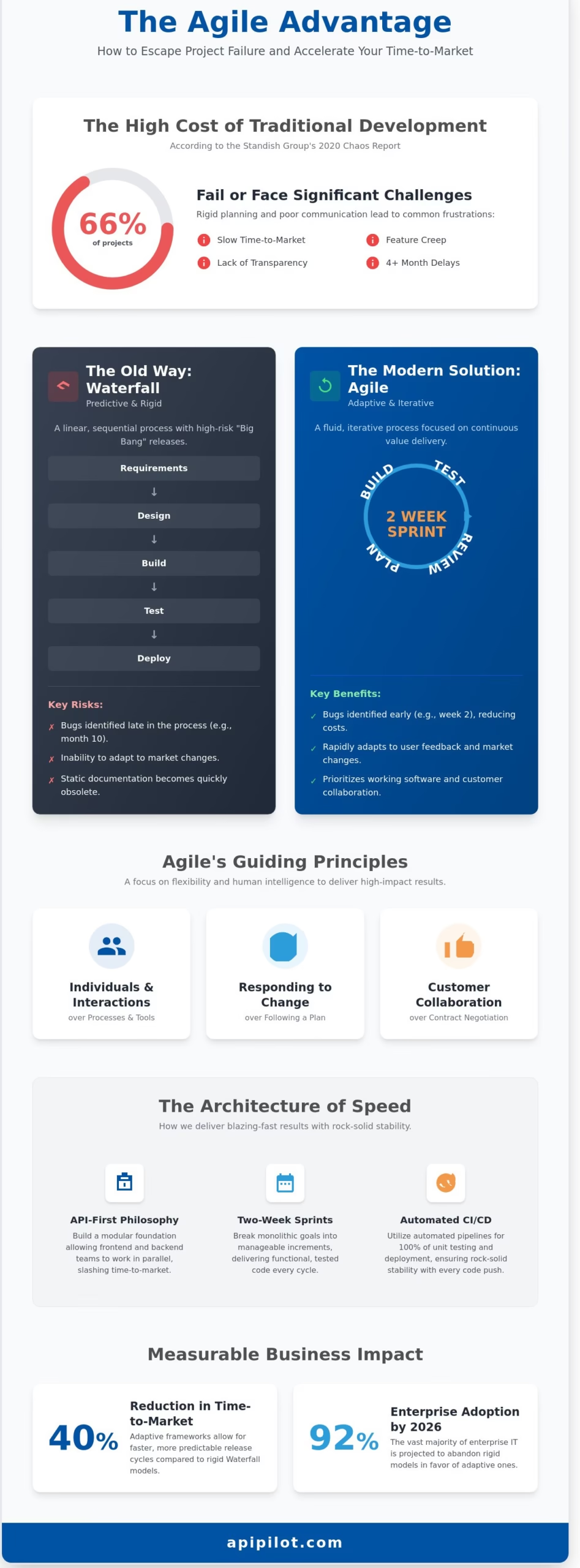
According to the Standish Group’s 2020 Chaos Report, 66% of software projects fail or face significant challenges because of rigid planning and poor communication. You’ve likely felt the frustration of feature creep or a slow time-to-market that pushes your launch date 4 months past the original deadline. It’s exhausting when a lack of transparency makes the development process feel like a black box. Professional agile software development services solve these pains by replacing guesswork with data-driven, iterative progress that keeps your team in control.
You’ll discover how to accelerate deployment and reduce risk while building rock-solid, enterprise-grade solutions that scale with your business needs. We’ll show you how to achieve predictable release cycles, establish a robust software architecture, and foster a collaborative partnership that delivers blazing-fast results regardless of market changes. By the end of this article, you’ll have a clear roadmap for creating digital products that are both powerful and adaptable to your specific goals.
Key Takeaways
- Learn how to replace high-risk “Big Bang” releases with a continuous delivery model that prioritizes rapid user feedback and iterative growth.
- Discover how an “API-First” philosophy and two-week sprints provide the architecture of speed needed to build robust foundations for complex enterprise integrations.
- Understand the critical differences between predictive and adaptive planning to mitigate risks and identify bugs in week two rather than month ten.
- Maximize your project’s ROI by utilizing agile software development services that align technical execution with business goals through precise success metrics like cycle time and velocity.
- Explore how to deploy rock-solid, enterprise-grade digital products that ensure seamless scalability and high-performance execution for your custom business solutions.
What are Agile Software Development Services?
Agile software development services represent a paradigm shift from rigid, linear engineering to a fluid, iterative process. This approach prioritizes the rapid delivery of functional code and continuous user feedback over exhaustive upfront planning. In a typical engagement, development teams break complex projects into manageable increments known as sprints, usually lasting two to four weeks. This ensures that the product evolves based on real-world usage rather than static assumptions made months prior. Agile software development is now the industry standard for organizations that require blazing-fast deployment without sacrificing code quality.
To better understand this concept, watch this helpful video:
The transition from “Big Bang” releases to continuous value delivery is no longer optional for competitive firms. By 2026, 92% of enterprise IT departments are projected to abandon rigid Waterfall models in favor of adaptive frameworks to reduce time-to-market by up to 40%. This shift focuses on producing working software over maintaining comprehensive but static documentation that often becomes obsolete before the first line of code is even written. It is about building enterprise-grade solutions that are robust, scalable, and ready for immediate deployment.
The Core Values of the Agile Manifesto
The foundation of agile software development services lies in four critical values that prioritize human intelligence and flexibility. These principles ensure that engineering teams remain focused on high-impact results:
- Individuals and interactions over processes and tools: Technology is only as effective as the people who build it. Direct communication prevents the bottlenecks common in siloed organizations.
- Responding to change over following a rigid project plan: In a volatile market, the ability to pivot is a competitive advantage. Agile teams adjust their roadmap every sprint to reflect new data.
- Customer collaboration throughout the entire development lifecycle: Clients aren’t just stakeholders; they’re active participants. This constant loop ensures the final product meets actual business needs.
Why “Done” is Better Than “Perfect”
In Agile engineering, the Minimum Viable Product (MVP) is the primary vehicle for innovation. Instead of spending years perfecting a feature-heavy application that might miss the mark, teams launch a rock-solid core version to gather data. This iterative cycle significantly reduces the cost of technical debt, as developers identify and fix architectural flaws early in the process. Agile is a high-performance risk-mitigation strategy that ensures modern software remains resilient against shifting market demands. By focusing on “done” increments, businesses achieve a seamless flow of value and maintain a reliable, high-uptime environment for their users.
The Architecture of Speed: How We Deliver Blazing-Fast Sprints
We adopt an API-First philosophy to ensure every enterprise-grade solution remains modular and extensible. This approach builds a robust foundation where internal and external integrations work without friction. By prioritizing endpoints and data structures first, our agile software development services allow frontend and backend teams to work in parallel. This methodology typically slashes time-to-market by up to 30% compared to traditional waterfall approaches.
Complex enterprise requirements don’t have to lead to project stagnation. We break monolithic goals into manageable two-week sprints. Each sprint delivers a functional, tested increment of the product. This iterative process has the potential to save the government billions and provides private sector firms with similar radical cost efficiencies by catching errors early. Our Scrum Masters act as the engine oil, removing technical friction and shielding the team from scope creep. We pair this human oversight with automated CI/CD pipelines. These pipelines handle 100% of the unit testing and deployment tasks, ensuring rock-solid stability with every code push.
Scrum vs. Kanban: Choosing the Right Workflow
We don’t believe in one-size-fits-all solutions. Scrum is our primary choice for structured, time-boxed delivery when building specific feature sets. It provides a predictable cadence for stakeholders. Kanban works better for high-velocity maintenance tasks or continuous flow environments where priorities shift daily. Many clients find success with hybrid models that tailor the methodology to specific business KPIs. If you need a partner to help you design your ideal workflow, we can align our process to your internal culture.
Developer-Centric Transparency
Transparency is a requirement, not a feature. Clients get real-time access to progress tracking tools like Jira or Trello. Daily stand-ups focus strictly on blockers and immediate solutions to keep the momentum high. We avoid long, theoretical meetings that drain productivity. Our teams prioritize clean, self-documenting code over fluff because technical debt is the primary enemy of long-term speed. Every line of code is written to be read by humans and executed by machines, ensuring your agile software development services investment remains valuable for years.
- Real-time Dashboards: Instant visibility into sprint velocity and burn-down charts.
- Automated Testing: CI/CD triggers that prevent broken code from hitting production.
- Blocker Resolution: Scrum Masters dedicated to clearing path-to-production obstacles within 24 hours.
Agile vs. Waterfall: Navigating the Shift in Enterprise Development
Choosing a methodology dictates your project’s trajectory, risk profile, and eventual ROI. Waterfall relies on predictive planning. You define every requirement upfront and move through linear phases. This creates a rigid structure where changes are costly. Agile software development services utilize adaptive planning. Instead of a single “big bang” release, you build in iterations. This shift allows teams to pivot based on real-time data and user feedback. According to the Standish Group’s Chaos Report, Agile projects are 3X more likely to succeed than Waterfall projects because they prioritize flexibility over rigid adherence to a 12-month-old plan.
Risk management is where the two diverge most sharply. In a Waterfall model, integration happens late. You might identify a critical logic flaw or security vulnerability in month 10, just before launch. At that stage, remediation is expensive and often delays the go-to-market date. Agile identifies these “deal-breakers” by week 2 or 3. By building, testing, and reviewing in two-week sprints, you ensure the technical foundation is rock-solid from the start. Stakeholder engagement also shifts from a passive “review at the end” role to an active “review every sprint” partnership. This constant visibility prevents the 45% budget overruns common in traditional enterprise projects.
- Predictive: Fixed requirements, high risk of late-stage failure.
- Adaptive: Evolving requirements, continuous risk mitigation.
- Budgeting: Agile provides better ROI by delivering high-value features first.
- Feedback: Bi-weekly demos replace monthly status reports.
When Waterfall Still Makes Sense
Waterfall isn’t obsolete; it’s specialized. It works for fixed-scope, low-complexity projects where requirements won’t change. This is often the case in highly regulated environments, such as medical device software or aerospace engineering, where strict sequential documentation is a legal mandate. However, applying Waterfall to innovative SaaS or mobile app products is dangerous. Research shows that 64% of features in traditional software are rarely or never used. Agile ensures you don’t waste capital building features your users don’t actually want.
The “Agile Fallacy”: Common Pitfalls to Avoid
Agile doesn’t mean “no deadlines” or “zero planning.” That’s a common misconception that leads to project drift. High-performing agile software development services require more discipline than Waterfall, not less. You need a strong Product Owner to act as a gatekeeper, preventing scope bloat that can sink a budget. It’s also vital to maintain architectural integrity. You can’t just “wing” the infrastructure. Every iteration must contribute to a scalable, enterprise-grade foundation, ensuring the code remains maintainable as the product grows. Without this focus, you’ll accumulate technical debt that slows development to a crawl by the sixth month.
Maximizing ROI: A Practical Guide to Managing Agile Projects
High performance development isn’t about working harder; it’s about working smarter. To get the most out of agile software development services, you need a framework that prioritizes value over volume. ROI in Agile is driven by transparency and the ability to pivot based on real time data. You can’t manage what you don’t measure. Tracking Velocity, Burn-down charts, and Cycle time provides a rock-solid foundation for decision-making.
- Velocity: This measures the amount of work a team completes in a single sprint. It helps project leads predict future delivery dates with 90% accuracy based on historical performance.
- Burn-down Charts: These visual tools show the remaining work versus the time available in the sprint. They offer an instant health check to ensure the team stays on track.
- Cycle Time: This calculates the total time from when a task enters “In Progress” to when it hits “Done.” Reducing cycle time by just 12% can significantly accelerate your total time to market.
The Product Owner acts as the critical bridge in this process. They translate business requirements into technical reality, ensuring the engineering team spends 100% of their energy on high impact tasks. Instead of rigid, fixed price contracts that stifle innovation, enterprise projects thrive on Time and Materials (T&M) budgets. This model provides the blazing-fast flexibility needed to adjust scope as your product evolves, ensuring you never pay for features that don’t add value.
Effective Backlog Grooming
Vague ideas lead to technical debt. Effective grooming turns high level concepts into actionable User Stories. Use the MoSCoW technique to categorize every task. By focusing the first 3 sprints on Must have features, you ensure a functional MVP is ready for testing sooner. This rigorous prioritization keeps the team focused on the most impactful tasks, preventing scope creep from draining your budget.
The Power of the Sprint Retrospective
The retrospective is your engine for continuous improvement. Every iteration is a learning opportunity to refine processes and optimize team velocity. Data shows that teams who conduct consistent retrospectives see a 20% increase in productivity over a six month period. Agile turns feedback into a competitive advantage by shortening the distance between identifying a bottleneck and implementing a rock-solid solution.
Build your next project with enterprise-grade agile software development services that prioritize performance and scalability.
Partner with API Pilot: Rock-Solid Agile Development
Choosing the right partner for agile software development services determines whether your project thrives or stalls. At API Pilot, we’ve replaced traditional, slow-moving agency models with a high-velocity framework built for speed and security. We specialize in blazing-fast execution that doesn’t cut corners. Our team delivers enterprise-grade security protocols in every build, ensuring your data remains protected as you scale. We don’t believe in “one size fits all” solutions. Instead, we build tailored systems, ranging from custom CRMs that manage 50,000+ concurrent users to high-performance mobile apps that maintain 99.99% uptime under heavy loads.
Our global expertise spans continents, delivering results for clients from the tech hubs of Las Vegas to the emerging markets of Karachi. This international perspective allows us to maintain 24/7 development cycles, significantly reducing your time-to-market. We’ve refined a “No-Nonsense” approach that prioritizes functional code over endless meetings. It’s a philosophy focused on technical excellence and measurable growth. We provide the architecture you need to dominate your niche without the typical friction of outsourced development.
Scalable Software for Global Growth
We build with future-proof tech stacks like Node.js, Python, and Go, ensuring your infrastructure scales as your user base grows. Our engineers focus on custom API development to connect your entire digital ecosystem, allowing seamless data flow between legacy systems and modern cloud environments. We handle the entire process from initial concept and wireframing to deployment and post-launch maintenance. By automating CI/CD pipelines, we ensure that new features are pushed to production in minutes, not days, maintaining the momentum your business requires.
Ready to Accelerate Your Development?
Success in a competitive market requires more than just code; it requires a strategic roadmap. Consult with our experts to define an Agile roadmap that aligns with your specific business objectives. You’ll experience the difference of a developer-first partnership where transparency and performance are the primary metrics. We’re ready to transform your vision into a robust, scalable reality. Contact API Pilot today for a custom software consultation and let’s build something powerful together.
Future-Proof Your Tech Stack Today
Transitioning from rigid Waterfall structures to agile software development services isn’t just a trend; it’s a strategic necessity for modern enterprises. You’ve seen how blazing-fast sprints and optimized ROI transform your project lifecycle from a bottleneck into a competitive advantage. Success depends on choosing a partner who provides rock-solid uptime and enterprise-grade custom software solutions that scale without friction. This approach ensures your architecture remains flexible enough to handle sudden market shifts while maintaining peak performance standards.
API Pilot supports your growth with technical precision and deep expertise. We’re already trusted by 1,000,000+ developers who rely on our infrastructure for its blazing-fast performance and reliability. Don’t let technical debt or slow release cycles hold your business back. It’s time to build a robust foundation that evolves with your market demands and keeps your users engaged. Our team is ready to help you navigate the complexities of modern software development with total confidence.
Ready to launch? Build Your Scalable Solution with API Pilot and start shipping better code faster.
Frequently Asked Questions
What is the primary benefit of agile software development services for a startup?
The primary benefit of agile software development services for a startup is the ability to launch a Minimum Viable Product (MVP) quickly to validate market assumptions. This iterative approach increases the success rate of complex software projects by 2X compared to traditional methods according to the Standish Group. You get to test core features with real users within 14 days. It ensures your limited capital goes toward features that actually drive user engagement.
How do you control the budget in an Agile project if the scope changes?
You control the budget by prioritizing a dynamic product backlog and fixing the cost per sprint. If you add a new high-priority feature, you must remove or deprioritize an existing item of equivalent effort. This trade-off mechanism keeps the total cost predictable. According to the 15th State of Agile Report, 43% of teams cite managing changing priorities as a top reason for Agile adoption because it keeps spending aligned with current business value.
Does Agile development mean there will be no documentation for my software?
No, it means just-in-time documentation that focuses on essential technical requirements and system architecture. You’ll receive clear API documentation, README files, and automated test suites that serve as living technical specs. This approach ensures your technical debt stays low while keeping the system maintainable. It’s about providing rock-solid documentation that developers actually use rather than static files that become obsolete 30 days after the project starts.
What is the difference between Scrum and Agile?
Agile is the overarching philosophy, while Scrum is a specific framework used to implement those principles. Think of Agile as the strategy and Scrum as the tactical execution plan. Scrum is the most popular Agile framework, used by 66% of Agile practitioners globally according to Digital.ai. It provides a structured rhythm with daily stand-ups, sprint reviews, and retrospectives to ensure the team delivers enterprise-grade code consistently.
How often will I see progress during the Agile development process?
You’ll review working software during a sprint demo every 14 days. These sessions allow you to interact with the latest build and provide immediate feedback. This fast-paced rhythm ensures the project never drifts from your vision for more than 10 business days. It creates a transparent environment where you can track velocity and see tangible results through a blazing-fast feedback loop.
Can I switch from Waterfall to Agile in the middle of a project?
You can switch to Agile mid-project by auditing your current progress and converting the remaining requirements into a prioritized backlog. According to a 2023 industry survey, 48% of teams successfully transitioned from Waterfall to Agile during active development phases. By shifting to agile software development services, you gain the flexibility to pivot based on new data. This transition typically requires a 3-week stabilization period to re-align the team’s workflow.
What is the role of a Product Owner in Agile development?
The Product Owner is the sole person responsible for managing the product backlog and maximizing the value of the work the team performs. They make the final call on which features have the highest ROI and ensure the development team understands the business goals. It’s a critical role that prevents scope creep and ensures every line of code contributes to a robust, scalable solution. Without a clear Product Owner, projects often suffer from 35% longer delivery times.


