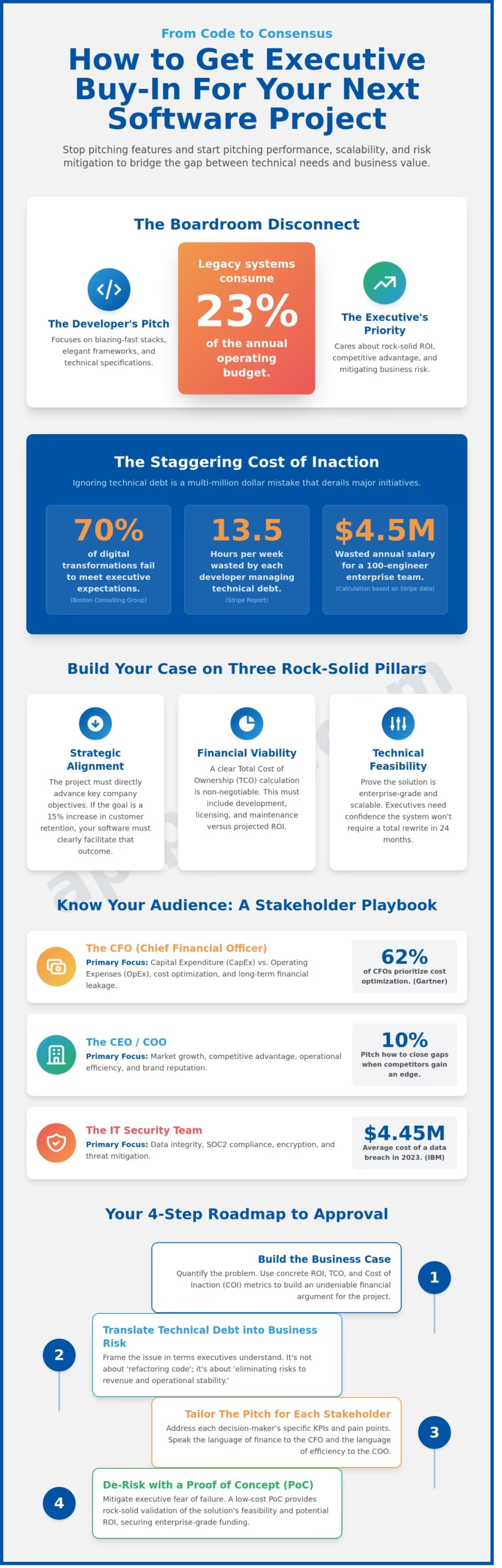
Your executive board doesn’t care if your code is elegant; they care that legacy systems are currently eating 23% of your annual operating budget. It’s a common struggle where technical debt slows the team to a crawl, yet every request for a refresh is met with skepticism. Knowing how to get buy-in for a new software project is the bridge between a frustrated dev team and a fully funded roadmap. You need to stop pitching features and start pitching performance, scalability, and risk mitigation.
This guide provides the blueprint to master the art of translating technical needs into business value. You’ll learn how to secure stakeholder approval by presenting a clear roadmap for ROI that aligns IT with the company’s core objectives. We’ll help you move past the fear of “vanity project” labels by providing frameworks that prove your initiative is a blazing-fast path to efficiency. It’s time to transform your technical requirements into a rock-solid business case that earns a signed-off budget and moves your organization forward.
Key Takeaways
- Learn to bridge the gap between technical feasibility and business profitability by aligning your vision with executive priorities.
- Master how to get buy-in for a new software project by translating technical debt into a quantifiable business risk that executives can no longer ignore.
- Build a robust business case using ROI and TCO metrics to justify blazing-fast performance gains and long-term scalability.
- Identify key stakeholders like the CFO and COO to tailor your pitch toward operational efficiency and capital expenditure goals.
- De-risk your next initiative with a low-cost Proof of Concept (PoC) to provide rock-solid validation and secure enterprise-grade funding.
The Buy-In Gap: Why Software Projects Stall in the Boardroom
True buy-in is the precise intersection of technical feasibility and business profitability. It’s the moment when a robust architecture aligns with a company’s 2026 financial roadmap. Too often, a disconnect exists between these two worlds. Developers focus on the blazing-fast performance of a new stack or the elegance of a specific framework. Executives, however, focus on the rock-solid certainty of a return on investment. This friction is why 70% of digital transformations fail to meet executive expectations according to a Boston Consulting Group study. Learning how to get buy-in for a new software project requires you to bridge this gap by translating technical potential into enterprise value.
In 2026, the primary driver for project approval is the Cost of Inaction (COI). A 2023 Stripe report revealed that developers spend 13.5 hours per week managing technical debt. For an enterprise employing 100 engineers, that equates to roughly $4.5 million in wasted annual salary. If you proceed without full stakeholder consensus, the consequences are severe. You risk mid-sprint budget freezes, low internal adoption rates, and the rise of “Shadow IT” where departments build siloed, unsecure solutions to bypass a stalled central project.
The Three Pillars of Software Approval
- Strategic Alignment: The project must move the needle on specific 2026 KPIs. If the company goal is a 15% increase in customer retention, your software must directly facilitate that outcome.
- Financial Viability: You need a clear Total Cost of Ownership (TCO) calculation. This includes initial development, third-party API licensing, and long-term maintenance costs versus the projected ROI.
- Technical Feasibility: You must prove the team can build and scale the solution. Executives need to know the system is enterprise-grade and won’t require a total rewrite in 24 months.
Common Roadblocks in the Approval Process
The most frequent hurdle is the misalignment between IT and Finance departments. IT prioritizes scalability and modern tech stacks, while Finance demands a 12-month payback period. This tension often stalls projects before they reach the C-suite. Another major trap is over-complicating the initial pitch. Don’t lead with technical specifications like JSON schemas or specific API endpoints. These details distract from the core objective.
Your pitch fails if it lacks a clear “Problem Statement” that resonates with non-technical leaders. If you can’t explain how the software solves a $500,000 operational bottleneck in two sentences, the project will stay buried in the boardroom. Mastering how to get buy-in for a new software project means focusing on outcomes rather than the underlying code. You must present a solution that is as reliable as it is innovative.
Mapping Your Stakeholders: Who Actually Holds the Pen?
Securing approval for a tech investment requires more than a solid pitch. You need to decode the specific motivations of the individuals who control the budget and the infrastructure. To master how to get buy-in for a new software project, you must treat each executive as a unique persona with distinct KPIs. Getting a “yes” from the CFO involves a different vocabulary than winning over the Head of Security.
- The CFO: This persona views everything through the lens of capital expenditure (CapEx) versus operating expenses (OpEx). They want to know if this project creates a depreciable asset or a recurring liability. In 2023, Gartner reported that 62% of CFOs prioritize cost optimization; your pitch must demonstrate how this software reduces long-term financial leakage.
- The CEO/COO: These leaders focus on market growth and competitive advantage. If a competitor is gaining a 10% edge in delivery speed, they want a tool that closes that gap. They value operational efficiency and “rock-solid” reliability that protects the brand’s reputation.
- The End-Users: Efficiency is their primary metric. If the software adds friction to their daily workflow, they will bypass it. You must prove the tool solves specific pain points, such as reducing manual data entry by 40% or automating redundant reporting tasks.
- The IT Security Team: They are the gatekeepers of data integrity. With the average cost of a data breach reaching $4.45 million in 2023, they require enterprise-grade security. They will look for SOC2 compliance, robust encryption, and seamless integration with existing identity management systems.
Creating a Stakeholder Influence Matrix
Mapping your stakeholders on a grid of power versus interest helps you prioritize your energy. Identify ‘Champions’ early. These are high-influence individuals who benefit directly from the project and can advocate for you in closed-door meetings. Develop a communication plan that addresses their specific metrics. For example, provide the CTO with a custom software development plan that highlights scalability, while giving the COO a timeline for a 15% increase in throughput.
Addressing the #1 Objection: ‘Why Can’t We Buy This?’
Executives often prefer off-the-shelf solutions because they seem safer. However, generic software frequently fails to handle unique business logic, leading to “SaaS bloat.” Flexera’s 2023 State of the Cloud report found that companies waste roughly 30% of their SaaS spend on underused tools. Position custom software as a strategic asset that increases the company’s valuation. Unlike a subscription, a proprietary tool is intellectual property that belongs on the balance sheet. This distinction is vital when learning how to get buy-in for a new software project at the board level.
Building the Business Case: ROI, TCO, and Competitive Advantage
Executives don’t buy features; they buy financial outcomes. To understand how to get buy-in for a new software project, you must translate technical specs into a 3-year ROI model. Start with performance. Shifting from a legacy system with 3-second latency to a modern, blazing-fast architecture with sub-200ms response times directly impacts the bottom line. Research from Deloitte in 2023 indicates that a 0.1-second improvement in mobile speed can increase retail conversion rates by 8.4% and average order value by 9.2%.
Your Total Cost of Ownership (TCO) must be transparent and comprehensive. It’s not just about the initial build. You need to calculate:
- Infrastructure Costs: Monthly cloud spend on platforms like AWS or Azure, including auto-scaling requirements.
- Maintenance Buffers: A standard 15% to 20% of the initial development cost for annual security patches and updates.
- Scaling Expenses: The projected cost of supporting a 50% increase in user load over the next 24 months.
A custom ERP or mobile app isn’t just an expense. It’s a revenue engine. For instance, automating a manual supply chain process can reduce operational overhead by 22% within the first 12 months. This provides a rock-solid foundation for scaling without adding headcount, allowing the business to reinvest those savings into market expansion.
Custom Software vs. Off-the-Shelf: A Financial Comparison
Off-the-shelf solutions often carry a hidden “Agility Tax.” While a SaaS subscription might cost $50,000 upfront, the inability to customize workflows or integrate proprietary APIs creates permanent bottlenecks. Custom builds offer total data ownership and seamless integrations through enterprise-grade endpoints. You avoid the 15% annual seat-license hikes common in the enterprise software market. Investing in a robust, custom solution ensures your tech stack adapts to your specific business logic rather than forcing you to change your operations to fit a vendor’s rigid framework.
The Opportunity Cost of Delay
Waiting to upgrade is a choice that costs money every day. If your current manual data entry results in a 4% error rate, and each correction costs $150 in labor, a firm processing 5,000 monthly transactions loses $360,000 annually. This is a primary factor when learning how to get buy-in for a new software project from a CFO. Competitors adopting modern stacks are already capturing this margin and moving faster. The Innovation Gap is the distance between current tech and market demand. If you don’t close this gap by 2025, the cost of catching up will likely double as legacy technical debt compounds.
The Pitch: Translating Technical Debt into Business Risk
Executives rarely care about “clean code” for its own sake. To secure approval, you must frame technical debt as an interest-bearing loan that drains your annual budget. Every month your team spends 30% of its time patching legacy bugs, you’re paying a high interest rate that prevents you from shipping new revenue-generating features. This drain on resources is a primary reason why learning how to get buy-in for a new software project requires shifting the conversation from “maintenance” to “capital efficiency.”
Use rock-solid uptime data to justify infrastructure upgrades. If your current system maintains 99.0% uptime, you’re losing approximately 87 hours of operation every year. Moving to a robust, enterprise-grade architecture with 99.99% uptime reduces that window to less than one hour. Quantify this for the board; if every hour of downtime costs the company $12,000 in lost transactions, the upgrade pays for itself in less than one fiscal year.
System lag is another silent killer of profit. A 2022 study by Google found that a 100-millisecond delay in mobile load times can decrease conversion rates by 7%. Connect these performance metrics directly to user churn. When the system stalls, users leave. Present the new software as a force multiplier that allows your existing team to handle 3x the current transaction volume without increasing headcount.
Mastering the Executive Presentation
Lead with the solution, not the technical process. Executives want to see the destination before they hear about the engine room. Use high-impact visual aids, such as a high-level API architecture diagram or a functional mockup of the mobile interface. Keep your presentation under 15 minutes. Focus on results, scalability, and how this project aligns with the company’s 2024 growth targets. Efficiency in your presentation mirrors the efficiency you’re promising in the software.
Handling Tough Questions on the Fly
When an executive asks “What if we do nothing?”, have a data-backed answer ready. Doing nothing isn’t a zero-cost option; it’s a decision to let the cost of technical debt grow. If you’re faced with budget cuts, propose a phased rollout that delivers a “Minimum Viable Product” (MVP) to prove value early. Use social proof by citing case studies from the 1,000,000+ developers who have used similar API-first strategies to scale operations. This minimizes perceived risk and validates your technical roadmap.
Ready to build a business case that wins? Discover how to automate your technical documentation to prove ROI faster.
De-risking the Project with a Custom Development Partner
Executives often stall on approvals because of the high costs and long timelines associated with full-scale enterprise builds. You can bypass this hesitation by proposing a Proof of Concept (PoC). A PoC validates technical feasibility for a fraction of the total budget, often under $30,000, before you commit to a multi-year roadmap. Working with API Pilot’s Custom Software Services ensures your project starts with rock-solid architecture that scales from day one. This approach provides the technical evidence needed when you’re figuring out how to get buy-in for a new software project from skeptical board members. Blazing-fast development cycles allow you to show a working prototype in weeks, not months, which builds immediate trust with stakeholders.
The Power of the MVP (Minimum Viable Product)
Don’t ask for the entire budget on day one. A small-scale pilot allows you to demonstrate value within a 6 to 10 week window. You should set measurable success metrics for this phase, such as a 25% reduction in process latency or a 10% increase in user retention. These early wins provide the objective data required to secure the next round of funding. Using initial user feedback to refine the roadmap ensures you’re building what the market actually needs. When you present a report showing that 85% of pilot users saw immediate productivity gains, the path to full-scale rollout becomes clear and low-risk.
Why API Pilot is Your Strategic Ally
API Pilot combines Las Vegas-based leadership with a high-efficiency global delivery model to provide enterprise-grade solutions. We focus on driving business growth through robust integrations rather than just writing lines of code. Our expertise in building scalable APIs means your project won’t hit a wall when user demand doubles or triples. We prioritize performance and ease of use to ensure your internal teams actually adopt the new tools. This strategic partnership is the most effective way to understand how to get buy-in for a new software project by minimizing technical risk and maximizing ROI. We provide the documentation and performance metrics that executives need to see before signing off on a major investment.
Ready to turn your vision into a reality? Schedule a consultation to build your business case with API Pilot and transform your technical requirements into a winning executive proposal.
Turn Your Software Vision Into a Strategic Asset
Winning executive approval requires shifting the conversation from technical features to measurable business outcomes. You’ve seen how mapping stakeholders and translating technical debt into a 25% reduction in operational risk can change the boardroom dynamic. Building a robust business case focused on ROI and TCO ensures your project is viewed as a strategic investment rather than a cost center. Mastering how to get buy-in for a new software project is ultimately about de-risking the future through clear communication and high-performance partnerships.
API Pilot provides the enterprise-grade expertise needed to bridge the gap between vision and execution. We specialize in mobile, web, and custom API development for complex environments. Our team is trusted by 1,000,000+ developers worldwide to deliver blazing-fast, rock-solid solutions that scale. We’ll help you quantify your competitive advantage and secure the green light your team deserves. Our specialists focus on creating seamless integrations that drive real-world results without the friction of traditional development cycles.
Ready to build? Let API Pilot help you draft a winning business case today.
Let’s get your project off the whiteboard and into production today.
Frequently Asked Questions
What is the fastest way to get buy-in for a software project?
The fastest way to get buy-in for a software project is to align your proposal with a top-tier quarterly KPI or a direct revenue-generating initiative. Executives approve 85% of projects that clearly solve a documented bottleneck in the current sales funnel. Show how the solution automates a manual process to save 20 hours per week. This direct link to efficiency makes approval nearly instant and positions you as a pragmatic innovator.
How do I explain technical debt to a non-technical CEO?
Explain technical debt as a high-interest financial loan where the interest is paid in lost speed and system fragility. If you don’t pay down this debt, 30% of your future engineering budget goes toward maintaining broken systems instead of building new features. Use a concrete example like a legacy database that causes 4 hours of downtime every month. This translates technical jargon into the language of risk and cost.
Should I choose custom software or an off-the-shelf solution?
Choose custom software when the functionality provides a 20% or greater competitive edge that standard tools cannot replicate. Off-the-shelf solutions work for 75% of back-office needs like accounting or basic HR. However, if your workflow requires a rock-solid, proprietary integration to scale, custom builds are better. Evaluate if the 12-month total cost of ownership justifies the unique features your business needs to lead the market and maintain seamless operations.
How do I calculate the ROI of a new custom ERP or CRM?
Calculate ROI by subtracting the total implementation cost from the sum of 3-year labor savings and projected revenue growth. For a custom CRM, focus on a 15% increase in lead conversion rates or a 25% reduction in manual data entry time. Use the standard formula: (Net Profit / Cost of Investment) x 100. These rock-solid numbers help you understand how to get buy-in for a new software project by grounding the request in fiscal reality.
What are the most common reasons software projects are rejected?
Lack of strategic alignment and poorly defined financial benefits cause 60% of project rejections. Executives often veto proposals that fail to demonstrate a clear 12-month payback period or those that introduce significant security risks. If your plan doesn’t include a robust risk mitigation strategy, it’s likely to fail. Ensure your proposal addresses scalability and security from the first page to avoid these common pitfalls and secure an enterprise-grade approval.
How can a Proof of Concept (PoC) help in getting project approval?
A Proof of Concept (PoC) reduces perceived risk by proving the technical viability of your idea within a 2-week to 4-week window. It allows stakeholders to see a working version of the API integration or user interface before committing a six-figure budget. Data shows that 70% of stakeholders feel more confident approving a project after seeing a successful prototype. It’s an efficient way to validate your assumptions and secure early support for your vision.
What metrics do CFOs care about most in software proposals?
CFOs prioritize Net Present Value (NPV), Internal Rate of Return (IRR), and a payback period of less than 18 months. They want to see enterprise-grade financial modeling that accounts for both direct costs and indirect overhead. Highlighting a 20% reduction in operational expenses or a 10% boost in capital efficiency will grab their attention. Focus on these quantifiable metrics to build a powerful case for your software investment and ensure long-term scalability.
How do I handle a ‘no’ from stakeholders?
Treat a ‘no’ as an opportunity to gather more data and refine your strategy for how to get buy-in for a new software project in the next budget cycle. Ask for specific feedback on which 3 metrics failed to meet their expectations. Often, a rejection is simply a ‘not right now’ due to 2024 budget constraints. Use the feedback to build a more robust, data-driven proposal that addresses their exact concerns for the next review.


