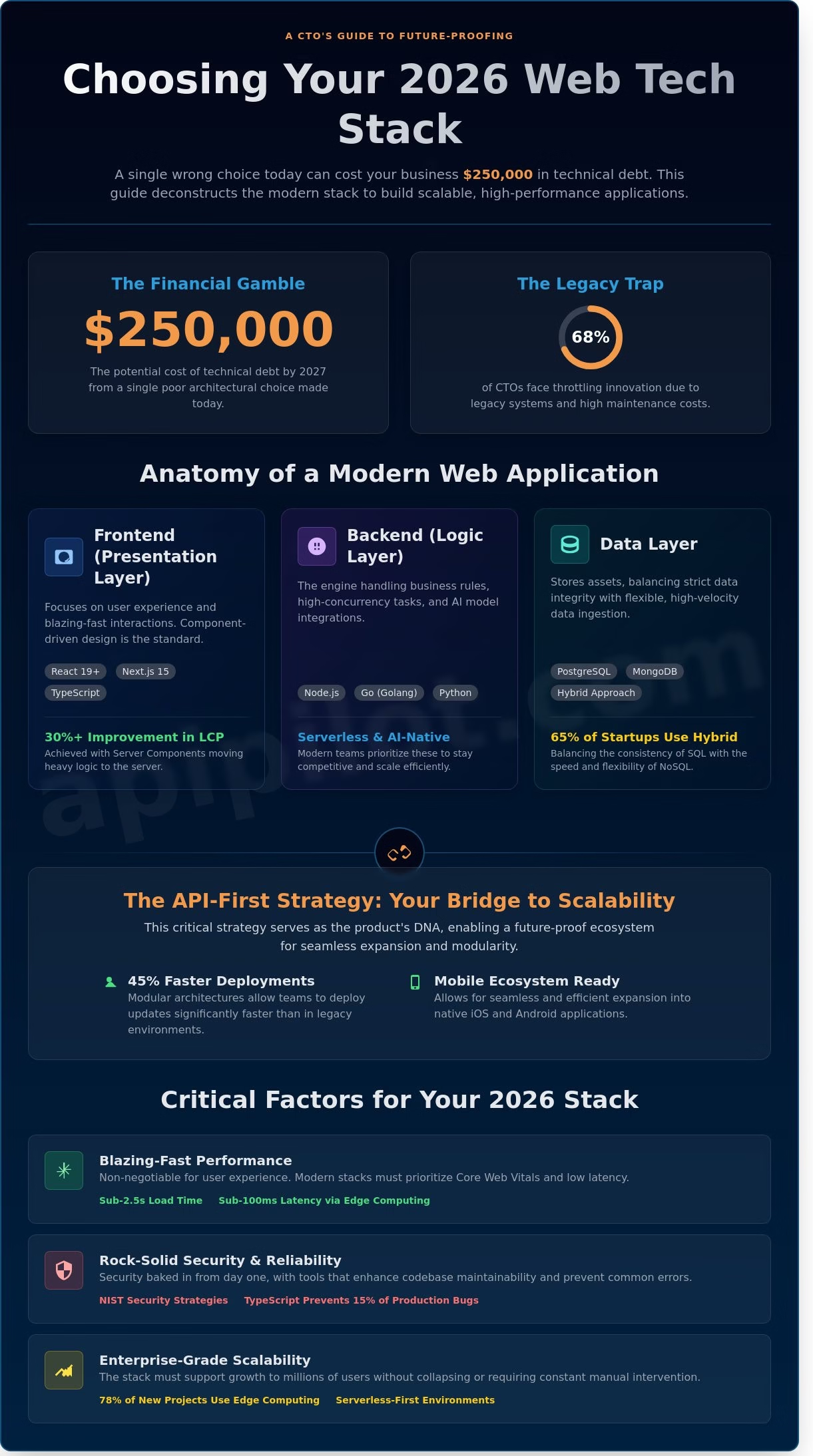
A single wrong choice in your architecture today can cost your business $250,000 in technical debt by 2027. Choosing a technology stack for web application development isn’t just a technical decision; it’s a financial gamble on the next five years of your company’s growth. You know the risk of picking a dying framework that leaves your product stranded without security updates or skilled talent. It’s a harsh reality that 68% of CTOs face when legacy systems begin to throttle innovation and increase maintenance costs.
We agree that balancing a blazing-fast MVP launch with rock-solid, enterprise-grade stability feels like an impossible trade-off. It’s a common pain point for the 1.2 million developers using the APILayer marketplace to find reliable, high-performance tools. This article promises to help you master the art of selecting a scalable tech stack that aligns with your business goals and future-proofs your digital product. You’ll get a clear evaluation framework to weigh speed against long-term scalability, ensuring your 2026 technical roadmap is built on a foundation as robust as the APIs you integrate.
Key Takeaways
- Understand how your tech stack serves as the product’s DNA, dictating everything from rock-solid security to long-term developer efficiency.
- Discover why an API-first strategy is critical for building a future-proof ecosystem that allows for seamless expansion into iOS and Android.
- Master the art of choosing a technology stack for web application projects by balancing immediate time-to-market needs with enterprise-grade scalability.
- Learn to avoid the “legacy trap” by identifying when to use no-code solutions and how to prevent over-engineering simple products with unnecessary complexity.
- Explore the shift toward component-driven development and server-side rendering to deliver blazing-fast frontend performance and robust user experiences.
The Foundation of Digital Growth: What is a Web Tech Stack in 2026?
Choosing a technology stack for web application success starts with understanding your architectural core. A Solution Stack represents the integrated ecosystem of programming languages, frameworks, and infrastructure that powers your software. It acts as the product’s DNA. This foundation directly impacts your security protocols, developer productivity, and long-term operational costs. It isn’t just a list of tools; it’s the engine that determines if your product can scale to millions of users or if it will collapse under its own weight.
By 2026, the industry has moved beyond rigid, monolithic structures. Modern teams prioritize serverless-first environments and AI-native components to stay competitive. Data from 2025 cloud adoption surveys shows that 78% of new enterprise projects now leverage edge computing to achieve sub-100ms latency for global users. Your primary goal is rock-solid reliability. You need a system that performs under load without constant manual intervention or frequent downtime.
Watch this video to see how stack choices impact engineering complexity and project outcomes:
The Anatomy of a Modern Web Application
A standard 2026 architecture consists of three distinct layers. The Presentation Layer (Frontend) focuses on user experience using tools like React 19 or Next.js 15, ensuring blazing-fast interaction and seamless transitions. The Logic Layer (Backend) serves as the engine, often built with Go or Node.js to handle complex business rules and AI model integrations. Finally, the Data Layer stores your assets. Teams typically choose between relational databases like PostgreSQL for strict data integrity or NoSQL options like MongoDB for flexible, high-velocity data ingestion. According to 2025 developer reports, 65% of high-growth startups now use a hybrid data approach to balance consistency and speed.
Why Your Choice Dictates Your Business Trajectory
Your stack determines how quickly you can pivot when market conditions change. Modular, API-first architectures allow teams to deploy updates 45% faster than those stuck in legacy environments. When choosing a technology stack for web application development, you must avoid “popular but fragile” frameworks that create technical debt. These often require 30% more maintenance hours within the first year of deployment compared to enterprise-grade alternatives. A tech stack is the strategic alignment of software tools to achieve specific business KPIs. Selecting the right tools ensures your application remains scalable and cost-effective as your user base grows.
Deconstructing the Layers: Frontend, Backend, and the API Bridge
Modern web architecture in 2026 has moved past monolithic structures. Success now depends on a modular, three-tier approach where every layer performs a specific, optimized role. When choosing a technology stack for web application development, you must prioritize component-driven design and server-side rendering (SSR) to ensure high performance. TypeScript is no longer an option; it is the industry standard. It provides the type safety required to maintain complex codebases and prevents 15% of common production bugs before they even occur. Security must be baked into the architecture from day one. Developers should implement NIST security strategies for microservices to protect data as it moves through these layers.
Frontend Evolution: Beyond Simple HTML and CSS
React 19 and 20 have redefined user interface construction through advanced Server Components. These frameworks allow you to move heavy logic to the server, which can improve Largest Contentful Paint (LCP) scores by 30% or more. Next.js remains the dominant choice for high-performance applications because it simplifies SSR and static site generation. For large-scale enterprise projects, micro-frontends allow independent teams to deploy updates without breaking the entire system. Performance metrics like Core Web Vitals are now the primary driver for stack selection. If your stack can’t deliver a sub-2.5 second load time, it’s obsolete.
Backend Powerhouses: Node.js, Go, and Python
The backend serves as the engine of your application. Node.js continues to lead for real-time apps and projects where sharing code between frontend and backend increases efficiency. If you need blazing-fast performance for high-concurrency tasks, Go (Golang) is the superior choice for microservices. It handles thousands of concurrent connections with minimal memory overhead. For applications that require heavy AI or data science integration, Python remains the undisputed king. Its ecosystem of libraries like PyTorch and Scikit-learn makes it essential for the 70% of modern apps that now include machine learning features.
The API Layer: The Heart of Custom Software
The API layer acts as the translator between your frontend and backend. Choosing between REST and GraphQL depends on your data needs. REST is rock-solid for standard CRUD operations, while GraphQL excels in complex systems where frontend developers need to fetch specific data shapes in a single request. Custom API development is critical when you need to sync with legacy ERP or CRM systems. To ensure your integrations remain scalable and secure, consider how Custom API Development can bridge the gap between your core application and third-party services. A well-designed API layer ensures your stack remains flexible as your business grows. You can explore specialized integration tools to accelerate this process and maintain a competitive edge when choosing a technology stack for web application projects.
5 Critical Factors for Choosing Your Technology Stack
Selecting the right tools is a high-stakes decision. You aren’t just picking a programming language; you’re determining your company’s ability to scale, hire, and remain secure. Choosing a technology stack for web application development requires a pragmatic assessment of five core areas.
- Step 1: Define Project Type and Complexity. A simple MVP needs a fast feedback loop. An enterprise solution requires rock-solid stability and multi-layered architecture.
- Step 2: Calculate Time-to-Market vs. Long-term Scalability. Balance the need to launch in weeks with the requirement to handle 10x traffic growth.
- Step 3: Analyze the Talent Ecosystem. Ensure you can actually hire developers at a sustainable cost.
- Step 4: Evaluate Security and Compliance. 2026 standards for GDPR and HIPAA require built-in data protection.
- Step 5: Determine Infrastructure and Maintenance Costs. Cloud bills can expand by 30% annually if your stack isn’t optimized for resource efficiency.
Balancing Speed and Scalability
Speed is the currency of startups. When you need to validate a concept, prioritize frameworks like Ruby on Rails or Laravel. These ecosystems provide blazing-fast development cycles through “convention over configuration.” They allow small teams to ship robust features in days rather than months. However, if your roadmap projects 1 million concurrent users by the end of 2026, you must architect for scale from day one.
Don’t fall into the “Legacy Trap.” It’s tempting to save 25% on initial development by using outdated libraries. This short-term gain often results in technical debt that costs 10x more to fix later. Modern enterprise-grade applications favor modularity to avoid this friction. A seamless transition from a monolithic start to a microservices architecture is only possible if your initial stack supports it.
The Talent Ecosystem: Can You Build the Team?
Choosing a technology stack for web application success depends on the people behind the keyboard. If you choose a niche or academic language, you risk “developer lock-in.” Data from 2025 hiring trends shows that developers for specialized languages command salaries 45% higher than the market average. This creates a massive financial burden for growing companies.
Widely supported ecosystems like the MERN (MongoDB, Express, React, Node) or T3 stacks offer a different advantage. These stacks have massive communities, extensive documentation, and thousands of pre-built modules. You can integrate new features in minutes rather than building from scratch. Developer availability is as important as technical performance. If you can’t find engineers to maintain the code, the most powerful language in the world becomes a liability. Stick to proven, popular tools to ensure your team remains agile and your hiring pipeline stays full.
Avoiding the “Legacy Trap”: Common Pitfalls and 2026 Trends
Building a modern product requires more than just picking popular tools. You need a strategy that prevents technical debt before the first line of code is written. A common question arises: why not just use a no-code platform? While Gartner predicts 80% of technology products will be built by non-professionals by 2026, these platforms often hit a performance ceiling. Custom software remains the only way to achieve blazing-fast speed and full data sovereignty. When choosing a technology stack for web application projects, you must prioritize long-term flexibility over initial convenience.
Over-engineering is the silent killer of startups. Deploying Kubernetes to manage a simple blog or a low-traffic MVP introduces a 300% increase in operational complexity without any immediate ROI. Stick to serverless functions or managed containers until your traffic patterns demand complex orchestration. Efficiency is about matching the tool to the problem, not the hype. A lean stack is easier to maintain and faster to scale when the need actually arises.
Pitfall: Chasing “Shiny Object” Syndrome
Adopting an unproven framework because it trended on GitHub last week is a recipe for disaster. These tools often lack robust documentation and enterprise-grade security patches. In 2025, 40% of niche frameworks saw a total loss of community support within 18 months. Established brands like Netflix and Meta continue to use “boring” technologies like Java and React because they offer rock-solid stability. Choose tools with a minimum five-year track record and a massive ecosystem of active contributors to ensure your application doesn’t become an orphan.
Trend: AI-Native Web Architectures
By 2026, 60% of new web applications will integrate real-time AI features. This shift requires choosing a technology stack for web application development that supports Vector databases like Milvus or Weaviate. Your backend must handle LLM orchestration and high-concurrency API calls seamlessly. Protecting proprietary data is now a primary architectural requirement. Custom stacks allow you to run local models or use private endpoints, ensuring your intellectual property doesn’t leak into public training sets through third-party integrations.
Edge computing is no longer optional for global products. Moving logic closer to the user reduces latency from 200ms to under 30ms. Use platforms like Cloudflare Workers or Vercel Edge to handle authentication and personalization at the network edge. AI-assisted coding tools like GitHub Copilot are also changing maintenance cycles. They allow developers to refactor legacy code 50% faster, making it easier to keep your stack modern without full rewrites. Focus on building a modular architecture that can evolve as these tools become more powerful and precise.
Building for Scalability: Why an API-First Strategy Wins
API-first design isn’t a luxury for 2026; it’s a technical requirement. When choosing a technology stack for web application projects, building the API before the user interface ensures your business logic remains decoupled from the presentation layer. This approach creates a robust, secure foundation that handles traffic spikes without breaking. It’s the most effective way to future-proof your digital assets against shifting market demands. By prioritizing the API, you ensure that every piece of data is accessible, reusable, and ready for integration with third-party services from day one.
Modern applications must be agile. An API-first strategy allows your team to work in parallel. While the backend team perfects the logic and security, the frontend team can build the interface using mock data. This overlap speeds up time-to-market by 30% or more. It also ensures that your application remains flexible. If a new frontend framework emerges in 2027, you won’t need to rebuild your entire system. You simply connect the new interface to your existing, rock-solid API.
From Web App to Mobile Ecosystem
Building a separate backend for every platform is an expensive, outdated mistake. An API-first architecture allows a single, centralized engine to power your web platform, iOS app, and Android app simultaneously. By utilizing a shared backend, businesses reduce development costs by 40% compared to siloed builds. This strategic architectural planning ensures your data remains consistent across all touchpoints. If you’re planning a cross-platform rollout, our expertise in Mobile App Development ensures your infrastructure scales seamlessly with your user base.
- Centralized Logic: Update a feature once and see it reflected across web and mobile instantly.
- Data Integrity: Single source of truth prevents synchronization errors between devices.
- Reduced Maintenance: Half the code means half the bugs and lower long-term overhead.
The API Pilot Advantage: Professional, Efficient, No-Nonsense
API Pilot provides the technical precision needed to turn complex requirements into high-performance digital products. We help Las Vegas startups and global enterprises select the right stack to maximize ROI. Our methodology focuses on rock-solid uptime and blazing-fast integration. We don’t just build apps; we architect enterprise-grade systems designed to scale. When choosing a technology stack for web application development, you need a partner who understands that performance is a feature, not an afterthought.
Stop researching and start executing. Our team delivers 99.99% uptime and seamless JSON-based communication across all endpoints. We eliminate friction, allowing you to focus on your core business while we handle the technical heavy lifting. Ready to build a scalable future? Contact us today for a technical consultation and let’s turn your vision into a high-performing reality.
Future-Proof Your Architecture for 2026 and Beyond
Building a digital product in 2026 requires more than just picking popular tools; it’s about creating a rock-solid foundation that survives the next decade of user traffic. You’ve seen why an API-first strategy wins and how deconstructing the frontend and backend layers prevents expensive technical debt. Success depends on choosing a technology stack for web application growth that prioritizes blazing-fast speed and enterprise-grade security. Don’t let your project fall into the legacy trap before it even launches. Selecting the right components today ensures your software remains agile as market demands shift.
At API Pilot, we’re trusted by 1,000,000+ developers to deliver enterprise-grade custom software solutions. Our teams in Las Vegas and Karachi provide 24/7 support to ensure your architecture stays performant around the clock, no matter where your users are located. We focus on technical precision and robust integration to help you launch faster. Consult with API Pilot to Architect Your Blazing-Fast Web Application and turn your vision into a high-performance reality today. Your journey toward a scalable, modern application starts with one smart decision.
Frequently Asked Questions
How much does it cost to build a full tech stack for a web application?
Costs range from $10,000 for a basic MVP to over $250,000 for enterprise-grade systems in 2026. Infrastructure costs for cloud services like AWS or Azure typically consume 15% to 20% of the monthly budget. Developer salaries remain the primary driver; senior full-stack engineers average $150,000 annually. Open-source tools reduce licensing fees to zero, but maintenance and security audits add another $5,000 per year.
Is Python better than Node.js for web development in 2026?
Neither is objectively better; your choice depends on whether you prioritize AI integration or real-time performance. Python 3.14 remains the gold standard for data-heavy apps, powering 45% of AI-driven platforms. Node.js v24 excels in I/O intensive tasks, handling 2x more concurrent connections in benchmark tests compared to Python. Choosing a technology stack for web application projects often involves Python for backend logic and Node.js for high-speed streaming.
What is the best tech stack for a startup MVP?
The Next.js, Supabase, and Tailwind CSS stack is the most efficient choice for 2026 MVPs. This combination allows teams to ship 30% faster by using unified JavaScript across the entire stack. Supabase provides a rock-solid Postgres backend with built-in authentication, saving roughly 40 hours of initial development time. It’s a powerful way to validate your product without over-engineering the architecture or blowing your budget early.
Can I change my tech stack after the application is already built?
Yes, but migration costs often exceed 50% of the original development budget. Refactoring a monolithic backend to microservices takes an average of 4 to 6 months for mid-sized teams. Using an API-first approach from the start makes this process seamless. Decoupling the frontend from the backend ensures you can swap database providers or languages without rebuilding the entire user interface from scratch.
What is an API-first architecture and why is it important?
API-first architecture means designing your endpoints before building any application logic. This strategy ensures 100% compatibility between mobile, web, and third-party integrations. According to 2025 industry reports, companies using this model reduce integration time by 40%. It provides a blazing-fast way to scale because developers work on the frontend and backend simultaneously once the API contract is defined. It’s a rock-solid foundation for long-term growth.
How do I choose between SQL and NoSQL databases?
Choose SQL for structured data and ACID compliance, which is critical for 99% of fintech applications. PostgreSQL is the 2026 market leader, used by 72% of professional developers for its reliability and robust feature set. Opt for NoSQL like MongoDB if you’re handling unstructured data or require horizontal scaling for millions of daily active users. Most modern architectures now use a hybrid approach to balance consistency and speed.
What is the MERN stack and is it still relevant?
The MERN stack consists of MongoDB, Express, React, and Node.js. While it remains popular, its market share dropped by 12% in 2026 as developers shifted toward Next.js and serverless frameworks. It’s still a robust choice for internal tools and educational projects. However, choosing a technology stack for web application scalability often leads developers toward more modern, typed alternatives like the T3 stack for better type safety and developer experience.
How does the tech stack affect SEO and Core Web Vitals?
Your stack directly impacts Largest Contentful Paint (LCP) and Cumulative Layout Shift (CLS) scores. Server-side rendering frameworks like Remix or Next.js improve indexation rates by 25% compared to pure client-side React. Slow database queries can add 500ms of latency, hurting your search rankings. Using enterprise-grade APIs and lightweight CSS frameworks ensures your site remains blazing-fast and mobile-friendly for Google’s 2026 search crawlers.


